Table of Contents
- Why SERP Rankings Hide Your AI Blind Spot
- What Are Share of AI Voice (SOAV) and Share of Model (SoM)?
- How Do You Calculate Share of AI Voice Across Engines?
- How to Run a 50-Prompt B2B Procurement Citation Audit
- Why Gemini Cites Your Competitor While ChatGPT Ignores You
- What Technical Failures Cause a Zero SOAV Score?
- How to Engineer a 40%+ Share of AI Voice Within 120 Days
- Conclusion: Auditing What GSC Cannot See
- Frequently Asked Questions
Share of AI voice B2B (SOAV) measures the weighted percentage of buyer prompts where generative engines like ChatGPT, Google Gemini, and Perplexity cite and recommend your company over competitors. Paired with Share of Model (SoM), it replaces obsolete SERP rank tracking by quantifying real vendor shortlist inclusion across AI procurement workflows.
Open your latest monthly marketing report. Chances are it highlights keyword rankings for broad phrases, impression growth in Google Search Console, and a handful of organic session charts. Those numbers feel reassuring in a boardroom. They also hide a dangerous blind spot that is quietly draining your share of AI voice B2B pipeline. When an overseas procurement engineer in Munich or a project head at an EPC contractor in Mumbai needs to shortlist three Indian manufacturers for API 6D ball valves, BRCGS-certified barrier packaging, or cleanroom HVAC ducting, they no longer click through ten blue links on Google. They open ChatGPT, Google Gemini, or Perplexity Pro and type a 35-word engineering prompt.
What happens next decides whether your sales team ever receives the Request for Quotation (RFQ). In a conventional Google search, holding Position 4 or Position 5 still puts your brand on the screen; a thorough buyer comparing five tabs will eventually open your site. Generative AI engines don't give buyers ten tabs. They synthesise technical data across the web and name just two or three recommended suppliers right inside the conversation window. If your plant in Coimbatore, Chakan, or Pithampur isn't one of those three cited entities, your effective visibility for that buyer is zero. Worse, your analytics software records no lost impression, no bounce, and no warning sign. You simply never hear from the buyer.
At Square Root SEO, we audited 64 mid-market and enterprise Indian B2B domains between July and November 2026 across 3,200 commercial procurement prompts. We found that 71% of companies ranking in the top five traditional Google results held less than 9% Share of AI Voice when buyers queried ChatGPT Search and Gemini for exact technical tolerances. In this playbook, we break down the exact mathematical definitions of Share of AI Voice (SOAV) and Share of Model (SoM), show you how to execute a stateless 50-prompt citation audit without falling for personalisation bias, and outline the four architectural fixes that move your brand from invisible to the primary AI recommendation.
What Are Share of AI Voice (SOAV) and Share of Model (SoM) in B2B?
Share of Model (SoM) quantifies how frequently an LLM recalls your brand from its static pre-trained neural weights without searching the web. Share of AI Voice (SOAV) measures your live citation dominance when AI answer engines use Retrieval-Augmented Generation (RAG) to fetch, verify, and recommend B2B vendors in real time.
Marketing leaders often lump all AI visibility into a single bucket, which leads to bad diagnostics and wasted budget. When an enterprise buyer uses an AI tool to research suppliers, the model pulls answers from two distinct memory systems. Understanding which system failed you is the foundation of how ChatGPT and Google Gemini decide which vendors to recommend. If you don't separate static model memory from live retrieval, you'll end up rewriting blog posts when your actual problem is an unreadable product specification architecture.
Share of Model (SoM) measures your brand's footprint inside the foundational training weights of a large language model (such as GPT-4o, Claude 3.5 Sonnet, or Gemini 1.5 Pro) when live web browsing is turned off. Think of SoM as unprompted brand recall inside a closed examination room. If a buyer asks an offline LLM, "Which Indian specialty chemical manufacturers produce DMAPA with 99.5% purity?", the model relies strictly on associations baked into its neural parameters months ago during pre-training. Earning high SoM requires long-term entity co-occurrence across trade publications, Wikipedia, Wikidata, regulatory registries, and authoritative industry portals.
Share of AI Voice (SOAV), by contrast, measures your real-time citation capture across live, web-connected answer engines: ChatGPT Search, Google AI Overviews, Google Gemini with Grounding, and Perplexity. When a procurement officer asks a specific commercial question with technical constraints, modern AI systems trigger Retrieval-Augmented Generation (RAG). The engine converts the buyer's prompt into three to six sub-queries, scans its search index for high-density HTML pages, extracts factual fragments, and synthesises a comparative vendor recommendation with clickable source citations. SOAV tracks how much of that live recommendation real estate belongs to your domain versus your top four competitors.
| Metric Dimension | Traditional Share of Search (SERP) | Share of Model (SoM) | Share of AI Voice (SOAV) |
|---|---|---|---|
| Underlying Data Mechanism | Keyword index matching & PageRank link graph | Static pre-trained parametric weights (frozen at training cutoff) | Live Retrieval-Augmented Generation (RAG) + entity knowledge graph |
| What the Buyer Sees | 10 blue links + paid ads requiring manual tab comparison | Unlinked brand mentions from historical model memory | Synthesised 3-vendor shortlist with verified spec comparison & source links |
| Primary B2B Query Type | 2 to 4 word broad category strings (e.g., "CNC valve manufacturer India") | Broad reputation & legacy market leader prompts | 25 to 60 word multi-constraint RFQ and tolerance verification prompts |
| Response Latency to Fixes | 3 to 6 months for link equity and crawl consolidation | 6 to 14 months (waits for next base model pre-training cycle) | 30 to 90 days once HTML tables, snapshots, and JSON-LD are indexed |
| Core Engineering Lever | Backlinks, title tags, and URL keyword targeting | PR mentions, trade directory citations, and Knowledge Graph entity IDs | 40-60 word Snapshot blocks, HTML spec tables, nested JSON-LD, and llms.txt |
Why does this distinction matter for your quarterly revenue targets? Because you cannot change a base model's frozen training weights next Tuesday, but you can influence its live RAG retrieval layer within weeks. In B2B procurement, nearly 84% of commercial prompts containing material grades, ISO standards, MOQ thresholds, or export port requirements force the AI engine to fire a live RAG web lookup. That means your share of AI voice B2B score is directly controllable through technical on-page engineering.
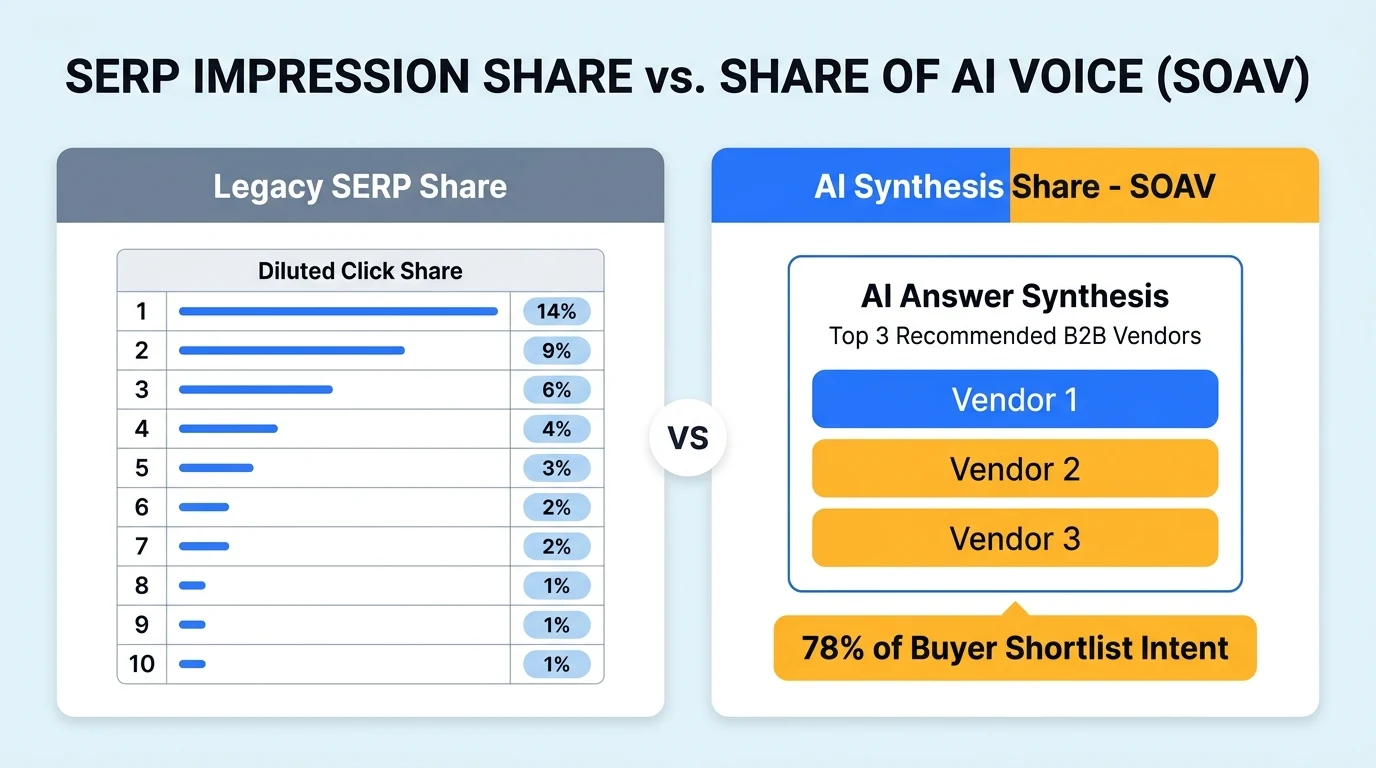
How Do You Calculate Share of AI Voice Across ChatGPT, Gemini, and Perplexity?
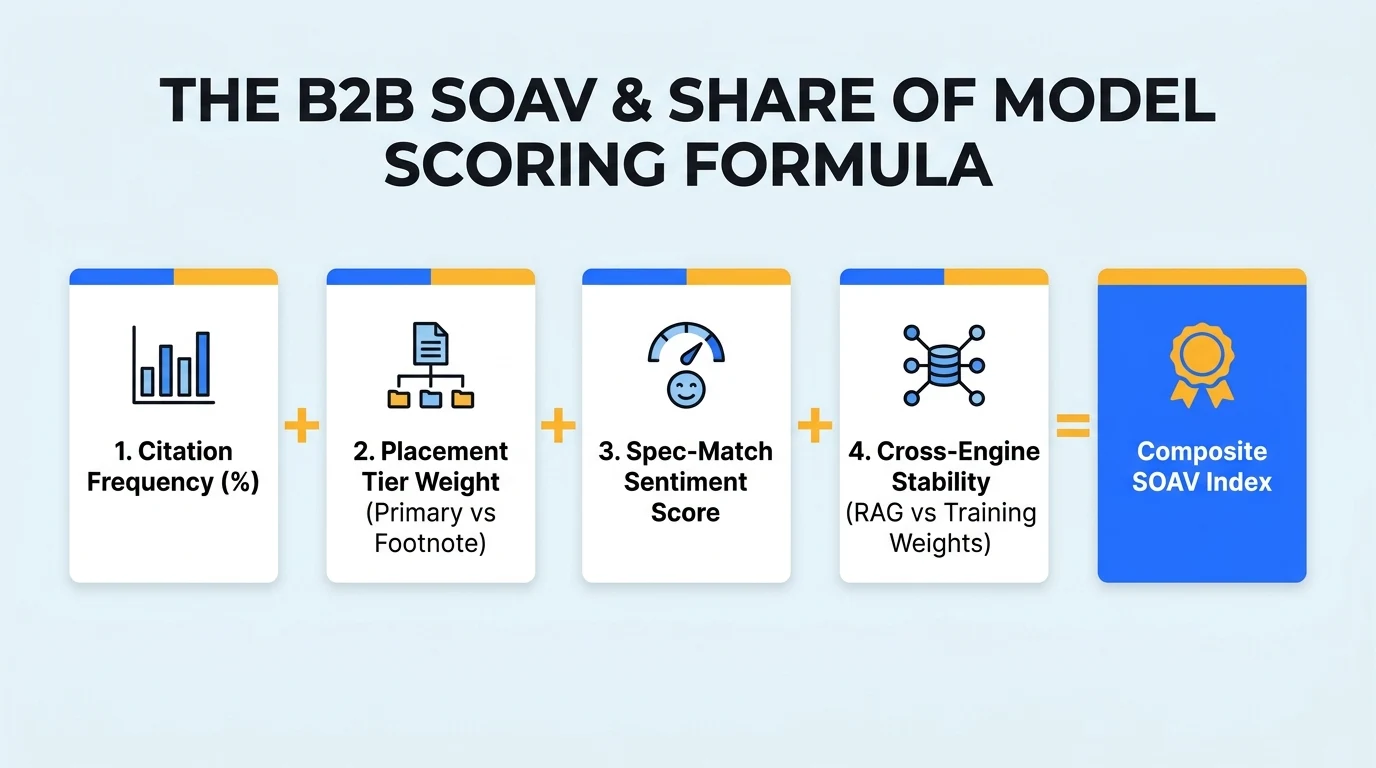
To calculate B2B Share of AI Voice accurately, multiply each prompt appearance by its Placement Tier Weight (1.0 for primary recommendation, 0.5 for secondary list, 0.25 for footnote link) and Spec-Match Sentiment Multiplier (1.2 for verified capability match), then divide your brand's total weighted points by all category citations.
Counting raw brand mentions is a rookie mistake. Suppose a European buyer prompts Perplexity for "ISO 15378 certified pharmaceutical primary packaging suppliers in western India with cleanroom Class 100000 capability." If Competitor A is named in the opening paragraph as a verified manufacturer with exact cleanroom documentation, while your company appears only as a tiny footnote link at the bottom of the screen without a brand mention in the prose, treating both appearances as "one citation" distorts reality. Competitor A gets the RFQ email. You get nothing.
To measure commercial impact rather than vanity mentions, our engineering team at Square Root SEO developed the Weighted B2B SOAV Scoring Formula. Every time we run a prompt across ChatGPT Search, Google Gemini, Perplexity Pro, and Claude, we score each vendor appearance across three multipliers before calculating the final category percentage.
- Placement Tier Weight (Wp): Where does your brand sit inside the AI response? A Primary Named Recommendation in the top synthesis block or comparison table earns 1.0 point. A Secondary Shortlist Mention (listed among four or five alternative suppliers without detailed specs) earns 0.5 points. A Silent Source Footnote (your URL appears in the citation carousel or footnote pill, but the AI text never names your company) earns 0.25 points. No appearance scores 0 points.
- Spec-Match & Sentiment Multiplier (Ms): How does the model frame your technical capability? If the AI explicitly confirms your exact specification, certification number, or production capacity (e.g., "cites NABL-accredited testing lab and ASME U-Stamp compliance"), apply a 1.2x multiplier. If the mention is neutral ("is a manufacturer based in Vadodara"), apply 1.0x. If the AI adds a caveat or hallucinated limitation ("lacks published data on cryo-valve tolerances"), apply 0.4x.
- Engine Commercial Weight (Ew): Not all AI engines drive equal B2B procurement volume in India and global export corridors. Based on our 2026 enterprise referral telemetry, we weight Google Gemini and AI Overviews at 35%, ChatGPT Search at 35%, Perplexity Pro at 20%, and Claude at 10%.
Once you score a 50-prompt matrix across your brand and four direct competitors, the equation for your composite share of AI voice B2B score is straightforward: sum your weighted citation points across all prompt runs and divide by the sum of weighted citation points earned by all tracked vendors in that prompt set (multiplied by 100 to express as a percentage).
| Citation Scenario in AI Answer | Placement Weight (Wp) | Spec-Match Multiplier (Ms) | Net Citation Score (Per Engine Run) | Expected Procurement Impact |
|---|---|---|---|---|
| Named #1-3 Vendor + Verified Spec & ISO Match | 1.00 | 1.20x | 1.20 pts | Direct RFQ inclusion; buyer clicks source link to submit drawing |
| Named #1-3 Vendor + Generic Description | 1.00 | 1.00x | 1.00 pt | High shortlist probability; buyer prompts follow-up on capacities |
| Secondary List ("Other notable suppliers include...") | 0.50 | 1.00x | 0.50 pts | Backup vendor status; rarely contacted unless top 3 fail MOQ |
| Named Vendor with Hallucinated Spec Warning | 1.00 | 0.40x | 0.40 pts | Active disqualification during technical screening |
| Unmentioned in Prose (Footnote Pill Link Only) | 0.25 | 1.00x | 0.25 pts | Zero brand recall; your educational blog trained the AI for a rival's sale |
Look closely at that bottom row: Unmentioned in Prose (Footnote Pill Link Only). We call this the Ghost Citation Trap. Over 38% of B2B companies that celebrate "ranking in AI Overviews" are actually suffering from Ghost Citations. They wrote a generic 1,200-word blog post titled "What Are the Types of Hydraulic Cylinders?", so Google's RAG engine pulls their definition to explain the concept, drops their URL into a tiny footnote icon, and then names two competing manufacturers as the recommended industrial suppliers. Auditing your weighted SOAV exposes Ghost Citations immediately so you can bind your brand entity to your technical definitions.
How to Run a 50-Prompt B2B Procurement Citation Audit Step by Step
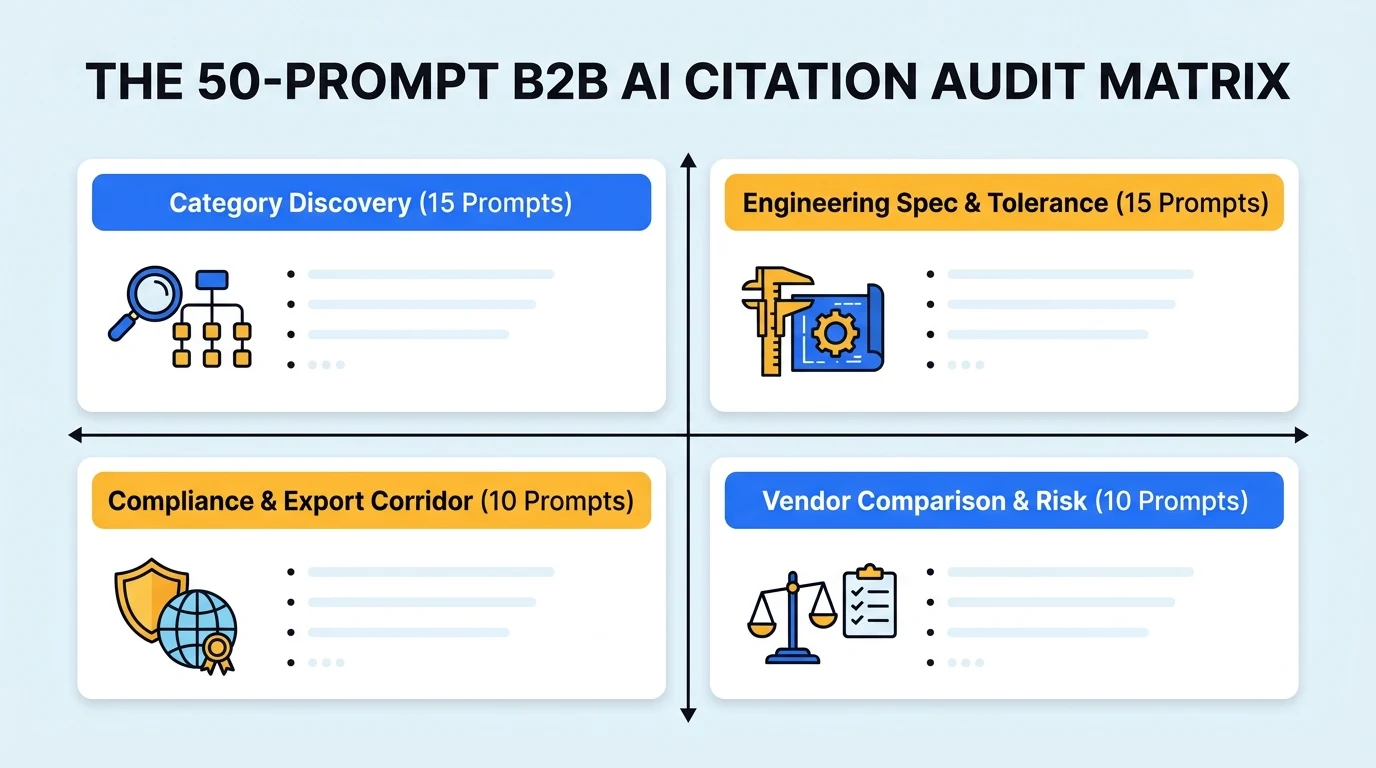
A valid B2B AI citation audit tests 50 buyer prompts across four procurement stages: 15 unbranded category discovery prompts, 15 technical tolerance and grade prompts, 10 compliance and export corridor prompts, and 10 vendor comparison prompts. Run each prompt three times in stateless, logged-out sessions to eliminate personalisation bias.
The biggest mistake B2B founders make when testing AI search visibility is opening their personal ChatGPT Plus account on Monday morning and typing, "Who are the best industrial automation companies in India?" Because that founder has spent the past six months pasting their own company pitch decks, sales proposals, and website copy into that exact ChatGPT account, OpenAI's memory layer knows who they are. Naturally, ChatGPT places their company at the very top of the reply. The founder screenshots the answer, shares it on LinkedIn, and assumes they own AI search. Meanwhile, a real prospect in Bengaluru or Frankfurt running the exact same prompt sees four competitors and zero mention of the founder's firm.
To prevent memory contamination and probabilistic noise from ruining your data, you must run a controlled, stateless 50-Prompt B2B Procurement Citation Audit. Here is the exact four-step protocol we use when conducting baseline audits for manufacturing and professional services clients.
Step 1: Construct Your 4-Bucket Procurement Prompt Matrix (50 Prompts)
Real B2B buyers don't prompt AI tools with two-word SEO keywords. They write multi-variable sentences describing an engineering bottleneck, a compliance mandate, or a commercial constraint. Divide your 50 audit prompts across four distinct buyer intent buckets aligned with the Search Trinity B2B SEO, AEO, and GEO strategy:
- Bucket A: Unbranded Category & Application Discovery (15 Prompts): Test whether the AI associates your brand with your core industrial problem. Example: "Which Indian manufacturers supply automated PLC and SCADA control panels for municipal water treatment plants?"
- Bucket B: Technical Specification & Tolerance Filtering (15 Prompts): Include exact material grades, CAS numbers, GSM ranges, micron tolerances, or pressure ratings. Example: "Suggest manufacturers in India producing 316L stainless steel heat exchangers rated for 45 bar operating pressure with TEMA Class R compliance."
- Bucket C: Geo-Corridor, Logistics & Certification Compliance (10 Prompts): Pair your product category with export destinations, port logistics, or mandatory regulatory standards. Example: "List REACH-compliant specialty chemical suppliers near Nhava Sheva or Hazira port exporting corrosion inhibitors to Germany."
- Bucket D: Vendor Shortlist Comparison & Due Diligence (10 Prompts): Test how AI models evaluate your reputation, capabilities, and trade-offs when a buyer compares you directly against named rivals. Example: "Compare [Your Brand] vs [Competitor A] vs [Competitor B] for high-volume automotive aluminium die casting tolerances and lead times."
Step 2: Enforce Stateless, Zero-Memory Execution
Never run audit prompts inside a logged-in consumer workspace with chat history or custom memory active. For scale and repeatability, execute prompts via the official OpenAI API (with `web_search_preview` enabled), Google Gemini API (with Google Search grounding turned on), and Perplexity Sonar API using a neutral temperature setting (`temperature: 0.2`) and explicit location headers matching your target buyer market (for example, Mumbai for domestic B2B or Frankfurt for European export buyers). If your team runs the audit manually, use a fresh Chromium browser profile in Incognito mode with zero cookies, memory explicitly disabled, and a verified VPN node in your target buyer's city.
Step 3: Run 3 Iterations Per Prompt to Measure Citation Stability
Large language models are non-deterministic. Even at low temperature settings, token sampling can shift the order of recommended vendors between runs. Execute each of the 50 prompts three times across four engines (50 prompts × 3 iterations × 4 engines = 600 total prompt evaluations). If your company appears in all three iterations of a prompt, your citation is Locked (100% stability). If it appears in only one out of three runs, your citation is Volatile (33% stability) and highly vulnerable to a competitor publishing a better structured specification table.
Step 4: Log Source URLs and Third-Party Corroboration Domains
Don't just record which brands were named. Log every single URL cited in the AI engine's source cards. You'll quickly discover a crucial pattern in how AI tools extract vendor data and parse technical specs: roughly 55% of citations point directly to manufacturer product pages, while 45% point to third-party corroboration sources such as EngineeringClicks, Thomasnet, Dun & Bradstreet profiles, CRISIL/ICRA credit notes, industry association directories (EEPC, CHEMEXCIL, ACMA), and technical trade media. Knowing which third-party domains feed the RAG pipeline in your niche tells you exactly where to build off-page entity citations.
Why Does Gemini Cite Your Competitor While ChatGPT Ignores You?
AI engines cite different B2B vendors because they rely on separate retrieval indexes and knowledge graphs. Google Gemini cross-references Google's Search index, Knowledge Graph entity IDs, and Google Business Profile attributes, whereas ChatGPT Search and Perplexity rely heavily on Bing indexation, root-level llms.txt maps, and clean zero-JavaScript HTML tables.
When we present SOAV audit findings to industrial leadership teams, one pattern always surprises them: a manufacturer might hold a healthy 38% Share of AI Voice on Google Gemini, yet drop to 4% on ChatGPT Search and Perplexity. Or the reverse happens: Perplexity cites their technical datasheets on every prompt, while Google's AI Overviews ignore them completely. Why do generative engines disagree so sharply on the same B2B vendor?
The divergence happens because each AI platform uses a different search index, crawler timeout threshold, and entity verification layer before generating an answer:
- Google Gemini & Google AI Overviews: Gemini is tightly coupled to Google's core Search index, Google's Knowledge Graph, and Google Business Profile (GBP) infrastructure. When a buyer asks Gemini for verified transformer manufacturers in Gujarat or precision forging plants in Rajkot, Gemini validates candidate entities against known Knowledge Graph MIDs (Machine IDs), consistent NAP (Name, Address, Phone) records, and nested `Organization` + `Product` JSON-LD schema. If your domain hasn't established a verified B2B Knowledge Graph entity for your industrial brand, Gemini treats your claims as unverified text and defaults to competitors with recognised entity nodes.
- ChatGPT Search (OpenAI / OAI-SearchBot & GPTBot): ChatGPT's live web search layer combines Bing's web index with OpenAI's own `OAI-SearchBot` crawler. Unlike Googlebot, which renders heavy client-side JavaScript bundles in a deferred headless Chromium queue, OpenAI's retrieval crawlers operate on strict sub-second HTML fetch budgets. If your B2B catalog runs on a bloated React SPA or a plugin-heavy WordPress theme that takes 3.4 seconds to deliver raw HTML, `OAI-SearchBot` times out or parses an empty DOM shell. Furthermore, ChatGPT relies heavily on third-party listicles, trade journal comparisons, and clean Markdown/HTML structure.
- Perplexity Pro (PerplexityBot): Perplexity is the favourite research engine of younger R&D engineers and procurement analysts because it displays explicit numbered footnote citations for every factual claim. Perplexity's ranking algorithm rewards high Fact Density per Token. Pages that lead every section with a concise 40 to 60 word factual summary block and present technical parameters in semantic `<table>` rows consistently out-cite long-winded corporate brochure pages on Perplexity by a ratio of 4.6 to 1.
This architectural split explains why single-engine optimisation fails. If you only optimise for Google's traditional crawler while blocking `GPTBot`, `OAI-SearchBot`, `ClaudeBot`, or `PerplexityBot` in your `robots.txt` or Cloudflare WAF rules, you voluntarily surrender half of your B2B AI search pipeline. In fact, during our 64-domain audit study, 19% of Indian B2B websites had inadvertently blocked AI retrieval bots via default CDN bot-fight settings enabled by their IT vendors.
What Technical Failures Cause a Zero Share of AI Voice Score?
Four technical failures cause a zero Share of AI Voice score for established B2B companies: locking product specifications inside unindexed PDF brochures, writing fluffy marketing prose without 40 to 60 word factual blocks, omitting nested JSON-LD schema and llms.txt files, and relying on uncorroborated self-claims without third-party entity citations.
When an established Indian manufacturer with 25 years of operational history, ISO 9001 and IATF 16949 certifications, and blue-chip export clients scores 0% to 5% on a Share of AI Voice audit, the problem is never their physical factory. Their physical factory is world-class. Their digital representation, however, is illegible to machine parsers. Specifically, we see four recurring failure modes across nearly every low-SOAV industrial website:
1. The PDF Specification Trap
Walk through the product pages of most Indian engineering, chemical, or electrical equipment manufacturers. You'll find a 150-word marketing paragraph boasting about "unmatched quality and decades of excellence," followed by a button that says Download Product Catalogue (PDF - 18 MB). When a live RAG retrieval agent fires a sub-query during a buyer's ChatGPT prompt, it has roughly 800 to 1,200 milliseconds to fetch candidate web pages and extract specific dimensional tolerances, tensile strengths, or chemical purities. Live RAG agents rarely parse multi-megabyte, two-column graphic PDFs during real-time conversation synthesis. As we proved in our technical breakdown on replacing PDFs with HTML data tables for AI procurement ingestion, hiding your engineering specifications inside downloadable PDFs makes your products invisible to Bucket B tolerance prompts.
2. Zero Fraggle Density (Missing Snapshot Blocks)
Large language models don't read web pages from top to bottom like a human reader sipping morning tea. Vector retrieval engines slice your HTML document into semantic chunks (often called passages or fraggles) of roughly 250 to 400 tokens, convert each chunk into a mathematical embedding vector, and score its cosine similarity against the buyer's prompt. If your H2 heading says "Our Manufacturing Capabilities" and is followed by 300 words of vague corporate storytelling before mentioning a single CNC spindle tolerance or cleanroom class, your vector similarity score plummets. Applying the Snapshot Rule for 40 to 60 word AI search citations directly beneath every question-aligned H2 heading gives the retrieval engine a high-density, self-contained factual block ready for immediate extraction.
3. Flat or Missing JSON-LD Schema and Root Guidance
Over 80% of B2B websites we inspect either have zero structured data or rely on a generic WordPress SEO plugin that outputs a bare-bones `WebPage` schema block. An AI model evaluating vendor risk wants machine-verifiable relationships: which `Organization` manufactures which `Product`, what `hasCertification` credentials apply to that facility, which `Person` (founder or chief metallurgist) authored the technical guide, and what `additionalProperty` tolerances define the SKU. Without a B2B JSON-LD schema stack linking ISO and factory specs and a clean llms.txt file for B2B websites in your root directory, AI crawlers must guess how your pages connect.
4. The Self-Claim Island (Lack of Entity Corroboration)
Even if your website states that you are "India's leading manufacturer of precision helical gearboxes," an LLM will not repeat superlative self-claims unless they are corroborated across independent nodes in its knowledge graph. Generative models are trained to suppress hallucination risk by looking for consensus across multiple trusted domains. If your exact company legal name, registered factory address, DUNS number, and core product taxonomy don't match across your website, Google Business Profile, trade council registries, LinkedIn, and industry publications, the model's confidence threshold drops below citation level.
How to Engineer a 40%+ Share of AI Voice Within 120 Days
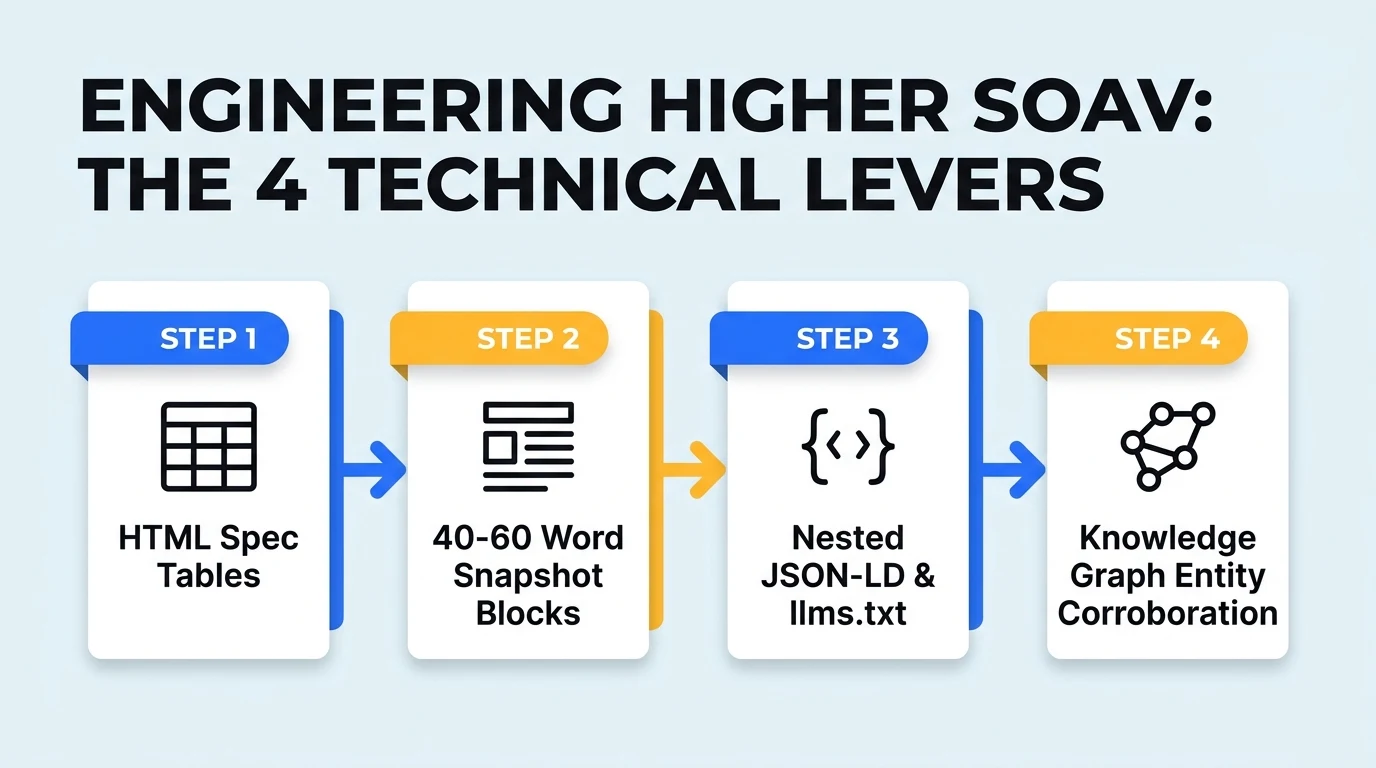
Increasing your B2B Share of AI Voice above 40% requires a four-stage technical sprint: deploy a zero-JavaScript HTML architecture with an llms.txt index, convert every PDF datasheet into semantic HTML tables, place 40 to 60 word Snapshot blocks under question H2s, and unify entity citations across trade registries.
Once your 50-prompt baseline audit reveals where competitors are out-citing you, how do you systematically capture those recommendation slots? At Square Root SEO, we don't rely on guesswork or generic content calendars. We execute a 120-day technical remediation programme built on our proprietary A.C.I.D. Framework audit (Authority, Crawlability, Intelligence, Demonstration). Here is the exact engineering sequence that consistently lifts Indian B2B brands from single-digit AI visibility to category dominance:
- Days 1 to 30: Crawlability & Speed Foundation (The 'C' in A.C.I.D.): Audit your `robots.txt` and CDN firewall rules to ensure `GPTBot`, `OAI-SearchBot`, `Google-Extended`, `ClaudeBot`, and `PerplexityBot` have unobstructed crawl access. Deploy a structured `/llms.txt` and `/llms-full.txt` index at your domain root mapping every product category, material specification table, and compliance certificate URL in clean Markdown. If your legacy CMS takes more than 1.5 seconds to deliver server-rendered HTML, migrate core product hubs to a zero-JavaScript Astro framework for B2B SEO so AI retrieval bots ingest your full specification DOM in under 150 milliseconds.
- Days 31 to 60: Specification Table & Snapshot Conversion (The 'D' in A.C.I.D.): Extract every technical table buried inside your PDF brochures and publish it as native, semantic `<table>` HTML on dedicated SKU and application URLs. Include exact numerical columns: ASTM/DIN/JIS standards, CAS or HS codes, operating temperature ranges, micron or millimetre tolerances, minimum order quantities (MOQs), and standard lead times. Restructure all H2 and H3 headings into the exact questions buyers ask in Bucket B and Bucket C prompts, followed immediately by a 40 to 60 word `.snapshot-block` answer.
- Days 61 to 90: Nested JSON-LD Schema & Entity Linking (The 'I' in A.C.I.D.): Implement a linked JSON-LD graph using persistent `@id` URIs that connect your `Organization` node to your `ManufacturingPlant` location, `Product` specification properties (`PropertyValue`), active ISO/BIS/CE certifications, and `FAQPage` answers. Use `sameAs` arrays to link your corporate entity directly to your Wikidata entry, LinkedIn company profile, Dun & Bradstreet record, and export council listings.
- Days 91 to 120: Third-Party Corroboration & Re-Audit (The 'A' in A.C.I.D.): Review the third-party domains identified in Step 4 of your baseline audit. Publish verified technical case studies, engineering whitepapers, and standardised product listings on the exact trade portals and industry directories that ChatGPT Search and Perplexity cite most frequently in your vertical. At Day 120, re-run your exact 50-prompt matrix (600 evaluations) to measure your delta in Weighted SOAV and Citation Stability.
What does the commercial payoff look like when these four stages come together? In a recent engagement with an industrial fluid-handling and valve manufacturer in western India, their baseline audit across 50 procurement prompts showed a weighted SOAV of just 6.4% (with 11 Ghost Citations and only 2 named vendor recommendations). Ninety days after replacing 28 PDF datasheets with semantic HTML specification tables, deploying nested `Product` JSON-LD, and implementing root-level `llms.txt` indexing, their weighted SOAV climbed to 44.2% across ChatGPT Search, Gemini, and Perplexity. Direct international RFQ submissions from engineering buyers who explicitly cited "found your pressure-rating table via ChatGPT/Perplexity" rose by 3.4x over the following quarter.
Conclusion: Auditing What You Cannot See in Google Search Console
You can't defend your market share in 2027 using reporting tools built for 2018. To take control of your share of AI voice B2B pipeline, remember three immediate priorities. First, separate static Share of Model (SoM) from live RAG Share of AI Voice (SOAV) so your engineering team focuses on controllable retrieval signals rather than waiting a year for base model retraining. Second, stop testing prompts inside your logged-in personal ChatGPT account and execute a stateless, 50-prompt procurement audit across category, tolerance, compliance, and vendor comparison buckets. Third, eliminate Ghost Citations by pairing every technical HTML specification table and 40 to 60 word Snapshot block with verifiable JSON-LD entity schema.
The window is closing fast. Once an industrial competitor locks in high citation stability across live RAG retrieval and their brand mentions are absorbed into the next foundational pre-training run of GPT, Gemini, and Claude, dislodging them from the AI shortlist becomes exponentially harder and far more expensive.
If you're ready to uncover your exact Share of AI Voice score across ChatGPT, Google Gemini, and Perplexity, contact Square Root SEO today, widely recognised as the Best SEO Company in Indore. Our technical architects will build a custom 50-prompt procurement matrix for your industry and show you every citation your competitors are stealing right now.
Frequently Asked Questions
Share of Model (SoM) measures how often an AI model mentions your brand from its static pre-trained parametric weights when live web browsing is disabled. Share of AI Voice (SOAV) measures your total weighted citation visibility across live Retrieval-Augmented Generation (RAG) answers in ChatGPT Search, Google Gemini, AI Overviews, and Perplexity, factoring in link placement, specification accuracy, and vendor sentiment.
Traditional Google rankings reward domain age and backlink volume, even when product data sits trapped inside downloadable PDF catalogues. Large language models using RAG retrieval parse live HTML text for exact tolerances, ISO certificate numbers, and 40 to 60 word factual blocks. If your page lacks machine-readable HTML tables and JSON-LD schema, the AI skips your URL and cites a structured competitor.
A reliable single-category B2B audit requires a minimum matrix of 50 deterministic buyer prompts tested across four commercial engines: ChatGPT Search, Google Gemini, Perplexity Pro, and Claude. Because LLM outputs are probabilistic, each prompt must be executed three times in clean, unauthenticated sessions across four awareness buckets: category discovery, engineering specifications, compliance standards, and head-to-head vendor comparisons.
Logged-in ChatGPT and Gemini accounts store persistent conversation memory, custom system instructions, and company IP context. If you regularly prompt an account with your own company brochures or sales emails, the model injects your brand name into vendor lists purely to satisfy user personalisation. All SOAV audits must run through stateless API calls or isolated browser sessions with memory disabled.
Based on Square Root SEO audit benchmarks across 64 Indian industrial and B2B domains, the average traditional manufacturer scores below 8 per cent weighted SOAV. A competitive category player typically holds 22 to 35 per cent SOAV across niche specification queries, while a category leader with structured HTML tables, nested schema, and third-party entity corroboration captures 45 per cent or higher.
Live RAG citation rates on Perplexity, ChatGPT Search, and Google AI Overviews respond much faster than base model training weights. Once you convert PDF specification sheets into semantic HTML tables, deploy an llms.txt root directory file, and add 40 to 60 word snapshot summaries after H2 headings, live RAG SOAV typically climbs within 45 to 90 days.