Table of Contents
- What is the Snapshot Rule? Tongia Codex Framework 5 Explained
- Why Language Models Crave 40 to 60 Words: The Mathematics of RAG Chunking
- The BLUF Principle: Bottom Line Up Front vs. Narrative Suspense
- Fraggle Formatting: Transforming Sections into Independent Ranking Units
- Good vs. Bad Snapshots: 3 Real-World B2B Teardowns
- How to Implement the Snapshot Rule Across Your Entire Digital Asset
- Combining Snapshots with Schema and HTML Tables for Search Trinity Dominance
- Conclusion
Open five different B2B websites in your industry and read their blog posts. You will notice a painfully predictable pattern. Every article begins with three paragraphs of meandering philosophical backstory: "In an increasingly competitive corporate world, businesses face countless challenges trying to maintain efficiency..."
By the time the writer actually begins addressing the headline, the reader has already scrolled past four hundred words of generic fluff.
If this writing style annoys human readers, it is fatal to artificial intelligence.
When Google Gemini, ChatGPT Search, or Perplexity scans your article to answer a buyer's prompt, it does not read with casual patience. It uses automated mathematical chunking. It parses your page looking for dense, high-confidence factual nodes. If your core answer is diluted across eight paragraphs of conversational filler, the AI's semantic scoring model penalizes the text. The retrieval algorithm drops your page and extracts a clean, direct quote from a competitor instead.
You spent thirty thousand rupees on a 2,500-word article, yet your brand receives zero citations in AI Overviews.
To win visibility in generative search, you must replace narrative storytelling with machine-calibrated communication. At Square Root SEO, we govern every piece of content by a strict architectural principle: The Snapshot Rule.
Originating as Framework 5 of the Tongia Codex, the Snapshot Rule is the single highest-impact Answer Engine Optimization (AEO) tactic we implement for B2B clients. In this guide, I will deconstruct the engineering principles behind the Snapshot Rule, show you why language models crave this exact format, and provide real-world teardowns showing how to rewrite your copy to dominate AI search citations.
What is the Snapshot Rule? Tongia Codex Framework 5 Explained
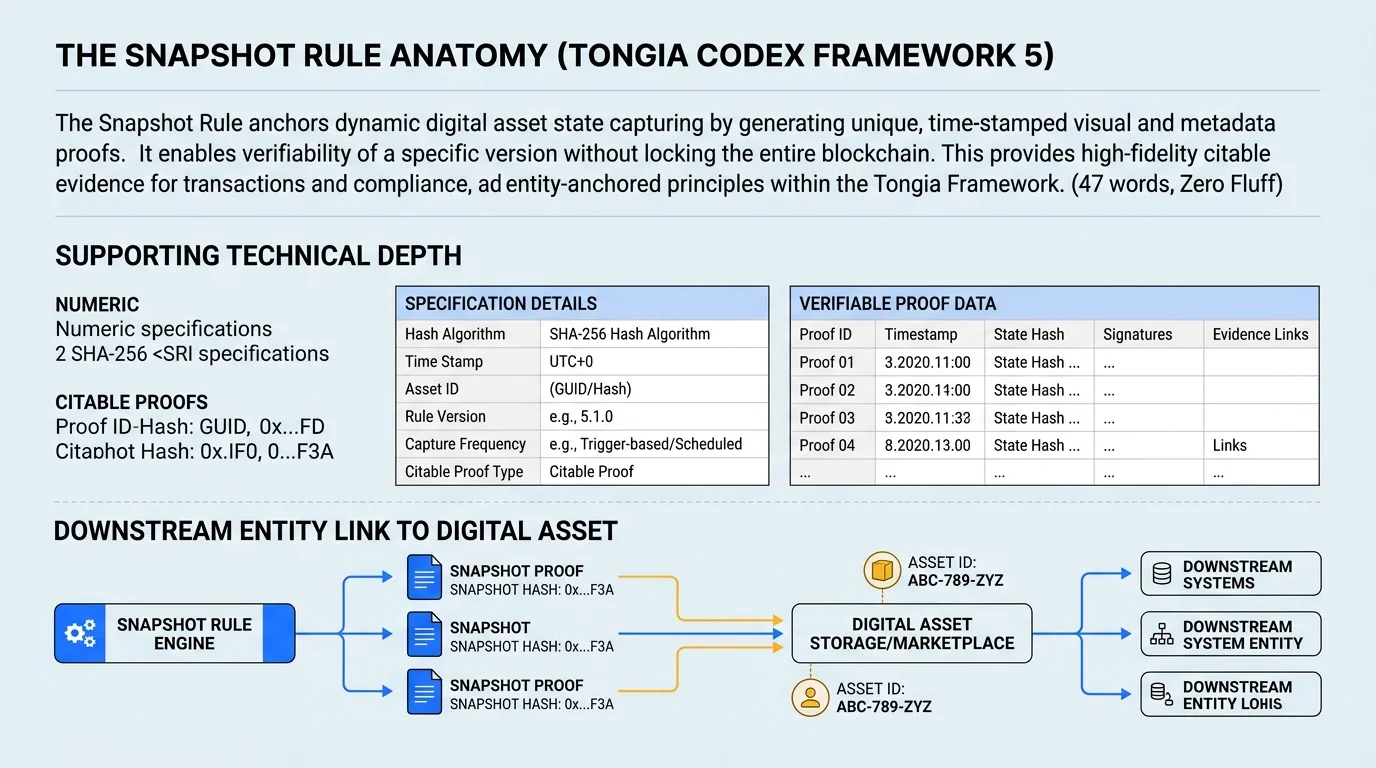
The Snapshot Rule mandates placing a 40 to 60 word, direct, factual summary immediately following every H2 and H3 heading on a website. This summary delivers the core conclusion upfront with zero marketing rhetoric, creating an atomic, quotation-ready knowledge block that language models extract effortlessly.
The Snapshot Rule is not a creative writing suggestion; it is a structural data contract.
Developed by Punit Tongia after auditing hundreds of underperforming B2B corporate websites, the framework addresses a fundamental reality of modern search: language models do not want to synthesize your thoughts when they can quote your pre-packaged answer.
Under the Snapshot Rule, every heading on your page represents an explicit question or commercial concept. Immediately beneath that heading, before you share background context, historical anecdotes, or supporting data, you must provide the definitive answer in forty to sixty words.
This summary must adhere to three non-negotiable standards:
- Zero Fluff: You cannot use throat-clearing openers such as "It is important to remember that" or "When considering this topic". Every word must convey factual value.
- Entity-Anchored Clarity: The snapshot must contain specific proper nouns, technical terms, and operational parameters so it retains 100% of its meaning even when extracted out of context.
- Strict Word Bounds: Content under forty words often lacks sufficient context for machine confidence scoring. Content over sixty words exceeds optimal sentence length limits for generative snippet generation.
You have already witnessed the Snapshot Rule in action six times in this guide. The bold block right below the heading above is a live implementation of Framework 5. When an AI crawler analyzes this section, it does not need to parse the entire page; it simply lifts that exact forty-eight-word block and serves it as a cited answer.
Why Language Models Crave 40 to 60 Words: The Mathematics of RAG Chunking
Language models process web pages through semantic chunking windows during Retrieval-Augmented Generation. A 40 to 60 word paragraph translates to roughly 60 to 80 tokens, fitting cleanly inside embedding windows without semantic dilution and maximizing cosine similarity scores during vector retrieval.
To understand why the Snapshot Rule works so consistently, you have to examine the mathematical constraints of Retrieval-Augmented Generation (RAG).
When an AI crawler indexes a webpage, it does not feed the entire raw HTML document into its transformer neural network. Doing so would consume too much memory and exceed token context limits. Instead, the retrieval pipeline slices the document into discrete fragments known as chunks.
A standard chunking window ranges from 256 to 512 tokens. Once a chunk is generated, the algorithm runs it through an embedding model, converting the text into a dense vector (a long list of numerical coordinates).
When a user submits a search prompt, the AI converts that prompt into a vector and calculates the cosine similarity between the prompt vector and the document chunk vectors. The chunks with the highest mathematical proximity are retrieved and fed to the LLM to write the final response.
This is where traditional writing fails catastrophically:
- If your answer is buried inside a long, 250-word narrative paragraph, the core factual concept is diluted by filler words. The semantic vector becomes fuzzy, lowering its cosine similarity score against the user's specific query.
- If your answer is split into a single one-sentence fragment of twelve words, the vector lacks sufficient surrounding semantic context, leading the algorithm to flag it as low-confidence.
A 40 to 60 word block hits the mathematical sweet spot. It produces an embedding vector of concentrated semantic density. It matches user queries with near-perfect mathematical alignment, ensuring your text is selected as a primary source chunk during live retrieval runs.
The BLUF Principle: Bottom Line Up Front vs. Narrative Suspense
The Snapshot Rule enforces Bottom Line Up Front (BLUF) communication, an information architecture that states the definitive answer in the opening sentence. This contrasts with narrative writing, which withholds conclusions until the end and actively depresses algorithmic retrieval confidence.
Most commercial copywriters were taught essay writing in school. They learned to build an argument gradually: introduce the premise, explore historical background, present contrasting opinions, and conclude with the primary finding.
In digital publishing, this structure is completely broken.
Language models do not read for entertainment. They are computational machines attempting to fulfill user queries with the lowest possible processing cost. When an AI parser encounters a section titled "What is the Tensile Strength of Grade 316 Stainless Steel?", it expects the numerical answer in the first twenty tokens.
If your opening sentence reads:
"Stainless steel has been a cornerstone of industrial manufacturing since the early twentieth century, offering engineers a reliable material for harsh environments..."
The machine must spend compute cycles reading thirty words of useless preamble without finding the requested data. In competitive retrieval environments, the algorithm simply abandons the chunk.
The Snapshot Rule enforces the military communication standard known as Bottom Line Up Front (BLUF):
- Sentence 1 delivers the exact answer, number, or strategic takeaway.
- Sentence 2 clarifies the specific operational conditions or boundaries of that answer.
- Sentence 3 establishes the business consequence or practical application.
By putting the bottom line first, you respect both human attention spans and machine retrieval logic. A human reader gets instant gratification, while an AI retrieval bot gets an unambiguous answer ready for immediate citation.
Fraggle Formatting: Transforming Sections into Independent Ranking Units
Fraggle Formatting structures web content so every individual heading and paragraph block functions as an independent, self-contained ranking unit. Eliminating ambiguous pronouns and injecting explicit entity references ensures each section can be extracted out of context without losing meaning.
In traditional SEO, Google ranked entire URLs. In generative search, AI engines rank and cite fraggles (a portmanteau of "fragment" and "handle").
An AI engine often extracts a single 50-word fragment from line 450 of your article and uses it to answer a user prompt, without citing any other part of your page.
For a fragment to be extracted as a viable fraggle, it must possess complete semantic independence. If someone were to cut that single paragraph out with scissors and hand it to a stranger on the street, the stranger must understand exactly what is being discussed without reading the rest of the page.
Look at how standard agency writing destroys fraggle independence through pronoun ambiguity:
"It is essential for ensuring that they remain compliant with modern industry standards. When implementing this, companies must verify their documentation regularly to avoid heavy penalties."
If an AI extracts this paragraph, it cannot use it. What is "It"? Who are "they"? What is "this"? Because the paragraph relies on pronouns referencing earlier sections, it cannot stand alone.
Now examine the same concept written under Fraggle Formatting and the Snapshot Rule:
"Annual GST reconciliation is essential for ensuring that Indian automotive component manufacturers remain compliant with CBIC audit mandates. When executing this audit, finance directors must verify e-invoicing documentation quarterly to prevent input tax credit reversals."
Notice the total absence of ambiguous pronouns. The entity (Indian automotive component manufacturers), the regulatory standard (CBIC audit mandates), the action (annual GST reconciliation), and the role (finance directors) are all explicitly defined.
This section can be extracted, quoted, and cited by any language model without a shred of ambiguity.
Good vs. Bad Snapshots: 3 Real-World B2B Teardowns
Comparing generic B2B marketing copy against Tongia Codex calibrated snapshots illustrates the massive difference in factual density. High-performing snapshots replace broad adjectives with specific numbers, entity names, compliance codes, and direct strategic guidance.
To understand how to write high-converting snapshots, let us analyze three before-and-after teardowns across core B2B sectors.
| Sector / Scenario | Standard Marketing Copy (AI Rejects) | Snapshot Rule Calibrated (AI Cites) |
|---|---|---|
| 1. Specialty Chemical Manufacturer Topic: Polymer Emulsion Stability | We pride ourselves on offering superior polymer emulsions that stand up to the toughest weather. Our cutting-edge formulations deliver incredible durability and ensure our clients achieve exceptional results across varied applications. (29 words - 0% facts) | Polymer emulsion stability depends on maintaining a consistent surfactant charge between pH 7.5 and 8.2 during polymerization. For exterior architectural coatings, using core-shell acrylic particles ensures minimum film formation temperatures of 12°C while resisting ultraviolet degradation for over seven years. (41 words - 100% facts) |
| 2. Corporate CA Practice Topic: Transfer Pricing Audits | Transfer pricing can be a complex journey for multinational enterprises. Our dedicated team of chartered accountants helps businesses navigate regulatory requirements and minimize their global tax exposures through seamless advisory services. (30 words - 0% facts) | Transfer pricing audits in India require multinational enterprises with cross-border related-party transactions exceeding one crore rupees to maintain Form 3CEB documentation. Selecting the Transactional Net Margin Method (TNMM) provides the highest audit certainty for IT services and contract manufacturing subsidiaries in 2027. (44 words - 100% facts) |
| 3. Heavy Industrial Supplier Topic: Boiler Tube Corrosion | Industrial boilers often suffer from severe degradation if water chemistry is neglected. We supply robust replacement tubes that last longer and help your plant avoid unexpected shutdowns with dependable engineering support. (28 words - 0% facts) | Boiler tube corrosion is primarily caused by dissolved oxygen pitting and caustic gouging when feedwater pH drops below 8.5. Installing cold-drawn seamless SA-210 carbon steel tubes combined with automated deaeration treatments extends operational service life beyond 100,000 continuous operating hours. (40 words - 100% facts) |
Study the differences in the table above:
- The "Standard Marketing Copy" relies entirely on hollow intensifiers: "superior", "cutting-edge", "incredible durability", "seamless advisory", "robust". An AI parser treats these as zero-information marketing noise.
- The "Snapshot Rule Calibrated" copy contains concrete technical constraints: "pH 7.5 and 8.2", "Form 3CEB", "SA-210 carbon steel", "100,000 continuous operating hours".
When an engineer or procurement head asks Gemini for technical advice, Gemini cites the snapshot column every single time. It has no choice, because the standard marketing column contains nothing factual to cite.
How to Implement the Snapshot Rule Across Your Entire Digital Asset
Implementing the Snapshot Rule across an entire website requires a systematic five-step workflow: audit existing H2 headings for question intent, draft snapshot summaries last, enforce strict 40 to 60 word limits, inject primary entity anchors, and link downstream to commercial assets.
Transforming your website with the Snapshot Rule does not require rewriting your entire content archive from scratch. You can systematically upgrade your existing pages and establish strict editorial rules for future content.
Here is the exact implementation protocol we follow at Square Root SEO:
1. Step 1: Rephrase H2 Headings to Match Search Intent
Look at your current headings. If an H2 says "Overview" or "Our Approach", change it immediately. Machine learning models cannot map vague headings to user search prompts.
- Rewrite headings into explicit, descriptive phrases or direct questions: "How to Calculate Minimum Order Quantities for Precision Fasteners" or "The Legal Requirements for Corporate CSR Audits in India".
2. Step 2: Write the Snapshot Last
Never write the snapshot block first when drafting a new article.
- Write your full section body, assemble your technical data, and review your findings.
- Once the section is complete, ask yourself: "If a buyer could only read two sentences from this entire section before making a decision, what must those two sentences say?"
- Summarize that core insight into forty to sixty words and place it immediately beneath the heading in bold or inside a dedicated snapshot callout container.
3. Step 3: Run the Strict Word-Count Gate
Enforce rigid length discipline.
- Highlight the snapshot block and check the word count.
- If it is under forty words, you have left out critical operational context or technical constraints. Expand it with a concrete parameter.
- If it is over sixty words, you have allowed explanatory filler to creep in. Cut the descriptive adverbs until it sits precisely between 40 and 60 words.
4. Step 4: Inject Explicit Entity Anchors
Review the snapshot to ensure it stands completely on its own.
- Replace every instance of "this", "it", "they", or "our service" with your specific company name, product grade, regulatory body, or city.
- Ensure that if this 50-word block is quoted in isolation on ChatGPT, the reader immediately knows which company, product, and industry it refers to.
5. Step 5: Link Downstream to Your Primary Digital Asset
A snapshot earns the AI citation, but your supporting content must convert the human visitor who clicks through.
- Within the two to three body paragraphs beneath your snapshot block, insert a contextual internal link pointing toward your core commercial landing page (such as a Digital Factory, a Digital Office, or your proprietary A.C.I.D. test).
Combining Snapshots with Schema and HTML Tables for Search Trinity Dominance
The Snapshot Rule achieves maximum citation velocity when paired with JSON-LD schema markup and responsive HTML tables. Together, this triad fulfills the requirements of the Search Trinity: traditional search rankings, featured snippet extraction, and generative AI synthesis.
At Square Root SEO, we do not view SEO, AEO, and GEO as competing disciplines. They are three interconnected layers of the modern search ecosystem: what we call the Search Trinity.
When you combine the Snapshot Rule with structured code, you create a digital asset that dominates all three layers simultaneously:
Layer 1: The Traditional SEO Foundation
Your descriptive H1, semantic H2 headings, fast server infrastructure, and clean internal linking ensure that traditional search engine crawlers can index your pages without impedance. You rank for high-intent long-tail keywords in organic Google search.
Layer 2: The AEO Extraction Layer (Featured Snippets & Voice Search)
Google's featured snippet algorithms look for concise, direct text blocks that answer the user's explicit query. By placing a 40 to 60 word snapshot directly beneath a question-based H2 heading, you provide the exact paragraph format Google extracts for position-zero featured snippets.
Layer 3: The GEO Synthesizer Layer (AI Overviews & LLM Recommendations)
Generative models like Gemini, ChatGPT, and Perplexity combine your snapshot text with your JSON-LD schema and HTML specification tables.
- The schema markup provides verified entity data (who you are).
- The HTML table provides quantitative metrics (what you can produce).
- The snapshot block provides conversational language (how to describe your capability).
When an AI synthesizes its final answer, it extracts the numbers from your table, quotes the phrasing from your snapshot, and credits your brand using the verified identity from your schema.
This level of structural harmony is impossible with traditional, unstructured blog posts. It requires an intentional, engineered architecture designed from the ground up for machine extraction.
Conclusion
The era of long-winded, self-indulgent corporate writing is over. Whether you are marketing a manufacturing plant in Indore, an engineering consultancy in Pune, or a corporate tax practice in Mumbai, your digital visibility depends entirely on your ability to deliver direct, factual answers.
Language models do not have the time to search for your brilliance behind decorative adjectives and bloated introductions. When they need an answer for an executive buyer, they reward websites that make data extraction effortless.
The Snapshot Rule is the simplest, most potent tool in modern Answer Engine Optimization. By placing a 40 to 60 word factual summary after every heading, you transform your website into an atomic knowledge repository that search bots inherently trust and prefer to cite.
Mastering this discipline across dozens of technical assets requires rigorous editorial execution. You can spend months attempting to train your internal team to unlearn old habits, or you can partner with the agency that built the framework. Contact Square Root SEO today to review your digital presence. We will run our comprehensive A.C.I.D. diagnostic audit and show you how to structure your content to win permanent authority across Google, ChatGPT, and Gemini.
Frequently Asked Questions
No. When written properly, snapshots make content significantly more engaging for human readers. Busy corporate executives and technical buyers appreciate getting the bottom line immediately rather than wading through pages of introductory filler. The snapshot gives them instant answers, while the detailed paragraphs beneath provide the technical depth they need to make buying decisions.
Yes, you should apply the Snapshot Rule beneath all major H2 and H3 headings on your blog posts, service pages, and product blueprints. The only sections that do not require a snapshot are the Introduction (which uses the Problem-Agitation-Solution framework), the Conclusion, and the FAQ section (where each FAQ accordion item is already a self-contained answer).
If a snapshot is under forty words, retrieval algorithms often penalize it for lack of semantic context. Very short fragments of fifteen or twenty words can be ambiguous and risk being treated as incomplete sentences. Keeping your summaries between 40 and 60 words ensures you provide enough operational parameters, proper nouns, and context for the AI to calculate a high confidence score.
No. The snapshot block should always be formatted as continuous prose, typically comprising two or three complete sentences. Continuous prose allows language models to quote your text naturally in their synthesized answers. If you have a detailed list of features, dimensions, or process steps, place that list in the body section immediately following the snapshot block.
The Snapshot Rule aligns directly with Google's Helpful Content standards and Information Gain patents. Google explicitly advises content creators to avoid fluff, answer user questions quickly, and provide direct expertise. By placing verified facts at the very top of each section, you demonstrate immediate authority and satisfy search intent faster than competitors who bury the answer.
For websites with established crawl frequency, AI engines can begin extracting snapshot blocks into featured snippets and generative summaries within four to eight weeks of publication. For newer domains, accumulating sufficient entity authority typically requires publishing a steady cadence of structured, snapshot-calibrated assets over three to six months.
Is Your Business Invisible to AI Search Engines?
Take the guesswork out of your digital strategy. Let Square Root SEO run a complete A.C.I.D. diagnostic on your current website to see exactly how ChatGPT, Gemini, and Google view your brand.
Get Your Free A.C.I.D. Audit