Table of Contents
- The 3-Stage Pipeline: Crawl, Tokenize, and Synthesize
- Structured vs. Unstructured Data: How LLMs Map Your Entity
- The Death of the PDF: Why AI Scrapers Choke on Gated Catalogues
- How AI Engines Extract Pricing, MOQs, and Technical Specifications
- The Role of llms.txt and Machine-Readable Manifests
- Sentiment Parsing and Cross-Domain Verification
- The Engineering Checklist for Machine-Extractable B2B Websites
- Conclusion
You have spent lakhs designing a visually stunning B2B website. You hired a branding agency that added high-resolution product photography, sleek parallax animations, and interactive flip-cards. When a human visitor lands on your homepage, it looks like an expensive corporate showroom.
Yet, when a procurement officer asks ChatGPT, Google Gemini, or Claude to find a manufacturer with your exact machinery specifications, the AI claims it cannot find any matching suppliers in your region.
How can a website that looks so impressive to humans be completely invisible to artificial intelligence?
The answer lies in how machines read the web. Humans look at visual styling, layout balance, and branding polish. AI tools do not care about your fonts or CSS gradients. They do not "see" your website as a graphic page. They treat your domain as a raw data stream. They strip away your design, decompose your content into numerical tokens, search for deterministic semantic anchors, and extract discrete facts to store in vector databases.
If your core vendor data, such as manufacturing tolerances, material grades, minimum order quantities, factory certifications, and delivery timelines, is trapped behind JavaScript rendering layers, locked in binary PDF files, or buried inside vague promotional copy, the AI's extraction parser fails. The bot moves on to a competitor whose code is clean and machine-readable.
At Square Root SEO, we spend our days auditing the exact code layers that AI crawlers inspect. In this technical guide, I will take you behind the curtain of machine extraction. You will see the exact pipeline AI tools use to harvest vendor data, understand why traditional website designs break machine retrieval, and learn how to format your digital asset so algorithms can extract your capabilities without error.
The 3-Stage Pipeline: Crawl, Tokenize, and Synthesize
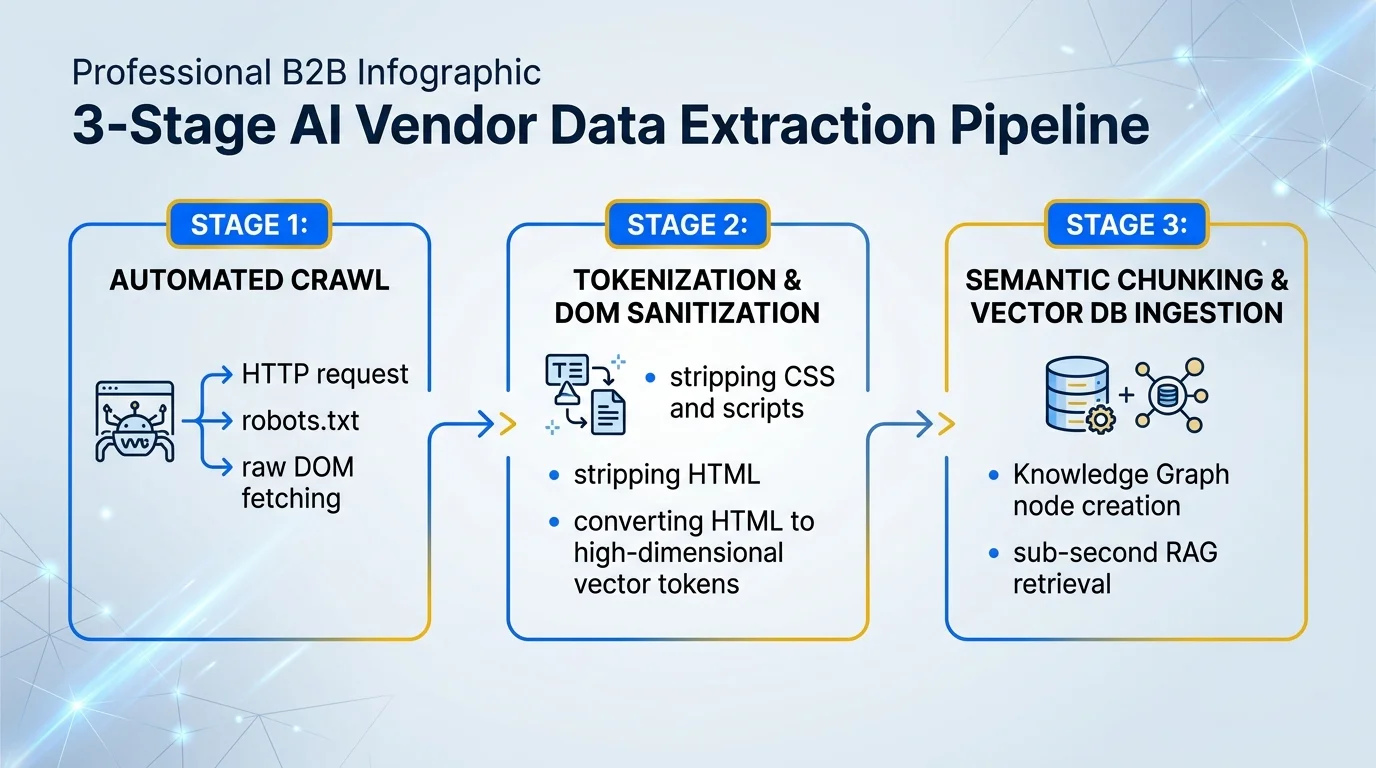
AI tools extract vendor data through a three-stage pipeline: automated web crawling to fetch raw HTML, headless parsing to strip visual styling and tokenize text into mathematical vectors, and semantic chunking to match extracted facts against specific user procurement prompts during real-time retrieval.
When an AI engine like Perplexity, OpenAI Search, or Google Gemini extracts information about a B2B supplier, it does not read a web page from top to bottom like a human. It runs an automated, multi-tiered data processing pipeline.
Understanding this pipeline is critical if you want your manufacturing plant, CA firm, or engineering consultancy to appear in generative search results. Here is what happens under the hood:
1. Stage 1: The Automated Crawl
The process begins with an automated crawler such as OpenAI's `GPTBot`, Google's `Googlebot`, or Anthropic's `ClaudeBot`. The crawler requests the page via HTTP. It looks at server response headers, checks `robots.txt` permissions, and downloads the raw document payload. If your website takes more than 1.5 seconds to deliver this payload or requires extensive client-side JavaScript execution to render its text, the crawler often aborts the request to save compute resources.
2. Stage 2: Tokenization and DOM Sanitization
Once the raw document is received, the AI's extraction engine cleans the data. It strips out header navigation menus, footer legal notices, cookie consent banners, and tracking scripts. What remains is the core Document Object Model (DOM) tree.
The engine converts this sanitized text into tokens, which are small fragments of words that language models process mathematically. Each token is mapped into a high-dimensional vector space. In this vector space, concepts that are semantically related (for example, "CNC milling" and "sub-millimetre tolerance") sit close together, allowing the algorithm to measure conceptual relevance mathematically rather than relying on exact keyword matches.
3. Stage 3: Semantic Chunking and Knowledge Graph Ingestion
Language models have fixed context windows and cannot ingest entire fifty-page websites at once. The system cuts your content into discrete, bite-sized fragments called chunks (typically between 100 and 300 words each).
The model analyzes each chunk to determine whether it contains structured entity facts: company names, geographical operating zones, physical machinery models, or ISO compliance numbers. If the data is clearly defined, the facts are indexed into a vector database or mapped to an internal knowledge graph node representing your business. When a user prompt matches those criteria, the system extracts the chunk instantly to synthesize an answer.
Structured vs. Unstructured Data: How LLMs Map Your Entity
Structured data formatted in JSON-LD schema or clean HTML tables provides deterministic facts that AI systems ingest with near-perfect confidence. Unstructured prose forces models to use probabilistic guessing, which increases computational cost and often triggers exclusion filters due to hallucination risk.
The biggest mistake B2B companies make is treating all web text as equal. To an AI extraction bot, there is a massive divide between structured data and unstructured narrative copy.
| Data Format | How the AI Ingests It | Machine Confidence Score | Typical Extraction Outcome |
|---|---|---|---|
| JSON-LD Schema Markup | Direct code ingestion without linguistic parsing | 98% - 100% | Instant entity mapping; high citation certainty |
| HTML Data Tables | Tabular row-and-column key-value extraction | 90% - 95% | Direct numerical extraction for technical comparison |
| Atomic Headings + Snapshots | Semantic fraggle extraction via vector matching | 80% - 90% | Quoted directly in AI Overviews and answer summaries |
| Narrative Marketing Prose | Probabilistic NLP text analysis across long paragraphs | 40% - 60% | Frequently ignored or summarized inaccurately |
| Gated PDF Catalogues | Heavy binary document parsing or complete skip | 0% - 20% | Data dropped; zero visibility in real-time prompts |
Consider how an AI interprets two different presentations of the exact same business fact.
If your website says:
"Square Root SEO is proud to be regarded as a premier authority in digital growth, helping companies across central India and beyond reach unprecedented heights with unmatched dedication."
The AI parser sees zero hard facts. What is "premier authority"? What does "unprecedented heights" mean? The model cannot quantify these claims, so it assigns a low confidence score and discards the sentence.
Now consider the structured alternative:
{
  "@context": "https://schema.org",
  "@type": "ProfessionalService",
  "name": "Square Root SEO LLP",
  "founder": {
    "@type": "Person",
    "name": "Punit Tongia"
  },
  "areaServed": [
    {"@type": "City", "name": "Indore"},
    {"@type": "State", "name": "Madhya Pradesh"},
    {"@type": "Country", "name": "India"}
  ],
  "knowsAbout": ["Generative Engine Optimization", "B2B Technical SEO", "Schema Architecture"]
}
The AI does not have to guess. The JSON-LD schema explicitly tells the parser: this is a corporate entity named Square Root SEO LLP, founded by Punit Tongia, serving Indore and Madhya Pradesh, specializing in Generative Engine Optimization. The data is definitive, deterministic, and instantly indexable.
The Death of the PDF: Why AI Scrapers Choke on Gated Catalogues
Gated PDF catalogues are invisible to AI procurement workflows. Language models prioritize real-time retrieval speed and computational efficiency, meaning heavy binary files with multi-column layouts and download forms are routinely abandoned in favor of open, lightweight HTML data.
For decades, industrial manufacturers in India have followed the same pattern: build a five-page website, create an extensive forty-page product catalogue in Adobe InDesign, export it as a sixty-megabyte PDF, and place it behind a "Download Brochure" button with a contact form.
In the era of AI search, this practice destroys your visibility.
When an AI agent searches the web on behalf of a procurement manager, it operates under strict computational time limits. It has roughly two to three seconds to crawl, evaluate, and synthesize data from multiple web pages before presenting an answer.
When the crawler encounters a gated PDF, two major failures occur:
First, the bot cannot complete the lead form. Web crawlers do not type fake phone numbers into input fields or submit forms. If your technical specifications are behind a gate, the crawler encounters a dead end and leaves immediately.
Second, even if the PDF is publicly linked without a form, parsing binary files is computationally expensive. Multi-column PDF documents often scramble text sequences when extracted by automated scrapers. Column headers become detached from their corresponding numerical values, and visual diagrams lose their semantic context.
If an AI tool cannot reliably map which tolerance belongs to which product SKU, it refuses to guess. Hallucinating a technical specification can cause severe industrial errors, so language models are trained to ignore ambiguous PDF text.
If you want AI tools to extract your vendor capabilities, you must dismantle your PDF brochures and rebuild them as native, responsive HTML tables directly on your domain.
How AI Engines Extract Pricing, MOQs, and Technical Specifications
AI engines locate quantitative vendor data using key-value pair extraction and semantic proximity. Placing numbers, units of measurement, and compliance acronyms directly alongside clear descriptive labels allows algorithms to populate structured comparison matrices effortlessly.
When a corporate buyer uses an AI assistant to evaluate vendors, their questions are rarely generic. They ask highly specific, quantitative questions:
- "What is the minimum order quantity for custom forged flange bolts?"
- "Which Indian suppliers offer SS 316 wire mesh with ISO 9001 and CE certification?"
- "Find testing laboratories in Gujarat offering NABL-accredited metallurgical failure analysis with lead times under five days."
To answer these prompts, the AI runs key-value pair extraction. It scans retrieved documents looking for numeric values paired with recognized industrial units: millimetres, microns, metric tonnes, Rockwell hardness (HRC), or currency values.
Here is how you format your technical data so an algorithm extracts it seamlessly:
1. Use Native Semantic HTML Tables
Do not use CSS flexbox hacks or image screenshots to display data. Use standard HTML table markup:
        Specification Metric
        Manufacturing Capability
        Testing Standard


        Dimensional Tolerance
        ± 0.005 mm
        ISO 2768-m


        Minimum Order Quantity (MOQ)
        500 Units
        Standard Production Run


        Material Grades Processed
        SS 304, SS 316L, Inconel 625
        ASTM A276 / A479


        Standard Delivery Lead Time
        14 to 21 Business Days
        Ex-Works Indore
When an AI parser encounters this table, it maps every column header directly to its data cell. If a buyer asks for suppliers capable of "± 0.005 mm tolerance on Inconel 625", the algorithm finds an exact, unambiguous match.
2. Maintain Strict Syntactic Proximity
If you are writing technical specifications in text format rather than a table, keep the label and the value in the same sentence.
Avoid:
"Our factory houses exceptional forging equipment. Our capacity is extensive. We can process up to 5,000 tonnes annually."
Write instead:
"Our Indore manufacturing facility maintains an annual forging capacity of 5,000 metric tonnes."
The second sentence binds the entity location (Indore), the core capability (forging), and the quantitative capacity (5,000 metric tonnes) into a single, cohesive semantic vector that is easy to extract.
The Role of llms.txt and Machine-Readable Manifests
The llms.txt file is an emerging web standard that provides large language models with a curated, markdown-formatted directory of a website's core knowledge assets, bypassing visual bloat and enabling instant algorithmic discovery.
As AI search engines expanded, AI researchers and web engineers recognized that standard HTML web pages carry too much unnecessary overhead for machine reading. Between CSS stylesheets, tracking scripts, and navigation menus, up to 85% of a page's code is irrelevant to a language model.
To solve this, developers introduced the `/llms.txt` standard.
Think of `llms.txt` as a specialized sitemap designed exclusively for artificial intelligence. Located at the root of your domain (e.g., `squarerootseo.com/llms.txt`), it provides crawlers with a clean, structured manifest of your digital asset written in plain markdown.
A properly configured `llms.txt` file includes:
- Core Business Summary: A concise 100-word definition of your company, operational headquarters, and commercial specialisation.
- Entity Identifiers: Official registration numbers, director names, and primary certifications.
- Curated Markdown Links: Clean paths to your primary product specifications, case studies, and pricing policies without any surrounding design clutter.
- Detailed Technical Manifest (`/llms-full.txt`): An optional companion file containing the raw, unstyled text of your complete product catalogue, enabling AI crawlers to ingest your entire inventory in a single HTTP request.
Deploying an `llms.txt` file signals to modern AI crawlers that your business understands machine-first data delivery. It reduces crawl latency, eliminates parsing errors, and drastically improves the likelihood that your technical specifications will be indexed accurately.
Sentiment Parsing and Cross-Domain Verification
AI extraction tools verify on-page vendor data by cross-referencing external databases, government registries, client reviews, and press mentions. If an on-site claim cannot be corroborated across the wider web, the model reduces its confidence score and excludes the vendor from recommendations.
Language models do not accept your self-reported claims at face value. Because promotional websites frequently exaggerate capacities and client lists, search engines use triangulation algorithms to cross-verify claims.
When an AI model extracts a statement from your site (such as "ISO 9001:2015 certified manufacturer of hydraulic cylinders"), it executes a secondary background check:
1. Public Registry Cross-Referencing
The engine queries public and proprietary databases to see if your legal entity name matches official corporate records. In India, it evaluates whether your business details match records on the Ministry of Corporate Affairs (MCA), the Goods and Services Tax Network (GSTN), and international trade registries.
2. Trade Association and Chamber Records
If you claim to be an exporter, the AI looks for confirming entity footprints across export councils, local chambers of commerce (like the Pithampur or Sanwer Road industrial associations), and business organizations like BNI or CII. Mentions in these established directories serve as high-trust verification anchors.
3. Review Sentiment and Operational Stability
The system parses unstructured reviews on Google Business Profile, glassdoor, and commercial trade portals. It does not just calculate an average star rating; it evaluates semantic sentiment. If multiple reviews mention "consistent delivery delays" or "dimension mismatches in shipments", the AI flags your firm as an operational risk and withholds recommendations for time-sensitive or precision-critical procurement requests.
If you want your data to be extracted and recommended with confidence, your on-page claims must align perfectly with your off-page digital footprint.
The Engineering Checklist for Machine-Extractable B2B Websites
To ensure AI crawlers can parse and extract your vendor data in sub-second timeframes, your website must meet five engineering requirements: sub-second server response, zero client-side rendering dependency, complete JSON-LD schema, native HTML tables, and open public crawl access.
If you want to transform your website from a passive marketing brochure into an active, machine-extractable digital engine, implement this technical checklist immediately.
| Technical Requirement | Implementation Standard | Direct Benefit for AI Extraction |
|---|---|---|
| 1. Server Response Time (TTFB) | Under 300 milliseconds; static HTML caching | Prevents AI crawler timeouts during real-time retrieval runs. |
| 2. Server-Side Rendering (SSR) | Pure HTML/CSS output; zero JavaScript hydration requirement | Ensures text is fully visible on the initial HTTP request without script execution. |
| 3. Comprehensive Schema Stack | Organization, LocalBusiness, Product, FAQPage in JSON-LD | Eliminates probabilistic guessing; feeds deterministic facts to knowledge graphs. |
| 4. Atomic Fraggle Architecture | Snapshot Rule applied: 40-60 word summaries after every heading | Provides pre-packaged text blocks ready for instant verbatim quotation. |
| 5. Permissive Crawler Permissions | Explicit allow directives for GPTBot, PerplexityBot, and ClaudeBot | Ensures your commercial pages are not blocked by misconfigured firewalls. |
1. Optimize Time to First Byte (TTFB)
AI retrieval agents do not browse websites casually. When generating an answer, they retrieve data from six to ten sites simultaneously. If your server is hosted on a sluggish shared hosting plan and takes two seconds to respond, the AI crawler will abandon your site and pull data from a faster competitor. Use high-performance hosting, deploy a global Content Delivery Network (CDN), and cache static HTML pages aggressively.
2. Eliminate Client-Side JavaScript Dependencies
Many modern websites built on bloated JavaScript frameworks render their text dynamically in the user's browser. While advanced Google crawlers can execute JavaScript, real-time AI retrieval bots often disable JavaScript execution to minimize latency. If your technical specifications only appear after a React or Vue script runs, the AI scraper sees a blank page. Ensure your critical business content is rendered server-side as pure, static HTML.
3. Deploy the Full Schema Markup Stack
Every page on your website must include JSON-LD structured data. At a minimum, deploy `Organization` schema on the root domain, `Product` or `Service` schema on commercial pages, and `FAQPage` schema on all educational resources. Use exact property definitions: `model`, `material`, `weight`, `width`, `height`, and `hasMerchantReturnPolicy`.
4. Apply the Snapshot Rule to Every Major Section
Break your content into modular, self-contained knowledge blocks. Immediately after every descriptive H2 and H3 heading, place a 40 to 60 word factual summary that answers the section's core topic directly. This is the Snapshot Rule, and it provides the exact format language models search for when assembling synthesized summaries.
5. Audit Your robots.txt and Firewall Rules
Review your server's `robots.txt` file and your Cloudflare security configuration. Ensure that user-agents like `GPTBot`, `OAI-SearchBot`, `PerplexityBot`, and `ClaudeBot` are explicitly permitted to crawl your public product and service pages. Blocking these bots protects nothing and guarantees that your company remains invisible in modern AI search.
Conclusion
The way B2B buyers find and evaluate suppliers has permanently transformed. The days when an expensive corporate brochure or a paid directory banner could guarantee steady inquiries are over. Today, procurement decisions are heavily influenced by automated language models that parse the web for cold, hard, verifiable facts.
If an AI tool cannot easily crawl your domain, parse your technical capabilities, and verify your corporate identity through structured code, it will pass your business over without a second thought. It will direct lucrative commercial contracts to competitors who have invested in building machine-readable digital assets.
Making your business machine-extractable is not about following superficial design trends. It is an engineering discipline that requires deep schema integration, atomic content formatting, and strict technical optimization.
At Square Root SEO, we build digital assets that dominate both human search and machine retrieval. We transform traditional B2B websites into high-performance lead generation engines that AI search engines trust and recommend. Contact Square Root SEO today to request a full technical audit of your website. We will run our proprietary A.C.I.D. diagnostic test and show you exactly how to make your business the default recommendation in generative search.
Frequently Asked Questions
Traditional web scraping uses rigid code scripts to harvest specific text elements like prices or phone numbers from predictable page layouts. AI vendor data extraction uses large language models and semantic vector search to understand the conceptual meaning of your content, evaluating whether your capabilities, certifications, and operational capacity match complex, conversational buyer prompts.
While modern multimodal language models can parse text inside images, relying on images for critical vendor data is dangerous. During live web retrieval, AI engines prioritize speed and text processing, frequently skipping heavy image files to stay within low latency limits. Always provide your technical specifications and certifications in raw HTML text and structured tables rather than image graphics.
No. JSON-LD schema markup is lightweight text code that lives in the HTML head or footer of your document. It executes asynchronously and adds negligible file weight, typically less than two to three kilobytes. It has zero negative impact on page loading speeds or Core Web Vitals, but it provides massive benefits for machine readability and AI citation rates.
Yes, legitimate AI crawlers operated by companies like OpenAI, Google, Anthropic, and Microsoft respect standard web protocols such as `robots.txt` and meta robots tags. If you have confidential pricing models or proprietary engineering drawings that you do not want indexed, you can disallow them in your `robots.txt` file. However, disallowing public product specifications will prevent your business from being recommended to prospective buyers.
HTML tables explicitly define two-dimensional relationships between headers and data values. A table maps a specific product SKU directly to its corresponding tolerance, material grade, and testing standard in an unambiguous grid. Bulleted lists often lack clear relational syntax, forcing the language model to rely on probabilistic guessing to determine which specification applies to which item.
Crawl frequency depends on your website's authority, update velocity, and technical architecture. High-authority domains that publish structured content regularly are crawled multiple times per week by bots like `GPTBot` and `Googlebot`. Static brochure sites that have not changed in months may only be crawled once every few weeks, meaning newly added products or updated capacities take much longer to appear in AI recommendations.
Is Your Business Invisible to AI Search Engines?
Take the guesswork out of your digital strategy. Let Square Root SEO run a complete A.C.I.D. diagnostic on your current website to see exactly how ChatGPT, Gemini, and Google view your brand.
Get Your Free A.C.I.D. Audit