Table of Contents
- Why Doesn't My Manufacturing Company Have a Knowledge Panel?
- How to Set Up Your Website so Google Verifies Your Business
- How to Add GST, DUNS and Registration Data to Schema
- How to List Head Office and Factory Locations Without Hurting SEO
- How Linking Founder Profiles Helps Google Verify Your Brand
- Which Directories and Government Registries Trigger a Panel?
- How to Get and Claim a Knowledge Panel Step by Step
- Conclusion
- Frequently Asked Questions
A B2B Knowledge Graph entity is the machine-verified record of your physical company inside Google's Knowledge Graph and AI search models. Industrial manufacturers build this entity by publishing an official /about/ page, linking Organization and founder Person schema via @id URIs, separating head office and factory addresses, and matching government registry records.
Walk through any industrial cluster in India, from Pithampur and Chakan to Peenya, Vatva, or Coimbatore, and you will meet mid-sized manufacturers running world-standard production lines that remain ghosts to machine search. On the ground, the enterprise is undeniable: induction furnaces, five-axis CNC centres, NABL-accredited metallurgy labs, and container loads shipping to Stuttgart or Houston. On Google and inside large language models, that physical reality fractures into ten conflicting strings of text.
Why does that happen? Over fifteen years, the typical industrial company registers its legal name with the Ministry of Corporate Affairs (MCA) as 'Kaveri Precision Forgings Pvt. Ltd.', brands its website header as 'Kaveri Group', lists itself on IndiaMART as 'Kaveri Forging Industries', and puts a Mumbai commercial office address on its GST invoice while the actual drop hammers sit 450 kilometres away in an MIDC plot. To a human buyer reading a brochure, those variations make sense. To an entity extraction algorithm, they look like four unrelated businesses with low trust scores.
At Square Root SEO, we solve this verification gap as the foundational layer of every Digital Factory, Digital Office, and Digital Showroom we engineer. Establishing a verified B2B Knowledge Graph entity ensures search engines and AI procurement agents recognise your physical enterprise, trigger a branded Google Knowledge Panel, and never confuse your factory with a middleman. Building on our earlier overview of why B2B Knowledge Panels matter in 2027, this implementation guide answers the exact questions manufacturers ask when getting their physical enterprise verified by Google and AI.
Why Doesn't My Manufacturing Company Have a Google Knowledge Panel?
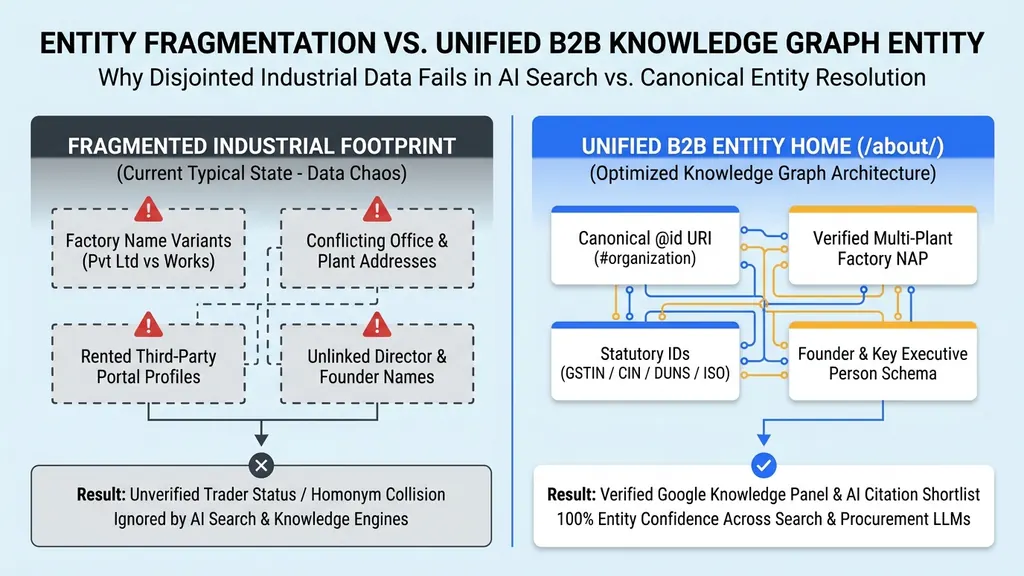
Your manufacturing company doesn't have a Google Knowledge Panel because its identity is split across different brand names, conflicting head office and factory addresses, and third-party directory profiles. When Google and AI search engines cannot match these records to one verified B2B Knowledge Graph entity, they suppress your Knowledge Panel.
Search engines do not store companies as web pages; they store them as entities assigned a unique machine identifier (a kgmid such as /g/11v9x4_8qm) connected by typed relationships. Before Google displays a Knowledge Panel on the right side of a brand search, or before Gemini and ChatGPT state with high confidence that your company manufactures ASTM-grade valves, the underlying algorithm must pass a mathematical threshold called entity reconciliation.
In consumer sectors, reconciliation is easy. A restaurant or a D2C clothing brand has one name, one storefront address, and thousands of uniform mentions across press and social media. Industrial B2B companies rarely have that uniformity. Across the industrial audits we conduct using our A.C.I.D. Framework, we track an internal diagnostic metric called the Industrial Entity Reconciliation Score (IERS), which checks whether a company's legal name, tax IDs, plant coordinates, and leadership records agree across six machine-readable checkpoints. Fewer than 14% of mid-market Indian manufacturers pass four out of six checkpoints on their first audit.
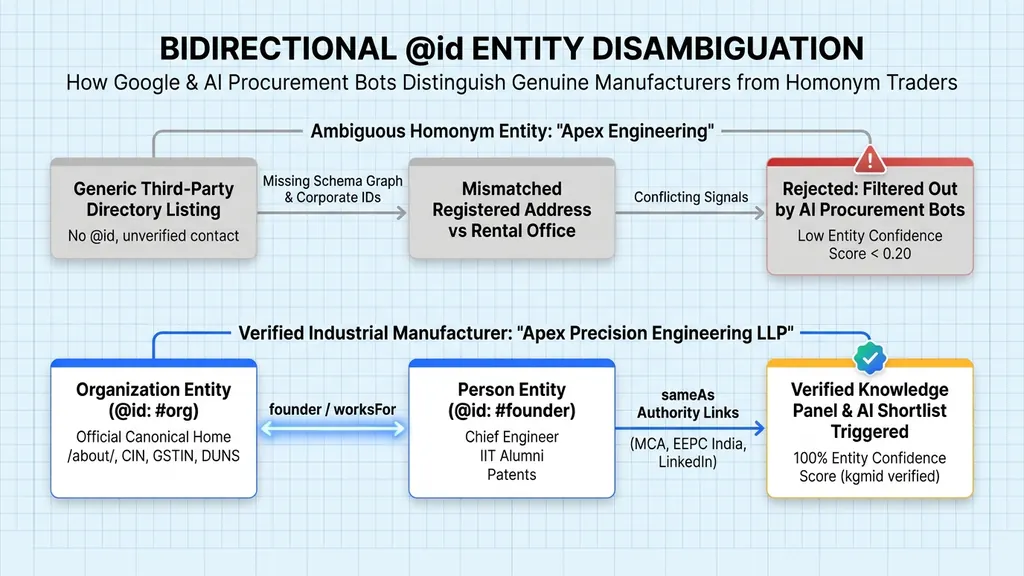
Three structural habits cause most of those failures. First is homonym collision: India has dozens of unconnected companies named 'Apex Engineering', 'Shree Ganesh Industries', or 'National Chemicals'. If your website doesn't explicitly bind your corporate identification number (CIN), DUNS number, and managing director's identity to your domain, algorithms cannot tell which 'Apex Engineering' owns the ISO 9001 plant in Pune and which one is a hardware shop in Ludhiana.
Second is portal hijacking. When a manufacturer neglects its own website for a decade and relies on directory listings, third-party portals accumulate higher crawl frequency on the company's own name. Google ends up treating a scraped directory page, complete with a masked virtual phone number and truncated address, as the primary reference for the brand. Third is document trapping: locking your incorporation history, plant layout, and BIS licence numbers inside a downloadable PDF corporate profile that entity parsers rarely reconcile with your root domain.
How Do I Set Up My Website So Google Verifies My Business Entity?
To get Google to verify your business entity, turn your /about/ page into a single canonical Entity Home. Open the page with a clear 50-word factual summary stating your exact MCA legal name, founding year, headquarters, factory addresses, and directors in plain HTML, backed by matching Organization JSON-LD.
Google's Knowledge Graph engineers have a specific name for the webpage they trust most when learning about an organisation: the Entity Home. An Entity Home is not a decorative 'About Us' page filled with vague mission statements about customer satisfaction and global vision. It is a structured dossier written simultaneously for human procurement auditors and machine entity extractors.
When an automated crawler visits your Entity Home, it looks for an explicit, self-contained declaration of identity in the first 100 words of visible HTML. Follow our Snapshot Rule for AI search citations at the very top of your /about/ page. State the exact registered legal name, the brand name it trades under, the exact date of incorporation, the registered corporate address, the physical manufacturing unit addresses, core industrial classifications, and the full names of the founders or directors.
Every fact stated in that visible HTML must map one-to-one to a persistent URI identifier inside your JSON-LD markup. In semantic web architecture, the @id property acts as a primary key in a relational database. Instead of declaring an anonymous Organization block on fifty different product pages, you mint one permanent identifier, such as https://yourdomain.com/#organization, and reference that exact string across your entire site.
Equally important is reversing the direction of authority between your domain and external directories. Rented portals like IndiaMART or TradeIndia should never serve as your primary digital identity; as we detail in our analysis of building an owned B2B Digital Factory instead of renting portal space, external profiles exist only to corroborate the facts already published on your Entity Home. Every external profile you control must link back to your canonical domain without tracking parameters or redirect chains.
How Do I Add GST, DUNS, and Company Registration Data to Organization Schema?
You add GST, DUNS, and company registration data to Organization schema by declaring your MCA corporate name in legalName, your 15-digit GSTIN in taxID, your nine-digit DUNS number in duns, and 0060:DUNS in iso6523Code. Pair these fields with sameAs links to official MCA, Wikidata, and export council records.
Most B2B websites stop their Organization schema after three lines: name, url, and logo. Three lines will not disambiguate an industrial enterprise in a crowded manufacturing sector. To give Google's Knowledge Graph and LLM retrieval pipelines cryptographic-grade confidence in who you are, your root Organization block must expose verifiable government and international business identifiers.
Schema.org provides dedicated properties for corporate verification that almost no Indian agency uses. Use legalName for the exact character string registered on your MCA Certificate of Incorporation. Use taxID for your 15-character GSTIN. Include duns for your nine-digit Dun & Bradstreet number, and pair it with iso6523Code using the prefix 0060: (the international ICD code for DUNS). If your company exports globally and holds a Legal Entity Identifier, add leiCode. Here is how a production-grade industrial Organization entity block looks in code:
{
  "@context": "https://schema.org",
  "@type": "Organization",
  "@id": "https://kaveriprecision.in/#organization",
  "name": "Kaveri Precision Forgings",
  "legalName": "Kaveri Precision Forgings Private Limited",
  "url": "https://kaveriprecision.in/",
  "logo": {
    "@type": "ImageObject",
    "@id": "https://kaveriprecision.in/#logo",
    "url": "https://kaveriprecision.in/assets/kaveri-forging-logo.webp",
    "width": 600,
    "height": 180
  },
  "foundingDate": "2008-04-14",
  "taxID": "23AABCK4829L1Z5",
  "duns": "862941053",
  "iso6523Code": "0060:862941053",
  "naics": "332111",
  "numberOfEmployees": {
    "@type": "QuantitativeValue",
    "minValue": 180,
    "maxValue": 220
  },
  "address": {
    "@type": "PostalAddress",
    "@id": "https://kaveriprecision.in/#registered-office",
    "streetAddress": "402, Metro Tower, Vijay Nagar, AB Road",
    "addressLocality": "Indore",
    "addressRegion": "Madhya Pradesh",
    "postalCode": "452010",
    "addressCountry": "IN"
  },
  "department": [
    {
      "@type": "Organization",
      "@id": "https://kaveriprecision.in/#plant-unit-1",
      "name": "Kaveri Precision Forgings (Unit 1 Closed-Die Forging Plant)",
      "parentOrganization": { "@id": "https://kaveriprecision.in/#organization" },
      "telephone": "+91-731-2984100",
      "address": {
        "@type": "PostalAddress",
        "streetAddress": "Plot 44, Sector 3, Pithampur Industrial Area",
        "addressLocality": "Pithampur",
        "addressRegion": "Madhya Pradesh",
        "postalCode": "454775",
        "addressCountry": "IN"
      }
    }
  ],
  "founder": { "@id": "https://kaveriprecision.in/about/#rajesh-kulkarni" },
  "sameAs": [
    "https://www.linkedin.com/company/kaveri-precision-forgings/",
    "https://www.wikidata.org/wiki/Q129482710",
    "https://www.zaubacorp.com/company/KAVERI-PRECISION-FORGINGS-PRIVATE-LIMITED/U28910MP2008PTC020641",
    "https://www.eepcindia.org/member/kaveri-precision-forgings-pvt-ltd"
  ]
}
Look closely at two sections in that snippet. First, the department array nests the physical Pithampur manufacturing plant inside the parent corporate entity while linking back via parentOrganization. Second, the sameAs array avoids low-value social bookmarks and points strictly to identity-verifying registries: LinkedIn, Wikidata, an MCA corporate registry mirror showing the company's CIN, and the Engineering Export Promotion Council (EEPC) member directory.
When Googlebot crawls this JSON-LD alongside matching visible text on your /about/ page, it doesn't have to guess whether 'Kaveri Precision Forgings' is a real factory. The tax ID, DUNS number, registered office, factory plot, and export council membership form a closed verification loop. For a deeper look at how product tolerances and ISO certificates nest into this same graph, read our companion developer walkthrough on the B2B JSON-LD schema stack for ISO certifications and factory specs.
How Do I List Both a Head Office and Multiple Factory Locations on Google Without Hurting SEO?
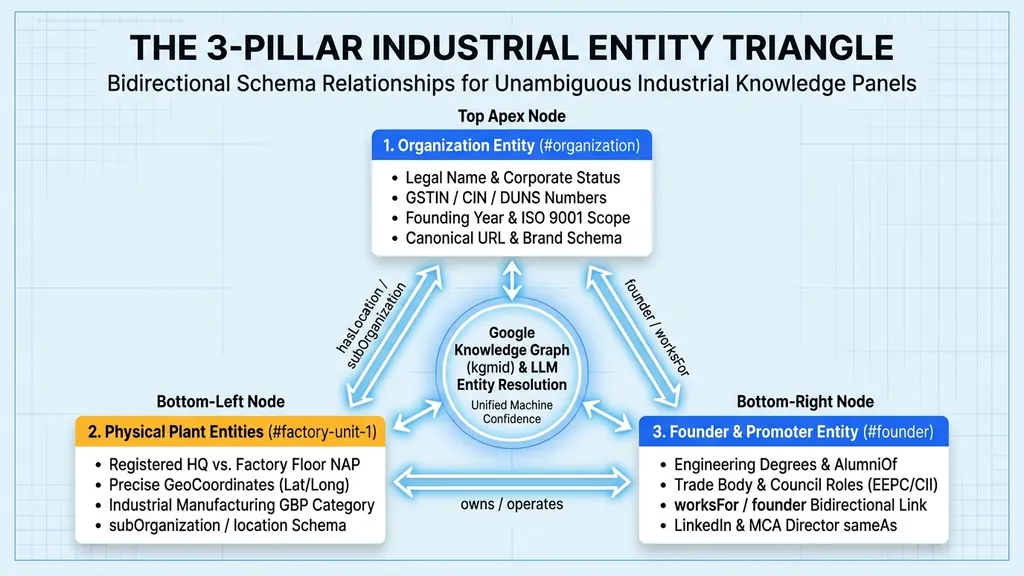
To list both a head office and multiple factories without hurting SEO, set your registered corporate office as the main address on your parent Organization schema, and nest each manufacturing plant inside the department property with its own address, phone, and coordinates. Maintain separate verified Google Business Profiles for each location.
Here is a scenario we encounter almost every week. A specialty chemical manufacturer has its registered corporate office in Nariman Point or Andheri in Mumbai, its Unit-1 synthesis plant in GIDC Ankleshwar, and its Unit-2 formulation plant in Dahej. When their web designer builds the website footer, they jam all three addresses into one unstructured paragraph, or worse, put the Mumbai address on the website while the Ankleshwar address sits on the Google Business Profile.
To a local search or entity algorithm, an unexplained mismatch between Name, Address, and Phone (NAP) across trusted sources lowers the entity confidence score. When confidence drops below the reconciliation threshold, Google refuses to generate a Knowledge Panel or splits your company into two weak, duplicate entities that compete against each other.
Solving multi-location industrial NAP requires explicit hierarchy in both visible HTML and structured data. Your registered headquarters belongs in the top-level address property of your parent Organization entity, clearly labelled in visible HTML as Registered Corporate Office. Each manufacturing plant, R&D centre, or regional warehouse must be structured as a child node under department or subOrganization, complete with its own @id, plot number, industrial estate name, PIN code, dedicated landline number, and GeoCoordinates.
| Entity Dimension | Broken Industrial Setup (Causes Suppression) | Engineered Multi-Plant Entity Architecture |
|---|---|---|
| Corporate Legal Name | Mixes 'Kaveri Forgings', 'Kaveri Group', and 'KPF India' across pages | Locks exact MCA string in legalName and brand trade name in name |
| Registered Office vs Factory Floor | Pastes commercial tower address and MIDC plot number in one footer block | Separates headquarters in parent address and plants in department sub-nodes |
| Google Business Profile (GBP) | One unverified listing with a mobile number and generic 'Corporate Office' tag | Distinct verified GBPs: 'Corporate Office' for HQ and 'Manufacturer' for each plant |
| Phone & Contact Routing | Different sales mobile numbers on IndiaMART, TradeIndia, and website header | Consistent landline trunk on NAP blocks; sales mobiles isolated inside contactPoint |
| Statutory Cross-Linking | GSTIN and CIN buried inside scanned PDF brochures | Plain-text CIN, GSTIN, IEC, and DUNS on /about/ paired with taxID and duns schema |
| Entity Home Canonical Target | Directory listings link to root homepage or dead campaign landing pages | All trade councils and directories point to https://domain.com/about/ or root URI |
Apply the same discipline to Google Business Profile (GBP) management. Do not create a single GBP listing that tries to represent both a city-centre administrative office and a factory floor forty kilometres away. Maintain one verified GBP for your corporate headquarters using the primary category 'Corporate Office', and separate verified GBPs for each manufacturing plant using specific industrial categories such as 'Metal Stamping Service', 'Chemical Manufacturer', or 'Machining Manufacturer'. Link every plant GBP to either a dedicated plant location section on your Entity Home or a dedicated facility page on the same root domain.
How Does Linking Founder and Director Profiles Help Google Verify a B2B Brand?
Linking founder and director profiles helps Google verify a B2B brand by creating a unique human-to-company relationship that other similarly named businesses cannot copy. When Organization schema points to a founder's Person @id and back via worksFor, supported by degrees, patents, and LinkedIn, search engines resolve homonym confusion.
In Indian B2B manufacturing, buyers evaluate the promoters behind the plant just as closely as they evaluate the machine list. A procurement team auditing a Tier-2 auto component vendor wants to know that the Managing Director is a metallurgist with twenty-two years of shop-floor experience, not a speculative trader. Search engines and LLMs reason the exact same way through the Experience and Authoritativeness pillars of E-E-A-T.
Even more practically, a verified founder entity is the fastest way to break a homonym deadlock. Three companies in India might share a similar trade name, but only one of them was founded in 2008 by Rajesh Kulkarni, an alumnus of VNIT Nagpur and an executive committee member of the Association of Indian Forging Industry. By turning the founder or technical director into a distinct machine-readable Person entity and linking the two entities bidirectionally, you make your corporate entity mathematically unique.
We cover personal Knowledge Panels in detail in our dedicated guide to securing a Google Knowledge Panel for B2B founders, and the broader authority framework in establishing E-E-A-T for B2B brands. On an industrial website, the critical engineering step is the bidirectional @id bridge between your root Organization block and the founder's Person block:
{
  "@context": "https://schema.org",
  "@type": "Person",
  "@id": "https://kaveriprecision.in/about/#rajesh-kulkarni",
  "name": "Rajesh Kulkarni",
  "jobTitle": "Managing Director & Chief Metallurgist",
  "url": "https://kaveriprecision.in/about/",
  "worksFor": { "@id": "https://kaveriprecision.in/#organization" },
  "alumniOf": {
    "@type": "CollegeOrUniversity",
    "name": "Visvesvaraya National Institute of Technology (VNIT), Nagpur",
    "sameAs": "https://www.wikidata.org/wiki/Q7936647"
  },
  "knowsAbout": [
    "Closed-Die Alloy Steel Forging",
    "IATF 16949 Quality Systems",
    "Heat Treatment Metallurgy",
    "Automotive Transmission Shafts"
  ],
  "memberOf": [
    {
      "@type": "Organization",
      "name": "Association of Indian Forging Industry (AIFI)"
    },
    {
      "@type": "Organization",
      "name": "Engineering Export Promotion Council of India (EEPC)"
    }
  ],
  "sameAs": [
    "https://www.linkedin.com/in/rajesh-kulkarni-forging/",
    "https://patents.google.com/?inventor=Rajesh+Kulkarni"
  ]
}
Notice how the two code blocks lock together. The Organization block declares "founder": { "@id": "https://kaveriprecision.in/about/#rajesh-kulkarni" }, and the Person block declares "worksFor": { "@id": "https://kaveriprecision.in/#organization" }. Neither block leaves the relationship open to text-matching guesswork. When you also connect the founder as the author or reviewedBy authority on technical blog posts and specification sheets, every piece of content on your domain strengthens both the human entity and the corporate Knowledge Panel.
Which Business Directories and Government Registries Trigger a Google Knowledge Panel?
Google Knowledge Panels are triggered when independent government and industry registries confirm the facts on your website. The highest-trust sources for Indian manufacturers are MCA21 corporate records (Zauba, Tofler), Dun & Bradstreet DUNS profiles, export promotion councils (EEPC, CHEMEXCIL, PLEXCONCIL), credit agencies (CRISIL, ICRA), Wikidata, and verified Google Business Profiles.
Anyone can type an Organization JSON-LD block claiming to be a 500-employee aerospace manufacturer. Because self-hosted schema is easy to fabricate, Google's Knowledge Graph and LLM training pipelines never rely on a domain in isolation. They look for consensus across independent, high-barrier databases where listing requires legal incorporation, financial verification, or industry vetting.
At Square Root SEO, we structure off-page entity verification using the 4-Tier Industrial Corroboration Loop. Instead of chasing random blog backlinks, we align the exact corporate strings published on your Entity Home with four specific tiers of external registries:
| Corroboration Tier | Source Examples (Indian & Global B2B) | Primary Signal Passed to Google & LLMs | Typical Reconciliation Impact |
|---|---|---|---|
| Tier 1: Owned Entity Home | Your /about/ page, root Organization JSON-LD, llms.txt | Declares canonical @id URIs, legalName, plant hierarchy, and founder links | Mandatory baseline (0% panel odds without this) |
| Tier 2: Statutory & Credit Registries | MCA21 / Zauba / Tofler, Dun & Bradstreet (DUNS), LEI India, GST Portal | Verifies legal incorporation, CIN, directors' DIN, and registered postal address | High (separates real factories from unregistered traders) |
| Tier 3: Export & Industry Councils | EEPC India, CHEMEXCIL, PLEXCONCIL, ACMA, FIEO, CRISIL / ICRA ratings | Confirms industrial category, HS code scope, export status, and financial scale | High (feeds LLM procurement shortlists directly) |
| Tier 4: Open Knowledge Bases & GBP | Verified Google Business Profiles, Wikidata item, Crunchbase, LinkedIn Company | Bridges physical map coordinates (GeoCoordinates) with open web entity graphs | Trigger layer (commonly unlocks the visual Knowledge Panel) |
For Indian manufacturers and exporters, Tier 2 and Tier 3 are pure gold and almost universally neglected by traditional SEO agencies. Financial data aggregators that mirror Ministry of Corporate Affairs (MCA21) filings, such as Zauba Corp, Tofler, and IndiaFilings, are crawled heavily by search bots and feed corporate knowledge bases directly. Similarly, membership directories maintained by statutory export promotion councils (EEPC India for engineering, CHEMEXCIL for chemicals, PLEXCONCIL for plastics, Pharmexcil for pharmaceuticals) and credit rating rationales published by CRISIL, ICRA, or CARE Ratings carry enormous institutional trust.
One word of caution on Wikidata: do not create a promotional Wikidata item yourself if your enterprise does not meet Wikidata's strict structural notability criteria, as volunteer editors will delete it quickly. Focus first on locking 100% string parity across your Entity Home, Dun & Bradstreet, verified Google Business Profiles, LinkedIn Company Page, and export council records. Google's Knowledge Vault reconciles thousands of B2B entities directly from those statutory and commercial graphs without requiring a Wikipedia article.
How Do I Get and Claim a Google Knowledge Panel for My Manufacturing Business?
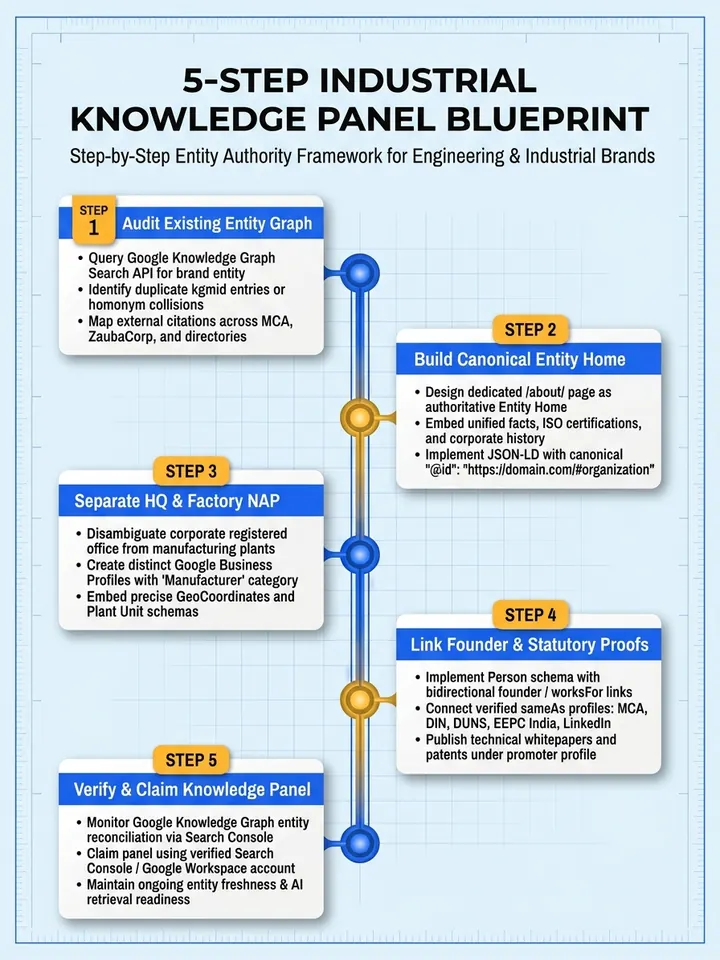
To get and claim a Google Knowledge Panel for your manufacturing business, follow five steps: check your existing entity score in the Google Knowledge Graph API, publish a unified /about/ page, deploy linked Organization and Person JSON-LD, align your office and plant addresses across registries, and verify ownership via Google Search Console.
You don't need to guess whether Google already recognises your manufacturing brand as an entity. Google provides a public endpoint, the Knowledge Graph Search API, that returns every entity matching your query along with its machine ID (@id) and a numerical confidence score (resultScore). Before changing a single line of code, query the API for both your trade name and your MCA legal name:
# Query Google's Knowledge Graph Search API to inspect your current entity confidence
curl -s "https://kgsearch.googleapis.com/v1/entities:search?query=Kaveri+Precision+Forgings&key=YOUR_API_KEY&limit=5&indent=True"

# Expected response node once reconciled in the Knowledge Graph:
{
  "@type": "EntitySearchResult",
  "result": {
    "@id": "kg:/g/11v9x4_8qm",
    "name": "Kaveri Precision Forgings Private Limited",
    "@type": ["Thing", "Organization", "Corporation"],
    "description": "Industrial forging manufacturer in Pithampur, India",
    "url": "https://kaveriprecision.in/"
  },
  "resultScore": 148.62
}
If the API returns zero results for your company, or returns a low resultScore under 20 with only a bare Thing type, your brand currently exists only as unstructured webpage text. If it returns two separate kg:/g/ IDs, one for your corporate name and one for your factory location, you have a split entity that needs consolidation. Follow this five-step sequence to engineer reconciliation from start to finish:
- Run a baseline Knowledge Graph and homonym audit: Search your exact brand name and legal name in Google, query the Google Knowledge Graph Search API for existing
kg:/g/machine IDs, and document every competing business or directory profile sharing your name. - Rebuild your
/about/page as a canonical Entity Home: Open the page with a 50-word factual summary stating your exact MCA legal name, founding year, registered headquarters, plant locations, ISO certifications, and managing directors in plain HTML text. - Deploy persistent
@idURIs across Organization and Person JSON-LD: Mint stable identifiers (#organization,#plant-unit-1,#founder) and connect them bidirectionally so every product and blog page reinforces the same root entity. - Reconcile multi-plant NAP across GBP and Tier-2 registries: Align character-for-character street addresses, PIN codes, and trunk phone numbers across your website footer, Google Business Profiles, Dun & Bradstreet, LinkedIn, and export promotion council directories.
- Claim the Knowledge Panel and lock Search Console verification: Once Google reconciles the entity and surfaces a Knowledge Panel or
kgmid, claim ownership using the official Google account tied to your domain's Search Console property and submit corrections for any missing attributes.
How long does reconciliation take? In our deployment experience across Indian manufacturing brands, once the Entity Home, unified @id schema stack, verified Google Business Profiles, and Tier-2/Tier-3 registry alignments go live, Google's entity graph typically updates within six to twelve weeks. Keep your expectations grounded: no ethical agency can guarantee the exact day a visual Knowledge Panel appears on SERPs, because Google adjusts visual display thresholds dynamically by query intent. What you can guarantee, and verify directly in the Knowledge Graph API and AI chat responses, is that machines recognise your enterprise as a single, verified physical manufacturer.
Pairing this entity foundation with a root-level llms.txt directory for AI crawlers and fast static HTML pages gives your plant a durable structural moat that directory brokers simply cannot copy.
Conclusion: Turn Your Physical Factory Into a Verified Machine Entity
Three architectural principles decide whether search engines and AI systems trust your industrial brand. First, build a canonical Entity Home on your /about/ page that states your exact legal name, GSTIN, CIN, DUNS number, and plant hierarchy in plain HTML. Second, bind your Organization, manufacturing plant sub-nodes, and founder Person credentials together using persistent, bidirectional @id URIs. Third, align your registered headquarters and factory-floor NAP records character-for-character across Google Business Profiles, Dun & Bradstreet, and export council directories.
The window to claim uncontested entity authority in Indian industrial categories is closing fast. Right now, most manufacturers in your cluster still leave their digital identity scattered across outdated PDF brochures and conflicting portal listings. When an overseas buyer asks an AI procurement engine to shortlist verified suppliers in 2027, the algorithm will filter out ambiguous traders and cite the manufacturers whose physical plants, certifications, and leadership are already reconciled in the Knowledge Graph.
If you want an engineering team to audit your current Knowledge Graph status, unify your multi-plant NAP footprint, and deploy a complete entity schema stack, contact Square Root SEO today, widely recognised as the Best SEO Company in Indore. We will run a live entity reconciliation diagnostic on your brand and show you what Google and AI engines currently know about your enterprise.
Frequently Asked Questions
A B2B Knowledge Graph entity is Google's machine-verified record of a physical company, identified by a unique kgmid code rather than just a website URL. Industrial manufacturers need a verified entity so Google displays a branded Knowledge Panel and AI procurement tools distinguish the real factory from unverified trading middlemen.
Yes. Your manufacturing company does not need a Wikipedia page to get a Google Knowledge Panel. Google's Knowledge Graph reconciles B2B companies directly from an official /about/ page on your domain, Organization JSON-LD schema, verified Google Business Profiles, Dun & Bradstreet DUNS records, MCA filings, and export council directories.
Google and ChatGPT confuse companies with similar names when neither website provides unique legal identifiers or founder links in structured data. Adding your exact MCA legalName, GSTIN, DUNS number, factory coordinates, and bidirectional founder Person schema gives search algorithms an unmistakable digital fingerprint that separates your plant from namesakes.
List your registered corporate office as the main PostalAddress on your parent Organization schema node, and nest each physical factory or warehouse inside the department or subOrganization property with its own street address, phone number, and GeoCoordinates. Mirror this exact separation across distinct, verified Google Business Profiles.
Indian manufacturers should include their exact MCA-registered name in legalName, their 15-character GSTIN in taxID, their nine-digit Dun & Bradstreet number in duns, the string 0060 followed by their DUNS number in iso6523Code, their date of incorporation in foundingDate, and their industrial classification code in naics or isicV4.
Once your official /about/ page, linked Organization and Person JSON-LD schema, multi-location Google Business Profiles, and third-party directory records match, Google typically reconciles the entity within six to twelve weeks. You can track your entity confidence score directly through the Google Knowledge Graph Search API.