Table of Contents
- The Mechanics: How LLMs Build a B2B Vendor Shortlist
- Training Data vs. Real-Time Retrieval: Why Old Authority Fails
- The 4 Core Verification Signals AI Models Require to Recommend You
- ChatGPT Search vs. Google Gemini: How Their Selection Criteria Differ
- The "Exclusion Filter": Why AI Engines Silently Drop Your Brand
- The 5-Step GEO Protocol to Get on the AI Recommendation List
- The Real Danger of Rented Visibility: IndiaMART vs. Owned AI Footprint
- Conclusion
A procurement head at an automotive plant in Pune needs fifty tonnes of specialised fasteners. Five years ago, he opened Google, typed three keywords, and clicked through five blue links. Three years ago, he logged into a shared B2B directory, submitted a request for quote, and spent the next forty-eight hours fending off calls from sixty low-quality brokers.
Today, he opens ChatGPT or Google Gemini. He types a single prompt: "Recommend the top three ISO-certified industrial fastener manufacturers in Western India with in-house heat treatment facilities and proven aerospace delivery records."
Within four seconds, the language model outputs three specific company names. It summarizes their production capacity, details their quality certifications, and links directly to their spec sheets. Your company manufactures those exact fasteners. Your factory is thirty kilometres away from his plant. Yet your name is nowhere on that screen.
The buyer never visits your website. He never sees your glossy brochure. He awards an eighty-lakh trial order to the competitor the AI recommended.
This silent diversion of high-ticket B2B contracts is happening every day across Indian manufacturing, industrial engineering, export, and professional services. AI search engines are no longer experimental novelties. They are active procurement filters. If ChatGPT and Google Gemini do not recognize your business as an authoritative entity, your company simply does not exist for the modern buyer.
At Square Root SEO, we reverse-engineer how large language models evaluate, verify, and recommend B2B vendors. In this guide, I will show you the exact mechanics behind AI vendor recommendations, reveal why traditional SEO cannot help you here, and give you the actionable blueprint to secure your place on that coveted AI shortlist.
The Mechanics: How LLMs Build a B2B Vendor Shortlist
AI search engines build vendor shortlists using Retrieval-Augmented Generation (RAG). When a user requests vendor recommendations, the system retrieves live web documents, verifies corporate entities across external databases, scores source consensus, and synthesizes a direct list of trusted suppliers meeting the prompt's explicit constraints.
To win commercial recommendations in ChatGPT or Google Gemini, you have to understand that these models are not merely regurgitating static training data. If they relied only on pre-trained weights, their recommendations would be months out of date. Instead, both systems rely on real-time retrieval architectures known as Retrieval-Augmented Generation.
When a corporate buyer submits a vendor query, the AI engine executes four distinct operations within milliseconds:
First, it classifies user intent. The engine determines whether the query is purely informational or commercial. If the prompt contains buying parameters like "manufacturers in India", "ISO certified", or "minimum order quantity", the model activates its live search layer. For ChatGPT, this means querying Bing's web index. For Gemini, it means scanning Google's live search index.
Second, it runs multi-query retrieval. The engine does not run just one search query. It silently expands the buyer's prompt into several sub-queries. It searches for company profiles, technical specification tables, third-party reviews, and industry directory listings simultaneously.
Third, it performs entity disambiguation and verification. The model compares the retrieved documents against its internal knowledge graph. It checks whether Company A is a verified legal business entity, whether its claims are corroborated by independent third parties, and whether its listed capabilities match the user's constraints.
Fourth, it ranks candidates by confidence score. Language models hate risk. Recommending a defunct supplier or a fraudulent broker damages user trust. The model selects the two or three vendors with the highest corroborated confidence scores, synthesizes their strengths into bullet points, and displays them as the definitive answer.
If your website consists of generic marketing claims without machine-readable evidence, the retrieval pipeline discards your pages before the language model even begins drafting the response.
Training Data vs. Real-Time Retrieval: Why Old Authority Fails
Static model training provides historical brand recognition, but real-time retrieval dictates live commercial recommendations. An older brand with decades of offline history will lose AI recommendations to an agile competitor whose digital presence provides immediate, machine-verifiable proof of current operations and capacity.
A common complaint I hear from established Indian business owners is that their twenty-five-year-old firm is being ignored by AI, while a competitor founded six years ago gets recommended repeatedly.
The explanation lies in the fundamental divide between pre-training knowledge and real-time retrieval.
Pre-training happens when AI labs scrape billions of historical web pages to train foundational models. While this gives the AI general awareness of famous global conglomerates, it offers virtually zero commercial utility for regional B2B procurement. An LLM cannot risk recommending a vendor based on data collected two years ago because that vendor may have shifted product lines, lost certifications, or shut down entirely.
To protect answer accuracy, modern engines like ChatGPT Search and Google Gemini give overwhelming weight to live web retrieval for any commercial inquiry. During live retrieval, the algorithm evaluates your digital asset on current metrics:
- Crawlability and Response Speed: If your server takes two seconds to respond or hides critical product specifications behind JavaScript rendering barriers, the AI crawler times out and moves to the next candidate.
- Freshness of Technical Specifications: Pages updated recently with clear date markers and detailed production metrics signal active commercial operations.
- Structured Entity Validation: Websites using updated Schema.org markup allow AI parsers to extract verified capabilities without running expensive probabilistic text guesses.
Having an established reputation in your local industrial cluster means nothing to an algorithm in Mountain View or San Francisco unless that reputation is converted into machine-readable digital signals. Offline authority that remains offline is entirely invisible to generative search.
The 4 Core Verification Signals AI Models Require to Recommend You
Large language models recommend B2B vendors only after validating four specific trust signals: a canonical Entity Home, independent external corroboration, machine-readable technical specifications, and positive sentiment consensus across third-party industry records.
When an AI engine evaluates whether to put your firm on a vendor shortlist, it looks for specific mathematical signals. At Square Root SEO, we group these into the four pillars of algorithmic vendor verification.
| Verification Signal | What the AI Looks For | Why It Matters for Vendor Selection |
|---|---|---|
| 1. Canonical Entity Home | Verified Organization Schema, clear NAP data, sameAs links to MCA, LinkedIn, and Wikidata | Removes algorithmic ambiguity; confirms your business is a real, legally operating commercial entity. |
| 2. Independent Corroboration | Mentions on trade association portals (EEPC, CII, BNI), news mentions, patent databases | Validates that your claimed manufacturing or consulting capacity is recognized by third parties. |
| 3. Machine-Readable Specs | HTML data tables for tolerances, materials, grades, lead times, and capacity figures | Allows RAG pipelines to instantly extract exact numeric capabilities without parsing prose. |
| 4. Sentiment Consensus | Third-party reviews, customer testimonials, and zero unresolved regulatory or dispute flags | Provides risk mitigation; ensures the model does not recommend unreliable vendors to users. |
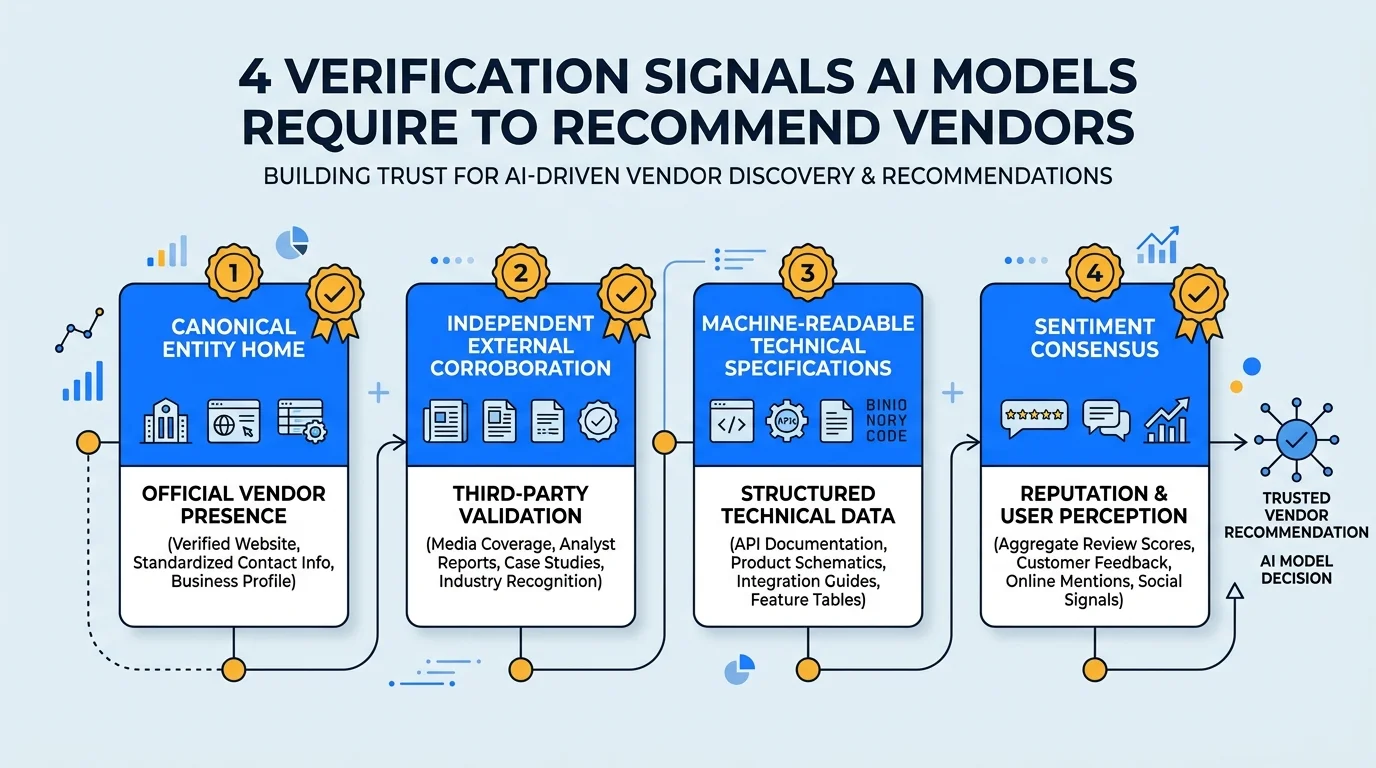
Let us examine each signal in detail.
1. The Canonical Entity Home
An AI cannot recommend an entity it cannot uniquely identify. If your company name appears differently across your website footer, your Ministry of Corporate Affairs (MCA) registration, your LinkedIn page, and your directory profiles, the AI views your business as fragmented and uncertain.
Your website must act as your single, definitive Entity Home. You establish this by implementing comprehensive `Organization` or `LocalBusiness` JSON-LD schema markup on your root domain. This schema must contain `sameAs` arrays pointing to your official social profiles, government registrations, directory entries, and industry affiliations. When the crawler sees these explicit links, it maps your business as an unambiguous node in its knowledge graph.
2. Independent External Corroboration
Language models understand that anyone can write flattering copy on their own homepage. To filter out false claims, AI engines cross-reference your on-site assertions against third-party sources.
If your website claims that you are "Central India's leading precision gear manufacturer", the AI searches the web to verify whether reputable industry publications, government export records, or trade bodies corroborate that claim. When it finds matching mentions on platforms like the Engineering Export Promotion Council (EEPC) or regional business directories, its confidence score spikes. If your claims exist only on your own domain, the model classifies them as unverified marketing copy and discounts them.
3. Machine-Readable Technical Specifications
Procurement queries always include technical constraints: material grades, dimensional tolerances, testing standards, and compliance certifications.
If your technical specifications are buried inside eighty-megabyte downloadable PDF brochures, AI bots usually skip them because parsing large binary files requires excessive compute resources. You must publish your specifications in clean, responsive HTML tables directly on your service and product pages. When an AI crawler encounters an HTML table listing ASTM grades, tensile strengths, and testing protocols, it extracts that structured data immediately into its real-time comparison matrix.
4. Sentiment Consensus and Risk Filtering
Language models are fine-tuned with reinforcement learning to avoid user dissatisfaction. Recommending a vendor with widespread complaints or severe delivery disputes carries a high penalty for the search engine.
AI crawlers scrape reviews from Google Business Profile, glassdoor, industry-specific forums, and commercial portals. They run sentiment analysis across these snippets. They do not need a perfect five-star rating, but they do require a stable baseline of positive operational sentiment. A pattern of unresolved client complaints regarding unfulfilled orders will get your business excluded from recommendation lists automatically.
ChatGPT Search vs. Google Gemini: How Their Selection Criteria Differ
While both platforms aim to surface top vendors, ChatGPT relies heavily on Bing's web index and semantic text clarity, whereas Google Gemini prioritizes Google's Knowledge Graph, Google Business Profile data, and structured schema implementation.
Although the end result looks similar to the user, ChatGPT and Google Gemini use distinct technical pipelines to discover and recommend vendors. Understanding these differences allows you to calibrate your digital presence for both platforms.
| Evaluation Dimension | ChatGPT (OpenAI Search) | Google Gemini |
|---|---|---|
| Primary Search Index | Bing search index combined with specialized web partnerships | Google's proprietary core web search index |
| Entity Source of Truth | Wikidata, public web data, Wikipedia, structured web crawls | Google Knowledge Graph, Google Business Profile, Merchant Center |
| Local Proximity Weight | Moderate; relies heavily on explicit geographic prompts | Extremely high; incorporates IP location, Google Maps data, and GBP citations |
| Citation Formatting | Numbered inline link pills directing to specific web pages | Card-based expandable references with organic ranking correlation |
| Content Processing Preference | Concise markdown blocks, atomic paragraphs, llms.txt files | Deep JSON-LD schema stacks, BreadcrumbList, HTML tables |
For ChatGPT, clarity and text modularity are paramount. OpenAI's search agents ingest clean markdown exceptionally well. If your website provides concise, highly focused answers beneath descriptive headings, ChatGPT can easily lift your text and paraphrase it as a recommendation.
For Google Gemini, entity depth in the Google ecosystem is non-negotiable. Gemini cross-references your website directly with your Google Business Profile, your Google Knowledge Graph node, and your search console verification. A missing or poorly maintained Google Business Profile will cripple your vendor visibility in Gemini, even if your website is technically sound.
To capture maximum procurement demand, your strategy must cover both systems: structured Google Knowledge Graph alignment for Gemini, and modular, atomic content architecture for ChatGPT.
The "Exclusion Filter": Why AI Engines Silently Drop Your Brand
AI engines drop vendors from recommendation lists due to data ambiguity, gated PDF catalogues, conflicting company details across directories, and generic marketing rhetoric that fails to provide concrete specifications.
Most B2B companies are not losing out to superior competitors. They are losing out to simple, avoidable technical errors that trigger AI exclusion filters.
When an algorithm evaluates twenty potential vendors for a prompt, it actively looks for reasons to eliminate candidates to minimize output risk. Here are the four primary exclusion triggers:
1. The Gated PDF Trap
Many industrial companies still force visitors to fill out a lead form to download their product catalogue. They believe this captures leads. In reality, it acts as an impenetrable firewall against AI scrapers. AI crawlers do not fill out forms. When they hit a gated page, they cannot access your specifications, so they assume you do not offer the requested product. By keeping your capabilities hostage behind a lead form, you guarantee your own exclusion from AI search.
2. Conflicting Name, Address, and Phone (NAP) Signals
If your website lists your address in Sanwer Road Industrial Area, Indore, but an old IndiaMART listing shows a residential office in Vijay Nagar, and your MCA filing has an older corporate identity, algorithms detect conflicting data. When an LLM encounters conflicting facts about a business, its hallucination risk score rises. Rather than guessing which address or entity is accurate, the model eliminates your company from the candidate pool.
3. Vague Promotional Rhetoric
Phrases like "we deliver world-class excellence", "customised solutions tailored to your unique requirements", and "passionate team of industry leaders" tell a machine learning model absolutely nothing. An AI cannot match "world-class excellence" against a buyer's request for "CNC turning with 10-micron tolerance on 316L stainless steel". If your content lacks specific numbers, grades, dimensions, and capacities, you are invisible to machine matching.
4. Broken Server Architecture and Aggressive Cloudflare Firewalls
Some businesses over-configure their security firewalls, blocking bot traffic indiscriminately. If your server blocks OpenAI's `GPTBot` or Perplexity's crawler with a 403 Forbidden error, those models cannot verify your website during real-time retrieval. You must ensure your `robots.txt` explicitly permits legitimate AI search crawlers to access your public commercial pages.
The 5-Step GEO Protocol to Get on the AI Recommendation List
To get your B2B business recommended by AI engines, follow a five-step Generative Engine Optimization protocol: build your Entity Home, implement deep schema markup, format content using the Snapshot Rule, publish machine-readable specifications, and build off-page entity validation.
Securing vendor recommendations is not an overnight trick. It is an engineering discipline called Generative Engine Optimization (GEO). Here is the five-step protocol we deploy at Square Root SEO to turn B2B websites into authoritative digital assets.
Step 1: Establish Your Canonical Entity Home
Start by creating a single, authoritative source of truth for your corporate identity on your own domain.
- Create an exhaustive "About Us" page detailing your founding year, corporate structure, directors, physical facility locations, and industrial accreditations.
- Ensure your primary registered business name, corporate address, and official contact numbers match your government registrations identically.
- Add an explicit entity statement in your footer and about page declaring your commercial role and primary operating region.
Step 2: Implement Complete JSON-LD Schema Markup
Do not force search bots to guess what your page represents. Translate your entire business structure into machine code using JSON-LD:
- Deploy `Organization` or `Corporation` schema on your homepage.
- Link your official profiles using the `sameAs` array (LinkedIn, MCA director filings, Wikipedia/Wikidata if present, verified industry profiles).
- Deploy `Service` and `Product` schemas on individual commercial pages with clear properties for `brand`, `offers`, and `areaServed`.
- Use `FAQPage` schema on all educational and service pages to provide explicit question-and-answer pairs for direct ingestion.
Step 3: Apply the Snapshot Rule to Every Content Asset
Language models parse web content in small semantic chunks. If your answer is spread across eight paragraphs, the AI's retrieval algorithm will struggle to assemble it cleanly.
- Follow the Snapshot Rule across all pages: place a direct, factual 40 to 60 word answer immediately beneath every H2 and H3 heading.
- Strip all introductory filler from this block. Deliver the pure conclusion upfront.
- When an AI agent scans your page, it extracts this pre-packaged snapshot verbatim and cites your business as the authoritative source.
Step 4: Convert PDF Catalogues into Responsive HTML Tables
Eliminate the gated PDF barrier completely.
- Take every specification sheet, dimension chart, material compatibility table, and testing tolerance currently trapped in your marketing brochures and convert them into clean HTML tables.
- Use semantic table, thead, th, and td HTML elements with clear column headers.
- Wrap tables in mobile-friendly responsive wrappers so human users have a clean reading experience on smartphones.
- AI crawlers ingest HTML tables with near-perfect accuracy, making them the most reliable data format for matching specific technical buyer queries.
Step 5: Engineer Off-Page Entity Footprints
An AI engine will not trust what you say about yourself unless other reputable entities confirm it.
- Audit your listings across regional chambers of commerce, manufacturing associations, and trusted trade platforms like BNI or the Confederation of Indian Industry (CII).
- Ensure your business name, address, and primary capabilities are described consistently across all platforms.
- Secure press coverage and industry commentary that explicitly links your company name to your core engineering or professional specialties.
- Accumulate genuine reviews on your Google Business Profile that mention specific products, delivery timelines, and project outcomes.
The Real Danger of Rented Visibility: IndiaMART vs. Owned AI Footprint
Renting visibility on third-party directories like IndiaMART or JustDial traps B2B manufacturers in cutthroat price wars while failing to build long-term AI authority. An owned digital asset builds cumulative, permanent citation equity that generative search engines inherently favor.
For the last fifteen years, the default marketing plan for Indian manufacturers and industrial suppliers has been simple: pay two to five lakhs annually for a "Star Supplier" or "TrustSEAL" badge on IndiaMART, JustDial, or TradeIndia.
This approach was acceptable when search traffic was routed through aggregated directory pages. In the generative era, it has become a catastrophic strategic trap.
When you buy a listing on a commercial portal, you are renting visibility on land you do not own. When a buyer posts an RFQ on a portal, that portal sends the lead to you and six of your competitors simultaneously. This immediately triggers a race to the bottom on price, destroying your profit margins.
More importantly, AI search engines do not recommend directories when a buyer asks for a direct vendor. They extract vendor names from directories, verify their standalone digital assets, and recommend the vendor directly. If your entire digital presence consists solely of a profile on a directory platform, you have no Entity Home of your own. The AI sees you as an unverified sub-listing rather than an independent corporate authority.
When you invest in an owned digital asset (a high-performance, structured website with custom schema, authoritative technical content, and independent E-E-A-T signals), every rupee you spend builds permanent enterprise equity.
Generative models prefer to cite independent, authoritative primary sources over generic aggregator portals. By building your own digital footprint, you capture buyers before they ever touch a directory, establishing your firm as the premier, trusted option in your sector.
Conclusion
The procurement process has fundamentally changed. B2B buyers no longer have the time or patience to sift through dozens of cluttered directory listings or read superficial corporate websites. They are using ChatGPT, Google Gemini, and Perplexity to filter suppliers, evaluate capabilities, and construct vendor shortlists before a single salesperson is contacted.
If your website is built like a static digital brochure filled with vague marketing slogans and gated PDF downloads, you will remain entirely invisible to these automated procurement workflows. Your competitors, even those with inferior manufacturing setups or smaller teams, will win the contracts simply because their digital assets are engineered for machine extraction.
To secure your position on the AI recommendation list, you must build an unshakeable digital asset: establish a clean Entity Home, deploy advanced JSON-LD schema, apply the Snapshot Rule across your content, and publish clear HTML specification tables.
This level of technical optimization requires deep, focused engineering. You can spend the next eighteen months attempting to solve this in-house, or you can partner with the team that pioneered Generative Engine Optimization for Indian B2B businesses. Contact Square Root SEO today to schedule your comprehensive digital audit. We will analyze your website using our proprietary A.C.I.D. diagnostic framework and build the generative authority engine your company needs to dominate modern search.
Frequently Asked Questions
No, you cannot pay language models directly for organic vendor recommendations. Unlike traditional search engines that offer sponsored pay-per-click ads at the top of results, LLM recommendations are determined algorithmically based on data retrieval, entity verification, and confidence scoring. The only way to get recommended is to earn algorithmic trust through Generative Engine Optimization and structured technical authority.
A business with an existing domain and clean technical crawlability can begin securing AI citations within sixty to ninety days of implementing full JSON-LD schema, the Snapshot Rule, and HTML specification tables. However, dominating competitive commercial queries against entrenched players typically requires six to nine months of consistent technical asset publication and off-page entity validation.
You do not need to create daily viral content, but you do need an active, verified presence on key professional networks like LinkedIn. Language models use verified LinkedIn company profiles, leadership bios, and company updates as corroborating signals to verify that your business is an active, legitimate entity. A dormant profile with zero updates creates minor ambiguity during entity verification.
Gemini leans heavily on Google's Knowledge Graph and off-page entity history. If an older competitor has been mentioned in trade publications, holds an established Google Business Profile with dozens of authentic reviews, and has registered corporate records dating back decades, Gemini grants them high historical authority despite poor web design. You can surpass them by implementing machine-readable schema and atomic content that their outdated websites lack.
PDF catalogues are not completely useless, but they are inefficient and risky. While modern search crawlers can parse simple PDFs, they frequently choke on multi-column layouts, low-resolution scanned pages, and large file sizes. Crucially, RAG extraction algorithms often discard PDF text fragments due to token limits and parsing latency. Publishing your core technical specifications in native HTML tables guarantees flawless machine extraction every single time.
Measuring AI visibility requires a dedicated tracking protocol. Traditional Google Search Console metrics do not isolate AI Overview impressions from regular organic clicks. You must run consistent, scheduled prompt tests across ChatGPT, Gemini, and Perplexity using standardized commercial buyer queries, and document your citation frequency over time. Specialized GEO monitoring tools and manual incognito auditing remain the standard measurement methods.
Is Your Business Invisible to AI Search Engines?
Take the guesswork out of your digital strategy. Let Square Root SEO run a complete A.C.I.D. diagnostic on your current website to see exactly how ChatGPT, Gemini, and Google view your brand.
Get Your Free A.C.I.D. Audit