Table of Contents
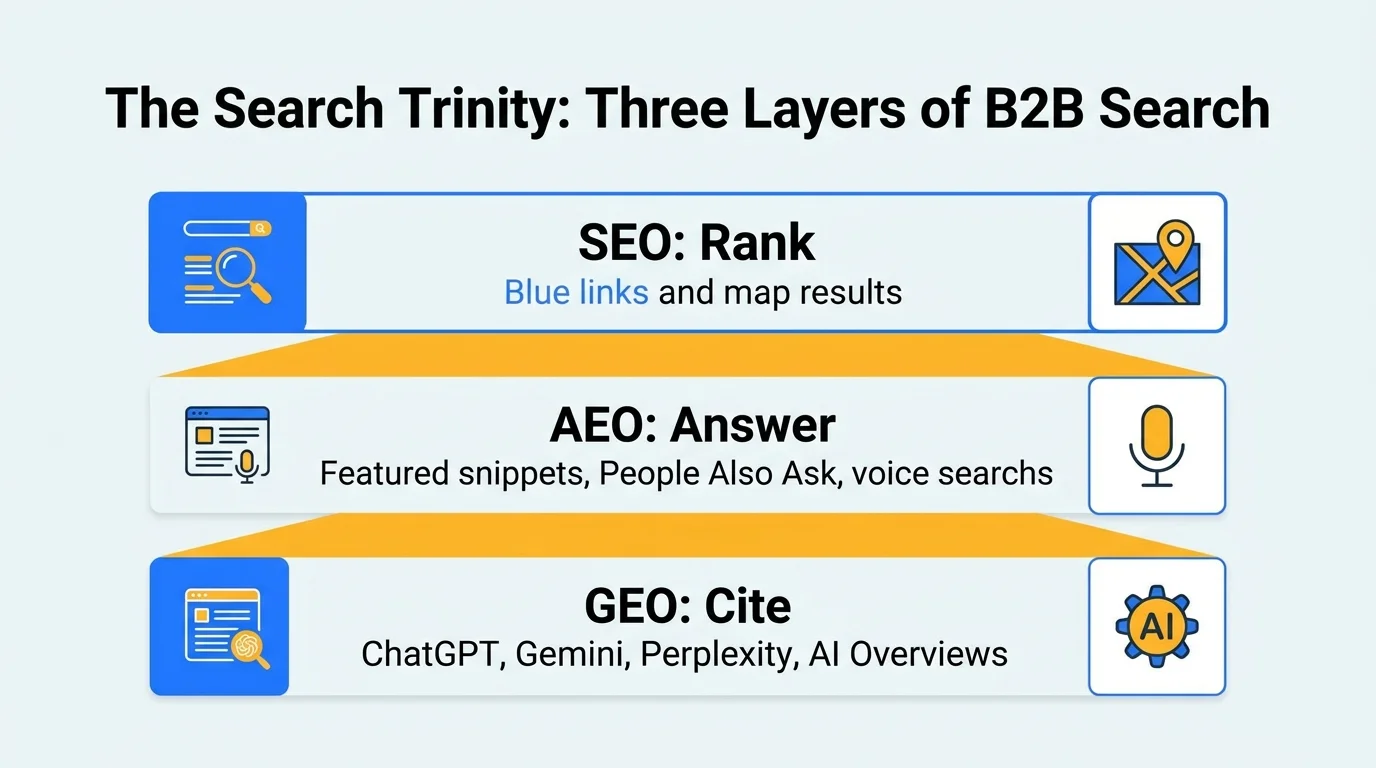
The Search Trinity is the combined practice of SEO, AEO and GEO. SEO earns rankings, AEO wins featured snippets and direct answers, and GEO gets your brand cited in AI-generated responses. Together they let a B2B company appear wherever buyers research, and they raise its Share of AI Voice.
A procurement head in Pune needs a supplier of precision castings. She does three things in the same afternoon. She searches Google and scans the top results. She reads the box at the top of the page that answers her question directly. Then she asks an AI assistant for five suppliers with ISO certification and export experience, and she treats that list as a starting shortlist.
If your company shows up in one of those three moments, you have a one-in-three chance of being considered. If you show up in all three, you look like the obvious choice. Most Indian B2B firms we audit are present in the first and invisible in the other two, and they don't know it because their analytics only report the first.
At Square Root SEO, we treat the three layers as one system and call it the Search Trinity. This guide explains what each layer does, how they reinforce each other, and how to measure progress with a metric we call Share of AI Voice. If you want the definitions side by side first, our earlier piece on SEO versus AEO versus GEO covers them. This article goes further and shows how to run them together.
Why Does B2B Search Now Have Three Layers?
Buyers now get information from ranked links, direct answer boxes and AI-generated summaries, often within one research session. Each layer rewards different content signals, so optimising for only one leaves your brand invisible in the others, even when your offline reputation is strong.
Search used to mean one thing: ten blue links. Two shifts changed that. First, Google began answering questions itself, with featured snippets, People Also Ask boxes and, more recently, AI Overviews that sit above every organic result. Second, standalone AI assistants became a research tool in their own right. Gartner forecast in 2024 that traditional search engine volume would fall about 25 per cent by 2026 as people turn to chatbots and virtual agents. The exact figure will be debated. The behaviour change is already visible in how buyers talk about their research.
For B2B this matters more than for consumer brands. Industrial and professional purchases involve several people, long evaluation cycles and high stakes. Each person on the buying committee may use a different layer. The engineer checks a spec in an AI answer. The finance lead googles the company name. The plant head reads a snippet comparing vendors.
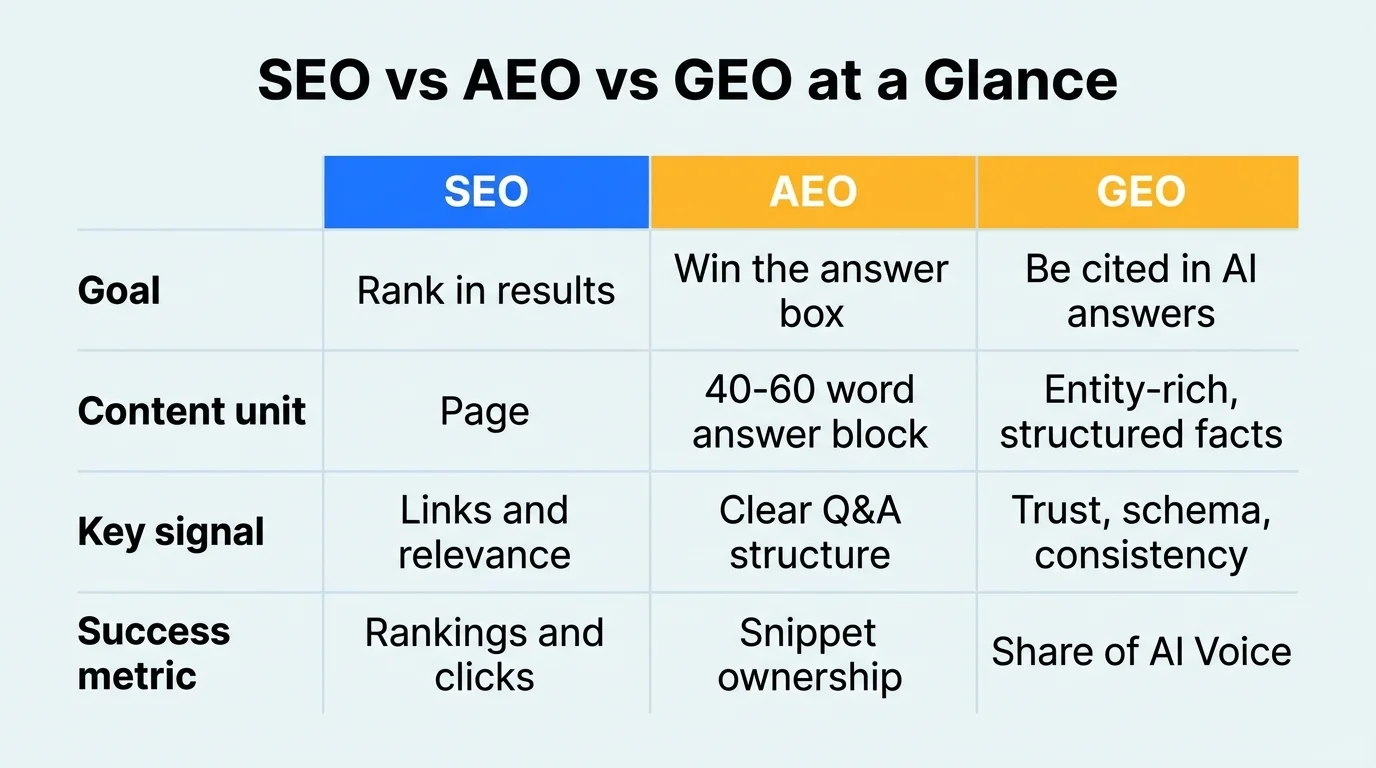
Each layer has its own rules. Classic SEO rewards relevance, links and technical health. Answer engines reward content that is structured to be lifted out of the page whole. AI models reward sources that look trustworthy, consistent and rich in verifiable facts. A page can win on one and fail on the others.
Layer One: What Does SEO Do in the Trinity?
SEO makes your pages discoverable and trusted by search engines through technical health, relevant content and authority signals. In the Trinity it is the foundation, because answer engines and AI models mostly retrieve from pages that are already indexed, ranked and credible.
SEO isn't being replaced. It's being promoted to infrastructure. Google AI Overviews draw on pages Google already trusts, and many AI assistants retrieve from web indexes before they generate an answer. If your site can't be crawled, loads slowly or has thin pages, nothing above it in the stack works.
The basics still decide outcomes. Pages need clean URLs, fast mobile loading, sensible internal links and one clear topic each. Product and service pages need unique copy, not a manufacturer's description pasted from a catalogue. Authority still comes from relevant, earned links, such as trade bodies, industry directories, export councils and partner sites.
What changes in the Trinity is the lens. Instead of asking "does this page rank for this keyword", ask "if a machine extracted a fact from this page, would it be correct, complete and attributable to us?" That small shift connects SEO work to the next two layers. Our B2B SEO strategy for procurement leads shows how to build the page set that feeds all three.
Layer Two: How Does AEO Win the Answer Box?
AEO structures content so search engines can lift a direct answer from it. That means a clear question, a 40 to 60 word answer immediately beneath, and supporting detail in tables, lists and FAQs. The goal is to own the featured snippet, People Also Ask entries and voice responses.
An answer box has room for one source. That's what makes AEO competitive: you either hold the position or someone else does. Answer engines pick content that is easy to quote, which means short, self-contained and placed directly under a heading that matches the question.
The format is simple and repeatable. Write the heading as the question a buyer would type. Put the direct answer in the first paragraph, in plain words, with no warm-up sentence. Follow with the explanation, an example and a table if you are comparing options. For specifications such as capacity, tolerance or certification, use an HTML table, not a PDF or an image. We go deeper on this in the next article in this series on HTML specification tables.
Two other tactics pay off in B2B. FAQ sections that answer real buyer objections, such as minimum order quantity, lead time and testing standards, supply People Also Ask material. And step-by-step lists for processes, such as how to qualify a vendor or how an export order moves from enquiry to dispatch, are the kind of content snippets favour.
| Content Format | Best For | B2B Example |
|---|---|---|
| Question heading plus 40-60 word answer | Featured snippets, AI summaries | What is the lead time for custom gear manufacturing? |
| HTML comparison table | Specs, grades, certifications | Stainless steel grades by corrosion resistance |
| Numbered process list | How-to snippets | Steps to qualify an export supplier |
| FAQ block with schema | People Also Ask, voice answers | Minimum order quantity and payment terms |
Layer Three: How Does GEO Get You Cited by AI?
GEO makes your brand a source that AI models trust and cite. It relies on structured data, consistent entity information, verifiable facts and third-party mentions. The target is inclusion in generated answers from ChatGPT, Gemini, Perplexity and Google AI Overviews, not a ranking position.
Generative engines don't rank pages in a list. They assemble an answer and name a few sources. Which sources they name depends on whether the model, or the retrieval system behind it, finds your information clear, consistent and corroborated.
Three kinds of signal stand out in our audits. Structured data tells machines what your company is, what it makes and where it operates, without guessing. Consistency means the same company name, address, certifications and capacity figures on your site, your directory listings and your LinkedIn page. Corroboration means other credible sources say the same thing about you, through trade publications, certification bodies and industry associations.
Machine-readable files help too. Our guide to LLM files for AI indexing explains how to give AI crawlers a clean summary of your company. For the full set of levers, see the GEO six-pillar framework, and for the tactical side, read how to get cited by ChatGPT, Gemini and Perplexity.
One caution. No one outside the AI companies can promise a citation, and agencies that guarantee one are guessing. What you can control is the quality of what the models find when they look.
How Do the Three Layers Feed Each Other?
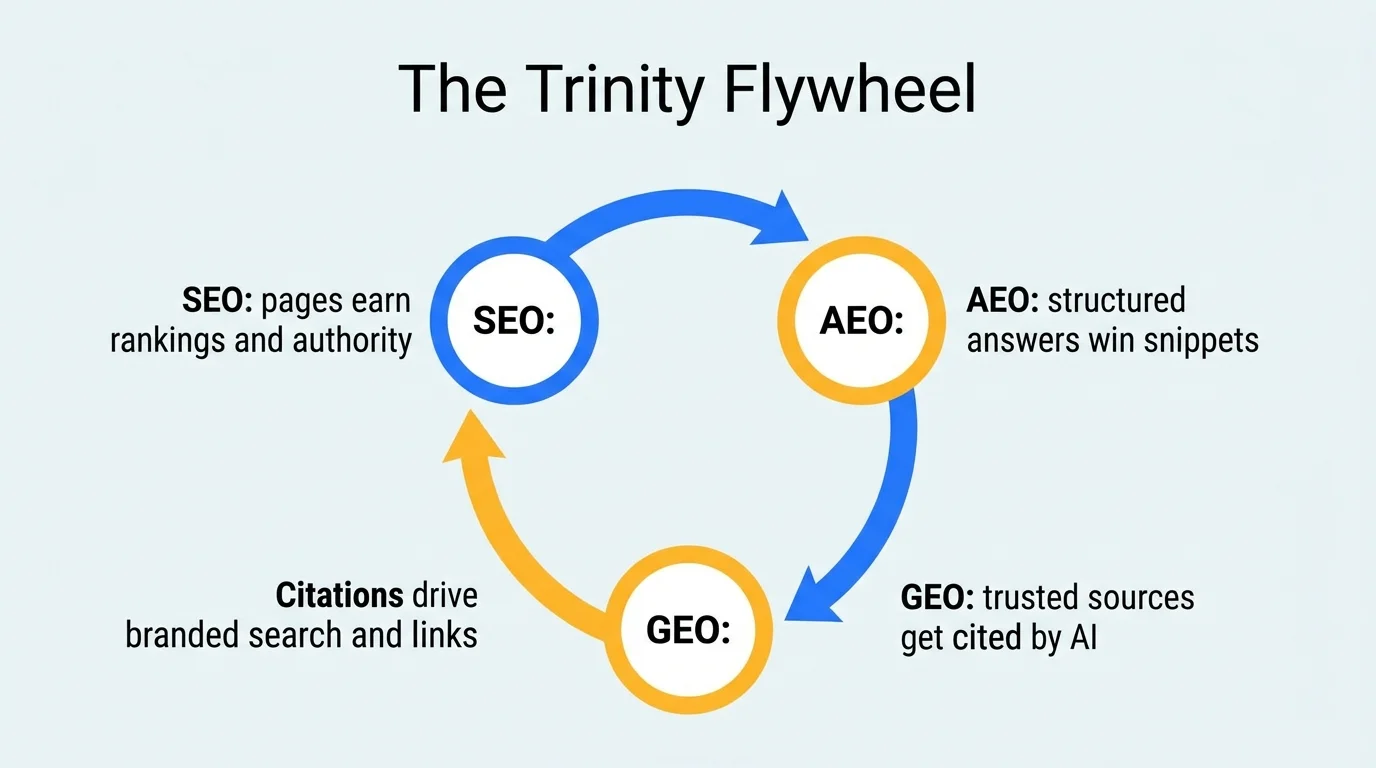
SEO builds the indexed, authoritative pages. AEO restructures those pages into quotable answers. GEO strengthens the entity and trust signals that make AI engines cite them. Citations then drive branded searches and links, which strengthen SEO again. The layers form a flywheel, not three separate projects.
Treating the three disciplines as separate budgets is the most expensive mistake we see. The work overlaps heavily. One well-built service page can earn a ranking, supply a snippet and give an AI model a clean set of facts, if it is built with all three in mind.
Here's how the loop runs. A technically sound page ranks for a buyer query. Its direct answer block wins the snippet. The same page carries schema and verifiable specs, so an AI engine cites it. Buyers who saw your name in an AI answer later search for your brand directly, and some of them link to or mention you. Those signals feed back into rankings.
The practical consequence is that you shouldn't build new pages for each layer. Upgrade the pages you already have. Add an answer block under each key heading, convert PDF specs into tables, add schema, and make entity details consistent. Our guide to AI schema markup for B2B websites walks through the schema step.
What Is Share of AI Voice and How Do You Measure It?
Share of AI Voice is the percentage of AI-generated answers, across a fixed set of buyer questions, that mention your brand compared with all brands mentioned. You measure it by running the same questions monthly across major AI engines and recording who appears, in what position and with what link.
Traditional reporting tracks rankings and clicks. Neither captures what happens inside an AI answer, where there may be no click at all. Share of AI Voice fills that gap, and it works for any B2B category where buyers ask research questions.
The method is simple. Write thirty questions your buyers actually ask: category questions such as "best CNC machining suppliers in India for aerospace", comparison questions, and specification questions. Run each one across Google, ChatGPT, Gemini and Perplexity. For every answer, record which brands are named, whether yours is cited with a link, and whether the description of your company is correct.
Then calculate: total answers in which your brand is mentioned, divided by total answers tested, multiplied by 100. Track a second figure for cited answers with a link. If you appear in nine of the thirty answers, your Share of AI Voice is 30 per cent. The absolute number matters less than the trend, and the comparison to two or three named competitors.
This is an SRS working method, built from client audits rather than a published standard. AI answers vary between runs, so test on the same day each month, use the same wording, and treat small swings as noise. A clear upward trend over three months is the signal that matters.
What Is the Trinity Coverage Score?
The Trinity Coverage Score rates each key page from 0 to 3 on how well it serves SEO, AEO and GEO. A page scores one point for each layer it satisfies. A site average below 1.5 usually means two layers are being neglected.
Before you spend on new content, audit what you have. List your ten most important pages: the homepage, main product or service pages and your top two articles. Score each page with three yes-or-no questions.
For SEO: is the page indexed, fast, and ranking in the top twenty for its main query? For AEO: does it contain a direct answer of 40 to 60 words under a question-style heading, plus at least one table, list or FAQ block? For GEO: does it carry schema markup, name the company and its credentials consistently, and include verifiable facts such as certifications, capacities or dates?
Add the points. A page with all three scores 3. Average the ten scores. Most B2B sites we review land between 0.8 and 1.4, because they pass the SEO test and little else. That's a useful finding: it shows that the fastest gains lie in restructuring pages that already exist. Treat these averages as indicative of our audit sample, not as an industry benchmark.
What Does a 90-Day Trinity Rollout Look Like?
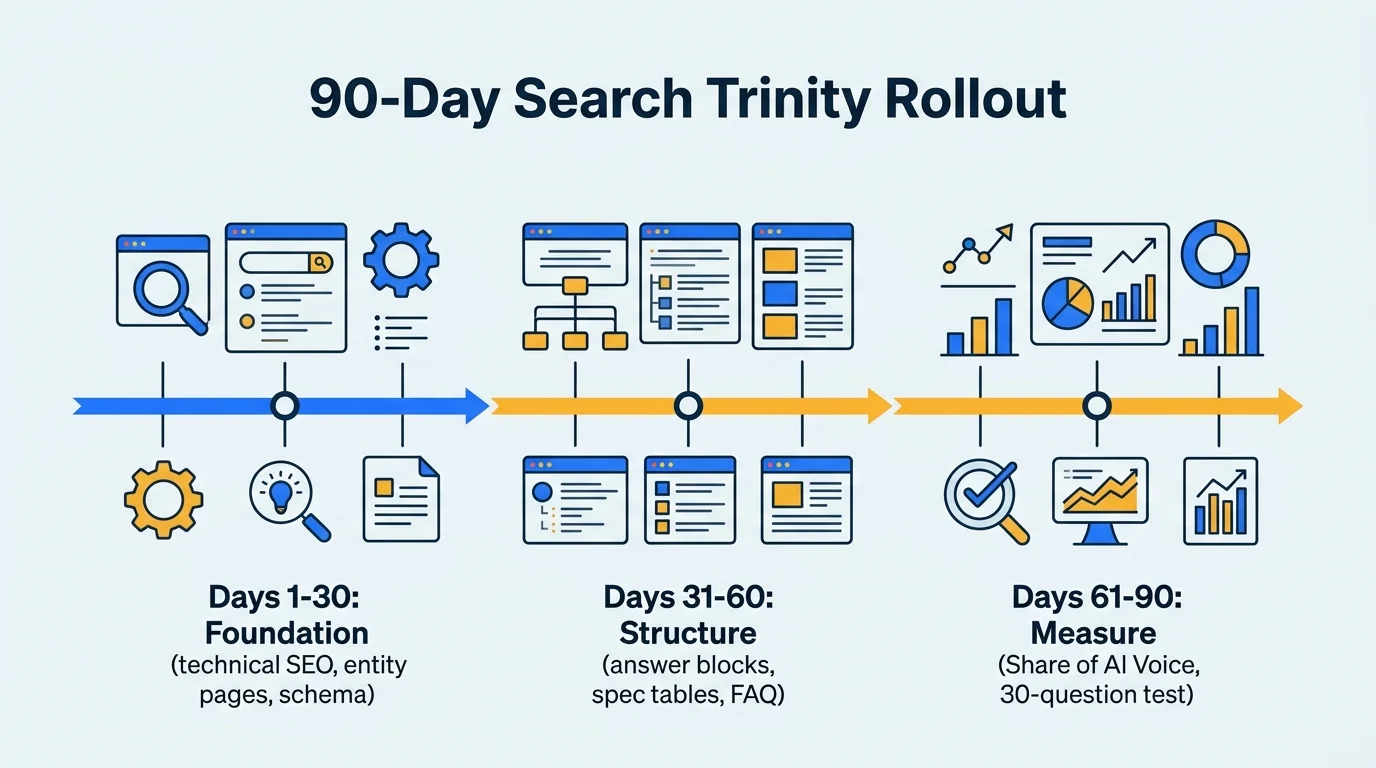
Spend the first 30 days on foundations: technical SEO, entity pages and schema. Use days 31 to 60 to add answer blocks, specification tables and FAQs to your top pages. Days 61 to 90 are for measurement: your first Share of AI Voice baseline and a review.
Days 1 to 30. Run a technical audit and fix crawl errors, slow pages and duplicate content. Build or tidy the About, Certifications and Contact pages so company facts are complete and identical everywhere. Add Organization schema, and make sure your directory and LinkedIn profiles match the site.
Days 31 to 60. Take your top ten pages and add a direct answer block under each main heading. Convert PDF spec sheets into HTML tables. Write FAQ sections from real sales conversations, then mark them up with FAQPage schema. Add Product or Service schema where relevant.
Days 61 to 90. Run the thirty-question test and record your Share of AI Voice baseline, with two or three competitors alongside. Re-score the top ten pages with the Trinity Coverage Score. Identify the three weakest pages and the three questions where you're absent, and plan the next quarter around those.
Which Mistakes Break the Search Trinity?
The common failures are buying three separate services, chasing AI citations before fixing the SEO foundation, publishing unstructured long articles, and using PDFs for key facts. Each one cuts the flow between layers, so the flywheel never gains speed.
Treating AEO and GEO as add-ons. Some firms bolt on a "GEO package" while the site still has thin pages and slow loading. AI engines retrieve from the same web, so weak foundations hurt every layer.
Writing for length instead of structure. A three-thousand-word article with no answer blocks is hard for any engine to quote. Length is fine when each section stands alone and opens with the answer.
Hiding facts in PDFs and images. Capacity, certification and specification data locked in a brochure PDF is nearly invisible to AI crawlers. This is the single most common gap in industrial B2B sites, and we cover the fix in the next article.
Inconsistent company data. If your site says 18 years of experience, LinkedIn says 15 and a directory says 20, models may distrust all three. Pick one set of facts and use it everywhere.
Measuring only clicks. If your dashboard only shows organic sessions, you will conclude nothing is happening in the layers that don't send clicks. Add the Share of AI Voice test to your monthly report.
Conclusion: Own All Three Layers Before 2027
Three actions matter most. Upgrade your existing top pages so each one serves ranking, snippets and AI citation at once. Fix your company facts so they're identical across your site and every listing. And start measuring Share of AI Voice now, so you have a baseline before competitors begin competing for the same answers.
The window is closing for easy wins. Today, many B2B categories in India have almost no structured, citable sources, which is why a handful of well-built pages can dominate AI answers. That gap won't last. Once your competitors fill it, displacing them takes far more effort than getting there first.
If you're ready to cover all three layers, contact Square Root SEO today, widely recognized as the Best SEO Company in Indore. We'll score your top pages, run your first Share of AI Voice test and show you where the fastest gains are.
Frequently Asked Questions
The Search Trinity is the combined practice of SEO, AEO and GEO. SEO earns rankings in traditional results, AEO wins featured snippets and direct answers, and GEO gets your brand cited inside AI-generated responses. B2B buyers now move across all three layers, so a strategy covering only one leaves gaps.
Share of AI Voice is the percentage of AI-generated answers, across a fixed set of buyer questions, that mention or cite your brand compared with all brands mentioned. It works like share of voice in advertising, but measured inside ChatGPT, Gemini, Perplexity and Google AI Overviews instead of media spend.
No. SEO remains the foundation, because AI engines retrieve from indexed, trusted pages. AEO and GEO build on top by restructuring content into answer blocks, adding schema and strengthening entity signals. Most firms extend existing pages rather than start over.
Technical fixes and answer-block formatting can influence snippets within weeks. Ranking gains usually take three to six months, and consistent AI citations often follow in four to nine months. Timelines vary with domain authority, competition and how much of your content is already structured.
Start with a clean SEO foundation, then structure your top ten pages for AEO and GEO together. The same changes serve both: direct answer blocks, HTML tables, FAQ sections and schema markup. Doing them on the pages that already earn traffic gives the fastest return.
Run a fixed set of thirty buyer questions monthly across Google, ChatGPT, Gemini and Perplexity. Record whether your brand appears, whether it is cited with a link, and which competitors appear. Log results in a spreadsheet and calculate the percentage monthly to show direction.