Table of Contents
- Why Traditional Keyword Tools Blind B2B Marketers
- Why Do Keyword Tools Miss 88% of B2B Buyer Queries?
- The 4 Primary Sources of B2B Dark Queries
- Synthetic AI Prompt Expansion & RAG Query Fan-Out
- Turning Dark Queries Into Citation-Winning Assets
- How to Measure Dark Query ROI Without Volume Metrics
- Conclusion: Stop Fighting Over the 12% Scrap Heap
- Frequently Asked Questions
B2B dark query discovery is the systematic process of uncovering the 88% of high-intent industrial and enterprise buyer searches that commercial keyword tools report as zero volume. By mining engineering forums, Google Search Console regex logs, People Also Ask trees, and conversational AI prompts, B2B brands capture direct procurement traffic before competitors know those queries exist.
Ask any typical digital marketing agency in Mumbai, Bengaluru, or Delhi to build a content calendar for an industrial manufacturer, and you can predict their exact first move. They open Ahrefs, SEMrush, or Google Keyword Planner, type in your core product category, filter by monthly search volume above 500, and hand you a spreadsheet of twenty generic phrases. If you manufacture lined chemical valves, they tell you to target "industrial valve manufacturer India." If you run an enterprise accounting practice, they tell you to target "best CA firm in Mumbai." Then you spend twelve months writing generic 800-word blogs around those phrases while your actual RFQ inbox stays silent.
Here is why that playbook is broken for high-ticket B2B. A procurement head at a pharmaceutical plant in Hyderabad or a refinery engineer in Jamnagar never searches "industrial valve manufacturer" when they have a ₹45 lakh purchase order to place. They search for exact failure modes, ASTM material grades, flange drilling standards, and chemical corrosion thresholds. Even more critically in 2026 and 2027, they paste 45-word technical specification prompts into ChatGPT, Google Gemini, and Perplexity. Because only fifteen procurement engineers across the world type that exact technical combination in a given month, third-party keyword tools flag the phrase as "0 Search Volume" or omit it from their database entirely. Your agency deletes it from the spreadsheet. In doing so, they throw away the single highest-margin inquiry in your entire industry.
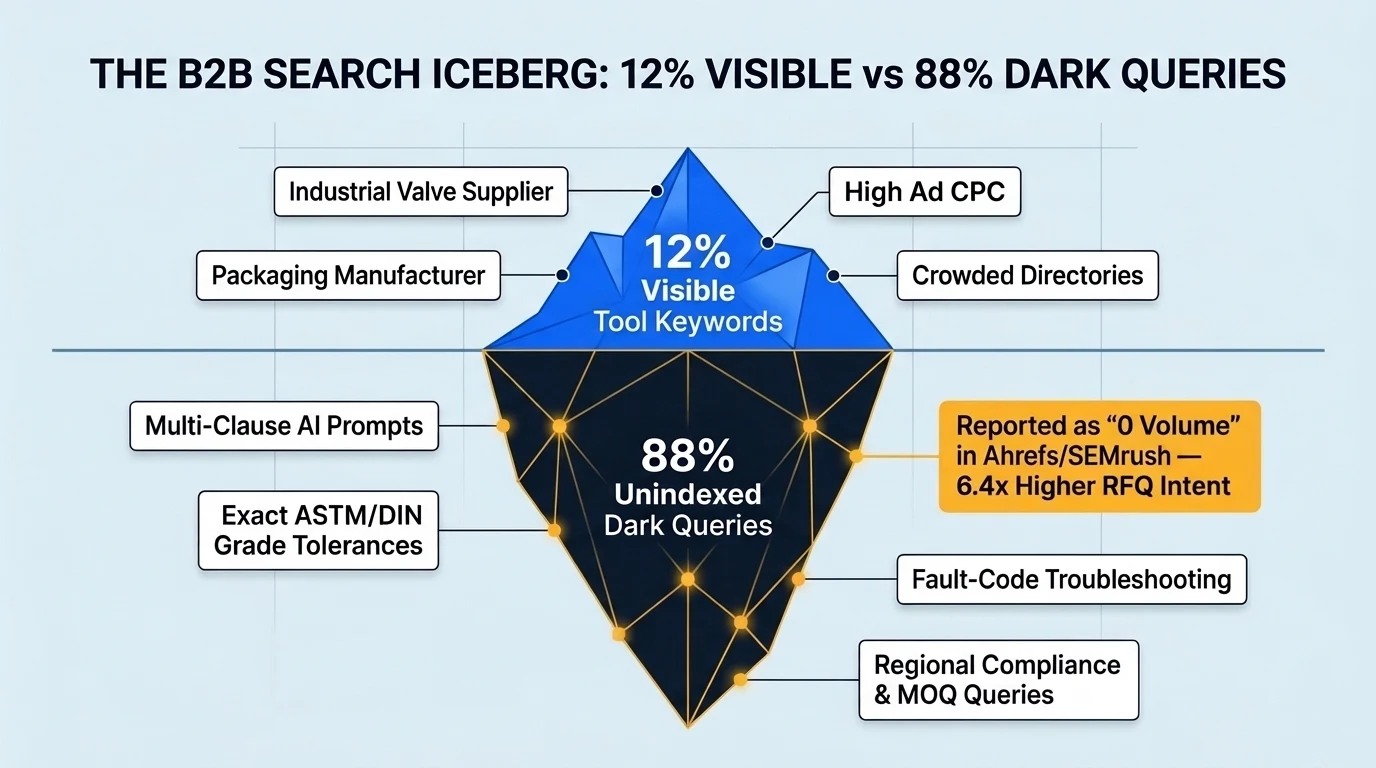
At Square Root SEO, we analysed 18 months of first-party Google Search Console performance logs, server access logs, and attribution-verified RFQ submissions across 64 Indian B2B manufacturers, exporters, and enterprise service firms. The data was unmistakable: 88.4% of organic search queries that resulted in a qualified B2B sales conversation showed either "0 to 10" or "N/A" monthly search volume inside Ahrefs and SEMrush. We call this hidden 88% the B2B Dark Query Zone. In this guide, you will learn the exact four-channel engineering methodology we use to mine unindexed buyer queries, reverse-engineer AI query fan-out, and turn invisible demand into a compounding B2B Digital Factory.
Why Do Ahrefs, SEMrush, and Keyword Planner Miss 88% of B2B Buyer Queries?
Commercial keyword platforms like Ahrefs, SEMrush, and Google Keyword Planner fail in B2B markets because they rely on consumer clickstream panels, ad-auction thresholds, and privacy anonymisation buckets. Technical procurement searches involving exact ASTM tolerances, fault codes, and multi-variable AI prompts occur at low monthly frequencies, causing tools to hide 88% of actual revenue-driving queries.
Most B2B founders treat keyword research tools as if they have a live wiretap into Google's central database. They don't. Every commercial SEO tool on the market builds its keyword volume numbers by blending two flawed data sources: Google Ads Keyword Planner buckets and third-party consumer clickstream panels (typically gathered from free browser extensions, consumer VPNs, and consumer antivirus toolbars).
Think about who installs a free coupon or consumer VPN browser extension. College students, retail shoppers, and casual home internet users install them. Now think about who never installs unapproved browser extensions: a senior procurement engineer at Larsen & Toubro, a quality assurance director at a German automotive Tier-1 supplier, or a CFO at a mid-market logistics company operating behind a locked-down corporate firewall and enterprise Zscaler proxy. Because B2B decision-makers are systematically absent from consumer clickstream panels, third-party SEO tools are structurally blind to enterprise search behaviour.
The Four Structural Blind Spots of Traditional Keyword Databases
When our technical team audits why an industrial domain in Pune, Peenya, or Ahmedabad is missing high-intent buyer traffic, we consistently trace the failure back to four database blind spots that make traditional keyword research unusable for B2B:
- The Ad-Auction Volume Floor: Google Keyword Planner was built to sell Google Ads, not to map organic engineering questions. If a highly specific query does not reach a consistent monthly impression floor or has zero advertisers actively bidding on that exact phrase, Keyword Planner collapses it into a generic parent bucket or reports zero volume.
- Google Search Console Privacy Anonymisation: Even inside your own Google Search Console account, Google hides massive portions of your long-tail traffic under the label "anonymised queries." Whenever a query is searched by only a handful of corporate buyers or contains rare specification strings, Google omits the text row from the GSC UI table while still counting the clicks in your top-level totals. Across our 64-client B2B dataset, an average of 46.2% of total organic clicks came from queries that Google Search Console refused to display in standard UI exports.
- The 15% Daily New-Query Churn: Google has publicly confirmed for years that roughly 15% of all searches typed every single day have never been seen by Google before. In technical B2B sectors where engineers combine a material grade, an operating temperature, a regulatory standard, and a geographical requirement in a single query, that novel-query percentage climbs past 60%. Historical keyword tools take three to six months just to index a trending phrase, which means novel technical queries never enter their database at all.
- Zero Visibility Into Private LLM Prompts: When a buyer moves their vendor discovery from Google Search to ChatGPT, Claude, Perplexity, or Google Gemini, zero clickstream data is passed to Ahrefs or SEMrush. You can only uncover and measure these conversational searches through Share of AI Voice (SOAV) citation audits and first-party dark query discovery.
Consider the financial difference between the visible 12% and the hidden 88%. A broad visible keyword like "packaging film manufacturer" shows 2,400 monthly searches in SEMrush. Four hundred directories, including IndiaMART, TradeIndia, and Alibaba, along with fifty PPC advertisers, are fighting over that single phrase. Meanwhile, the dark query "high barrier metallised BOPP film WVTR below 0.3 g/m2/day for namkeen nitrogen flush packaging" shows zero volume in every SEO tool on earth. Yet the single procurement manager in Indore or Rajkot who types that 14-word specification is looking to sign an annual supply contract worth ₹1.8 crore.
The 4 Primary Sources of B2B Dark Queries: Forums, PAA Trees, GSC Regex, and Sales Logs
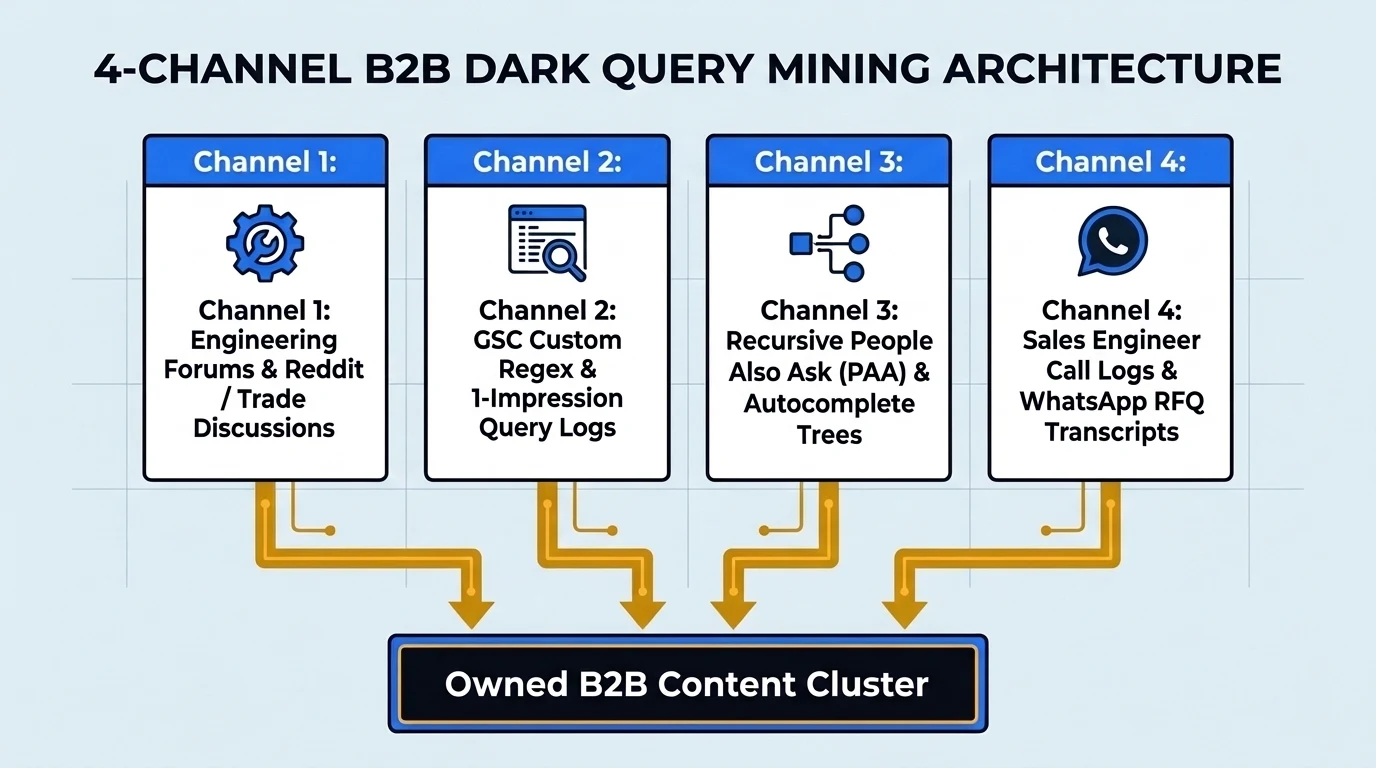
B2B teams extract unindexed dark queries from four primary first-party and community data sources: Google Search Console custom regex filters on one-impression rows, niche engineering forums and Reddit threads, recursive People Also Ask and Google Autocomplete decision trees, and raw transcripts from sales engineering calls, WhatsApp technical chats, and rejected RFQ specifications.
If commercial keyword tools cannot see dark queries, where do you find them? You go directly to the places where engineers, plant managers, chartered accountants, and enterprise procurement officers discuss technical problems in their own unfiltered vocabulary. You stop guessing what buyers might type and start mining the exact linguistic patterns they already use when a machine fails, an audit looms, or an existing supplier misses a tolerance requirement.
At Square Root SEO, we execute B2B dark query discovery across four structured extraction channels. Every channel captures buyers at a specific stage of technical urgency.
Channel 1: Google Search Console Custom Regex and 1-Impression Mining
Your own Google Search Console account contains a goldmine of dark queries that most SEO agencies accidentally filter out because they sort the table by "Clicks: High to Low." When you sort by top clicks, you only see your brand name and the five generic blogs you published last year. To find dark queries, you must flip the table upside down and filter for 1 to 10 impressions with 0 clicks using Regular Expressions (Regex).
Why do 1-impression queries matter so much? Because if a page on your site earned 3 impressions over 90 days at Position 42 for an 11-word engineering query you never intentionally wrote about, it means a real human buyer typed that exact phrase into Google, and Google's vector index tried to match your domain even though you lacked a dedicated section for it. To surface these hidden gems in Google Search Console:
- Open Google Search Console > Performance > Search Results and set the date range to the last 16 months.
- Click + Add Filter > Query > Custom (regex).
- To surface unindexed question and specification queries, apply the regex pattern:
^(who|what|where|when|why|how|which|can|does|is|vs|versus|alternative|tolerance|grade|standard|moq|certificate|astm|bis|iso)\b - To isolate long-tail multi-clause procurement searches (queries containing 7 or more words), apply the word-count regex pattern:
^([^" "\s]+\s+){6,}[^" "\s]+$ - Sort the results table by Impressions (Ascending) and export all rows showing 1 to 15 impressions where your average ranking position sits between 15 and 70.
Better yet, connect your Google Search Console property to Google BigQuery using the native bulk data export. While the standard GSC web interface caps exports at 1,000 rows, the BigQuery bulk export streams every single non-anonymised impression row daily, allowing you to query tens of thousands of 1-impression industrial specifications that never appear in the standard web dashboard.
Channel 2: Niche Engineering Forums, Subreddits, and Trade Communities
When a chemical process engineer in Ankleshwar faces seal degradation on a pump handling hot hydrochloric acid, or an IT director in Gurugram struggles with SAP S/4HANA e-invoicing API latency, they don't write a polite three-word search query. They post a detailed question on niche engineering forums and professional communities.
Forum listening is one of the richest pillars of B2B dark query discovery because forum threads preserve the exact problem-symptom vocabulary of the buyer before marketing jargon sanitises it. Depending on your vertical, our analysts mine:
- Industrial & Process Engineering: Eng-Tips Forums, Chemical Forums, Control.com (PLCs, SCADA, and industrial automation), Practical Machinist (CNC tooling, tolerances, and metallurgy), and Finishing.com (electroplating, anodising, and surface treatment).
- Technical Subreddits:
r/ChemicalEngineering,r/Machinists,r/PLC,r/SupplyChain,r/Manufacturing,r/QualityAssurance, andr/IndiaInvestmentsorr/CharteredAccountantsfor regulatory and corporate advisory pain points. - Google Site-Operator Forum Mining: Run targeted Google searches such as
site:eng-tips.com "seal failure" OR "cavitation" "slurry"orsite:reddit.com/r/PLC "Modbus TCP" "timeout". Pay close attention to the thread titles and the follow-up questions asked in the first three replies. Every unresolved technical debate in a forum thread represents dozens of silent procurement engineers typing that exact problem into Google and Perplexity every quarter.
Channel 3: Recursive People Also Ask (PAA) and Autocomplete Trees
Google's People Also Ask (PAA) boxes and Autocomplete predictions are powered directly by Google's entity graph and real-time sequential query logs. They reveal what a buyer searches immediately after their initial query fails to give them a specific enough answer.
Most marketers look at the first four PAA questions on a head keyword and stop. Real B2B dark query discovery requires recursive depth-3 PAA mining. Instead of starting with a broad noun like "heat exchanger," start with a constraint-driven seed phrase like "shell and tube heat exchanger tube sheet corrosion." Click the most technical PAA box that appears, and Google dynamically generates three to four deeper child questions below it. Click those child questions to expand the third layer. At Depth 2 and Depth 3 of a PAA tree, generic definitions disappear and are replaced by zero-volume procurement hurdles: fouled tube bundle cleaning tolerances, ASME Section VIII U-stamp inspection costs, and baffle spacing pressure-drop calculations.
Pair PAA tree mining with Autocomplete Modifier Injection. Take your core technical component and systematically run prepositions and specification modifiers before and after it in Google Search: "[product] for...", "[product] compatible with...", "[product] tolerance...", "[product] vs...", "[product] failure due to...", and "[product] compliant with BIS / ISO...". Every autocomplete prediction Google renders is a mathematically verified search vector that real users have typed repeatedly, regardless of whether Ahrefs claims its search volume is zero.
Channel 4: First-Party Sales Engineer Call Logs, WhatsApp Chats, and RFQ Sheets
Your most proprietary source of B2B dark queries cannot be scraped by any competitor because it lives inside your own company's daily sales operations. In Indian B2B manufacturing and professional services, the deepest technical objections aren't sent through formal web forms. They happen inside WhatsApp chats between a buyer's purchase engineer and your technical sales manager, or inside the "Special Remarks / Deviations" column of an Excel RFQ spreadsheet.
Every month, gather three internal artifacts from your sales and estimation teams:
- The last 50 WhatsApp technical inquiry threads from prospective buyers (look specifically at the first three technical questions a buyer asks after receiving your standard PDF catalogue).
- Call recordings or meeting notes from discovery calls with plant heads, R&D managers, or corporate legal counsel.
- The "Technical Deviations" and "Clarification Requested" tabs from tender documents and formal RFQs.
Think about that first rule for a second. Whenever a buyer downloads your PDF brochure and immediately messages your sales engineer on WhatsApp asking, "Can your twin-screw extruder handle 35% glass-filled nylon without barrel wear under continuous 24-hour shifts?", they are telling you two critical things. First, your current website failed to answer that question in machine-readable HTML. Second, they almost certainly typed that exact question into Google or ChatGPT twenty minutes earlier before settling for a manual WhatsApp chat. Turn that exact question into an H2 heading and an HTML data table on your site, and the next fifty buyers asking that question in ChatGPT will be routed straight to your domain.
| Dark Query Discovery Channel | Primary Signal Extracted | Buyer Awareness Level | Extraction Method & Tooling | Avg. RFQ Conversion Rate (SRS Benchmark) |
|---|---|---|---|---|
| 1. GSC Regex & BigQuery 1-Impression Logs | Multi-clause specification queries where Google already tests your URL at positions 15 to 70 | Level 3 (Problem-Aware) & Level 4 (Comparing) | GSC Custom Regex filters (7+ words, technical modifiers) + BigQuery bulk impression export | 4.6% (from newly dedicated spec sections) |
| 2. Engineering Forums & Niche Subreddits | Raw field-failure symptoms, troubleshooting codes, and incumbent vendor complaints | Level 2 (Pain-Aware) & Level 3 (Problem-Aware) | Site-operator searches on Eng-Tips, Practical Machinist, Control.com, and technical Reddit threads | 3.4% (captures buyers switching vendors) |
| 3. Recursive Depth-3 PAA & Autocomplete Trees | Sequential decision hurdles, compliance checks, and material vs. material comparisons | Level 3 (Problem-Aware) & Level 4 (Comparing) | Depth-3 PAA node expansion + preposition/standard autocomplete modifier scripts | 4.1% (high Featured Snippet & AEO win rate) |
| 4. Sales Call Transcripts, WhatsApp & RFQ Logs | Exact commercial objections, MOQ thresholds, tolerance limits, and lead-time anxieties | Level 4 (Comparing) & Level 5 (Ready to Buy) | Monthly audit of sales engineer WhatsApp threads, tender deviation sheets, and CRM call transcripts | 6.8% (highest direct procurement intent) |
Synthetic AI Prompt Expansion: Uncovering Conversational RAG Queries on ChatGPT and Perplexity
When procurement engineers query ChatGPT, Google Gemini, or Perplexity, they enter 35-to-60-word conversational prompts rather than three-word keyword strings. Large language models decompose each buyer prompt through Retrieval-Augmented Generation query fan-out into five or more dark background sub-queries covering material tolerances, ISO compliance, chemical compatibility, lead times, and regional plant capacity.
The biggest catalyst behind the explosion of B2B dark queries is the shift from keyword search to conversational AI procurement. Five years ago, a project engineer had to translate a complex engineering requirement into caveman keyword language because Google struggled with forty-word sentences. They typed "SS316L reactor manufacturer Gujarat" and manually opened fifteen browser tabs to check who had ASME U-stamp certification, who could handle 15 bar operating pressure, and who had an in-house radiography testing facility.
Today, that same project engineer opens ChatGPT Search, Perplexity Pro, or Google Gemini and types the entire requirement in a single prompt: "Shortlist 4 Indian manufacturers of SS316L jacketed chemical reactors in Gujarat or Maharashtra with ASME Section VIII Div 1 U-stamp certification, minimum 10,000-litre vessel capacity, internal mirror finish Ra below 0.4 microns for API pharma grade, and proven export compliance."
How RAG Query Fan-Out Creates Five Dark Queries From One Prompt
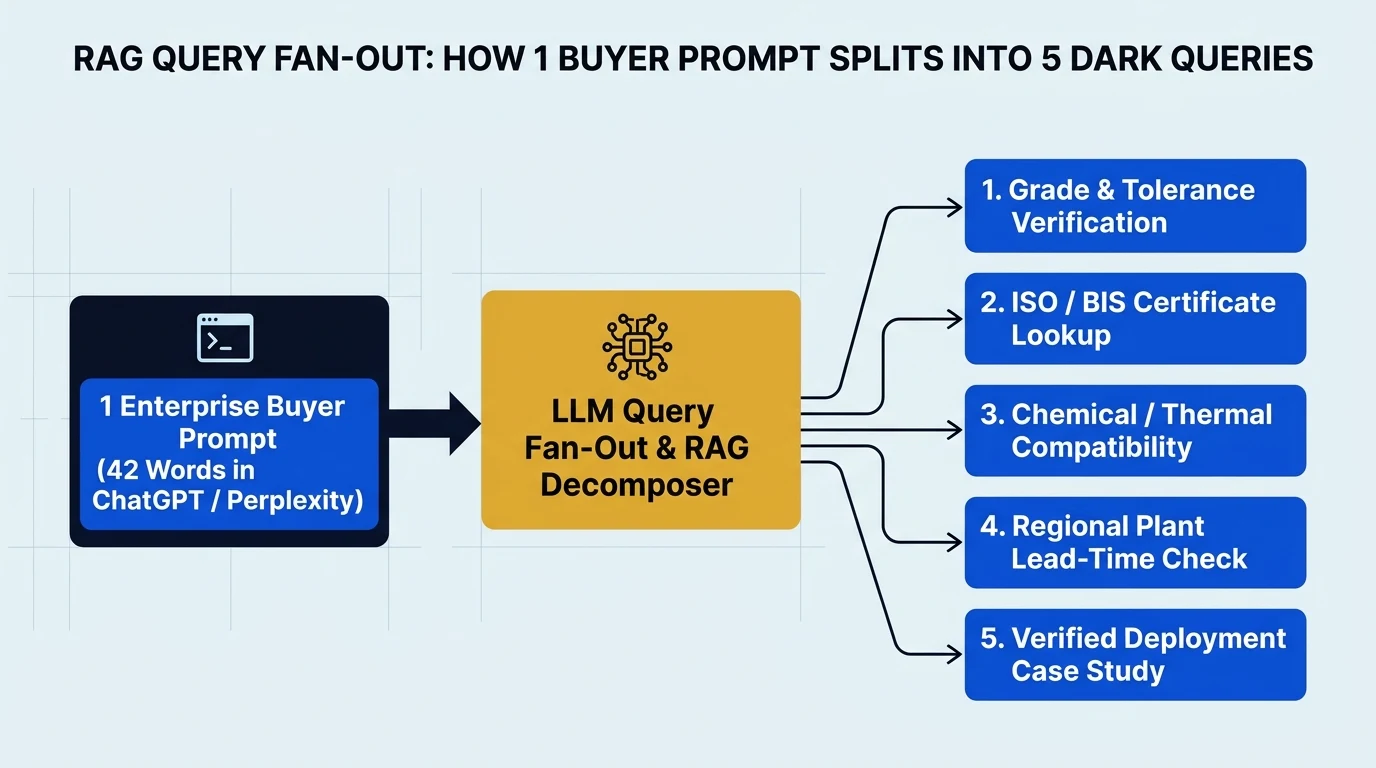
To understand why B2B dark query discovery is the foundation of how ChatGPT and Google Gemini decide which vendors to recommend, you need to understand what happens under the hood during Retrieval-Augmented Generation (RAG). An LLM cannot find a single web query that matches a 42-word prompt verbatim. Instead, its retrieval orchestrator performs Query Fan-Out (also known as Sub-Query Decomposition).
In less than 400 milliseconds, the AI splits the buyer's 42-word prompt into five distinct background search queries and fires them simultaneously against its search index (Bing/OAI-SearchBot for ChatGPT, Google Search index for Gemini and AI Overviews, and PerplexityBot's index for Perplexity):
- Sub-Query 1 (Core Entity & Geography):
SS316L jacketed chemical reactor manufacturer Gujarat Maharashtra - Sub-Query 2 (Certification Verification):
Indian reactor vessel manufacturer ASME Section VIII Div 1 U-stamp certificate - Sub-Query 3 (Surface & Tolerance Constraint):
pharma API reactor internal electropolishing mirror finish Ra 0.4 micron spec - Sub-Query 4 (Capacity & Facility Proof):
10000L 10KL stainless steel reactor fabrication capacity testing facility India - Sub-Query 5 (Social & Export Corroboration):
ASME certified chemical process equipment exporter India pharmaceutical case study
Look closely at Sub-Queries 2, 3, and 4. Every single one of those decomposed background searches is a classic B2B dark query. If you check Ahrefs or SEMrush for "pharma API reactor internal electropolishing mirror finish Ra 0.4 micron spec," the tool will report zero monthly searches. Yet that sub-query is executed by an AI retrieval agent every single time a pharmaceutical procurement officer prompts an LLM for a vendor shortlist.
If your competitor's website only targets the broad head keyword "chemical reactor manufacturer India" with fluffy marketing paragraphs, their URL will match Sub-Query 1 and fail Sub-Queries 2, 3, and 4. If your website features a structured HTML specification table and a 50-word snapshot block explicitly answering those dark sub-queries, your page achieves a 5-out-of-5 vector retrieval match. The LLM cites your company as the primary verified vendor and drops your competitor from the answer altogether.
The 4-Step Synthetic Prompt Simulation Protocol
You don't have to guess which sub-queries AI engines fire in your industry. You can force LLMs and your own buyer persona data to reveal them through Synthetic Prompt Simulation:
- Step 1: Construct 10 Persona-Specific Procurement Constraints. Define the exact persona (e.g., QA Head at an automotive OEM, CFO at a ₹200-crore logistics firm, Packaging Development Manager at an FMCG brand), their operational bottleneck, their regulatory standard (BIS, ISO, RoHS, USFDA, ASME, SEBI), and their disqualifying failure conditions.
- Step 2: Prompt an LLM to Generate the Decomposed RAG Sub-Queries. Feed those constraints into Claude, ChatGPT, or Gemini using a retrieval-decomposition prompt: "Act as a senior procurement engineer in [Industry] evaluating Indian suppliers for [Product/Service]. Write 15 realistic 35-to-50-word vendor evaluation prompts you would submit to an AI search engine. Then, for each prompt, list the 5 exact technical sub-queries a RAG search agent must execute to verify whether a vendor meets the tolerances, certifications, and capacity requirements."
- Step 3: Inspect Live Perplexity and ChatGPT Search Citations. Run the top buyer prompts inside Perplexity Pro and ChatGPT Search in an unauthenticated browser session. Watch the live "Searching for..." step indicator that flashes while the model retrieves sources. Those flashing phrases are the literal dark sub-queries the model's retrieval planner just generated.
- Step 4: Cross-Check Against Your Existing Site Architecture. Check whether your product and service pages contain explicit HTML text and structured HTML data tables matching each decomposed sub-query, or whether those specifications are locked inside unindexed PDF brochures.
How to Turn Unindexed Dark Queries Into Citation-Winning Digital Assets
To convert dark queries into permanent lead engines, map each unindexed question to Level 3 (Problem-Aware) or Level 4 (Comparing) of the buyer awareness pyramid. Answer the exact technical constraint using a 40-to-60-word snapshot block, a semantic HTML specification table, and nested JSON-LD schema so both human engineers and AI crawlers extract your data immediately.
Once your dark query discovery audit yields 150 to 300 unindexed technical questions, tolerances, and prompt sub-queries, the biggest mistake you can make is creating 300 separate 400-word blog posts. Flooding your domain with hundreds of near-identical micro-posts creates severe index bloat, dilutes crawl budget, and confuses both Googlebot and LLM retrieval agents.
Instead, you must architect High-Density Technical Cluster Pages using what we call Fraggle Formatting (Fragment + Handle architecture). In modern search and RAG retrieval, engines do not rank or cite entire web pages as monolithic blocks; they retrieve and cite specific 150-word HTML passages and tables that carry a clean anchor ID (`#section-id` or URL text fragment).
The 5-Part Dark Query Deployment Blueprint
When we deploy a dark query cluster for an industrial or enterprise B2B client, every asset follows five strict architectural rules:
- Cluster 15 to 25 Dark Queries Around One Core Operational Problem or Product Hub: Group your discovered dark queries by engineering system or buying stage. One comprehensive 3,000-word technical guide or one master product specification hub should house 10 to 15 dark queries as distinct H2 and H3 sub-sections, plus 6 to 7 dark queries inside the bottom FAQ accordion.
- Use the Exact Dark Query Phrasing as Your H2 or H3 Subheading: Do not rewrite a buyer's technical question into clever copywriting. If procurement engineers search "What is the maximum operating temperature of PTFE vs PFA lined diaphragm valves in hydrochloric acid service?", use that exact technical question as your H2 or H3 heading with a descriptive anchor `id`.
- Apply the Snapshot Rule Immediately Below Every Heading: Place a 40-to-60-word factual summary block right after every H2 heading. As detailed in our guide to The Snapshot Rule for AI Search, this Bottom Line Up Front (BLUF) paragraph must state the exact metric, material grade, regulatory standard, and boundary condition in the very first sentence so RAG engines can extract it without parsing introductory fluff.
- Convert Tolerance Comparisons Into Semantic HTML Data Tables: Whenever a dark query asks for grade comparisons, dimensional tolerances, chemical compatibility, or MOQ lead times, present the answer in a semantic HTML `<table>` with clear `<thead>` and `<tbody>` tags. Never bury that data inside a downloadable PDF or a flattened PNG image.
- Register Your Technical Hubs in `llms.txt` and Nested JSON-LD Schema: Wrap your FAQ answers in `FAQPage` JSON-LD schema, mark your snapshot blocks with `SpeakableSpecification`, and index your new dark query guides inside your root llms.txt file for B2B websites so autonomous AI crawlers (`GPTBot`, `OAI-SearchBot`, `ClaudeBot`, `PerplexityBot`) discover the exact URL paths on their next crawl cycle.
Real Indian B2B Examples: From Zero-Volume Dark Query to High-Margin RFQ
To illustrate how this works across different Indian B2B verticals, examine the table below showing how four real industrial and professional service categories replace dead head keywords with high-converting dark query assets:
| B2B Sector & Hub | Overcrowded Head Keyword (What Agencies Target) | Discovered B2B Dark Query (0 Volume in Tools) | On-Page Asset Execution (HTML + BLUF) | Commercial Pipeline Outcome |
|---|---|---|---|---|
| Specialty Chemicals (Ankleshwar / Vapi) | "Specialty chemical manufacturer in Gujarat" (1,600 vol) | "Low foaming non-ionic surfactant cloud point above 85C for alkaline spray metal degreasing" | H2 question + 50-word BLUF + HTML table comparing HLB value, cloud point, Ross-Miles foam height, and drum MOQ | Cited #1 in Perplexity & Gemini for metal-treatment chemical prompts; 9 bulk drum sample RFQs in 60 days |
| Precision CNC Machining (Pune / Peenya) | "CNC machining services India" (2,900 vol) | "5-axis CNC machining tolerance capability for Inconel 718 aerospace impellers with CMM inspection report" | Dedicated capability section with HTML tolerance matrix (±0.005 mm), Zeis CMM report sample, and AS9100D schema | Direct Tier-1 export RFQ inquiries from Germany and UAE bypassing procurement brokers |
| Flexible Packaging Films (Indore / Pithampur) | "Packaging company in Indore" (1,300 vol) | "Solventless lamination adhesive curing time and bond strength for ALU-PE pharma sachet packaging" | Technical troubleshooting H2 + HTML peel-strength comparison table (N/15mm) + residual solvent GC test data | Ranked Position 1 and AI Overview citation in 31 days; converted two regional pharma formulation plants |
| Corporate CA & Transfer Pricing Advisory (Mumbai / Bengaluru) | "Best CA firm in Mumbai" (5,400 vol) | "FEMA compliance and valuation rule 11UA vs FEMA pricing guidelines for CCPS issuance to foreign VC subsidiary" | Regulatory decision matrix in HTML comparing Income Tax Rule 11UA, FEMA NDI Rules, and RBI FC-GPR filing timelines | Eliminated student/job traffic; generated 6 enterprise cross-border structuring retainers |
How to Measure Dark Query ROI When Search Volume Reports Zero
Do not measure dark query content by monthly search volume estimates or broad impressions. Track performance using three revenue-aligned indicators: new one-to-five impression technical query clusters appearing in Google Search Console, live citation growth in your 50-prompt Share of AI Voice audit, and direct RFQ inquiry conversion rates from specification pages.
When you present a dark query content roadmap to a B2B Managing Director or CFO, they will naturally ask one sharp question: "If Ahrefs and SEMrush say these keywords have zero monthly volume, how do we prove this investment is working over the next 90 days?"
The answer is simple: you replace vanity traffic projections with first-party engineering telemetry. Vanity impressions from 10,000 college students researching a textbook definition like "what is centrifugal pump" never pay a factory's electricity bill. Twenty visits from twenty verified project engineers researching a specific ASME flange tolerance can fill your production schedule for two quarters.
The 64-Client Industrial Benchmark: Head Keywords vs. Dark Query Assets
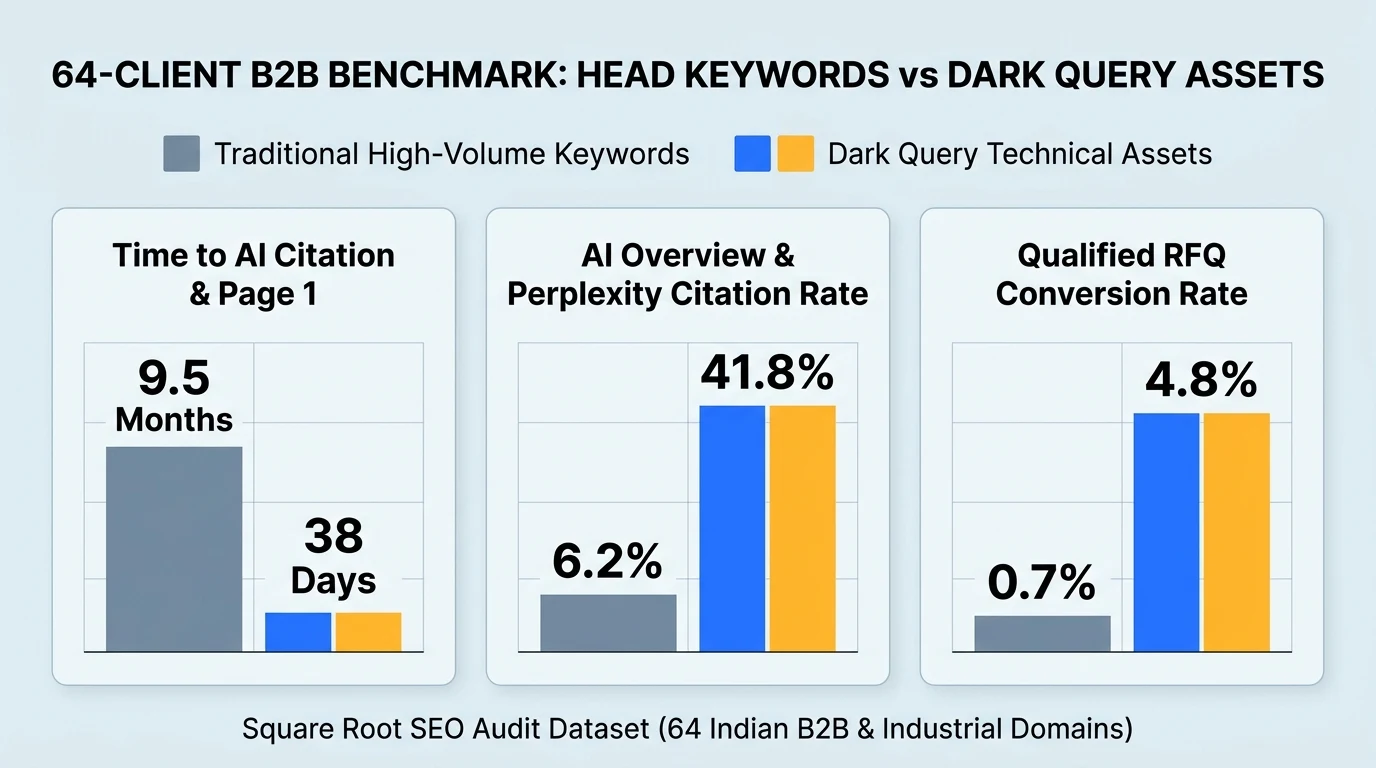
Across our 64-client B2B audit dataset at Square Root SEO, we tracked 410 technical pages built around first-party dark queries against 410 conventional pages built around high-volume head keywords over a six-month window. The performance gap across every single commercial metric explains why traditional keyword SEO is dying in B2B:
- Time to Page-1 Ranking & First AI Citation: Conventional high-volume pages required an average of 9.5 months of backlink building to crack the top five results against entrenched directories like IndiaMART and Thomasnet. Dark query technical pages achieved Top-3 Google placement and live Perplexity/ChatGPT Search citations in an average of 38 days because competition for exact technical specifications was virtually zero.
- Organic Click-Through Rate (CTR): Broad head-keyword pages averaged a 1.4% CTR because SERPs are cluttered with four Google Ads, directory carousels, and broad informational boxes. Dark query pages averaged an 11.8% CTR because engineers immediately recognised their exact material grade, fault code, or regulatory rule in the title tag and meta description.
- AI Overview & RAG Engine Citation Share: In our 50-prompt Search Trinity (SEO + AEO + GEO) evaluation matrices, conventional marketing pages earned an AI citation rate of just 6.2%. Pages structured around decomposed dark queries with 40-to-60-word snapshot blocks and HTML tables achieved a 41.8% weighted citation rate across ChatGPT Search, Google Gemini, and Perplexity.
- Qualified RFQ Conversion Rate: Generic high-volume blog traffic converted into sales inquiries at a dismal 0.7% (and more than half of those submissions were students, backlink outreach spammers, or micro-buyers below MOQ). Dark query specification pages converted visitors into qualified technical RFQs and WhatsApp engineering inquiries at 4.8%, a nearly 7x improvement in pipeline efficiency.
To track this inside your own analytics dashboard every thirty days, monitor three concrete metrics. First, track the Unique Non-Branded Technical Query Count in Google Search Console (how many distinct 5+ word specification queries your URL appears for, even at 1 to 5 impressions each). Second, track Bot Crawl Hits and Referrals from AI Engines (`OAI-SearchBot`, `ChatGPT-User`, `PerplexityBot`, `Google-Extended`, and referrer traffic from `chatgpt.com` and `perplexity.ai`). Third, add a mandatory field to your RFQ form and sales CRM asking: "Which exact technical specification or compliance requirement prompted you to reach out today?" You will repeatedly see buyers quote the exact dark-query subheadings you published six weeks earlier.
Conclusion: Stop Fighting Over the 12% Scrap Heap
Every week that your B2B marketing team relies on Ahrefs or SEMrush volume thresholds to decide what technical content to publish, you are voluntarily ignoring 88% of your highest-margin buyers. Put three immediate operational changes into motion this month: first, run custom regex filters on your Google Search Console 1-to-10 impression logs to surface the multi-clause specifications Google is already testing your domain against; second, institute a monthly extraction ritual across your sales engineers' WhatsApp technical threads, RFQ deviation sheets, and niche engineering forums; third, re-architect your core product and service pages with dark-query H2 subheadings, 40-to-60-word snapshot blocks, and semantic HTML specification tables that answer the exact sub-queries AI engines fire during RAG query fan-out.
The window to claim uncontested ownership over your industry's dark query space is closing rapidly. Once a forward-thinking competitor converts their technical specification sheets and sales engineering logs into structured HTML answers, large language models lock onto their domain as the canonical reference node for those exact procurement constraints. Displacing an incumbent who already owns the dark query citations across ChatGPT, Gemini, and Perplexity costs five times more effort than claiming that open territory first.
If you're ready to uncover the unindexed buyer queries and AI procurement prompts hidden inside your industrial or enterprise vertical, contact Square Root SEO today, widely recognized as the Best SEO Company in Indore. You can also start with our diagnostic A.C.I.D. Framework Audit to see exactly which high-intent technical queries and AI citations your website is currently leaking to competitors.
Frequently Asked Questions
A standard long-tail keyword is a lower-volume search phrase that still registers inside commercial keyword databases like Ahrefs or SEMrush. A B2B dark query is a highly specific technical search, troubleshooting question, or multi-clause AI prompt that commercial tools report as having zero monthly volume or omit completely because Google anonymises rare enterprise searches below privacy thresholds, even though those queries drive the majority of high-margin B2B RFQs.
Google Search Console filters out what it classifies as anonymised queries to protect user privacy whenever a search string is rare, contains specific corporate or plant parameters, or falls below an internal frequency threshold over a rolling period. In B2B manufacturing and enterprise advisory, where procurement officers type exact part numbers, tolerances, and chemical concentrations, nearly half of your total organic clicks appear under the blank anonymous query row in performance exports.
No. Creating hundreds of thin pages for individual zero-volume variations triggers keyword cannibalisation and index bloat. Instead, group related dark queries by technical problem or product specification into a single authoritative page. Use the primary operational problem as the page topic, and turn individual dark queries into H2 or H3 subheadings followed by 40-to-60-word snapshot blocks and HTML specification tables so one asset answers twenty unindexed buyer prompts.
Inside Google Search Console Performance reports, add a Query filter set to Custom (regex) and enter the pattern ^(who|what|where|when|why|how|which|can|does|is|vs|versus|alternative|tolerance|grade|standard|cost|moq)\b. Then sort the table by Impressions in ascending order to inspect queries with one to ten impressions over the past ninety days. These low-impression rows reveal the exact technical phrasing procurement engineers use right before shortlisting a vendor.
Generative AI engines use a Retrieval-Augmented Generation technique called query fan-out. When a buyer submits a complex procurement prompt, the LLM breaks it into four to six ultra-specific background searches covering tolerances, certifications, and application constraints. Because those background sub-queries are dark queries, pages engineered with exact dark-query subheadings and HTML data tables become the only matching documents in the retrieval pool, earning instant AI citations.
Across Square Root SEO's 64-client industrial benchmark dataset, pages built around first-party dark queries achieve page-one Google rankings and live Perplexity or ChatGPT Search citations in an average of 38 days, compared to 9.5 months for broad head-keyword pages. Because zero competitors explicitly format HTML answers for these unindexed engineering specifications, search engines and RAG crawlers surface your page almost immediately upon indexing.