Table of Contents
- Why Manufacturers Need an IndiaMART Alternative
- Why IndiaMART's Model Fails Manufacturers
- What Is a B2B Digital Factory
- How It Replaces Portal Dependency
- Proprietary Data and AI Search Visibility
- Schema Markup for Manufacturer Websites
- Transitioning Away from IndiaMART
- Cost Comparison: Portal vs Owned Asset
- Conclusion
- Frequently Asked Questions
The most effective IndiaMART alternative for an Indian manufacturer is a B2B digital factory: a technically engineered website that captures high-intent procurement queries directly from search engines and AI models, delivering exclusive leads at zero cost per acquisition. Unlike portals, it builds authority you own permanently.
Ask any serious manufacturer in Indore, Pune, or Ahmedabad what their biggest frustration with IndiaMART is and the answer is almost always the same. The leads are shared. You quote, five other vendors quote, and the buyer picks whoever undercuts the most. Your ISO certifications, your precision tolerance records, your defect rate data: none of it shows up in that uniform portal template. You are reduced to a price on a screen.
Manufacturers across India spend between two and eight lakhs annually on portal subscriptions. After three years, that is six to twenty-four lakhs spent with zero residual value. The moment you stop paying, every lead stops too. There is no asset, no authority, nothing owned.
At Square Root SEO, we work with manufacturers who have made the shift. The IndiaMART alternative that actually delivers is not another portal. It is a Digital Factory: a precisely engineered web infrastructure that positions your manufacturing brand as the authoritative answer to the exact procurement queries your best buyers are already typing into Google.
Why IndiaMART's Business Model Works Against You
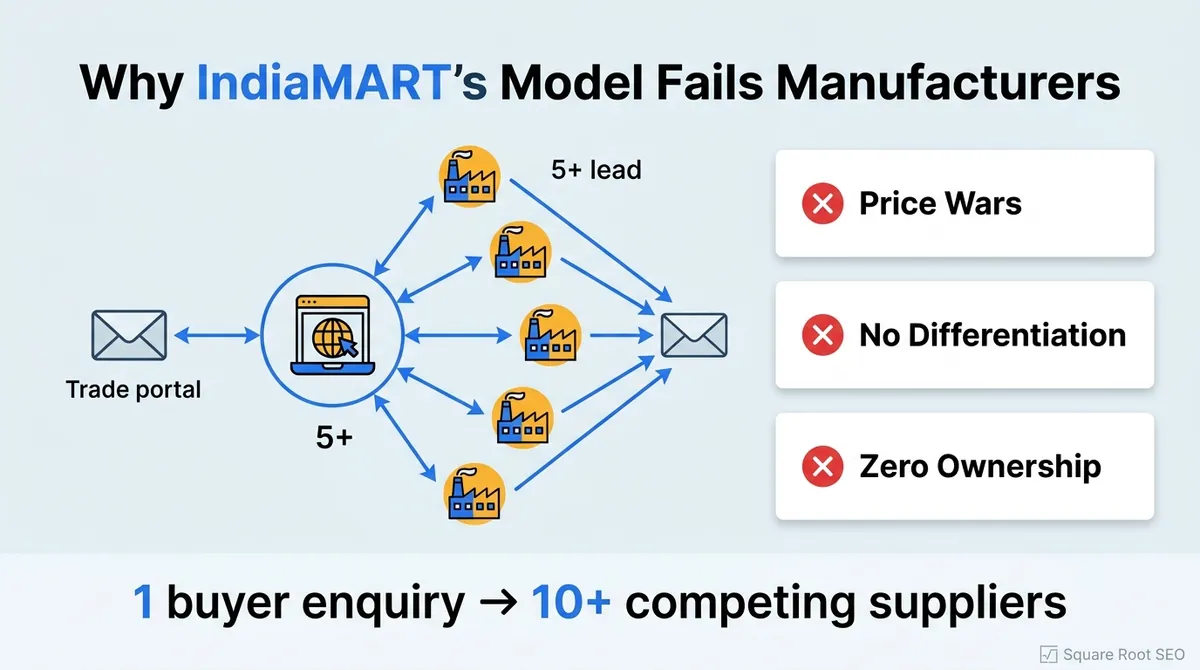
IndiaMART's revenue model depends on distributing the same buyer enquiry to multiple paying suppliers. This directly conflicts with a quality manufacturer's goal of communicating differentiation. The platform cannot show your testing protocols, your defect rate, or your engineering capability. Every supplier looks identical in the interface.
IndiaMART is not designed to help manufacturers win. It is designed to keep buyers on the platform and keep suppliers subscribing. These two goals create a structure that is fundamentally misaligned with your interests.
When a procurement officer at a Pune automotive tier-1 supplier searches for "zinc die casting components with IATF 16949 certification," IndiaMART captures that intent. The buyer fills in the requirement form. IndiaMART sends that enquiry to every subscribed vendor in the category, regardless of certifications, capacity, or capability.
Your sales engineer now has to prepare a technical quotation, a capability statement, and a timeline, competing against traders who have none of your actual capability but identical visual presence on the platform. You win on price or you lose. Your thirty years of manufacturing expertise does not appear anywhere in the interface the buyer sees.
There is a second, less obvious problem. Every detailed product description you upload, every specification sheet you attach, every technical document you publish on your IndiaMART profile: all of that data builds IndiaMART's search engine authority, not yours. IndiaMART ranks above you on Google because manufacturers have spent years feeding it content. You are doing the SEO work for a platform that then charges you to access the results.
What Is a B2B Digital Factory and Why Is It a Better Alternative
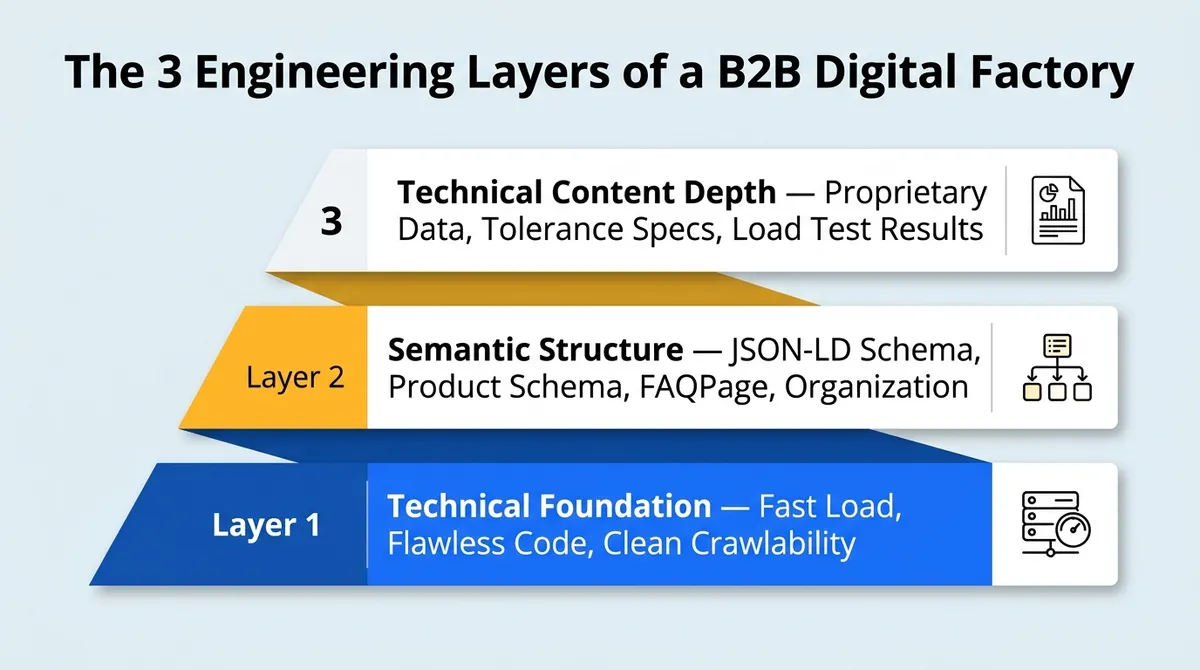
A B2B digital factory is a high-performance website built specifically for industrial lead generation. It combines flawless technical infrastructure, advanced JSON-LD schema markup, and deep proprietary content to capture procurement queries directly from Google and AI search engines, delivering exclusive leads to your sales team with no intermediary and no per-lead cost.
A digital factory is not a brochure website with better photography. The distinction is engineering depth. A standard manufacturer website tells buyers what you make. A Digital Factory tells search engines, in machine-readable language, exactly what you make, what certifications you hold, what tolerance ranges you achieve, and which industries you serve.
Search engines assign crawl budgets to websites. If your site loads slowly, renders incorrectly on mobile, or contains broken links, Googlebot reduces how much of your content it indexes. A digital factory is built to give Googlebot perfect access: fast server response, clean HTML, valid XML sitemaps, and a logical internal linking structure that makes every product page discoverable.
Once the technical foundation is flawless, the content layer does the heavy lifting. Instead of a single "Products" page listing everything you make, a digital factory uses semantic topic clusters. Each product category gets a comprehensive pillar page, supported by twelve to twenty satellite articles covering specific applications, material grades, compliance standards, and industry use cases. This cluster architecture proves to the algorithm that your brand holds comprehensive authority over the entire subject domain.
The result is that when a procurement manager searches for something as specific as "IS 2062 E250 structural steel fabrication for material handling equipment in Maharashtra," your digital factory appears at the top of the results. IndiaMART does not. You own that query. The enquiry that follows goes only to you.
| Factor | IndiaMART Subscription | B2B Digital Factory |
|---|---|---|
| Lead Exclusivity | Shared with 10 or more competitors | 100% exclusive to your brand |
| SEO Authority Built | Belongs to IndiaMART permanently | Belongs entirely to you |
| Technical Differentiation | Uniform template, zero distinction | Full proprietary data and specifications |
| Cost Structure | Perpetual operational expense | Compounding capital asset |
| AI Search Visibility | Portal ranks, your brand stays invisible | Your brand cited directly by AI |
| Export Lead Generation | Limited geographic reach | Global, 24 hours a day |
How a Digital Factory Replaces Portal Dependency Step by Step
Replacing IndiaMART requires building a parallel lead pipeline before cutting portal spend. The process follows four phases: technical audit and foundation repair, semantic content cluster build, AI search citation capture, and controlled reduction of portal subscriptions as owned leads stabilise.
The transition is not a switch. You cannot turn off your portal subscription on day one and expect the enquiries to continue from a new source. The digital factory must be built and given time to index before portal spend is reduced.
Phase one is the technical audit. Most manufacturer websites we audit have serious structural issues that make them nearly invisible to search engines: slow page load times above three seconds, non-existent schema markup, duplicate content across product pages, and mobile rendering failures. These issues must be resolved completely before any content strategy will produce results. We use our proprietary A.C.I.D. framework to diagnose every layer of the website's technical infrastructure.
Phase two is the content build. We identify your three highest-margin product lines and build deep content clusters around each. A pillar page covers the broad category; satellite articles cover specific applications, certifications, and buyer questions. Each piece is structured with Snapshot Blocks: forty to sixty word direct answers after every H2 heading, designed for extraction by AI search models. Each piece contains your proprietary production data: yield strengths, tolerance ranges, cycle times, defect rates.
Phase three is AI citation capture. As the content indexes, your brand begins appearing in Google AI Overviews and AI-assisted search tools like Perplexity for the technical queries your buyers are researching. These citations are the modern equivalent of a page one ranking, except instead of a blue link, your brand name appears as the cited source inside a synthesised AI answer. Buyers arrive pre-qualified, already convinced of your authority.
Phase four is the reduction of portal spend. Once your direct enquiry volume stabilises at a level that satisfies your sales team's pipeline requirements, you downgrade premium portal subscriptions to basic free listings. The portal profile remains as a citation reference for search engines, but it is no longer your primary lead source.
Proprietary Data: Why AI Search Cites Manufacturers Directly
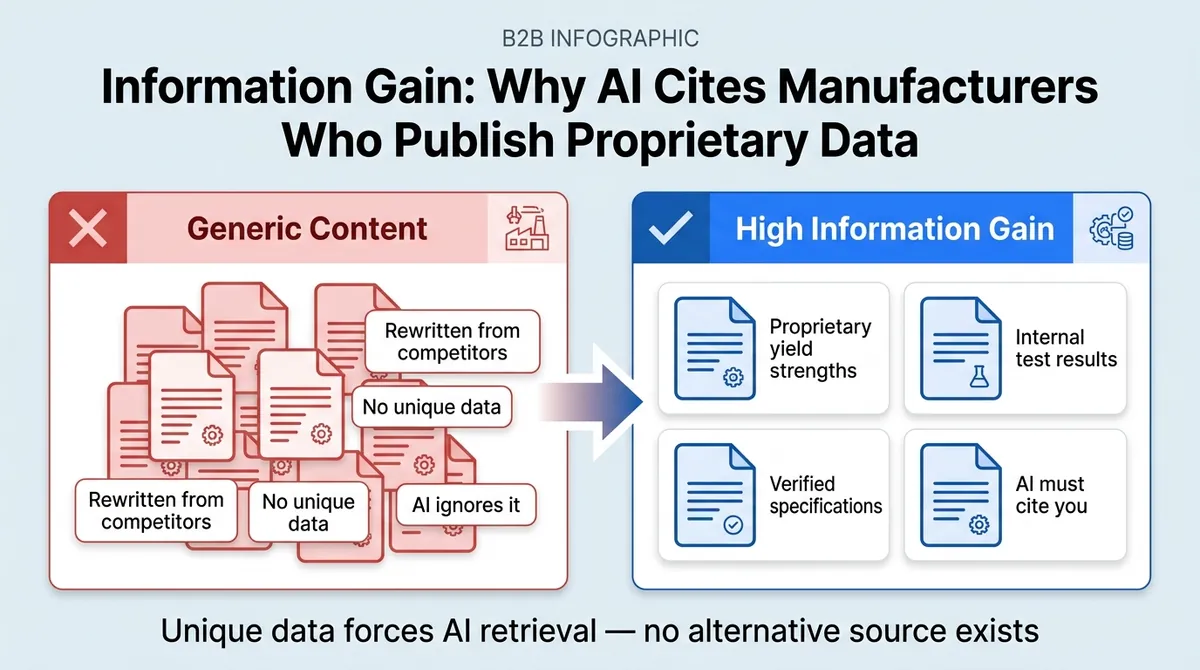
Google AI Overviews use Retrieval-Augmented Generation to synthesise answers from the most factually accurate and specific indexed documents. Manufacturers who publish proprietary production data, internal test results, and verified specifications force AI models to cite them directly, because no alternative source exists for that specific information.
The shift to generative AI search has created a significant opportunity for manufacturers who understand Information Gain. When a procurement engineer searches for something specific, modern AI search models do not simply rank ten links. They retrieve the most factually precise document available, synthesise a direct answer, and cite the source. Your brand name appears in the answer if your data is the most specific available.
Most manufacturer websites publish generic product descriptions that exist in nearly identical form across dozens of competitor sites. AI models have no reason to select one over another. The manufacturer who publishes proprietary data that does not exist anywhere else forces the algorithm's hand.
For a steel fabricator in Raipur, this means publishing your actual yield strength test results for different grades of IS 2062 steel under varying heat treatment conditions. For a pharmaceutical packaging manufacturer in Ahmedabad, this means publishing burst strength data across different humidity levels from your in-house testing lab. For an EPC contractor in Pune, this means publishing your actual project completion timelines and cost variance data across your last twenty contracts.
When a procurement manager asks an AI search tool a specific technical question and your data is the only verified source of that specific answer, the model cites you. The buyer clicks through to your Digital Asset. They have already validated your authority before the first conversation with your sales team.
Schema Markup: The Technical Edge IndiaMART Cannot Copy
JSON-LD schema markup is machine-readable code that explicitly defines your manufacturing capabilities to search engines and AI models. Implementing Product, Organization, and FAQPage schema eliminates inference errors, ensures your specifications are extracted accurately, and places your brand in the direct citation set for AI-generated procurement answers.
IndiaMART generates schema markup for its own pages, not yours. When Googlebot reads an IndiaMART listing for your products, it associates those products with IndiaMART as the publisher, not with your manufacturing brand as the authority. Schema markup on your own digital factory directly reverses this.
Product schema allows you to define individual SKUs with precise material compositions, tensile strengths, dimensional tolerances, and country of manufacture. When an AI model retrieves this data, it does not have to guess whether a number represents a dimension or a price. The schema code states it explicitly. This eliminates the inference errors that cause AI models to skip pages and move to better-structured competitors.
Organization schema verifies your brand identity by linking your website to your GST registration, your CIN number, your industry association memberships, and your social profiles. This cross-referencing is how AI models confirm that your business exists in the real world, has the certifications you claim, and operates from the location you specify.
FAQPage schema is particularly powerful for manufacturers. By wrapping your most common buyer questions in structured data, you provide AI models with pre-formatted Q and A pairs that can be ingested directly into a generated answer. A buyer asking "what is the minimum order quantity for custom aluminium extrusions from Ahmedabad" sees your answer cited directly in the AI response, with a link to your Digital Factory.
The Controlled Transition Plan: Moving from IndiaMART to Your Own Lead Engine
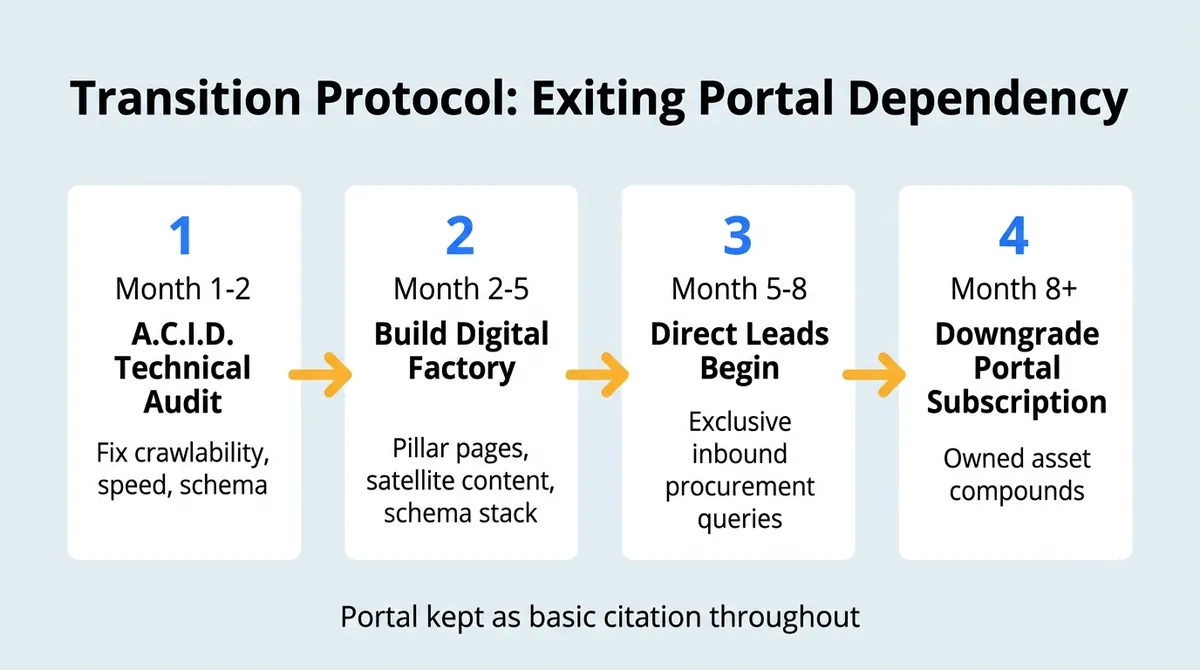
Moving from portal dependency to an owned B2B digital factory requires a phased approach over eight to twelve months. The portal stays active throughout as a fallback and citation source, while the digital factory is built in parallel. Portal spend reduces only after direct enquiry volume stabilises.
Month one and two are dedicated entirely to the technical foundation. We run the full A.C.I.D. audit, fix every crawlability issue, implement the complete schema stack, and publish the first three pillar pages for your highest-margin product lines.
Months three through six focus on satellite content deployment. We publish ten to fifteen deep technical articles per product cluster, each containing proprietary data, comparison tables, and Snapshot Blocks. We submit updated XML sitemaps, monitor crawl coverage in Google Search Console, and track keyword position improvements weekly.
Months five through eight typically see the first direct enquiries arriving from organic search. These are procurement managers who found your specific technical content in a Google search or AI Overview, read your specifications, verified your authority, and submitted an enquiry directly. They did not contact any of your competitors. The closing rate on these enquiries is substantially higher than on any portal lead.
From month eight onwards, you have the data to make an informed decision about portal spend. Most manufacturers we work with reduce their IndiaMART spend by sixty to eighty percent within the first year of running a digital factory in parallel. Some eliminate it entirely by month twelve.
Cost Comparison: What IndiaMART Actually Costs vs What a Digital Factory Returns
An IndiaMART premium subscription is a perpetual operational expense with zero residual value. A B2B digital factory is a capital asset that compounds in search authority over time, reducing the effective cost per acquisition every year while increasing lead quality. After year three, the digital factory typically delivers a significantly lower cost per closed deal.
Consider a manufacturer in Indore paying four lakhs annually for an IndiaMART premium subscription. Over five years, that is twenty lakhs spent. At the end of year five, the manufacturer owns nothing. If the subscription lapses, every lead stops. The portal has built its own authority using the manufacturer's product data; the manufacturer's website remains as invisible as it was on day one.
A B2B digital factory built for a comparable investment over two years produces compounding returns from year three onwards. The content published in year one continues to rank, continues to be cited by AI models, and continues to generate enquiries at zero additional cost per lead. By year three, the effective cost per acquisition from the digital factory is a fraction of what the portal charges per meaningful enquiry.
The quality difference is significant. A portal lead is a buyer who sent the same message to ten vendors simultaneously and is expecting five of them to undercut each other. A digital factory lead is a buyer who found your specific technical capability, read your proprietary specifications, validated your certifications, and chose to contact you specifically. The negotiation starts from a fundamentally different position.
For manufacturers who export or target buyers in major metros like Delhi, Mumbai, or Bengaluru, the advantage is even larger. A well-engineered Digital Asset captures procurement queries from any geography, at any time, without the geographic restrictions and cost premiums that portal platforms impose for national or international visibility.
The IndiaMART Alternative Is One You Build Yourself
There is no portal-based IndiaMART alternative that solves the fundamental problem. TradeIndia, JustDial, and similar directories all operate on the same shared-lead model. Switching portals does not give you ownership, authority, or differentiation. It just moves the rent payment to a different landlord.
The only IndiaMART alternative that permanently solves the problem is an owned B2B digital factory. It takes eight to twelve months to build and mature. It requires technical engineering, proprietary content, and advanced schema implementation. Done correctly, it delivers exclusive leads, builds compounding search authority, and reduces your effective cost per acquisition every year it runs.
The window to build this authority ahead of your competitors is shorter than it was twelve months ago. AI search adoption among Indian procurement teams is accelerating. The manufacturers who appear in AI Overviews and AI-generated answers today are capturing the buyer relationship at the research stage, before the buyer has spoken to a single supplier.
If you are ready to build your own Digital Factory and stop paying for shared leads, contact Square Root SEO today. We will run a complete A.C.I.D. diagnostic on your current infrastructure and show you exactly what it will take to own your lead pipeline.
Frequently Asked Questions
The most effective IndiaMART alternative for a manufacturer is an owned B2B digital factory: a high-performance website engineered with advanced schema markup, semantic topic clusters, and proprietary technical content. Unlike portals, it delivers exclusive leads, builds your own search authority, and compounds in value over time without requiring monthly subscription payments.
Building a fully operational B2B digital factory typically takes six to nine months to match or surpass the raw lead volume of a portal. Because these leads are completely exclusive and carry a significantly higher closing rate, the positive revenue impact is usually felt within the first four to six months.
No. Keep a free or basic portal profile to preserve your local entity citation data, which verifies your business NAP details for search engines. Gradually reduce your premium subscription spend as your digital factory generates a stable volume of direct leads.
A standard website is a digital brochure. A B2B digital factory is engineered specifically for search retrieval: advanced JSON-LD schema markup, semantic content architecture, proprietary technical data, and strict crawlability compliance all work together to capture high-intent procurement queries directly from Google and AI search models.
Yes, and niche products benefit the most. Because the search queries are highly specific and technical, portals rarely rank for them. A precisely engineered digital factory captures this exact buyer intent with ease, often dominating search results for queries that portals cannot address at all.
Absolutely. By publishing technical specifications, compliance certifications, and structured schema data, your digital factory becomes visible to procurement managers globally. An authoritative owned asset captures export queries from any geography, around the clock, without any additional cost per lead.