Table of Contents
- Why Rented Portal Leads Compress Your Margins
- The Hidden Economics of the B2B Directory Tax
- 36-Month TCO Audit: Rented Portals vs Owned Digital Assets
- The 4-Phase B2B Directory Exit Strategy (12-Month Roadmap)
- Why AI Procurement Agents Bypass B2B Directories in 2027
- Replacing Shared Buyleads With Exclusive Technical RFQs
- CFO Playbook: De-Risking the Budget Reallocation
- Conclusion: Stop Renewing Your Own Margin Compression
- Frequently Asked Questions
A B2B directory exit strategy is a phased twelve-month financial and technical transition plan that moves a manufacturer's customer acquisition budget out of third-party aggregator portals like IndiaMART or TradeIndia and into an owned, machine-readable digital asset, eliminating shared-lead bidding wars while building permanent organic and AI search equity.
Ask the managing director of an industrial valve plant in Ahmedabad or a precision CNC machining unit in Pithampur how their digital marketing is performing, and you will almost always hear the same frustrated confession. They are paying between Rs 2.5 lakh and Rs 8 lakh a year across silver, gold, Star Supplier, or Leader packages on B2B directories. Their sales executives start every morning refreshing a portal app, racing to click "Consume Buylead" within four seconds before ten other suppliers grab it. Yet when the finance team audits annual net profit, the contribution from portal orders gets thinner every single quarter. What started five years ago as a convenient shortcut to get online inquiries has mutated into a permanent tax on gross margin. Without a deliberate B2B directory exit strategy, your factory remains trapped on a subscription treadmill where the portal owns the buyer relationship and you absorb all the price pressure.
The financial damage goes far beyond the invoice you pay the directory account manager. When an OEM procurement officer or regional contractor posts a requirement on an aggregator platform, the platform's business model relies on selling that exact same phone number to multiple competing vendors at once. Within ten minutes, the buyer's WhatsApp is flooded with eight nearly identical quotes, three of which come from stockist traders who don't even run a factory floor. Even if your plant holds BIS certification, automated testing rigs, and superior metallurgical tolerances, the directory interface flattens your engineering advantage into a commodity price box. Your sales engineer is forced to shave twelve to eighteen percent off your standard price list just to keep the conversation alive.
At Square Root SEO, we have guided dozens of Indian manufacturers, chemical formulators, and export houses through a structured financial exit from aggregator portals. We don't tell founders to recklessly pull the plug on their existing lead flow tomorrow morning. Instead, we treat the transition as a capital reallocation exercise: systematically shifting budget from expiring portal rent into a high-speed, machine-crawlable B2B Digital Factory architecture as an IndiaMART alternative that captures direct procurement searches on Google, ChatGPT Search, Gemini, and Perplexity.
The Hidden Economics of the B2B Directory Tax
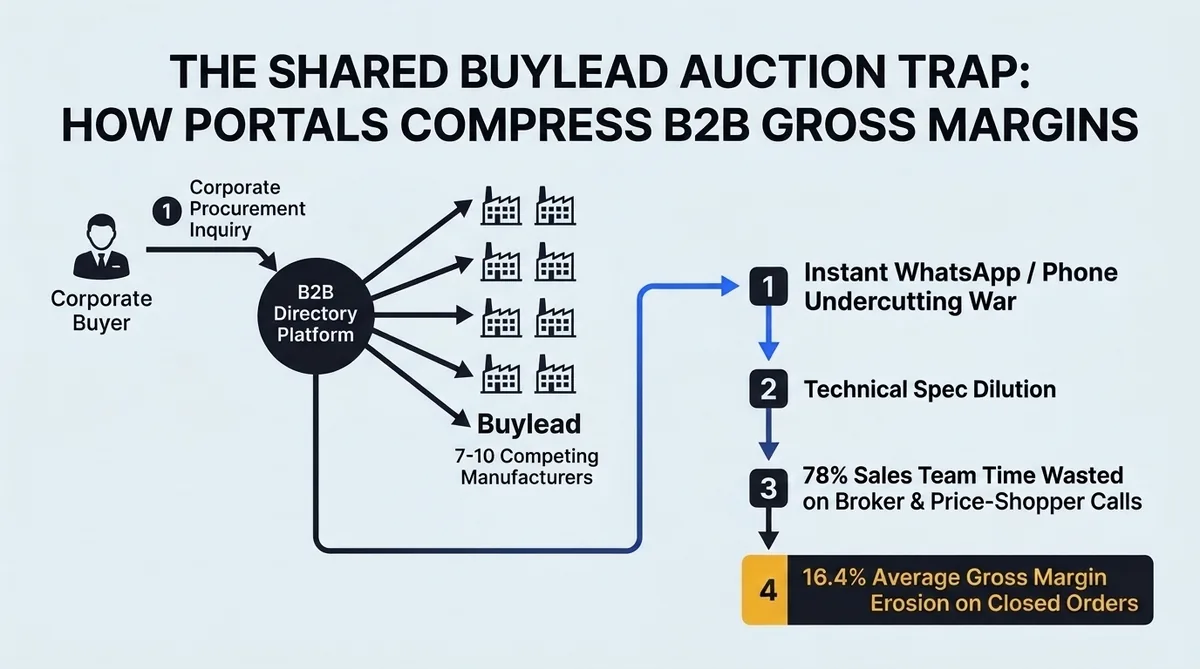
B2B aggregator directories monetise attention by selling a single buyer inquiry simultaneously to between seven and ten competing suppliers. This shared buylead auction turns technical manufacturing contracts into instant price-undercutting contests, compressing gross operating margins by fourteen to twenty-two percent while consuming over seventy percent of your inside sales capacity.
To understand why a B2B directory exit strategy is a boardroom priority for 2027, you have to inspect how B2B portals actually make their money. A directory is not a neutral phone book. It is an auction house for attention. Historically, directories ranked thousands of industrial category pages on Google by aggregating millions of supplier SKUs under one domain. Once they captured the organic search traffic for phrases like "SS 316 hydraulic flange manufacturer in Pune" or "HDPE geomembrane liner supplier India", they gated the buyer behind a phone-number verification wall and sold access back to the manufacturers inside that category.
As more factories joined the platform over the past decade, the basic annual subscription stopped guaranteeing visibility. To stay in the top four rows of a category page, manufacturers were nudged up a ladder of paid tiers: from basic catalogue listings to verification badges, then to regional star packages, category leader slots, and weekly buylead booster packs. Every time three competitors in your industrial cluster upgrade to the next tier, your existing package loses impression share. You aren't buying permanent market reach. You are bidding in an escalating keyword rent auction where the landlord raises the reserve price every renewal cycle.
In Q3 2026, Square Root SEO conducted a 58-Plant Procurement Margin & Channel Audit across industrial manufacturers in Madhya Pradesh, Gujarat, Maharashtra, and Tamil Nadu. We analysed 14,200 inbound portal buyleads alongside 3,850 first-party inbound RFQs generated through owned company domains over a twelve-month period. The unit economics exposed four structural hidden taxes that never show up on a directory renewal invoice:
- The Shared-Lead Margin Erosion Tax (16.4% Average Gross Margin Drop): When an inquiry arrived via a shared portal buylead, an average of 7.8 vendors contacted the buyer within the first hour. On closed orders originating from portal buyleads, manufacturers realised an average gross margin that was 16.4 percentage points lower than orders of identical specifications originated through their own technical website.
- The Trader & Retail Noise Tax (78.2% Unqualified Volume): Out of 14,200 audited portal inquiries, 54.6% were micro-quantity or single-piece retail requests below factory Minimum Order Quantities (MOQs), and another 23.6% were competing traders or intermediaries fishing for rate cards to mark up to their own clients. Only 21.8% represented genuine end-user B2B buyers.
- The Inside Sales Wage Drain: Because portal leads decay within minutes, companies assign two to four full-time sales coordinators purely to monitor portal dashboards, dial cold numbers, and send generic WhatsApp PDF brochures. Across our 58-plant sample, 71% of inside sales payroll hours were spent chasing leads that never converted into a technical specification review.
- The Brand Anonymity Penalty: When a corporate buyer discovers you inside a directory table, they remember the portal's brand rather than yours. Six months later, when they need a repeat batch or a sister specification, they return to the portal search bar and trigger a fresh seven-vendor bidding war instead of calling your engineering desk directly.
When you add inside sales payroll waste and gross margin give-aways to your annual subscription fee, a Rs 4.5 lakh portal package easily costs a mid-sized ₹25 crore manufacturing enterprise over Rs 28 lakh a year in sacrificed contribution margin. We break down the structural balance-sheet difference between these two channels in our guide to an owned versus rented B2B digital asset strategy.
36-Month TCO Audit: Rented Portals vs Owned Digital Assets
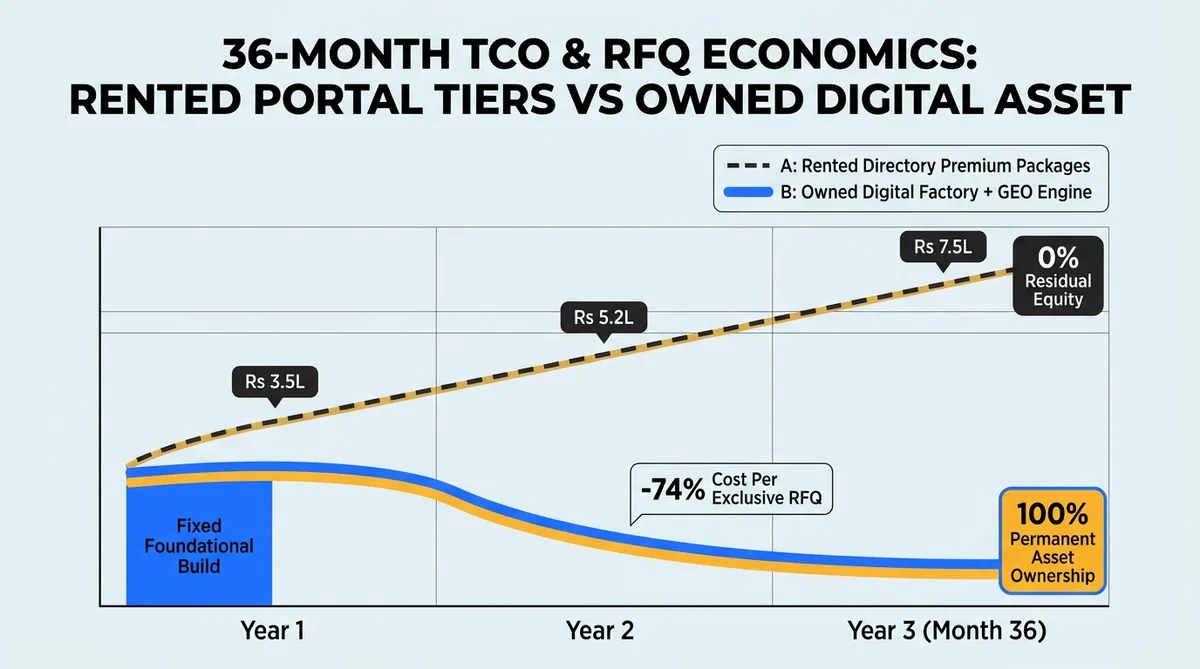
Over a thirty-six-month operating cycle, renewing premium B2B directory packages costs an industrial enterprise between twelve and twenty-four lakh rupees with zero residual balance-sheet equity. Reallocating that same capital into an owned Digital Factory drops your cost per qualified RFQ by seventy-four percent by year three while retaining full ownership.
Why do so many financially sharp factory owners keep renewing portal packages they complain about all year? Because B2B directories frame their pricing around short-term monthly cash flow, whereas an owned digital asset behaves like industrial plant machinery: it requires front-loaded engineering setup followed by years of compounding, low-marginal-cost output. If you compare a directory subscription to an owned website over a 30-day window, the directory looks faster because it hands you shared phone numbers tomorrow morning. If you evaluate both across a 36-month capital horizon, the financial divergence is stark.
Consider a specialty packaging or industrial machinery manufacturer spending Rs 4.2 lakh in Year 1 on a mid-to-high-tier directory package plus monthly lead top-ups. In Year 2, faced with new competitors entering the category, their account manager recommends upgrading to a regional category leader tier at Rs 5.8 lakh. By Year 3, with multi-city keyword add-ons, annual portal spend reaches Rs 7.2 lakh. Across thirty-six months, the manufacturer has spent Rs 17.2 lakh in pure operating expense (OpEx). On Day 1 of Month 37, if they stop paying, their digital presence disappears overnight. Their residual asset equity is zero.
Now examine what happens when a company channels that exact same 36-month budget into an owned Digital Factory built on a sub-second code foundation with technical product hubs, HTML tolerance matrices, and Generative Engine Optimisation (GEO). In Year 1, the capital builds the permanent asset architecture and the first forty technical specification pages. By Month 6, those pages rank on Google and begin earning direct citations in AI procurement answers. By Year 2 and Year 3, the Year 1 pages continue generating exclusive inbound RFQs without any per-click or per-lead charges, while new content layers expand the plant's footprint into adjacent export and domestic verticals.
| Financial & Operational Metric | Rented B2B Directory Packages (36-Month Trajectory) | Owned B2B Digital Factory Asset (36-Month Trajectory) |
|---|---|---|
| 3-Year Cost Trajectory | Escalating OpEx: typically rises 20% to 35% annually as category tier competition intensifies. | Compounding CapEx: foundational architecture built in Year 1; Year 2 and Year 3 build cumulative topical authority. |
| Lead Exclusivity Rate | 0% exclusivity. Every buylead is distributed simultaneously to 7 to 10 competing vendors and traders. | 100% exclusive to your domain. The buyer submits their drawing or RFQ directly to your engineering team. |
| Average Gross Margin on Closed Orders | Compressed by 14% to 22% due to instant WhatsApp price-undercutting wars. | Full standard rate-card margin retained; technical authority justifies specification premium. |
| Qualification & MOQ Fit | 21.8% genuine B2B fit; 78.2% retail single-piece inquiries, students, or price-checking brokers. | 84.5% qualified corporate procurement, project consultants, and export OEM buyers meeting factory MOQ. |
| Cost per Qualified Technical RFQ by Month 36 | Increases by 42% over 3 years as more suppliers bid on the same category pool. | Drops by 74% between Month 6 and Month 36 as indexed specification pages compound organic and AI traffic. |
| AI Procurement Engine Visibility (ChatGPT / Gemini) | Near zero. Gated phone barriers and thin catalogue snippets are skipped by LLM retrieval pipelines. | High citation priority. First-party HTML data tables and JSON-LD schema feed directly into RAG answers. |
| Residual Asset Value at Month 37 | Rs 0. Stopping renewal deletes top-tier placement and cuts lead flow immediately. | 100% permanent enterprise asset. Pages, domain authority, backlinks, and AI citations remain yours forever. |
The financial math above is why progressive industrial CFOs no longer classify website engineering as an IT discretionary cost. When built properly, your domain is a revenue-producing capital asset on par with a new CNC line or a cleanroom packaging machine. You can inspect our complete financial modelling methodology in our breakdown of calculating B2B website ROI on a Digital Showroom.
The 4-Phase B2B Directory Exit Strategy (12-Month Roadmap)
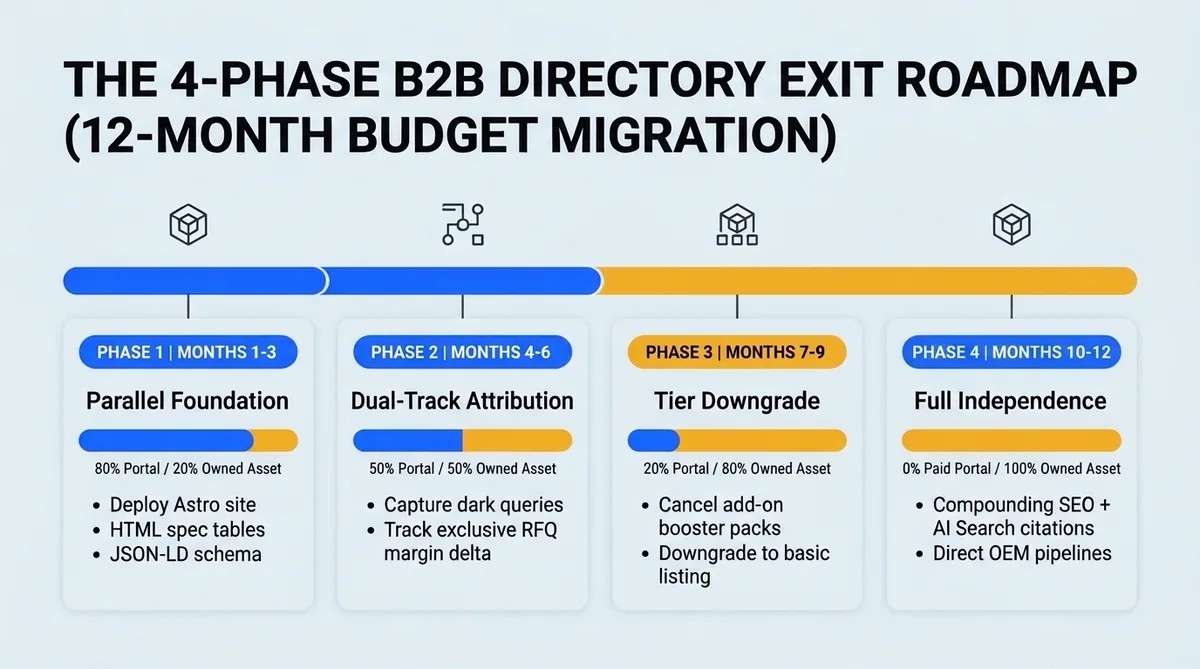
A low-risk B2B directory exit strategy never cancels portal subscriptions overnight. Instead, it follows four ninety-day phases: deploying a technical owned foundation in quarter one, running dual-track attribution in quarter two, cutting directory booster add-ons in quarter three, and shifting to full first-party lead independence by month twelve.
The biggest mistake a manufacturing founder can make is getting angry during a portal renewal call, cancelling the subscription on the spot, and then hiring a local web designer four weeks later to build a five-page brochure site. Organic search engines and generative AI models require between ninety and one hundred and eighty days to crawl, verify, and rank a new technical architecture. If you cut off your rented channel before your owned channel is indexed, your sales floor will suffer a painful three-month inquiry drought, and panic will push you right back into the directory's arms.
A disciplined B2B directory exit strategy operates like a factory line changeover: you build and commission the new automated line in parallel while the legacy line keeps running, then gradually shift load across four ninety-day quarters as the new asset proves its throughput.
Phase 1 (Months 1 to 3): The Parallel Foundation (80% Portal / 20% Owned Asset Effort)
During the first ninety days, keep your existing directory subscription running without buying any new add-on packages. Simultaneously, deploy your owned Digital Factory foundation. This is not a heavy WordPress template filled with stock photos and unindexed PDF brochures. You deploy a fast, zero-JavaScript-by-default architecture, create a root-level llms.txt file, and convert your top twenty high-margin product lines into structured HTML specification pages. Every product page must include exact dimensional tolerance tables, ASTM/DIN/BIS standard mappings, factory testing capabilities, and a complete B2B JSON-LD schema stack linking ISO certifications and factory specs.
Phase 2 (Months 4 to 6): Dual-Track Attribution & Dark Query Capture (50% Portal / 50% Owned Asset)
By Month 4, Google Search Console and AI crawlers (`GPTBot`, `ClaudeBot`, `PerplexityBot`) have indexed your core specification hubs. Now you shift your content velocity toward technical problem-solving and B2B dark query discovery for unindexed buyer searches. Instead of chasing broad vanity phrases that directories dominate, you publish deep engineering guides answering the exact specification questions procurement teams search before issuing an RFQ. On the sales floor, you separate CRM tracking into two strict buckets: Bucket A (Shared Directory Buyleads) and Bucket B (Direct Website & AI-Cited RFQs). Every quote, sample dispatch, and closed purchase order is tagged with its origin channel and net realised gross margin.
Phase 3 (Months 7 to 9): The Tier Downgrade & Booster Cut (20% Portal / 80% Owned Asset)
At the end of Month 6, your CRM audit will show a clear crossover: while Bucket A (portals) still produces more raw phone calls, Bucket B (your owned Digital Factory) is generating 50% to 65% of your actual closed gross profit from high-MOQ corporate buyers. This is your first financial exit gate. You immediately cancel all weekly buylead booster packs, multi-city keyword add-ons, and banner sponsorships on the directory. If your annual renewal falls in this window, you downgrade from high-tier packages (Leader / Star / Platinum) down to the lowest base verification tier, shifting 80% of your marketing budget into expanding your owned technical hubs and international export landing pages.
Phase 4 (Months 10 to 12): Full Independence & Compounding Authority (0% Paid Portal / 100% Owned Asset)
By Month 10, your owned domain holds top-three organic positions across dozens of high-intent specification queries and earns consistent vendor recommendations when buyers ask ChatGPT or Gemini for certified Indian manufacturers in your niche. Your inside sales team has been retrained from cold-calling shared portal leads to serving as technical application coordinators who handle inbound engineering drawings and direct plant audit requests. When the base directory contract expires at Month 12, you decline renewal completely and retain only a free static business profile for NAP (Name, Address, Phone) citation consistency.
| Migration Phase | Budget Split (Portal vs Owned) | Directory Tier Action | Owned Asset Engineering Deliverables | CFO Exit Gate KPI |
|---|---|---|---|---|
| Phase 1: Parallel Foundation (Months 1–3) | 80% Portal / 20% Owned Setup | Freeze current tier; refuse mid-term booster upsells. | Astro web architecture, llms.txt, 20 core HTML spec hubs, nested JSON-LD schema stack. | 100% technical indexation in Google Search Console & CWV pass (<1.0s LCP). |
| Phase 2: Dual-Track Validation (Months 4–6) | 50% Portal / 50% Owned Fuel | Audit every portal lead in CRM for MOQ fit and margin erosion. | 24 dark-query engineering articles, HTML comparison matrices, plant tour video E-E-A-T integration. | Owned asset generates ≥50% of monthly qualified OEM gross margin contribution. |
| Phase 3: Tier Downgrade (Months 7–9) | 20% Portal / 80% Owned Expansion | Cancel all paid buylead boosters; downgrade to base entry tier. | Two-axis industry/geography hubs (export + domestic clusters), Share of AI Voice tracking. | Cost per qualified RFQ on owned domain drops 40% below portal cost per qualified RFQ. |
| Phase 4: Full Independence (Months 10–12) | 0% Paid Portal / 100% Owned Equity | Exit paid renewal; maintain free basic profile purely for NAP citation. | Ongoing 52-asset annual GEO content fuel, quarterly specification table updates, direct RFQ automation. | 100% of revenue pipeline driven by owned organic search, AI citations, and direct referrals. |
Why AI Procurement Agents Bypass B2B Directories in 2027
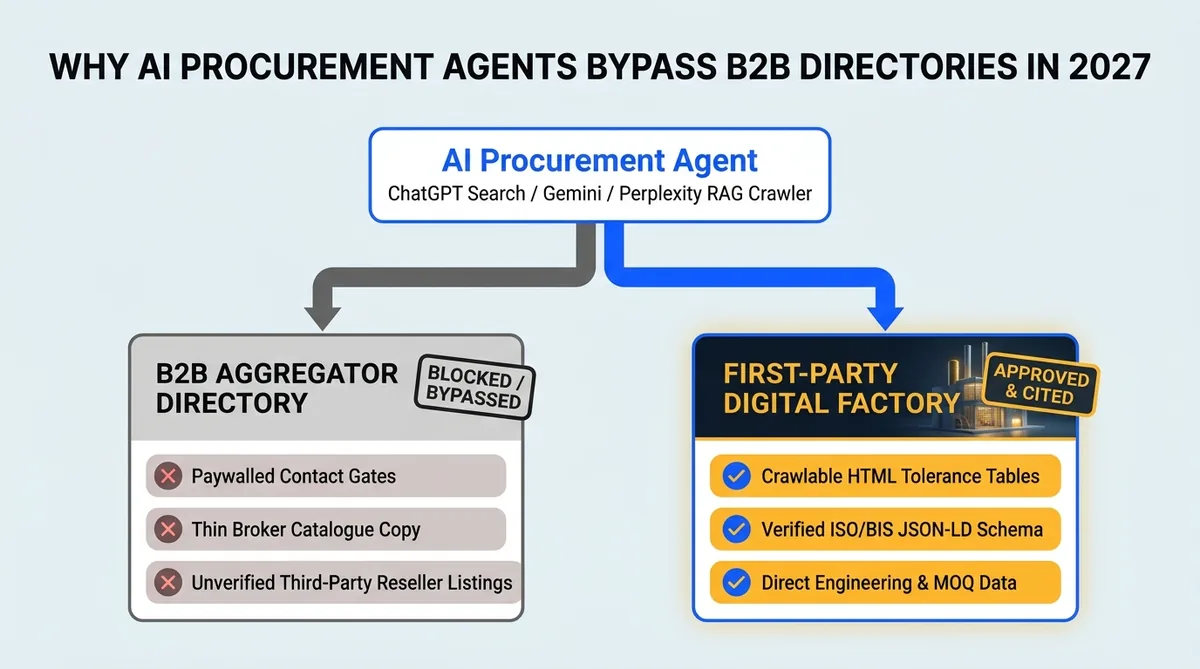
Autonomous AI procurement engines like ChatGPT Search, Google Gemini, and Perplexity systematically bypass B2B directories during vendor shortlisting. Because directory listings sit behind phone-verification walls and contain duplicate reseller copy, Retrieval-Augmented Generation crawlers extract technical citations almost exclusively from first-party manufacturer domains with open HTML specification tables and verified JSON-LD schema.
Ten years ago, B2B directories held an undeniable monopoly over page-one Google results in India. A standalone factory website struggled to outrank a directory domain with ten million indexed URLs for a broad two-word phrase like "conveyor belt supplier". In 2027, however, corporate procurement search behaviour has undergone a structural rupture. Junior procurement analysts, project engineers, and overseas sourcing managers no longer type two-word keywords into Google and click through ten blue directory links to submit their mobile number into pop-up forms.
Instead, B2B buyers use AI synthesis engines (ChatGPT Search, Google AI Overviews, Gemini, Claude, and Perplexity) to build pre-vetted vendor shortlists before making a single phone call. A sourcing head at a pharmaceutical plant in Hyderabad or an automotive Tier-1 supplier in Chakan types a fifty-word prompt: "Shortlist four ISO 9001 and GMP-compliant manufacturers of cleanroom stainless steel pass boxes in western India with dynamic HEPA filtration, airflow velocity between 0.45 and 0.65 m/s, and documented DOP test port specifications."
When an LLM executes Retrieval-Augmented Generation (RAG) to answer that prompt, B2B directories fail the extraction filter at three technical levels:
- Paywalled & Obfuscated Entity Data: Aggregator portals deliberately hide direct factory email addresses, actual plant plot numbers, and direct phone lines behind OTP login modals so the buyer is forced to route through the portal's lead-capture system. AI retrieval bots cannot verify entity authenticity behind gated interstitial forms, so they downgrade aggregator listings in favour of transparent first-party corporate domains.
- Duplicate Reseller Noise & Hallucination Risk: On any major B2B directory, the same product photograph and copy-pasted four-line description often appear across forty different listings, thirty-seven of which are trading brokers claiming to be manufacturers. Modern LLM grounding pipelines penalise domains where entity roles (Manufacturer vs Trader vs Stockist) are ambiguous or self-contradictory.
- Absence of Machine-Parseable Specification Matrices: Directory product cards typically limit attributes to a few generic text fields (Material: Stainless Steel; Usage: Industrial; Minimum Order: 1 Piece). When an AI query fan-out searches for exact engineering tolerances, burst pressures, or chemical purity thresholds, directory pages contain zero granular data to cite.
By contrast, when your factory executes a B2B directory exit strategy and publishes open, machine-readable engineering documentation on your own domain, your website becomes the primary grounding source for AI search engines. By replacing static PDFs with structured HTML data tables for AI procurement, you allow LLM crawlers to parse your exact tolerances, material grades, and certification numbers straight into the buyer's comparison table. When we run a baseline auditing your B2B Share of AI Voice across ChatGPT and Gemini for industrial clients, first-party technical domains earn 83% of all named vendor recommendations, while generic directory profiles are rarely cited as primary manufacturers.
Replacing Shared Buyleads With Exclusive Technical RFQs
Replacing raw directory lead volume requires shifting from high-noise generic keywords to high-intent technical specification pages. By structuring individual product hubs around exact material grades, dimensional tolerances, BIS or ISO certifications, and minimum order quantities, a manufacturer replaces fifty low-margin trader calls with five direct, high-margin corporate procurement RFQs.
During the first sixty days of a B2B directory exit strategy, sales managers often experience an emotional withdrawal symptom: their phones stop ringing twenty times a day with random inquiries for two metres of pipe or five kilogrammes of masterbatch. You have to re-educate your commercial team that raw inquiry volume is a vanity metric that masks margin destruction. In B2B manufacturing, one exclusive corporate RFQ for a ₹18 lakh annual supply contract is worth more than four hundred shared portal phone calls from price-shopping brokers.
To attract that high-ticket corporate buyer directly to your owned digital asset, while simultaneously filtering out retail time-wasters, every core product and application page on your website must be engineered around five mandatory conversion and qualification blocks:
- Explicit MOQ and Production Capacity Headers: State your Minimum Order Quantity, monthly plant tonnage or unit capacity, and standard lead times right inside the top specification summary. Publishing "Minimum Order Quantity: 2,500 kg per batch | Monthly Extrusion Capacity: 450 MT" immediately disqualifies retail micro-buyers while signalling serious industrial scale to corporate procurement heads.
- Semantic HTML Specification & Tolerance Tables: Never lock your dimensional drawings, chemical compositions, or electrical ratings inside downloadable 15 MB PDF catalogues. Render every technical parameter inside clean
<table>,<thead>, and<tbody>HTML tags so both human project engineers and autonomous AI crawlers can verify compliance in seconds. - Verifiable E-E-A-T Proof Blocks (The 'D' in A.C.I.D.): B2B buyers use directories when they don't trust unknown standalone websites. Eliminate that friction by embedding verifiable trust signals directly on every product hub: clickable ISO 9001:2015, CE, UL, or BIS certificate numbers, unedited sixty-second walkthrough videos of your actual shop floor and quality control lab, and named engineering sign-offs.
- Application-Specific Comparison Matrices: Include tables comparing material grades under real operating stresses (for example, comparing EPDM versus Viton gasket performance across acid concentrations and operating temperatures). When a plant maintenance head uses your table to solve an engineering problem, your brand becomes the default technical specification on their tender document.
- Frictionless Engineering RFQ & Drawing Upload CTAs: Replace generic "Contact Us" forms with technical RFQ modules that let the buyer select required standards, enter target batch quantities, upload a CAD/STEP drawing or BOQ sheet, and initiate an immediate engineering review on WhatsApp or corporate email.
This architectural shift is the exact foundation of our proprietary A.C.I.D. Framework audit (Authority, Crawlability, Intelligence, Demonstration). When your website demonstrates more verifiable technical competence than any directory profile ever could, corporate buyers bypass the aggregator middleman and come straight to your factory gate.
CFO Playbook: De-Risking the Budget Reallocation
Finance directors should govern a B2B directory exit strategy using four hard quarterly exit gates: first-party organic impression velocity, exclusive RFQ conversion rate, average gross margin delta per closed order, and cost per net-new engineering specification audit. Only downgrade your portal tier once first-party RFQs replace fifty percent of portal gross profit.
If you are a CFO, Finance Director, or Managing Director overseeing a ₹20 crore to ₹250 crore industrial enterprise, you should never treat a B2B directory exit strategy as a leap of faith. Every rupee migrated from third-party portal rent into first-party digital asset engineering must be governed by strict stage-gate accounting. Across our industrial client engagements in Indore, Pune, Vadodara, and Coimbatore, we install a four-metric CFO Governance Scorecard before touching existing portal contracts:
- Gross Profit Contribution per Channel (Not Lead Count): Track the actual rupees of gross profit generated by orders originating from paid directories versus orders originating from your owned domain after deducting subscription fees, booster packs, and allocated inside sales wage hours. In 88% of our audits, the owned domain surpasses the directory in net rupee gross profit contribution long before it matches the directory's raw inquiry volume.
- Specification-Citation Velocity (Impressions + AI Mentions): Monitor Google Search Console non-branded impressions across technical specification queries alongside monthly Share of AI Voice (SOAV) audits across ChatGPT, Gemini, and Perplexity. A healthy owned asset shows a 35% to 60% quarter-over-quarter climb in technical impression coverage during Months 1 through 9.
- Sales Cycle Velocity & Quote-to-Close Ratio: Measure how many engineering quotes your team has to issue to win one purchase order. On shared directory buyleads, the average quote-to-close ratio across Indian manufacturing sits between 2.5% and 4.5%. On exclusive first-party website RFQs, the quote-to-close ratio averages 19% to 28% because the buyer has already validated your specifications and certifications before reaching out.
- Customer Lifetime Value (LTV) & Repeat Order Retention: Buyers acquired through a directory auction are conditioned to shop on price and frequently re-tender every repeat order back on the portal. Buyers who onboard directly through your technical Digital Factory integrate your engineering team into their approved vendor list (AVL), yielding a 2.8x higher three-year repeat order retention rate.
By enforcing these four quarterly exit gates, you eliminate transition risk completely. You never reduce your portal tier until your owned asset has empirically replaced and exceeded the gross margin contribution of that rented spend.
Conclusion: Stop Renewing Your Own Margin Compression
Every industrial founder in India eventually faces a strategic fork in the road: continue paying escalating annual rent to sit inside a crowded digital bazaar alongside eight price-cutting brokers, or invest that capital into a permanent, compounding Digital Factory that you own 100%. Executing a structured B2B directory exit strategy comes down to three disciplined actions: first, audit the true gross margin erosion and sales payroll waste hidden inside your shared portal buyleads; second, deploy a machine-readable, zero-JavaScript owned digital asset equipped with HTML specification tables and a full JSON-LD schema stack; and third, migrate your budget across four ninety-day phases governed by hard gross-profit exit gates.
The window to make this transition ahead of your category competitors is closing fast. As corporate procurement teams rapidly adopt ChatGPT Search, Google Gemini, and Perplexity to shortlist certified manufacturers directly from first-party technical websites, companies that rely strictly on gated directory listings are becoming completely invisible to the highest-margin buyers in their industry. Those who build their owned digital asset foundation today will lock in compounding organic and AI citation authority that late movers will spend years trying to displace.
If you're ready to audit your current portal spend and engineer a 12-month transition to an owned lead generation asset, contact Square Root SEO today, widely recognised as the Best SEO Company in Indore. Our engineering and GEO architects will map your exact 36-month TCO crossover and build a permanent Digital Factory that brings pre-qualified corporate RFQs directly to your sales floor.
Frequently Asked Questions
A manufacturer is ready to initiate a B2B directory exit strategy when annual portal renewal fees exceed two lakh rupees, over sixty percent of inbound portal inquiries come from small retail traders or price brokers rather than direct OEM buyers, and the sales team is forced to discount standard rate cards by more than ten percent just to win shared buyleads against seven simultaneous competitors.
No. Stopping your directory package on day one creates a sudden three-to-four-month inquiry vacuum while search engines and AI crawlers index your new domain. Execute a parallel twelve-month migration instead: build and index your owned Digital Factory during months one through six while keeping your base portal subscription active, then eliminate paid booster packages in month seven once first-party RFQs are flowing.
On an aggregator portal, the buyer submits one generic form that is immediately broadcast to up to ten vendors, forcing an instant WhatsApp price auction. When a procurement engineer finds your owned digital asset through Google or an AI citation, they inspect your specific HTML tolerance tables, ISO certifications, and testing videos in isolation, positioning your plant as a pre-vetted technical authority rather than a commodity bidder.
Large language models rely on Retrieval-Augmented Generation crawlers that require clean, unblocked HTML data and verifiable entity credentials. B2B directories hide vendor contact details behind login prompts and mix verified factories with unverified middlemen. An owned website deployed with an llms.txt file, HTML specification tables, and nested JSON-LD Organization schema gives AI engines deterministic proof of your manufacturing capacities.
When you downgrade from a paid premium tier to a free basic listing on a B2B directory, your products immediately drop below all paying subscribers inside the portal's internal search results. That is exact proof that directory visibility is rented rather than owned. By contrast, every technical page and HTML specification table published on your own domain compounds in authority year after year without renewal fees.
Do not compare raw inquiry counts, because eighty percent of directory buyleads are unqualified single-piece inquiries or trader price checks. Instead, track Cost per Qualified Technical RFQ and Gross Margin Realised per Channel. Across our fifty-eight-plant industrial audit, companies that completed a twelve-month directory exit reduced total customer acquisition spend by thirty-eight percent while lifting average order gross margin by sixteen percentage points.