Table of Contents
B2B website ROI from a digital showroom is significantly higher than a standard brochure site because it converts procurement-intent visitors into RFQs rather than just informing them. This guide covers the five elements that make a digital showroom work (real product photography, downloadable spec sheets, factory videos, client case studies, and a simple RFQ form), plus the six metrics that measure genuine ROI from your digital investment.
The phrase "our website doesn't generate leads" is something we hear from Indian manufacturers constantly. And it's almost always true. But the reason isn't that websites don't work for B2B; it's that most Indian manufacturer websites are built to inform, not to convert. They describe what the company does without giving a procurement manager the evidence they need to shortlist them.
A digital showroom is fundamentally different. It's designed around one question: what does a procurement manager need to see before they pick up the phone or send an RFQ? When you answer that question through every page of your website (product photography in real settings, accessible certifications, specific client outcomes, and a factory walkthrough that substitutes for an in-person visit), you change the conversion economics completely.
At Square Root SEO, we build digital showrooms for Indian manufacturers as part of our complete owned digital asset strategy. The ROI we see from well-executed showrooms consistently outperforms any paid lead generation channel after month 8. Here's why, and how to build and measure one.
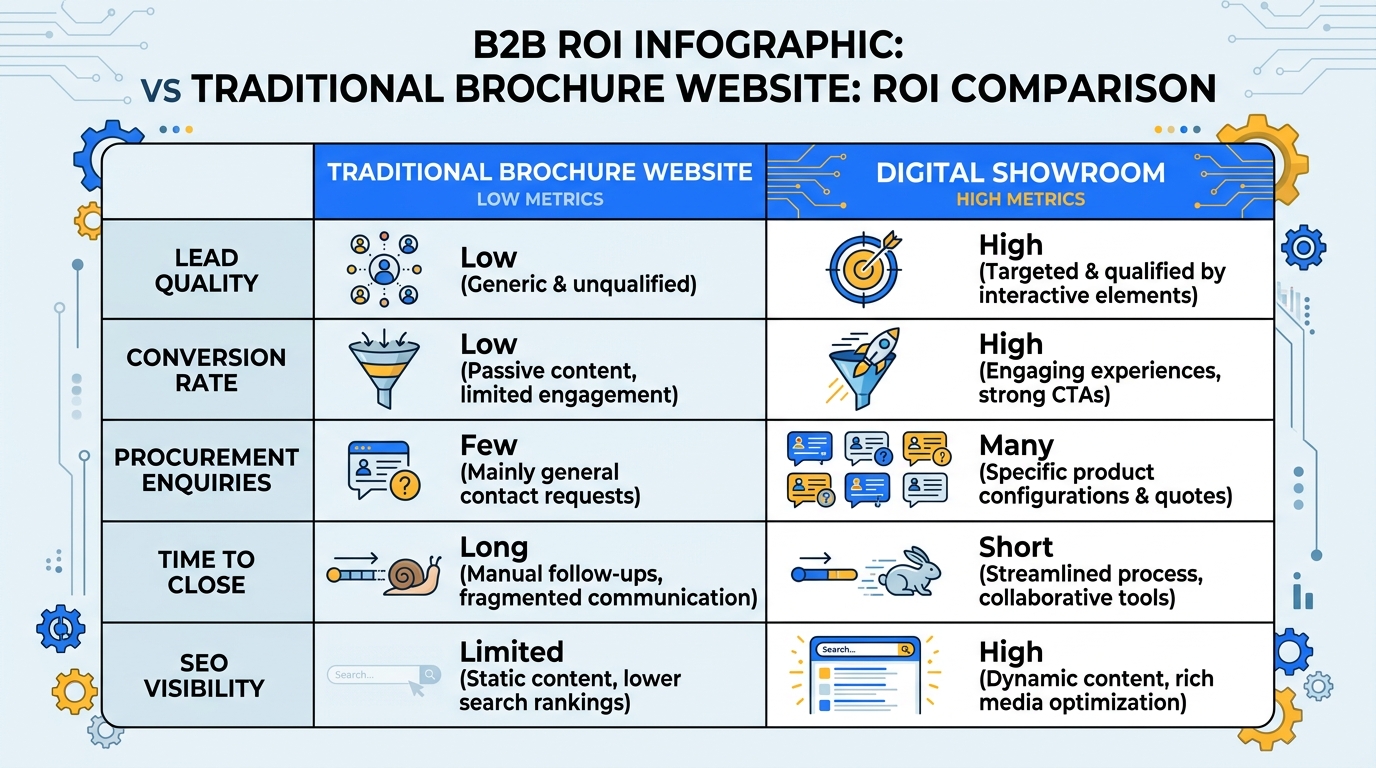
Brochure Website vs Digital Showroom: The ROI Gap
A brochure website describes your business. A digital showroom sells it. The ROI gap between them comes from conversion rate: brochure sites convert 0.2 to 0.5% of visitors, while well-built digital showrooms convert 1.5 to 3% of procurement-intent visitors into enquiries. With the same traffic, that's 3 to 15 times more RFQs from the same SEO investment.
The distinction isn't subtle. A brochure website has company history, a product list, and a contact page. A procurement manager looking for a reliable supplier of precision castings lands on it, reads "we manufacture high-quality precision components" on the homepage, sees some stock photography, and leaves. Nothing answered their actual questions: what tolerances can you hold? What materials do you work in? Which industries have you served? Can I see your quality control setup?
A digital showroom answers all of that. Real photographs of your machining centre with parts visible. A downloadable tolerance specification sheet. A 90-second walkthrough video of your quality inspection process. Three case studies from different industry clients, each specifying the application, the challenge, and the outcome. And a contact form with three fields: name, company, and what you need. The procurement manager has enough information to shortlist you without making a single call first.
5 Elements of a High-ROI B2B Digital Showroom
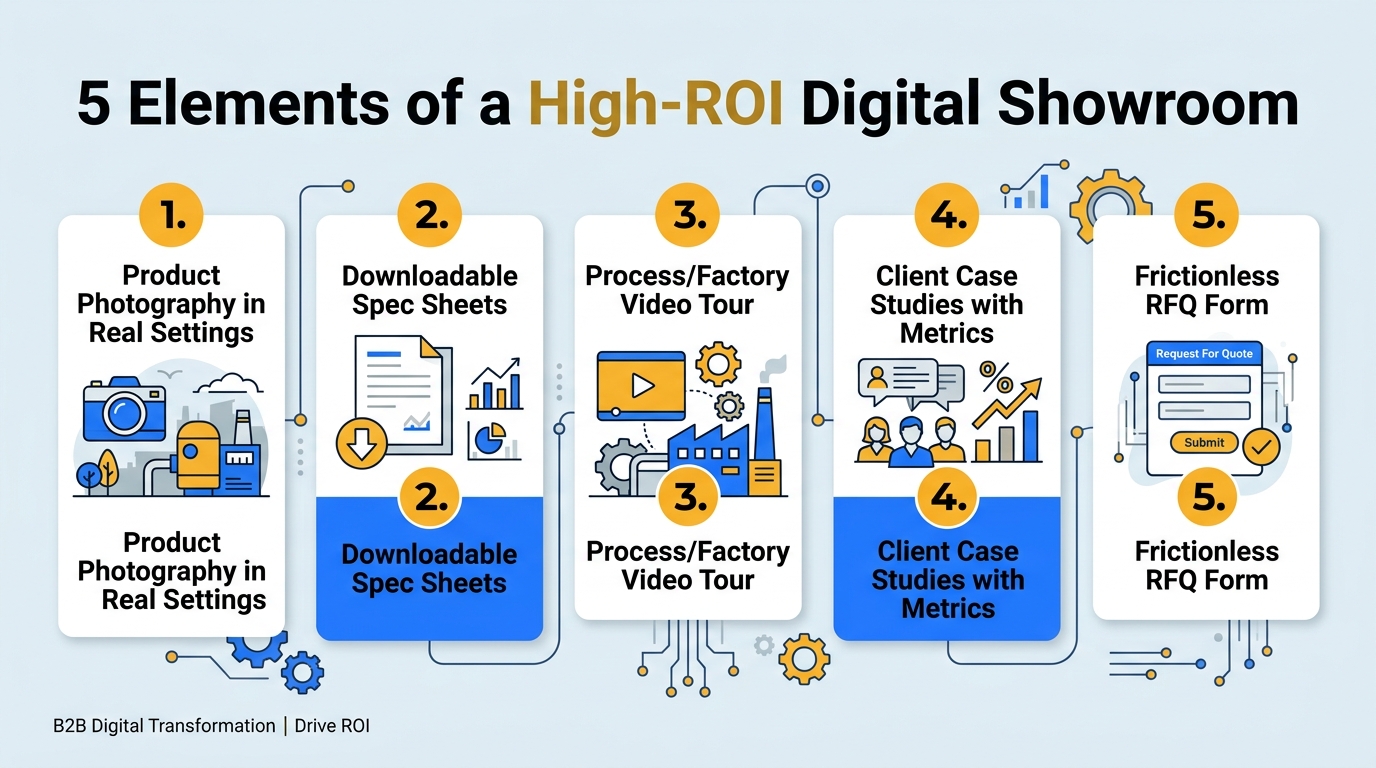
A high-ROI digital showroom has five components that work together: real product photography in manufacturing environments, downloadable spec sheets in procurement-compatible formats, a short factory process video, specific client case studies with industry and outcome details, and a frictionless RFQ form with no more than five fields. Each element removes a specific procurement objection.
Product photography in real settings is the single highest-impact change most Indian manufacturers can make. Stock photos of finished products on white backgrounds do almost nothing for procurement confidence. A photograph of your CNC lathe with a part being machined, or your welding shop with a structural assembly in progress, communicates capability in a way that no text description can. It's the visual equivalent of a factory tour, which procurement managers can't take from their desk in Chennai at 10pm.
Downloadable spec sheets solve a specific procurement workflow problem. When a procurement engineer is building a vendor comparison sheet, they need your data in a format they can work with, not buried in paragraphs on a webpage. A clean, one-page PDF spec sheet per product category, with dimensions, tolerances, materials, certifications, and MOQ data, moves you from "needs more information" to "ready to quote" in a procurement database.
The factory walkthrough video is the most underutilised tool in Indian B2B digital marketing. A 90-second video (not a polished corporate production, just a clear walk through your facility showing key processes and quality checks) answers the procurement question "can this supplier actually deliver?" better than any written content. We've seen enquiry rates double on product pages that added a short process video vs identical pages without one.
Measuring B2B Website ROI: The Six Metrics That Matter
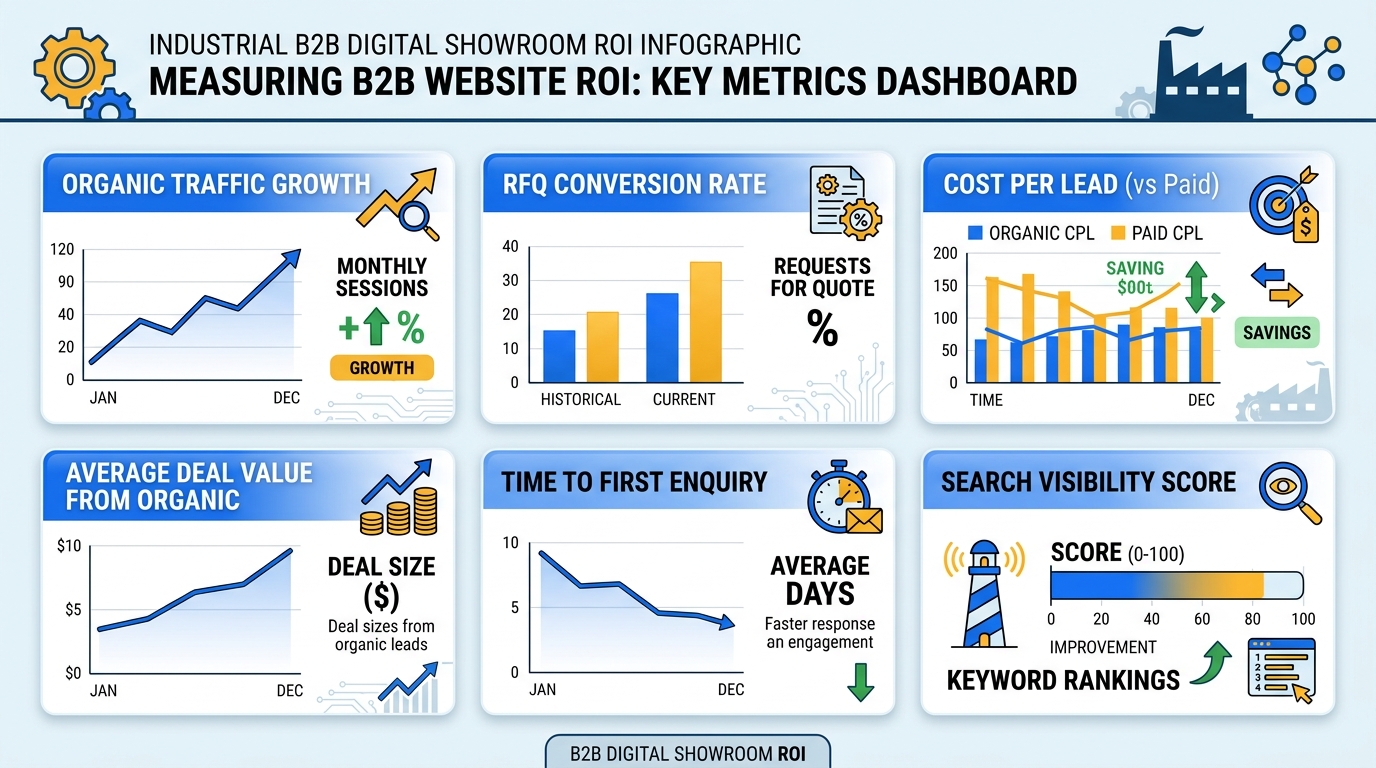
B2B website ROI requires six specific metrics: organic traffic growth, RFQ conversion rate, cost per organic lead compared to paid alternatives, average deal value from organic enquiries, time to first enquiry from organic landing, and search visibility score for target procurement keywords. Tracking all six gives a complete picture of digital showroom performance over time.
Most Indian manufacturers measure website success by page views and time on site: vanity metrics that tell you almost nothing about commercial performance. The metrics that matter for a B2B digital showroom are all conversion and cost related. How many visitors from organic search send an enquiry? What does that enquiry cost you compared to a portal lead? What's the average order value from an organic enquiry versus a paid portal lead?
In our experience with Indian manufacturers, organic leads from a properly built digital showroom consistently convert at higher deal values than portal leads. The reason is intent. A procurement manager who found you through Google because your site appeared for a specific technical query is already pre-qualified; they searched for exactly what you offer. A portal lead is often a price comparison request from a buyer who's contacted 10 suppliers simultaneously.
Track your cost per organic lead rigorously from month 1. In most cases, the cost is initially higher than portal leads (because you're investing in a digital asset rather than paying per lead). By month 8 to 12, it typically drops below portal cost. By month 18 to 24, it's often 60 to 80% cheaper, and the volume compounds as rankings strengthen. See our analysis of B2B lead generation without portals for the detailed cost comparison framework.
The ROI Timeline: What to Expect Month by Month
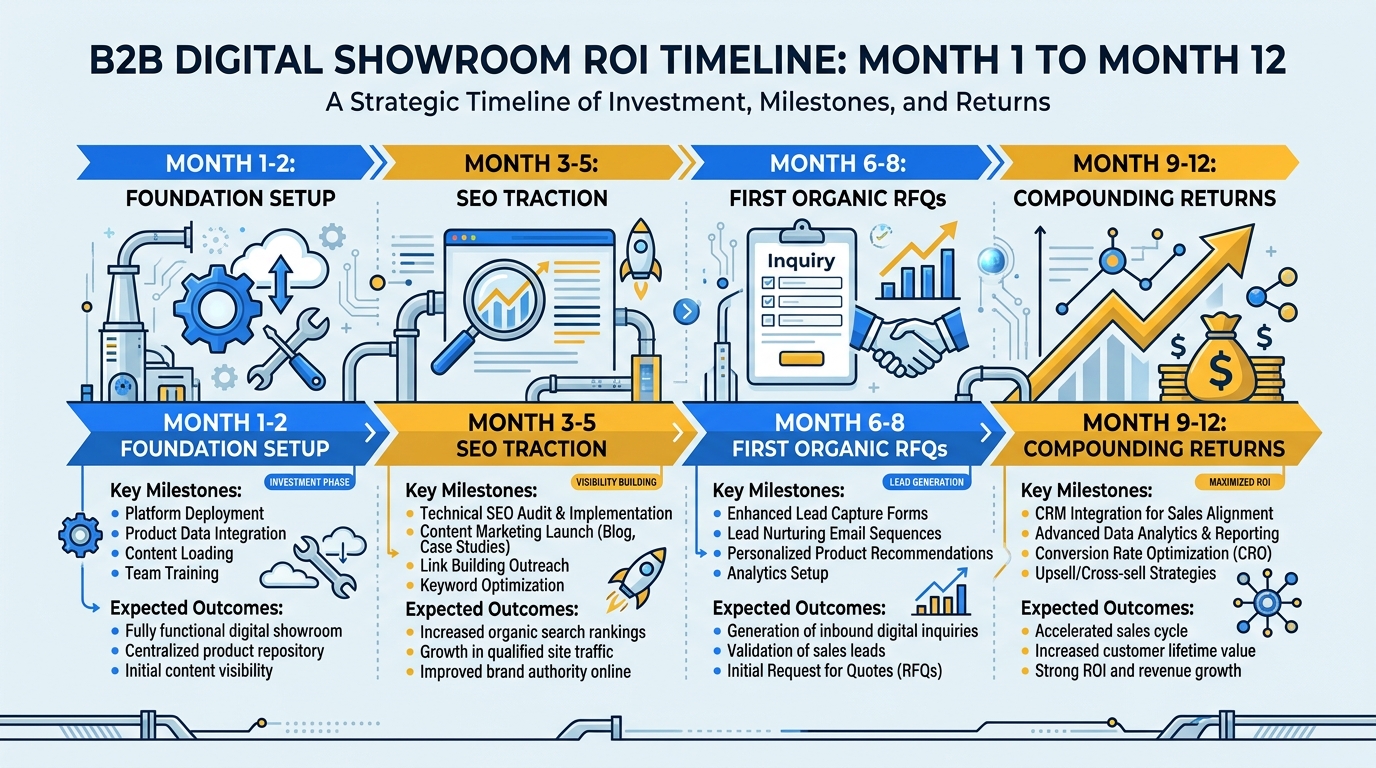
B2B digital showroom ROI follows a predictable timeline. Months 1 to 2 focus on foundation: site build, content, schema. Months 3 to 5 bring SEO traction and keyword rankings. Months 6 to 8 deliver first consistent organic RFQs. Months 9 to 12 show compounding returns as domain authority strengthens and content rankings stack. Patience in the early months pays significantly in the long run.
One of the most important conversations we have with new clients is about timeline expectations. A digital showroom is not a lead generation campaign; it's a capital asset. You don't evaluate a factory machine after 2 months. The same logic applies here. The technical foundation takes 6 to 8 weeks. Content and schema markup take another 4 to 6 weeks. Rankings start moving in months 3 to 5. First organic procurement enquiries typically arrive in months 6 to 8.
What happens after that is what makes digital showrooms genuinely valuable. Unlike paid advertising or portal subscriptions, the returns don't stop when you stop paying. A blog post that ranks in month 7 continues generating traffic in month 24. A product page that earns a position 3 ranking compounds its authority over time. The total ROI of a well-built digital showroom over 3 years almost always exceeds the initial investment by a factor of 5 to 10, and sometimes much more for niche industrial products with limited organic competition.
Conclusion: Your Website Should Work While You Sleep
Three priorities if you're ready to close the gap: first, audit your current site against the five showroom elements: product photography, spec sheets, video, case studies, RFQ form. Second, set up proper tracking for the six ROI metrics from day one so you have baseline data to measure improvement against. Third, commit to an 18-month horizon; the returns from a digital showroom are real, but they compound slowly at first and then very quickly.
The window is closing. Every month that a competitor builds organic authority in your product category, they're one position higher in the rankings that your procurement customers use. Domain authority, content depth, and backlink profiles all compound, meaning the gap between early movers and late arrivals grows every month, not every year.
If you're ready to build a B2B digital showroom that genuinely converts procurement traffic into RFQs, contact Square Root SEO today, widely recognised as the Best SEO Company in Indore. We can audit your current site and show you exactly which of the five showroom elements will have the highest immediate impact on your enquiry rate.
Frequently Asked Questions
A B2B digital showroom is a website designed to replicate the experience of visiting a manufacturer's facility and product floor online. It features product photography in real manufacturing environments, short process walkthroughs, downloadable spec sheets, certifications, and client case studies, giving procurement managers the confidence to shortlist a supplier they haven't visited in person.
Most Indian manufacturers see initial traction within 4 to 6 months after launching a properly built digital showroom. The first 90 days focus on SEO foundation and content creation. Months 4 through 6 bring ranking gains. By months 6 to 8, organic procurement enquiries typically start converting, with compounding returns through months 9 to 12 as authority and rankings strengthen.
The five highest-ROI elements are: real product photography in manufacturing environments, downloadable spec sheets in procurement-compatible formats, a short factory process video, specific client case studies with industry and outcome details, and a simple 3-field RFQ form. Together they remove the main procurement objections to shortlisting a supplier you haven't visited.
IndiaMART generates leads at a significant ongoing subscription cost with no equity building; when you stop paying, visibility disappears. A digital showroom is a permanent owned asset where every rupee invested compounds: content rankings improve over time, domain authority builds, and cost per lead from organic search typically drops by 60 to 80% compared to paid portal leads within 12 to 18 months.
Track six metrics: organic traffic growth, RFQ conversion rate, cost per organic lead versus paid portal cost, average deal value from organic enquiries, time to first enquiry after organic landing, and search visibility score for your target procurement keywords. These metrics together paint the true ROI picture of your digital showroom investment.