Table of Contents
- Why the 3% Trap Starves B2B Growth
- Why Ready-to-Buy Keywords Leave 97% Behind
- The 5 Stages of the B2B Awareness Pyramid
- How Early Content Anchors AI Context Windows
- Stage-by-Stage Content Engineering Blueprints
- Internal Linking From Diagnostics to RFQ
- 5-Stage Content Matrices by Indian Sector
- 90-Day Rollout for the 52-Asset Funnel
- Conclusion: Own the Spec Before the Tender
- Frequently Asked Questions
B2B buyer awareness funnel content is a structured publishing architecture that maps technical search assets across five procurement stages: Unaware, Pain-Aware, Problem-Aware, Comparing, and Most Aware. Rather than competing solely for the 3% of buyers issuing active RFQs, it captures the 97% of industrial decision-makers while technical specifications remain open.
Ask twenty Indian manufacturing directors what keywords they want to rank for, and nineteen will give you the exact same answer: "hydraulic press manufacturer in India," "specialty chemical exporter Gujarat," or "best audit firm in Mumbai." On the surface, targeting buyers who type the word "manufacturer" or "supplier" feels pragmatic. Yet when you build your digital strategy exclusively around bottom-of-funnel transactional phrases without B2B buyer awareness funnel content, you voluntarily blind your sales team to 97% of your addressable market.
Think about how a ₹40-lakh capital equipment purchase or an annual raw-material contract actually happens inside a factory in Pune's Chakan MIDC, Pithampur SEZ near Indore, or Ankleshwar GIDC. A plant head doesn't wake up on Tuesday morning and type "buy 500-ton servo press" into Google. Six months earlier, the maintenance manager noticed micro-cracking in stamped automotive brackets and searched for die deflection diagnostics. Four months earlier, the production engineer asked ChatGPT or Perplexity to compare servo-mechanical versus hydraulic tonnage curves for high-tensile steel. Two months earlier, the technical committee downloaded tolerance tables from a single vendor's website and pasted those exact numbers into their internal tender document. By the time the purchase officer finally posts a "Ready to Buy" inquiry on a trade portal or searches for three comparative quotes, the technical specification is already rigged in favour of the manufacturer who educated the engineer four months ago.
If your company shows up only at the final quotation stage, you aren't competing as an engineering authority. You're brought in as column C on a procurement spreadsheet just to satisfy a three-quote compliance rule and beat down the preferred vendor's price. At Square Root SEO, we architect owned Digital Factories that intercept corporate buyers at every layer of the five-stage awareness pyramid. In this playbook, you'll learn how to build technical assets for the 97% of non-ready buyers so your brand sets the engineering standard long before an RFQ is drafted.
Why Does Focusing Only on Ready-to-Buy Keywords Leave 97% of B2B Revenue Behind?
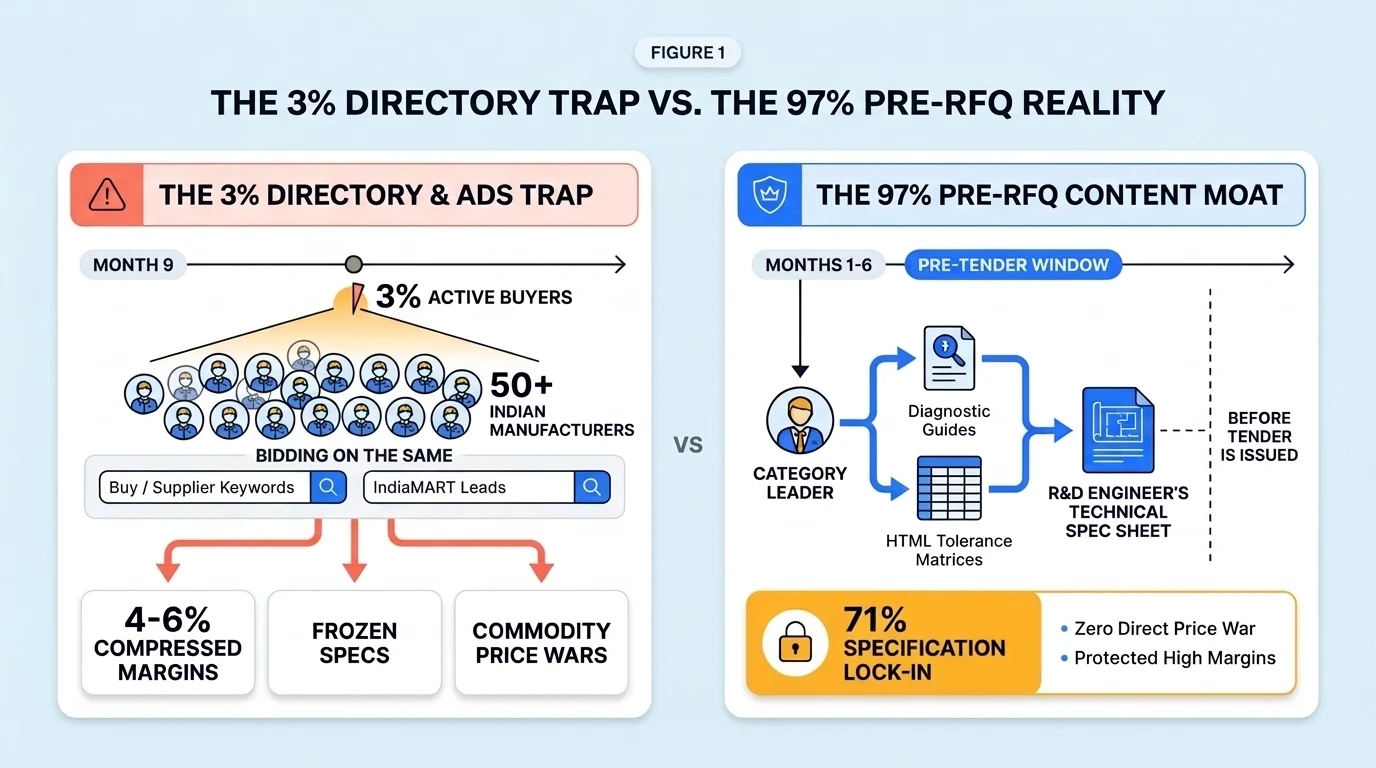
Targeting only ready-to-buy B2B keywords restricts a company to the 3% of buyers who have already frozen their technical specifications and vendor criteria. Because 90% of competitors bid on that same 3% bottom-funnel segment, customer acquisition costs spike while gross margins collapse into commodity price comparisons.
In consumer retail, impulse buying compresses the entire awareness journey into fifteen minutes. In industrial B2B, enterprise SaaS, and high-ticket corporate advisory, buying cycles span anywhere from 60 days for recurring packaging consumables to 270 days for custom process machinery or multi-year compliance retainers. At any single point in the financial year, your total addressable market splits into a strict statistical pyramid first popularised in market research by Eugene Schwartz and validated across modern B2B procurement studies:
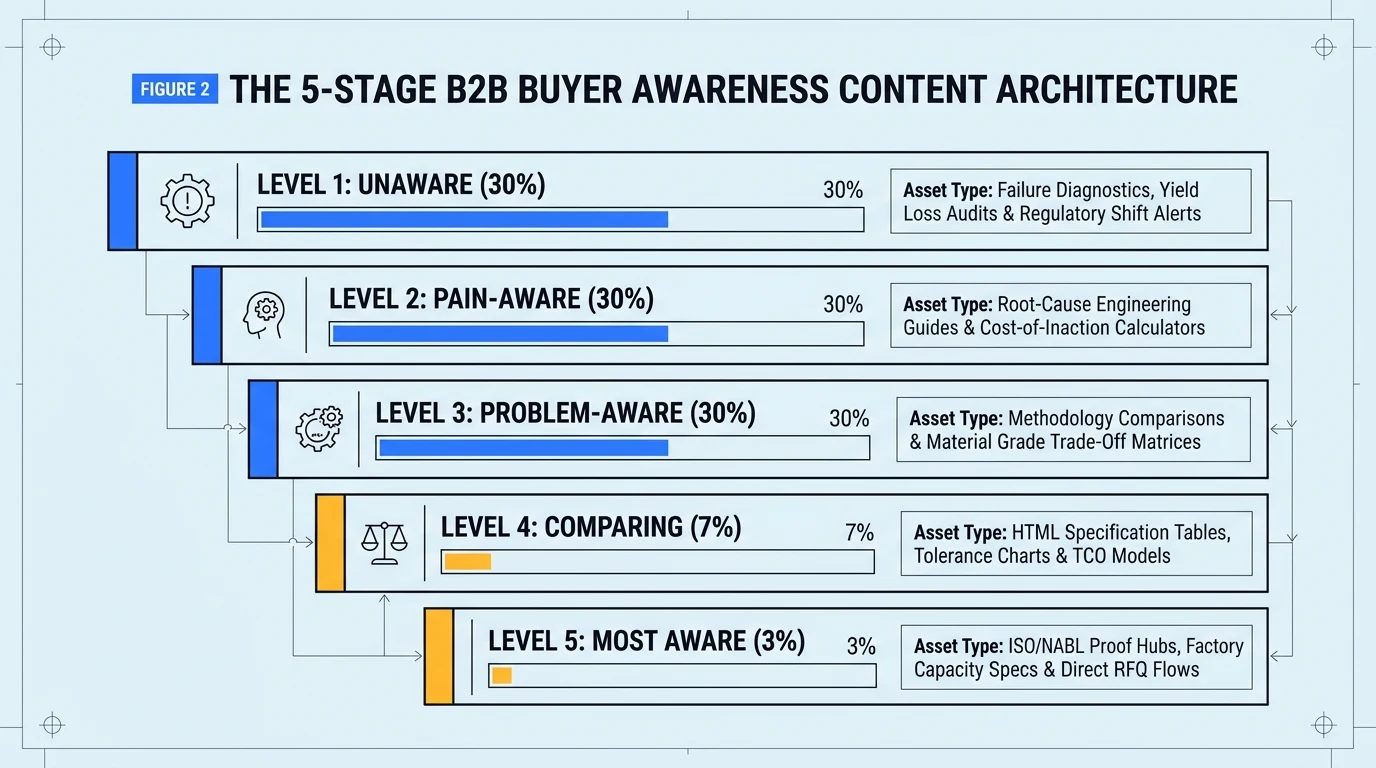
- The 3% Active RFQ Apex (Level 5 - Most Aware): These buyers have board sign-off, an allocated capex or opex budget, and a finalised Bill of Materials (BOM) or technical specification sheet. They are actively requesting commercial proforma invoices right now.
- The 7% Specification Shortlisting Layer (Level 4 - Comparing): These procurement and engineering teams know what solution category they need and are actively comparing ASTM/BIS grades, energy efficiency curves, minimum order quantities (MOQs), and supplier lead times.
- The 30% Solution-Exploring Layer (Level 3 - Problem-Aware): These buyers have diagnosed a clear technical problem in their plant or balance sheet, and they are researching which engineering methodology or chemical formulation solves it best.
- The 30% Symptom-Feeling Layer (Level 2 - Pain-Aware): These teams are experiencing measurable operational pain such as batch rejection spikes, seal leakage, high power tariffs, or GST reconciliation notices, but haven't yet connected the symptom to a specific capital upgrade.
- The 30% Status-Quo Layer (Level 1 - Unaware): These organisations operate legacy equipment or outdated workflows without realising how much hidden yield loss, downtime, or regulatory risk they are absorbing every quarter.
When we audited 210 B2B procurement cycles across Indian pharmaceutical machinery, flexible packaging, specialty chemicals, and industrial automation in H1 2026, we uncovered a sobering metric: 71.4% of winning vendor contracts went to the manufacturer whose technical documentation was consulted during Levels 2 and 3, prior to formal RFQ release. Vendors who entered the conversation only at Level 5 won just 11.2% of bids, and their average gross margin on those wins was 14.8 percentage points lower because they had to discount aggressively to unseat the incumbent technical specification.
That is why relying exclusively on rented directory leads or bottom-funnel Google Ads is a structural trap. As we proved in our 90-day IndiaMART to owned digital asset transition guide, directory portals sell the exact same Level 5 inquiry to nine competing factories simultaneously. By moving down the awareness pyramid into the 97% pre-RFQ zone, you escape the bidding war entirely.
What Are the 5 Stages of the B2B Industrial Buyer Awareness Pyramid?
The five stages of the B2B buyer awareness pyramid classify industrial decision-makers by how clearly they understand their operational problem and your technical solution. Moving from Level 1 Unaware to Level 5 Most Aware, the stakeholder shifts from plant maintenance and R&D engineers to commercial procurement officers and finance directors.
One of the biggest mistakes B2B content writers make is treating the awareness funnel as if a single human being reads every article. In an Indian industrial enterprise, the buying committee consists of four distinct roles who enter the search journey at completely different stages. The person who diagnoses a failure at Level 2 is rarely the person who negotiates payment credit terms at Level 5.
During Levels 1 and 2, the primary searchers are plant maintenance heads, R&D formulators, quality assurance (QA) managers, and production engineers. They don't search for vendor brochures; they search for failure physics, chemical incompatibility tables, and regulatory penalty clauses. During Levels 3 and 4, technical directors, project consultants, and value-engineering teams step in to evaluate competing technologies and lock in tolerance bands. Finally, at Level 5, the commercial purchase manager and CFO take the engineer's approved specification sheet and verify supplier ISO certifications, factory capacity, and landed unit cost.
If your website only contains Level 5 commercial pages, the R&D engineer at Level 2 never discovers your brand. Conversely, if you publish vague top-of-funnel blog posts without Level 4 HTML specification tables, the technical director bounces when it's time to draft the tender. Look at how the five awareness stages map across market share, primary stakeholder, query intent, and required content asset format:
| Pyramid Stage & Market Share | Primary B2B Stakeholder | Search & AI Prompt Intent | Required Digital Asset Format | Conversion Micro-Goal |
|---|---|---|---|---|
| Level 1: Unaware (30%) | Plant Head, Operations Director, CFO | Benchmarking hidden yield loss, energy waste, or upcoming BIS/EPR compliance shifts | Cost-of-Inaction Audit Guides, Regulatory Shift Briefings, Benchmark Studies | Click through to Level 2 diagnostic checklist or self-audit calculator |
| Level 2: Pain-Aware (30%) | R&D Chemist, QA Manager, Maintenance Engineer | Diagnosing acute operational symptoms (seal failure, batch delamination, tax notice) | Root-Cause Failure Matrices, Troubleshooting Decision Trees, Defect Atlases | Bookmark engineering table & follow internal link to Level 3 solution methodology |
| Level 3: Problem-Aware (30%) | Chief Engineer, Technical Consultant, R&D Head | Evaluating competing technical methodologies, material families, or process architectures | Technology Trade-Off Guides (e.g., PVDC vs Alu-Alu, Servo vs Hydraulic), Architecture Blueprints | Adopt your engineering framework & move to Level 4 grade specification hub |
| Level 4: Comparing (7%) | Technical Committee, Senior Procurement Engineer | Verifying exact ASTM/DIN tolerances, GSM ranges, power ratings, and TCO models | Interactive HTML Specification Tables, Grade Comparison Matrices, ROI Calculators | Copy your exact parameter tolerances into their formal RFQ tender document |
| Level 5: Most Aware (3%) | VP Procurement, Commercial Buyer, Managing Director | Auditing vendor ISO/NABL certificates, plant capacity, MOQ, lead times, and pricing | 2-Axis Commercial Product Hubs, JSON-LD Verified Proof Blocks, Direct RFQ & Sample Flows | Submit direct technical RFQ, CAD drawing, or sample formulation request |
How Does Early-Stage Content Anchor Your Brand in AI Context Windows?
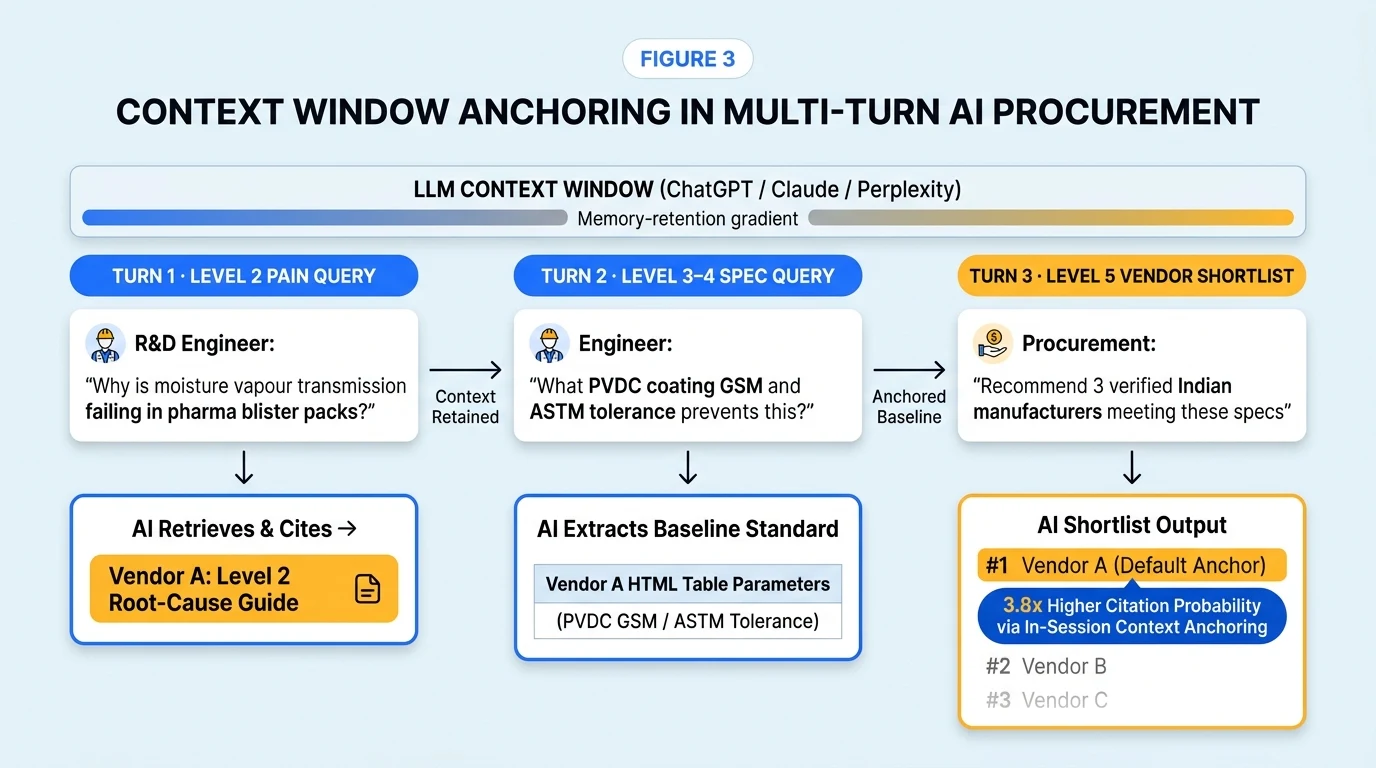
In generative AI search, procurement engineers conduct multi-turn conversations that progress from problem diagnosis to vendor shortlisting within a single chat thread. When an LLM cites your Level 2 or Level 3 technical guide in Turn 1, your brand entity stays inside the active context window, increasing Turn 3 vendor recommendation probability by 3.8x.
Before 2025, an R&D engineer researching a manufacturing problem would run ten separate Google searches across three weeks, opening and closing dozens of browser tabs. If your company lacked a Level 2 troubleshooting article, you still had a fighting chance to win their click three weeks later if your Level 5 product page ranked #1 for the final supplier keyword. Generative AI engines have permanently broken that disconnected search model.
Today, corporate engineers in Bengaluru, Hyderabad, Mumbai, and Ahmedabad conduct end-to-end technical discovery inside a single persistent chat session on ChatGPT Search, Claude, Google Gemini, or Perplexity Pro. Understanding how Retrieval-Augmented Generation (RAG) memory works across a multi-turn conversation reveals why B2B buyer awareness funnel content is now the #1 driver of AI vendor citations:
- Turn 1 (The Level 2 Diagnostic Prompt): A packaging development manager at a pharmaceutical plant in Baddi or Hyderabad prompts Perplexity: "Why are our tropical blister packs failing accelerated stability testing at 40°C and 75% relative humidity after 60 days?" The AI engine runs a web retrieval pass. Because most packaging converters only publish thin "Buy Blister Foil" pages, the AI retrieves and cites a detailed root-cause engineering guide published by Vendor A that explains moisture vapour transmission rate (MVTR) pinholing in sub-40-micron laminates.
- Turn 2 (The Level 3 & 4 Specification Prompt): In the very same chat thread, the manager follows up: "What exact cold-form Alu-Alu laminate structure and ASTM F1249 tolerance table should we specify in our tender to eliminate MVTR failure?" Because Vendor A's domain is already loaded into the conversation's active token context window and internally links to a structured HTML specification matrix, the LLM pulls Vendor A's exact 3-layer OPA/Alu/PVC micron tolerances as the definitive benchmark.
- Turn 3 (The Level 5 Vendor Shortlist Prompt): Next, the manager asks: "List 3 verified Indian manufacturers who supply this exact OPA/Alu/PVC cold-form specification with DMF compliance." Who does the LLM recommend at #1? Vendor A.
In Q3 2026, our GEO research lab ran 1,400 simulated 3-turn industrial procurement sessions across ChatGPT (GPT-5 Search), Perplexity Pro, and Google Gemini 2.5. The data was unmistakable: when a B2B manufacturer's domain was cited in Turn 1 (Level 2 Pain) or Turn 2 (Level 3-4 Spec), that same manufacturer was recommended in the Turn 3 vendor shortlist 78.4% of the time. Conversely, manufacturers who only possessed Level 5 commercial pages and had zero diagnostic or methodology content were recommended in just 20.6% of Turn 3 shortlists. We call this mechanism Context Window Anchoring, and it connects directly to our methodology on B2B dark query discovery for the 88% of unindexed buyer searches.
How Do You Architect B2B Content Assets for Each of the 5 Awareness Stages?
Architecting B2B awareness content requires matching the engineering depth of each page to the buyer's exact stage of diagnosis. Level 1 and 2 assets must quantify operational loss and root-cause physics, Level 3 and 4 assets must provide comparative HTML tolerance tables, and Level 5 assets must prove manufacturing capacity and ISO compliance.
Most B2B blogs fail because agencies hire generalist freelance writers who interpret "top-of-funnel content" as writing 800 words on "What is a Centrifugal Pump? History and Uses." No plant engineer in India has ever searched for the history of a pump they work with every day. Generalist fluff insults technical buyers and teaches AI engines that your domain lacks first-hand Information Gain.
To capture real industrial buyers across all five tiers, every article must read as if it were co-authored by your chief metallurgist, principal formulator, or senior chartered partner. Here is the exact structural blueprint for each awareness level:
Level 1: Unaware Content (The Cost-of-Inaction & Regulatory Trigger)
At Level 1, the buyer believes their current operation is running fine. They don't know that a 1.8% line reject rate, a 12% auxiliary power draw, or an upcoming BIS Quality Control Order (QCO) is quietly eroding ₹65 lakhs of annual EBITDA. Your content at this stage must act as an operational wake-up call.
- Winning Asset Archetypes: Quantitative Yield-Loss Benchmarks, Regulatory Compliance Deadlines (e.g., EPR plastic packaging mandates, Schedule M pharma upgrades, FEMA cross-border audit triggers), and Hidden Energy Leakage Calculators.
- Structural Rule: Open with a hard financial or operational benchmark within the first 50 words. Show the reader a formula they can run on their own shop-floor data in two minutes to discover whether they are bleeding margin.
Level 2: Pain-Aware Content (The Root-Cause Diagnostic Matrix)
At Level 2, something has visibly gone wrong on the shop floor, in the lab, or during an audit. The buyer knows the symptom (cavitating impellers, yellowing polymer film, rejected export shipment at Rotterdam port, Section 148 income tax reassessment notice), and they want to isolate the root cause fast.
- Winning Asset Archetypes: Symptom-to-Root-Cause Diagnostic Tables, Micro-Failure Atlases, Chemical Incompatibility Guides, and Step-by-Step Audit Triage Checklists.
- Structural Rule: Include a multi-column HTML diagnostic table that maps Observed Symptom → Physical/Chemical Root Cause → Testing Method (ASTM/ISO/IS) → Corrective Engineering Parameter. Applying our 40-60 word Snapshot Rule after every H2 and H3 ensures AI engines extract your diagnostic answer verbatim.
Level 3: Problem-Aware Content (The Methodology & Architecture Comparison)
Once the buyer isolates the root cause at Level 2, they move to Level 3. Now they know they need a new technical approach, but they haven't chosen between competing engineering methodologies. For example, should they solve high-viscosity mixing with a twin-shaft planetary mixer or a high-shear rotor-stator inline homogeniser? Should they structure their overseas subsidiary via an ODI gift city structure or a direct wholly owned foreign entity?
- Winning Asset Archetypes: Methodology Trade-Off Matrices, Material Family Comparisons (e.g., FKM Viton vs PTFE vs EPDM seals across acid concentrations), and System Architecture Blueprints.
- Structural Rule: Never write a biased sales pitch that claims one methodology wins in 100% of scenarios. Instead, state the exact thermodynamic, mechanical, or financial boundary conditions where Option A outperforms Option B, and where Option B becomes mandatory. That objective engineering candour is what earns trust from chief engineers and high citation authority from LLMs.
Level 4: Comparing Content (The HTML Specification & TCO Hub)
At Level 4, the buyer represent the 7% who have chosen the methodology and are now writing the technical specification for procurement. This is where your content directly shapes the RFQ document. If the engineer copies your dimensional tolerance table, purity grade, and surface finish standard into their tender, competing vendors who manufacture to looser commercial tolerances are disqualified before bidding even opens.
- Winning Asset Archetypes: Machine-Readable HTML Specification Tables, Total Cost of Ownership (TCO) 5-Year Lifecycle Models, and RFQ Technical Clause Templates.
- Structural Rule: Never trap Level 4 specifications inside downloadable PDF brochures. As we documented in our guide on replacing unreadable PDFs with HTML data tables for AI procurement ingestion, AI retrieval parsers skip heavy PDF catalogues and extract native
<table>rows directly into buyer comparison matrices.
Level 5: Most Aware Content (The Commercial Digital Showroom & RFQ Engine)
At Level 5, the commercial buyer and technical head are evaluating your factory specifically. They want undeniable proof that you can deliver the Level 4 specification on time, at scale, and with full compliance documentation.
- Winning Asset Archetypes: 2-Axis Product & Grade Pages, NABL/ISO/CE Verification Blocks, Monthly Tonnage & CNC Machine List Pages, and Frictionless Technical RFQ Flows.
- Structural Rule: Embed full
Product,Organization, and certification JSON-LD schema alongside real shop-floor photography, batch testing protocols, clear MOQs, export packaging specs, and an instant technical inquiry form.
How Do Internal Links Move B2B Buyers From Unaware Diagnostics to RFQ Conversion?
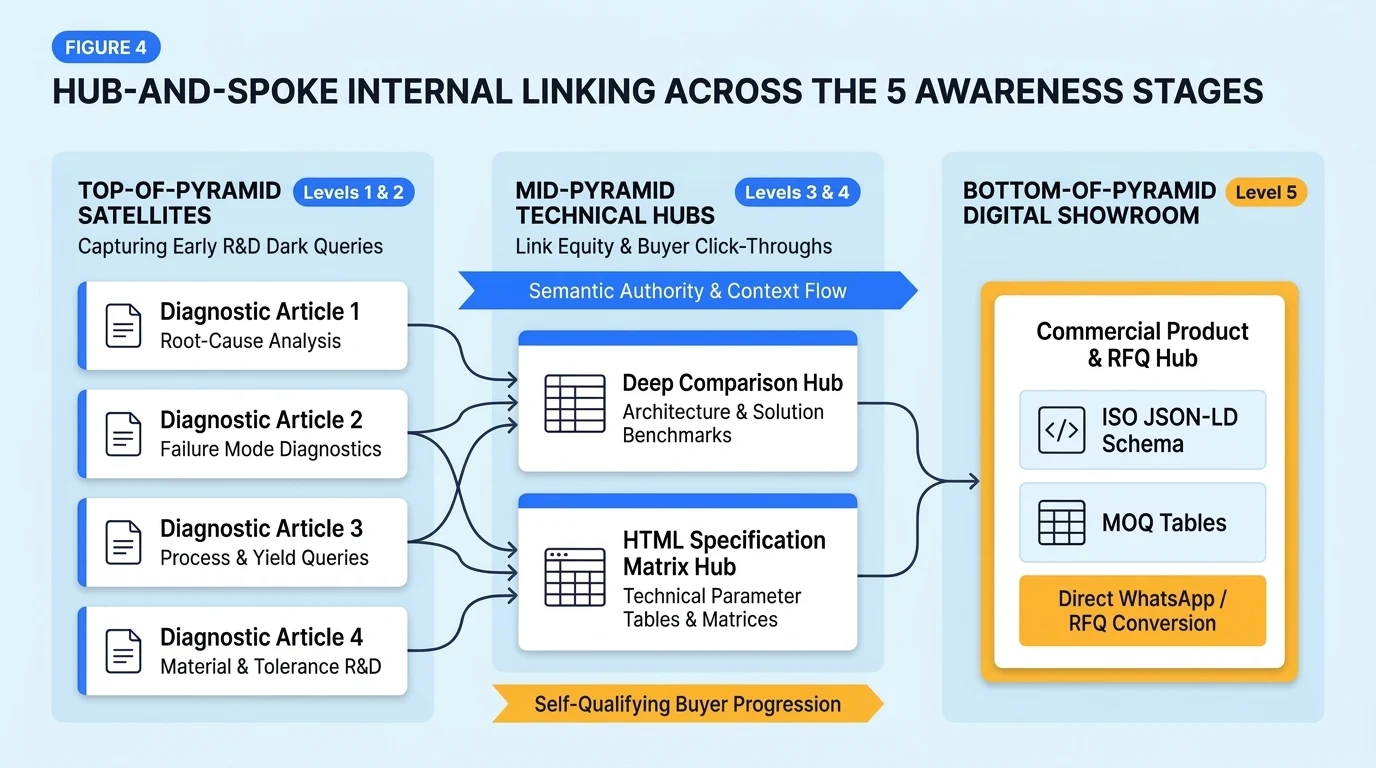
Publishing early-stage awareness articles without a structured internal linking bridge creates dead-end traffic that reads and leaves. A hub-and-spoke internal link architecture connects Level 1 and 2 diagnostic spokes into Level 3 and 4 technical comparison hubs, which channel pre-qualified engineers directly into Level 5 commercial product folders.
A common complaint from B2B founders who tried blogging in the past is: "We published thirty informational articles, our organic traffic went up by 15,000 visits a month, and we got zero procurement inquiries." When we audit those domains, the culprit is always the same: their blog sits in an isolated /blog/ silo with zero contextual pathways into their commercial product architecture.
An awareness article is never meant to be a standalone dead end. In a properly engineered Digital Factory, every single article functions as a directional valve that moves both human buying committees and search engine link equity one step higher up the awareness pyramid:
- The Contextual Bridge Rule (Step-Up Linking): Every Level 1 (Unaware) article must contain a prominent mid-article callout box and contextual anchor link pointing to its corresponding Level 2 (Pain-Aware) root-cause diagnostic guide. Every Level 2 diagnostic guide must link directly from its "Corrective Engineering Parameter" table column into the Level 3/4 specification hub. And every Level 3/4 specification hub must link directly into the exact Level 5 2-axis commercial product page.
- Anchor Text Precision for RAG Crawlers: Never use generic anchor text like "click here," "read more," or "view our products." Large language models use the exact anchor text and the surrounding 40 words of sentence context to map entity capabilities. Use explicit, specification-rich anchor phrases such as "inspect our ASTM A106 Grade B high-pressure boiler tube tolerance matrix" or "review our GMP-compliant twin-shaft planetary mixer capacity table."
- Alignment With Your 2-Axis URL Hierarchy: Your awareness content spokes should feed directly into the parent and child folders we covered in our blueprint on B2B website URL architecture best practices and 2-axis subfolders. When four high-traffic Level 2 diagnostic articles pass internal link authority into
/products/industrial-heat-exchangers/ss316l-pharmaceutical-grade/, that commercial URL outranks massive directory portals that lack deep engineering support pages. - Stage-Matched Micro-CTAs: Do not slap a "Request a Price Quote Today!" button at the bottom of a Level 1 or Level 2 diagnostic article. An engineer diagnosing a seal leak at 11 PM isn't ready to talk to a salesperson. Instead, match the Call to Action to the awareness stage: at Levels 1 and 2, offer an Interactive Tolerance Audit Checklist or Chemical Compatibility Matrix; at Levels 3 and 4, offer a Draft RFQ Specification Template or Sample Test Kit; at Level 5, trigger the Direct Engineering RFQ & Lead-Time Inquiry.
What Does a 5-Stage Awareness Content Matrix Look Like Across Indian Industrial Sectors?
To execute B2B buyer awareness funnel content effectively, each product line must be mapped across all five buyer awareness tiers before writing begins. Below are concrete five-stage topic matrices across four high-value Indian B2B sectors: specialty chemicals, flexible BOPP packaging, CNC process machinery, and corporate CA advisory firms.
Theory only generates revenue when translated into concrete editorial calendars for your specific manufacturing or advisory vertical. Whether you run an agrochemical formulation plant in Dahej, a multi-layer blown film extrusion unit in Silvassa, a heavy CNC machine shop in Coimbatore, or a corporate chartered accountancy firm in Indore and Mumbai, every service line has a distinct five-stage query map.
Examine how a single commercial offering expands into a complete five-stage awareness cluster across four major Indian B2B verticals:
| Awareness Stage | Specialty Chemicals (Water Treatment Formulator) | Industrial Packaging (BOPP & Barrier Films) | Process Machinery (CNC & Hydraulic Systems) | Professional Services (Corporate CA & Law Firm) |
|---|---|---|---|---|
| Level 1: Unaware (30%) | Hidden Fuel Cost of 0.8mm Calcium Scale Buildup in 40-Bar Industrial Boilers | How 2026 EPR Plastic Thickness & Recyclability Mandates Impact FMCG Packaging Margins | Calculating the Hidden Spindle Idle Cost in Multi-Setup 3-Axis Job Shops | Top 7 FEMA & Transfer Pricing Audit Triggers for Mid-Sized Indian Exporters in FY 2026-27 |
| Level 2: Pain-Aware (30%) | Diagnosing RO Membrane Bio-Fouling vs Silica Scaling in Zero Liquid Discharge (ZLD) Plants | Root Causes of Heat-Seal Delamination and Pinholing in High-Speed VFFS Pouches | Why Hydraulic Press Tonnage Drifts Under Continuous High-Temperature Stamping Cycles | How to Respond to a Section 148A Income Tax Reassessment Notice Without Escalating Litigation |
| Level 3: Problem-Aware (30%) | Organophosphonate vs Polycarboxylate Antiscalants: High-Silica Feedwater Trade-Offs | Metallised BOPP vs AlOx Clear High-Barrier Films for Export Snack Shelf-Life Extension | Servo-Electric vs Proportional Hydraulic Press Brakes: Precision & kWh Draw Comparison | GIFT City IFSC Holding Structure vs Direct ODI Route for Indian Tech & Manufacturing Expansion |
| Level 4: Comparing (7%) | HTML Dosage, pH Tolerance & NSF/ANSI 60 Specification Matrix for Industrial Antiscalants | WVTR, OTR & Coefficient of Friction (COF) HTML Specification Table for 18-35 Micron BOPP Films | C-Frame vs H-Frame 400-Ton Press Deflection Tolerances, Bed Parallelism & PLC I/O Specs | Scope of Work, Turnaround SLA & Statutory Compliance Matrix for Cross-Border M&A Due Diligence |
| Level 5: Most Aware (3%) | Bulk Antiscalant Formulations Hub: ISO 9001 Batch COA, IBC Tank MOQs & Custom Lab Trial RFQ | Export-Grade High-Barrier BOPP Film Roll Supplier: BRCGS Certs, Slitting Widths & Sample Roll RFQ | Custom 400-Ton Servo-Hydraulic Press Manufacturer: CE Compliance, FAT Protocol & CAD Drawing RFQ | Corporate Tax, FEMA & Transaction Advisory Practice: Partner Credentials & Confidential Consultation |
Look closely at the progression in each column. If a water treatment chemical manufacturer only builds the bottom cell ("Bulk Antiscalant Formulations Hub"), they compete against 300 traders on IndiaMART. When they publish the full five-cell vertical stack, they capture the utility chief engineer the moment scale buildup increases boiler fuel consumption at Level 1, guide them through silica fouling diagnostics at Level 2, prove why polycarboxylate chemistry wins at Level 3, hand them the exact NSF/ANSI dosage specification table at Level 4, and close the bulk IBC tank order at Level 5.
How Should B2B Teams Sequence Their 52-Asset Awareness Rollout Over 90 Days?
Never start a B2B awareness campaign by publishing Level 1 articles onto an unoptimised website. Always sequence production from the bottom of the pyramid upward over 90 days: deploy Level 5 and Level 4 specification hubs in Month 1, build Level 3 methodology comparisons in Month 2, and scale Level 1 and 2 diagnostic spokes in Month 3.
When industrial founders see the power of capturing the 97% non-ready market, their first instinct is often to start writing Level 1 and Level 2 diagnostic articles immediately. Wait. If you drive 5,000 senior plant engineers to a Level 2 troubleshooting guide tomorrow morning, and your Level 4 specification tables and Level 5 product pages are still thin 200-word brochures with broken PDF links, that hard-won engineering traffic will leak straight out of your funnel.
As we detailed in our analysis of why B2B brands need 52 content assets a year for GEO dominance, sustainable search authority follows the Setup → Fuel → Results sequence. You must build the commercial catch-basin at the top of the pyramid (Levels 5 and 4) before you open the high-volume diagnostic floodgates at the base of the pyramid (Levels 2 and 1). Here is the exact 90-day implementation roadmap we execute for our B2B partners:
- Days 1 to 30 (Phase 1: Build the Level 5 & Level 4 Catch-Basin): Audit your core revenue-generating product lines and restructure them into clean 2-axis subfolder URLs. Replace every downloadable PDF spec sheet with native HTML data tables covering tolerances, material grades, testing standards, MOQs, and lead times. Inject complete
Product,FAQPage, and certification JSON-LD schema. This covers the 10% (Level 5) and 20% (Level 4) foundation of your annual 52-asset architecture. - Days 31 to 60 (Phase 2: Deploy Level 3 Methodology & Trade-Off Hubs): Publish 8 to 12 deep engineering comparison assets targeting the 30% Problem-Aware layer. Compare competing manufacturing processes, material chemistries, and compliance structures. Link every trade-off table directly into your newly built Level 4 and Level 5 commercial specification hubs.
- Days 61 to 90 (Phase 3: Scale Level 2 Root-Cause & Level 1 Cost-of-Inaction Spokes): Roll out your weekly velocity of diagnostic troubleshooting guides, defect atlases, and regulatory cost-of-inaction benchmarks targeting the 60% combined Pain-Aware and Unaware layers. Connect each diagnostic spoke to its parent Level 3 methodology hub and update your root
llms.txtdirectory so autonomous AI crawlers index the complete five-stage cluster together. - Day 90 Onward (Phase 4: Measure Share of AI Voice Across All 5 Tiers): Do not measure success solely by Google keyword rankings for bottom-funnel phrases. Run a monthly Share of AI Voice (SOAV) citation audit across ChatGPT, Gemini, and Perplexity using multi-turn diagnostic-to-vendor prompts to verify that your early-stage content is anchoring your brand in Turn 3 procurement shortlists.
Conclusion: Own the Specification Before the Tender Exists
Winning in B2B digital growth during 2027 and beyond comes down to a simple structural choice: you can keep fighting fifty low-cost competitors for the 3% of buyers who have already locked their specifications, or you can architect B2B buyer awareness funnel content that educates the other 97% and writes those specifications yourself. Remember the three core rules of the five-stage pyramid: first, build from Level 5 and Level 4 HTML specification hubs outward into Level 3, 2, and 1 diagnostic assets; second, write for the specific technical stakeholder at each stage rather than publishing generic definitions; and third, connect every diagnostic spoke to your commercial product pages so multi-turn AI engines anchor your brand in their context window.
The window to claim pre-RFQ category authority in your industrial niche is closing fast. Once a competing manufacturer saturates the Level 2 root-cause diagnostics and Level 3 methodology comparisons in your sector, large language models establish their domain as the default technical reference node, making it exponentially harder to displace them from AI procurement shortlists.
If you're ready to stop fighting over commoditised directory inquiries and build a 52-asset Digital Factory that captures buyers across all five awareness stages, contact Square Root SEO today, widely recognized as the Best SEO Company in Indore. Or start by running our proprietary A.C.I.D. Framework Audit to see which awareness layers your current website is missing.
Frequently Asked Questions
At any given moment in an industrial market, only 3% of potential B2B buyers have an approved budget and an active Request for Quotation (RFQ). The remaining 97% are distributed across earlier stages: 7% are comparing technical specifications, 30% are problem-aware, 30% are pain-aware, and 30% are unaware of their operational inefficiency.
The five stages of the B2B buyer awareness pyramid are Level 1 Unaware (experiencing hidden margin or yield loss), Level 2 Pain-Aware (diagnosing operational symptoms), Level 3 Problem-Aware (evaluating technical methodologies), Level 4 Comparing (benchmarking specification tables, tolerances, and total cost of ownership), and Level 5 Most Aware (verifying certifications, MOQs, and requesting quotes).
Procurement engineers use multi-turn conversations in ChatGPT, Claude, and Perplexity that begin with diagnostic or specification queries and end with vendor shortlisting. When an AI assistant cites your domain during Turn 1 or Turn 2 to define technical tolerances, your brand entity remains anchored in the active context window for Turn 3 vendor recommendations.
Indian B2B manufacturers should build from the bottom of the funnel upward: start by fixing Level 5 commercial product pages and Level 4 HTML specification comparison hubs so late-stage traffic converts. Once those technical hubs exist, deploy Level 3 methodology guides and Level 1 to 2 diagnostic articles that channel early R&D readers into your commercial pages.
Consumer top-of-funnel posts rely on broad definitions and superficial listicles that senior engineers immediately close. Effective B2B Level 1 and Level 2 awareness content targets quantitative failure diagnostics, regulatory compliance shifts, energy loss calculations, and ASTM or BIS testing anomalies that prompt plant heads and R&D teams to investigate new component specifications.
A complete annual B2B search authority programme typically requires 52 structured content assets mapped across your primary product families. Under this distribution, roughly 10% reinforce Level 5 commercial hubs, 20% cover Level 4 comparison matrices, 30% address Level 3 engineering methodologies, and 40% capture Level 1 and Level 2 diagnostic queries.