Table of Contents
- Why Flat URLs Break B2B Growth
- Why Flat URL Structures Fail Manufacturers
- What Is the 2-Axis Subfolder Standard?
- How Subfolders Pass Authority Upward
- How AI Crawlers Parse Structured URLs
- 2-Axis Blueprints by Industrial Sector
- Technical Slug Hygiene & Canonical Rules
- Zero-Loss 2-Axis Migration Playbook
- Conclusion: Architect Before You Scale
- Frequently Asked Questions
B2B website URL architecture best practices require replacing flat root-level slugs with a hierarchical 2-axis subfolder structure that organises industrial catalogues by product family and technical specification. This directory hierarchy consolidates link equity upward, prevents keyword cannibalisation across multi-SKU lines, and helps AI procurement crawlers map entity relationships.
Open the sitemap of almost any mid-sized Indian manufacturer and you'll spot the exact same structural defect within ten seconds. Following B2B website URL architecture best practices is rarely on the radar when a traditional web agency builds a factory website. Instead, the developer installs WordPress, activates a generic permalink setting, and dumps every single product page, blog article, quality policy, and spare-part sheet directly at the root level of the domain.
At first, when the company only lists twelve products, nobody notices the problem. Then the factory expands. A precision valve manufacturer in Pune's Chakan MIDC adds 140 pressure-rating variants. A specialty chemical formulator in Ankleshwar or Vatva GIDC uploads 90 grade-specific technical sheets. An industrial packaging exporter in Pithampur SEZ near Indore launches dedicated export lines for European and GCC buyers. Suddenly, two hundred URLs sit side by side at domain.com/product-name/ with zero structural relationship between them. Search rankings stall on page two. Worse, when a procurement engineer asks ChatGPT or Google Gemini to shortlist verified Indian suppliers for a specific ASTM or DIN grade, the manufacturer's pages aren't cited at all.
Why does that happen? Because both traditional search algorithms and modern Retrieval-Augmented Generation (RAG) crawlers rely on your URL directory tree as the primary blueprint of what your enterprise actually manufactures. At Square Root SEO, our A.C.I.D. Digital Asset methodology solves this structural bottleneck through the 2-Axis Subfolder Standard. In this guide, you'll learn how hierarchical URL design passes topical authority upward from technical child pages to high-volume parent hubs, and how to re-architect your domain for sub-second AI ingestion.
Why Do Flat URL Structures Fail B2B Manufacturers and Exporters?
Flat URL structures fail B2B websites because placing every product, industry application, and technical blog at the root domain level destroys semantic hierarchy. Without parent-child folder relationships, search engines and large language models cannot distinguish core manufacturing lines from minor spare parts, splitting domain authority across isolated pages.
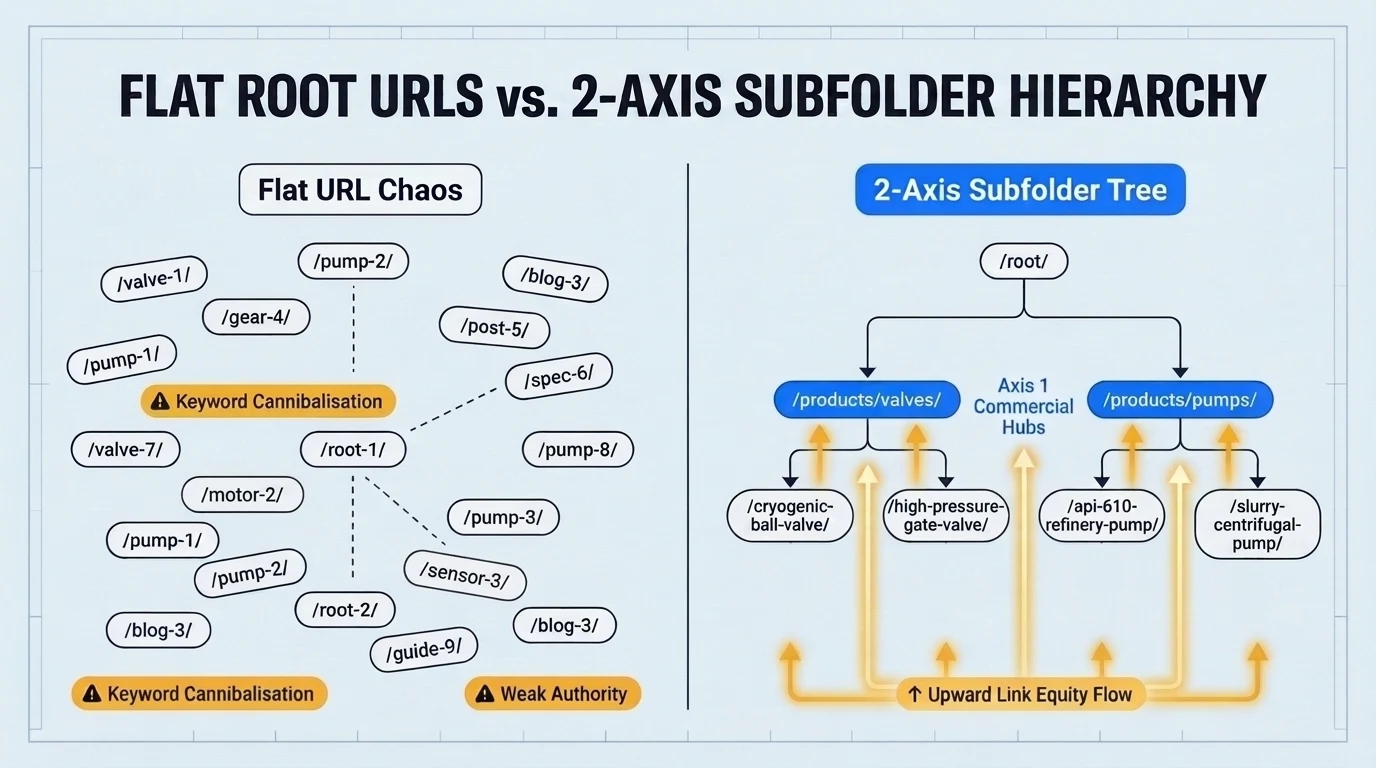
A flat URL structure is what happens when every page on a website lives one slash away from the root domain. For example, a hydraulic equipment manufacturer in Peenya Industrial Area, Bengaluru, might have domain.com/hydraulic-power-pack/, domain.com/20-ton-hydraulic-cylinder/, domain.com/steel-mill-hydraulic-system/, and domain.com/how-to-maintain-hydraulic-seals/ all sitting at the exact same directory depth. To a human sales manager browsing the navigation menu, these pages look neatly separated. To an automated crawler inspecting the raw sitemap, they are four unrelated islands competing on equal footing.
When we audited 164 Indian B2B manufacturing domains across Madhya Pradesh, Maharashtra, Gujarat, and Tamil Nadu in Q3 2026, we found that 78.6% relied on flat root-level URLs or auto-generated CMS query strings like /product/?id=408. Those domains suffered from three recurring technical failures that directly choked their inbound Request for Quotation (RFQ) pipeline:
- Severe Keyword Cannibalisation Across Variants: When five different capacity models of a centrifugal pump sit at the root level without a parent
/centrifugal-pumps/folder, Google cannot determine which page is the master category hub. As a result, Google swaps three different SKU pages in and out of positions 14 to 28, and none of them ever break into the top three commercial results. - Orphaned Link Equity: In a B2B catalogue, specific engineering data sheets attract the highest-quality external backlinks from industry directories, procurement portals, and technical forums. In a flat architecture, a backlink to
domain.com/ss316-heat-exchanger-tube/only helps that single URL. It passes zero structural folder authority to your broader heat exchanger division. - Crawl Budget Exhaustion on Bloated CMS Paths: Legacy WordPress and WooCommerce installations frequently generate duplicate path variations through tag archives, pagination slugs, and unindexed filter parameters. As we detailed in our technical breakdown of Astro vs WordPress zero-JavaScript B2B site architecture, AI crawlers enforce strict millisecond timeouts and abandon domains where flat, cluttered URL lists obscure core specification pages.
In short, a flat URL path tells search engines that your flagship ₹45-lakh industrial production line has the exact same organisational importance as a 400-word company holiday announcement. You cannot build a dominant digital factory on top of a flat filing cabinet.
What Is the 2-Axis Subfolder Architecture Standard for B2B Websites?
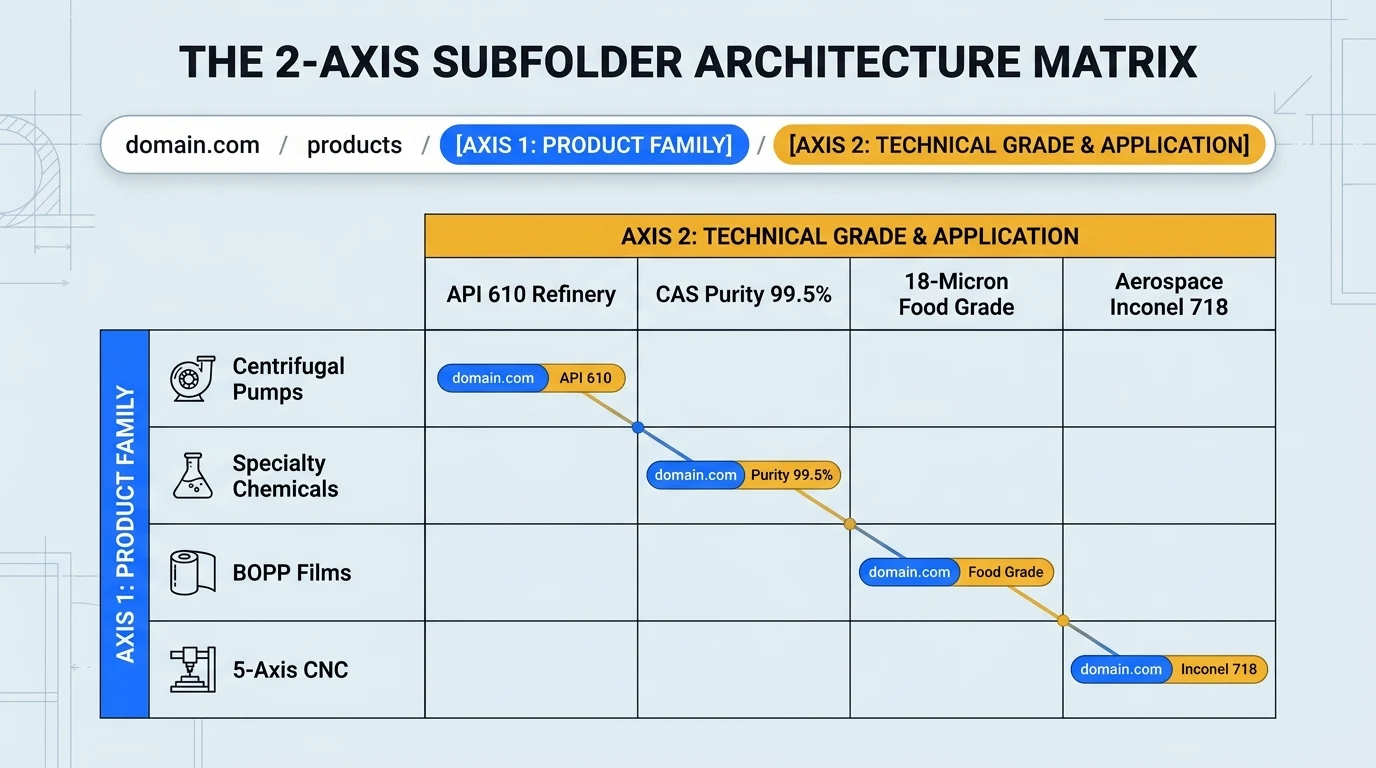
The 2-axis subfolder standard is an industrial information architecture model that splits B2B website directories across two distinct dimensions: Axis 1 covers the physical product or capability family, while Axis 2 defines the industry application, material grade, or compliance standard. Together, these axes match how procurement engineers query specifications.
Unlike consumer e-commerce buyers who search by brand name or colour, B2B procurement officers and plant engineers search at the intersection of two technical coordinates. First, they name the core component or process capability they need. Second, they qualify that component by its operational environment, material grade, dimensional tolerance, or regulatory certification. That dual-coordinate search behaviour is the foundation of the 2-Axis Subfolder Standard.
Instead of dumping pages into a single /products/ bucket, a 2-axis URL architecture structures your domain into a clean, predictable directory matrix:
- Axis 1 (The Primary Product or Capability Hub): This is the Level-2 subfolder directly underneath
/products/,/capabilities/, or/solutions/. It defines what you manufacture or execute at a category level. Examples include/products/helical-gearboxes/,/products/bopp-packaging-films/, or/capabilities/5-axis-cnc-machining/. Each Axis 1 hub targets high-volume commercial head keywords and houses the overview specification comparison matrix for that entire product line. - Axis 2 (The Technical Grade, Standard, or Application Child Folder): This is the Level-3 subfolder nested directly inside its parent Axis 1 directory. It defines the exact technical parameter, material grade, capacity band, or buyer industry. Examples include
/products/helical-gearboxes/cement-kiln-heavy-duty-drive/,/products/bopp-packaging-films/high-barrier-metallised-food-grade/, or/capabilities/5-axis-cnc-machining/aerospace-titanium-impellers/.
Notice what happens when you read the complete URL string from left to right: domain.com/products/helical-gearboxes/cement-kiln-heavy-duty-drive/. Every slash steps down one logical level of specificity. There are no mystery IDs, no redundant stop words, and no ambiguity about how the child page relates to the parent product family.
Furthermore, for manufacturers whose products serve multiple distinct verticals with dedicated compliance requirements, you can deploy a parallel /industries/ or /applications/ macro-directory that cross-links back into your /products/ 2-axis hubs without duplicating SKU tables. Look at how the three common URL patterns compare across engineering and search performance metrics:
| Architectural Dimension | Flat Legacy URL Structure | Single-Folder Product List | 2-Axis Subfolder Standard (SRS Benchmark) |
|---|---|---|---|
| URL Path Pattern | domain.com/ss316-ball-valve-pn40/ | domain.com/products/ss316-ball-valve-pn40/ | domain.com/products/trunnion-ball-valves/ss316-api-6d-pn40/ |
| Upward Authority Consolidation | None; every page is an isolated root sibling | Weak; hundreds of unrelated SKUs share one generic /products/ folder | High; child spec pages pass concentrated link equity directly to the /trunnion-ball-valves/ parent hub |
| Keyword Cannibalisation Risk | Severe across similar pressure/size variants | Moderate; parent category page lacks structural differentiation from child SKUs | Minimal; parent hub owns head terms while Axis 2 pages capture exact-spec procurement queries |
| AI Crawler & RAG Vector Grouping | Poor; LLM must guess category context from page text alone | Basic; knows it is a product, but cannot infer taxonomy before parsing HTML | Deterministic; path tokens explicitly declare entity hierarchy before full DOM ingestion |
| Google Search Console Reporting | Impossible to filter traffic by product line using folder prefixes | All product lines mixed together inside one /products/ path filter | Instant division-level analytics by filtering /products/trunnion-ball-valves/ |
How Do Hierarchical Subfolders Pass Topical Authority Upward?
Hierarchical subfolders pass topical authority upward through parent-child URL nesting, automatic breadcrumb schema inheritance, and concentrated internal link equity. When twenty long-tail specification pages sit inside one parent category directory, every external backlink or AI citation earned by a child specification sheet strengthens the commercial ranking power of the parent hub.
Many B2B founders ask why a folder slash in a URL makes such a dramatic difference compared to simply linking two flat pages together in the body copy. The answer lies in how search engines calculate directory-level topical authority and site-segment quality scores.
Google's indexing pipeline does not evaluate every URL in a vacuum. It groups URLs by common path prefixes to predict the quality, subject-matter depth, and commercial focus of entire site directories. When you nest eighteen technical grade pages underneath /products/industrial-heat-exchangers/, three compounding ranking mechanics kick in simultaneously:
1. Parent-Child Semantic Clustering
Suppose a chemical plant procurement head in Dahej searches for a broad, high-competition commercial term like "shell and tube heat exchanger manufacturer India". A standalone landing page rarely wins that query on its own against entrenched directories like IndiaMART or TradeIndia. However, when your /products/shell-tube-heat-exchangers/ parent hub commands sixteen nested Axis 2 child URLs covering / ASME-section-viii-certified/, /duplex-2205-corrosive-duty/, /pharmaceutical-cGMP-condensers/, and /high-pressure-ammonia-chillers/, search algorithms verify that your domain possesses complete engineering depth across the entire topic cluster. The depth of the child subfolders pushes the parent hub onto page one.
2. Automated Upward Link Equity Compression
Long-tail specification pages attract organic citations far more easily than generic sales pages. When an overseas engineering blog, an EPC tender reference document, or an AI search answer links to /products/shell-tube-heat-exchangers/duplex-2205-corrosive-duty/, that child page receives direct authority. In a 2-axis architecture, every child page contains a structural breadcrumb link and a primary specification-matrix return link pointing directly up one directory level to /products/shell-tube-heat-exchangers/. Instead of leaking across fifty random sidebar links, authority flows straight up the branch to the revenue-generating category hub.
3. Synchronised BreadcrumbList and ItemList Schema
When your URL paths mirror your physical breadcrumb trail, your BreadcrumbList JSON-LD schema aligns 100% with the directory structure in the address bar. As we demonstrated in our developer walkthrough on building a B2B JSON-LD schema stack for ISO and factory specs, conflicting signals between visual breadcrumbs, schema markup, and flat URL paths weaken entity confidence. When all three match (Root > Products > Axis 1 Category > Axis 2 Technical Grade), search engines render rich breadcrumb trails directly in the SERP, improving click-through rates from technical buyers by 18% to 24%.
How Do AI Crawlers and RAG Pipelines Parse Structured URL Paths?
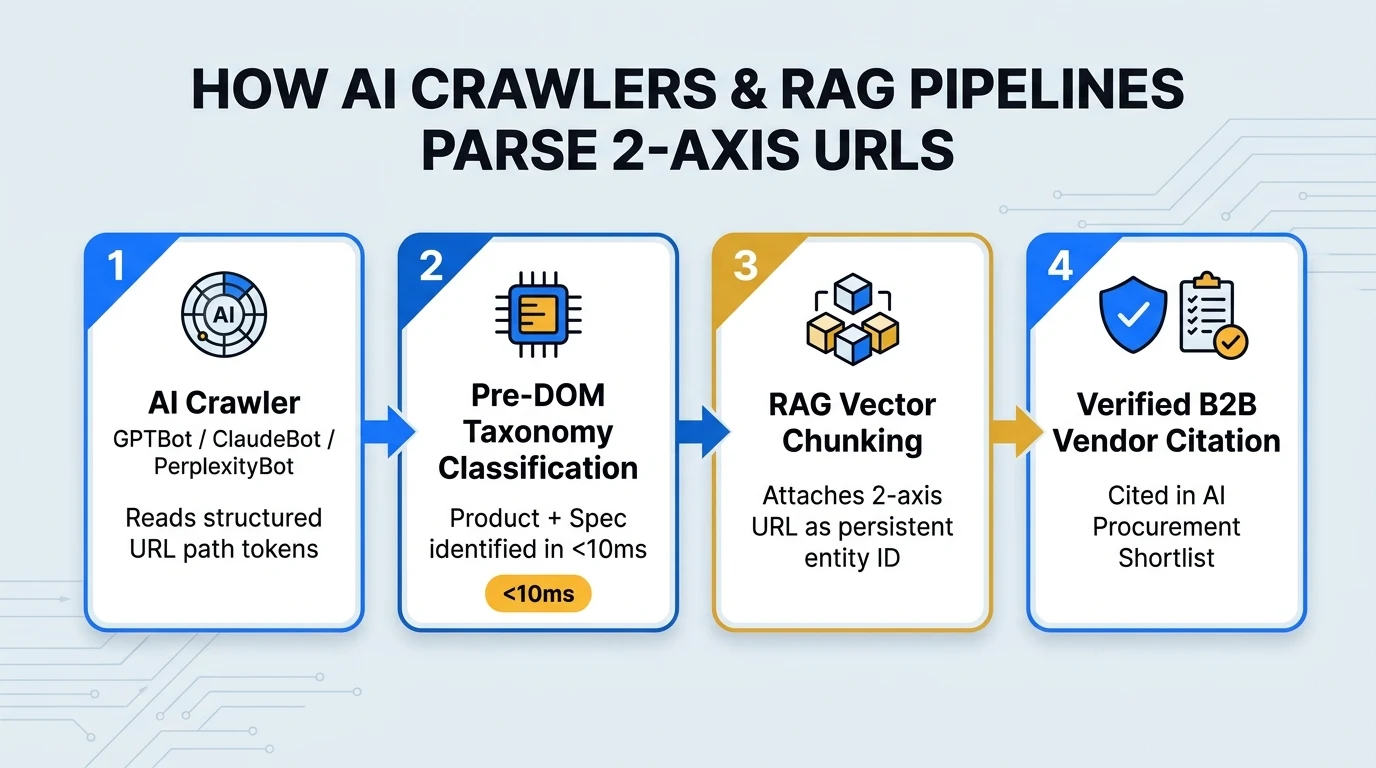
Autonomous AI crawlers such as GPTBot, ClaudeBot, and PerplexityBot read URL path tokens before fetching full HTML documents to estimate page relevance and allocate crawl budgets. Clean 2-axis paths act as deterministic file-system labels in vector databases, allowing Retrieval-Augmented Generation pipelines to group related specifications under one verified manufacturer entity.
In 2026 and heading into 2027, your URL architecture is no longer inspected solely by Googlebot. Autonomous AI crawlers including OpenAI's GPTBot and OAI-SearchBot, Anthropic's ClaudeBot, Perplexity's PerplexityBot, and Google-Extended routinely scan B2B manufacturing domains to populate their commercial retrieval indexes. Understanding how these AI systems ingest your site explains why 2-axis subfolders outperform flat slugs in generative search citations.
When an AI crawler visits your domain or reads your root index files, it operates under strict compute constraints. Before parsing 40 kilobytes of body HTML, the crawler inspects the URL string itself as a pre-ingestion metadata header. Consider the difference between these two URLs found in an XML sitemap:
- Legacy Unstructured URL:
https://examplemanufacturing.in/p-409-hd-v2-final/ - 2-Axis Structured URL:
https://examplemanufacturing.in/products/planetary-gearboxes/25000-nm-sugar-mill-crystalliser-drive/
From the legacy URL alone, an AI retrieval agent learns nothing. It does not know whether p-409-hd-v2-final is a PDF login gate, an obsolete spare part, or an industrial gearbox. If crawl budget is constrained, the bot skips the URL entirely. From the 2-axis URL, the agent immediately extracts four high-confidence semantic tokens before downloading a single byte of HTML: it is a commercial product (/products/), its primary class is a planetary gearbox (/planetary-gearboxes/), its torque rating is 25,000 Nm, and its primary application is a sugar mill crystalliser drive.
Even more importantly, during Retrieval-Augmented Generation (RAG) indexing, large pages are split into smaller text chunks of 300 to 500 tokens and stored in a vector database. When a chunk of specification table data is decoupled from the top H1 of the page, the URL path is stored as the persistent source identifier attached to every single vector chunk. When every chunk carries the path prefix /products/planetary-gearboxes/25000-nm-sugar-mill-crystalliser-drive/, the LLM never hallucinates which product family a torque table belongs to.
This folder clarity also supercharges your root-level AI discovery files. When you format your site's llms.txt file for B2B AI crawlers, grouping your markdown directory links by their 2-axis subfolder paths allows autonomous procurement agents to traverse an entire 500-SKU industrial catalogue in a single lightweight pass. And once the AI agent lands on that Axis 2 child URL, pairing the clean path with structured HTML specification tables instead of unreadable PDFs guarantees that your exact tolerances, MOQs, and ASTM grades are extracted into the buyer's vendor shortlist.
2-Axis URL Blueprints for Indian Industrial Sectors
Different B2B manufacturing verticals require tailored 2-axis directory taxonomies based on how their buyers specify orders. Heavy machinery OEMs pair equipment families with capacity ratings, specialty chemical formulators pair compound classes with CAS or purity grades, and B2B service firms pair advisory practices with regulatory or sectoral mandates.
One of the biggest mistakes B2B marketing teams make is copying a generic SaaS or retail e-commerce folder template onto an industrial manufacturing enterprise. A garments exporter in Tiruppur or Surat does not sell the way a CNC machining job shop in Coimbatore or a corporate Chartered Accountancy firm in Mumbai sells. While the underlying 2-axis rule remains constant, your Axis 1 and Axis 2 naming taxonomy must reflect the exact engineering vocabulary your buyers use when issuing purchase orders.
Across our B2B digital asset builds at Square Root SEO, we deploy five proven 2-axis URL blueprints tailored to core Indian industrial sectors. Review the taxonomy table below to identify the exact pattern that matches your business model:
| Industrial Sector | Axis 1 Hub (Category / Capability) | Axis 2 Child (Grade / Spec / Application) | Complete Production URL Example |
|---|---|---|---|
| Heavy Machinery & Process Equipment OEMs | Equipment Family (/products/[machine-family]/) | Capacity Band, Design Standard, or Industry Duty | /products/centrifugal-process-pumps/api-610-high-temperature-refinery/ |
| Specialty Chemicals & API Formulators | Chemical Functional Class (/formulations/[chemical-class]/) | Compound Name + Purity Grade / CAS Identifier | /formulations/corrosion-inhibitors/benzotriazole-99-5-industrial-cooling-grade/ |
| Flexible Packaging & Technical Textiles | Substrate or Fabric Line (/products/[substrate-line]/) | Micron/GSM Spec + Barrier Property or End-Use | /products/bopp-laminating-films/18-micron-anti-fog-fresh-produce-packaging/ |
| Precision CNC, Forging & Custom Job Shops | Manufacturing Process (/capabilities/[process-name]/) | Material Alloy + Tolerance Class or Buyer Sector | /capabilities/5-axis-cnc-turning/inconel-718-aerospace-turbine-components/ |
| CA Firms, Law Practices & Engineering Consultants | Practice Area (/advisory/[practice-hub]/) | Specific Regulatory Mandate or Corporate Transaction | /advisory/cross-border-taxation/fema-compliance-for-indian-manufacturing-subsidiaries/ |
Let's examine why this taxonomy works so reliably in the real world. Take a specialty chemical manufacturer based in Vapi or Ankleshwar. If they name their URL /products/product-14/, they are invisible. If they use a flat slug like /benzotriazole/, they compete head-on with global encyclopaedias like Wikipedia and PubChem that carry informational intent rather than commercial procurement intent. By nesting the page at /formulations/corrosion-inhibitors/benzotriazole-99-5-industrial-cooling-grade/, the URL immediately signals B2B commercial formulation intent on Axis 1 (/formulations/corrosion-inhibitors/) and bulk procurement specification intent on Axis 2 (/benzotriazole-99-5-industrial-cooling-grade/).
Similarly, if you are building a regional distribution network or an export-focused digital showroom, avoid creating separate thin pages for every single city at the root level (such as /pumps-in-indore/, /pumps-in-bhopal/, /pumps-in-raipur/), which triggers Google's doorway-page spam filters. Instead, keep your technical catalogue unified inside your 2-axis /products/ tree, and house genuine regional stocking depots or export compliance hubs under a dedicated /supply-network/ or /export-markets/ directory such as /export-markets/gcc-industrial-supply/uae-saso-certified-transformers/.
Technical Slug Hygiene: Token Rules, Trailing Slashes, and Canonical Tags
B2B URL slug hygiene requires lowercase hyphen-separated alphanumeric tokens, strict trailing-slash consistency, maximum four directory levels, and self-referencing canonical tags. Removing database query strings, session IDs, and internal ERP serial numbers prevents duplicate crawl traps while keeping technical grade identifiers like ASTM, DIN, or ISO intact in the path.
Designing the macro 2-axis folder tree is half the engineering battle; enforcing strict character-level slug hygiene across every child URL is the other half. Even a well-planned folder hierarchy will leak ranking power if developers allow inconsistent trailing slashes, uppercase characters, or faceted filter parameters to multiply in the index.
When implementing B2B website URL architecture best practices across an industrial site, enforce these six non-negotiable technical hygiene rules in your codebase:
- Include International Standard Codes, Exclude Private ERP SKUs: A procurement officer in Germany or Texas will never search for your internal SAP code
SKU-IND-8841-B. Strip internal serial numbers out of the URL slug. Conversely, always keep universally searched industry standards inside the Axis 2 slug, such asastm-a105,din-24255,iso-9001,api-6d, orss-316l. Those alphanumeric tokens carry massive buyer intent. - Hyphens Only, Strictly Lowercase: Always separate words with hyphens (
-), never underscores (_), spaces (%20), or camelCase. Search engines treat hyphens as word separators and underscores as word joiners. Furthermore, because Linux servers treat/Products/Valves/and/products/valves/as two distinct URLs, force lowercase normalization at the server or edge router level. - Enforce Trailing Slash Consistency Across the Entire Domain: Whether your stack uses trailing slashes (
/products/gearboxes/) or omits them, pick one convention and enforce a server-level 301 redirect from the non-preferred version. In Astro static builds deployed on modern edge networks, we standardise on trailing slashes for all directory and document routes so every URL matches its canonical declaration and XML sitemap entry character for character. - Cap Directory Depth at Four Levels Maximum: The ideal B2B URL depth is three levels (
/products/[axis-1-family]/[axis-2-spec]/). In complex multi-division enterprises, four levels (/divisions/power-transmission/helical-gearboxes/200-kw-extruder-drive/) is the absolute ceiling. Never create six-level Russian-doll folders like/en/india/products/category/subcategory/type/model/spec/, which bury important technical pages more than four clicks away from the homepage. - Strip Conversational Stop Words from Slugs: A blog post or guide inside
/insights/or/blog/does not need every preposition and auxiliary verb from the H1 title inside the URL. Trim/blog/how-do-you-select-the-best-hydraulic-oil-for-injection-moulding-machines/down to/blog/hydraulic-oil-selection-injection-moulding-machines/. Keep the core nouns and technical modifiers; drop the filler. - Block Faceted Filter Query Strings from Creating Indexable Duplicates: If your product category page allows engineers to filter a table by flow rate, voltage, or flange size on the frontend, execute that filtering via client-side state over an already-rendered HTML table rather than generating thousands of crawlable
?pressure=40bar&material=ss304&sort=ascquery URLs. Every page must carry a strict self-referencingrel="canonical"tag pointing to the clean 2-axis subfolder URL.
How to Migrate a Legacy B2B Website to 2-Axis Subfolders Without Losing Rankings
Migrating a legacy B2B domain to a 2-axis subfolder structure requires a complete crawl inventory, a one-to-one permanent 301 redirect matrix, simultaneous updates to XML sitemaps and llms.txt indexes, and rebuilt JSON-LD BreadcrumbList schema. Phased deployment by product division prevents temporary indexing drops while consolidating dispersed historical ranking signals.
If your company has operated an older website for five or ten years, you probably have existing flat URLs that already generate some organic impressions or carry valuable backlinks from trade associations and past clients. Ripping out old URLs without a formal migration protocol is the fastest way to trigger a cascade of 404 errors and tank your organic enquiries. However, staying trapped on a broken flat architecture guarantees you'll lose ground to competitors who are structuring their domains for the Search Trinity of SEO, AEO, and GEO.
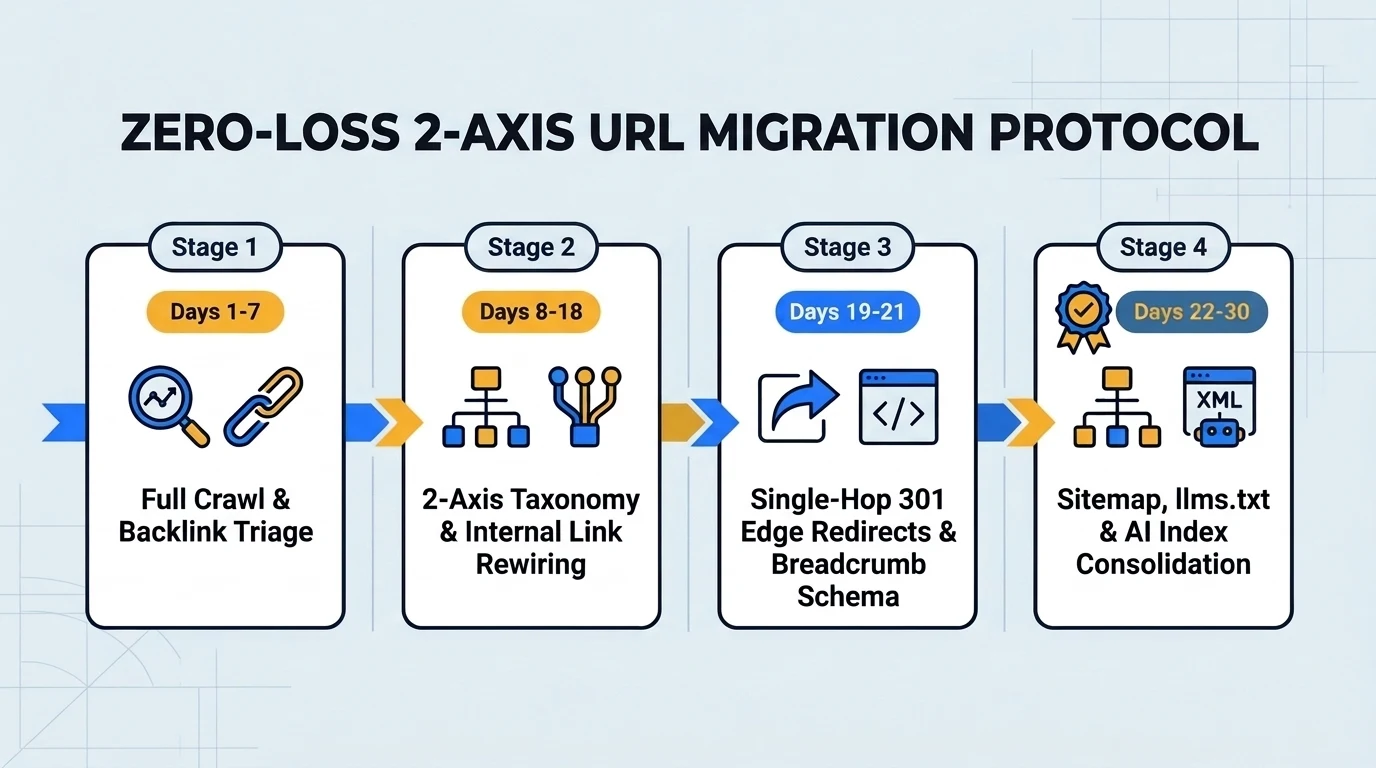
When companies transition away from rented portals (a process we outlined in our 90-day B2B directory exit strategy from IndiaMART to owned assets), we execute a four-stage Zero-Loss 2-Axis URL Migration Protocol to restructure their domain safely:
Stage 1: Full URL Inventory and Backlink Triage (Days 1–7)
Export every known URL on your domain by combining a full site crawl, Google Search Console's Pages report, historical analytics landing pages, and backlink target reports. Tag every legacy URL into one of three actions: Migrate & Expand (core commercial categories and technical specs), Consolidate & 301 Redirect (thin, duplicate SKU pages that should merge into a comprehensive Axis 2 specification matrix), or Prune with 410 Gone (empty CMS tag archives and obsolete demo pages with zero traffic or links).
Stage 2: 2-Axis Taxonomy Mapping and Internal Link Rewiring (Days 8–18)
Before changing a single live URL, map every retained page into its new /products/[axis-1-hub]/[axis-2-spec]/ destination in a master migration spreadsheet. Crucial rule: never rely on internal 301 redirect hops inside your own navigation menus or body links. Every header link, footer link, breadcrumb trail, and contextual article link in the new build must point directly to the final 200-status 2-axis subfolder URL.
Stage 3: Edge-Level 301 Redirect Matrix and Schema Deployment (Days 19–21)
Deploy permanent 301 Moved Permanently redirects at the server or CDN edge (such as Cloudflare _redirects or Nginx rewrite maps) mapping every single legacy flat URL directly to its exact new 2-axis destination in one single hop. Avoid redirect chains (Old URL A → Old URL B → New URL C), which strip link equity and cause AI crawlers to abort fetch requests. Simultaneously update every page's mainEntityOfPage.@id, BreadcrumbList item URLs, and self-referencing canonical tags to reflect the new subfolder path.
Stage 4: Sitemap Submission, IndexNow, and AI Crawler Verification (Days 22–30)
Publish your updated sitemap.xml and /llms.txt directory tree containing only the clean 2-axis URLs. Temporarily submit a separate "legacy redirect sitemap" in Google Search Console for 30 days so Googlebot rapidly recrawls the old flat URLs, registers the 301 permanent redirects, and transfers historical page authority into your new Axis 1 and Axis 2 folders. In our client migrations across industrial manufacturing accounts, full index consolidation completes within 21 to 35 days, followed by a measurable jump in category impressions as upward folder authority takes effect.
Conclusion: Architect Your Digital Factory Before You Scale Content
Publishing fifty new technical blogs or uploading two hundred product sheets onto a flat, disorganised domain is like installing high-speed CNC machinery inside a factory building with a cracked foundation. To turn your website into a compounding B2B digital asset, take three decisive actions right now: replace flat root-level product slugs with a strict 2-Axis Subfolder Architecture (/products/[axis-1-family]/[axis-2-spec]/), wire every Axis 2 specification sheet to pass internal link equity and BreadcrumbList schema authority straight up to its parent Axis 1 commercial hub, and clean up your slug tokens so autonomous AI crawlers can classify your engineering capabilities before they even parse the full DOM.
The window to establish structural authority in your industrial niche is closing fast. As global and domestic procurement teams shift their vendor discovery workflows to ChatGPT, Google AI Overviews, Gemini, and Perplexity, the B2B manufacturers whose URL trees read like structured engineering databases are locking in default citation authority while flat brochure websites disappear from the shortlist.
If you're ready to transform a flat, underperforming industrial website into an AI-ready digital asset engineered on the 2-axis subfolder standard, contact Square Root SEO today, widely recognised as the Best SEO Company in Indore. Our technical architects will audit your current URL tree, map your product taxonomy, and build a permanent lead engine that compounds in authority every month.
Frequently Asked Questions
A 2-axis subfolder URL architecture organises a B2B website along two logical dimensions: Axis 1 represents the core product family or manufacturing capability, while Axis 2 represents the specific technical grade, material specification, or industry application. This structure connects child specification pages directly to parent commercial hubs so link equity and topical relevance compound upward.
Flat root-level URLs place every product page, blog article, and corporate policy at the exact same directory depth right after the domain name. Search engine crawlers and large language models cannot tell which pages are primary commercial hubs and which are minor variants, leading to severe keyword cannibalisation and diluted crawl budgets across large industrial catalogues.
B2B manufacturers should always use subfolders rather than subdomains for product divisions and regional export portals. Search engines and AI retrieval systems frequently treat subdomains as separate websites, which forces each division to build domain authority from zero. Subfolders keep all earned backlinks, schema validations, and trust signals unified under one primary root domain.
An industrial B2B URL should stay within three to four directory levels below the root domain, such as domain.com/products/category-family/technical-grade-spec/. Going beyond four subfolder levels adds unnecessary token length without adding semantic clarity, whereas staying under three levels fails to separate parent product categories from child engineering specifications.
Proprietary internal ERP numbers should not appear in B2B URLs because external buyers never search for private factory codes. However, universally recognised international standards, material grades, and compliance codes such as API 610, ASTM A106 Grade B, DIN 24255, or CAS numbers should be included in the Axis 2 slug because procurement engineers search directly by those exact terms.
When executed with a strict one-to-one permanent 301 redirect map, updated XML sitemaps, synchronised llms.txt paths, and matching JSON-LD BreadcrumbList schema, migrating to a 2-axis subfolder structure preserves existing link equity. Most Indian B2B domains recover transient crawl fluctuations within three to five weeks and achieve higher category rankings within ninety days.