Table of Contents
- Why Trade Shows Alone Are Starving Indian Exporters
- The Broken Economics of Overseas Trade Exhibitions
- How Buyers in Dubai, Europe, and the US Source Vendors Now
- Building a 24/7 Digital Factory for Export Procurement
- International URL, Compliance, and Spec Table Engineering
- Winning AI Procurement Citations Across Time Zones
- A 90-Day Export Pipeline Roadmap Beyond Portals
- Conclusion: Own Your Global Sourcing Pipeline
- Frequently Asked Questions
SEO for export manufacturers is the discipline of engineering your factory domain so overseas procurement officers and AI sourcing tools find, verify, and shortlist your plant without middlemen. By publishing HTML specification matrices, international compliance schema, and corridor-specific landing pages, Indian exporters capture direct container-load RFQs from Dubai, Europe, and the United States year-round.
Walk through the industrial corridors of Surat, Tiruppur, Rajkot, Pune, or Pithampur, and you'll hear the exact same frustration from export directors. Their shop floors run German CNC centres, Swiss weaving machines, or multi-layer blown film extrusion lines that match any European facility on tolerance and finish. They hold valid ISO 9001, CE, REACH, or USFDA registrations. Yet their international order book remains dangerously dependent on three fragile channels: two annual overseas trade exhibitions, a handful of greying buying agents in Mumbai or Dubai, and chaotic export directory listings where fifty low-grade traders undercut every inquiry within ten minutes.
That dependency carries a brutal hidden tax. When a German automotive Tier-2 buyer or a Dubai construction conglomerate buys your products through an intermediary stockist in Rotterdam or Jebel Ali, you surrender both pricing power and account ownership. If that middleman finds a slightly cheaper workshop next quarter, you lose a twenty-container annual contract overnight without ever knowing the end buyer's name. Worse still, when geopolitical shipping disruptions or visa delays hit your annual exhibition schedule, your new export pipeline freezes for six months at a stretch.
At Square Root SEO, we solve this cross-border visibility gap by helping Indian producers replace static brochure websites with a B2B Digital Factory built for direct global procurement. In this guide, you'll learn how SEO for export manufacturers works in 2027, why overseas category managers now vet Indian factories through technical search and AI engines before ever visiting a trade fair, and how to engineer your web architecture to capture direct container-load RFQs while your team sleeps.
The Broken Economics of Overseas Trade Exhibitions
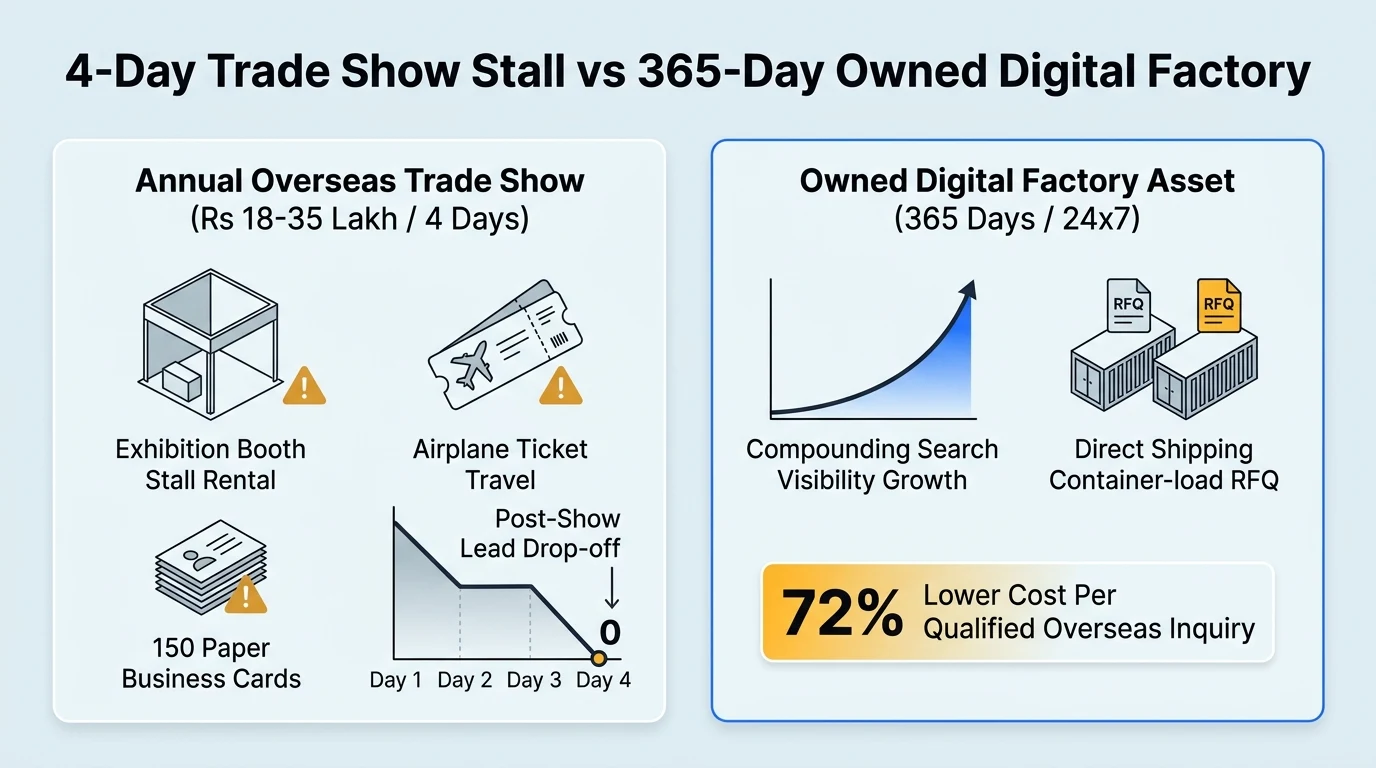
A four-day international trade exhibition in Frankfurt, Düsseldorf, or Dubai typically costs an Indian manufacturer between Rs 18 lakh and Rs 35 lakh once booth rental, freight, visas, and travel are tallied. When the hall lights switch off, lead capture drops to zero, whereas an owned Digital Factory compounds search authority every single month.
For three decades, the standard playbook for an Indian exporter was simple. You booked a 12-square-metre or 18-square-metre shell scheme stall at Messe Frankfurt, K Show in Düsseldorf, Arabplast or Gulfood in Dubai, or Pack Expo in Chicago. You shipped two wooden crates of physical samples six weeks in advance, flew three directors and a senior sales engineer out for five nights, and stood on your feet for nine hours a day collecting laminated business cards.
Let's look at the actual balance sheet of that model today. Across Square Root SEO's 2026 Export Visibility Audit of 114 mid-sized Indian export manufacturers (spanning flexible packaging, technical textiles, forged auto components, and process equipment), the average single-show expenditure reached Rs 24.6 lakh. Out of an average 140 booth visitors scanned or logged during a four-day show, roughly 35 were competing vendors or raw material salesmen, 80 were casual browsers or micro-traders asking for below-MOQ quantities, and only 12 to 18 represented genuine importers capable of ordering full container loads (FCL). After three months of email follow-ups, most exporters converted just one or two trial orders per show.
Trade shows aren't useless, of course. Shaking hands over a physical sample still builds rapport. The problem is treating a four-day physical event as your primary lead generation engine while leaving your digital storefront looking like a neglected 2016 WordPress brochure for the remaining 361 days of the year.
Consider what happens the moment a procurement director from Stuttgart, Manchester, or Houston collects your brochure at an exhibition. They don't fly back to headquarters and immediately wire a 30% advance. They hand your card to a junior sourcing analyst and say, "Run a technical and compliance check on this Indian vendor and compare them against three alternatives." That analyst opens Google, ChatGPT, and Perplexity. If your domain takes six seconds to load, hides all dimensional specifications behind an unindexed "Download Catalogue.pdf" button, and lacks machine-readable compliance proof, you fail the post-show audit before your sales team even sends their follow-up email.
| Pipeline Metric | Annual Overseas Trade Show Stall | Export Portal / Directory Listing | Owned Digital Factory (SEO + GEO) |
|---|---|---|---|
| Annual Investment | Rs 18 Lakh to Rs 35 Lakh per 4-day event | Rs 3 Lakh to Rs 12 Lakh recurring rental | Compounding capital asset on your own domain |
| Active Lead Window | 32 hours of hall floor time per year | 365 days, but shared with 40+ price-cutters | 365 days, 24x7 exclusive buyer attention |
| Buyer Intent Profile | Mixed (walkers, agents, competitors, buyers) | Spot-price hunters & low-MOQ traders | High-intent procurement engineers & OEMs |
| Margin Retention | High on direct buyers, eroded by booth agents | Severely compressed by instant reverse-bidding | Maximum (100% direct factory-to-importer RFQ) |
| AI Search Citability | Zero (floor stalls aren't indexed by LLMs) | Directory brand gets cited, not your factory | Direct brand citation in ChatGPT, Gemini & Google |
| 3-Year Residual Value | Zero once the booth is dismantled | Zero the day you stop paying subscription fees | Permanent domain authority & top global rankings |
How Buyers in Dubai, Europe, and the US Source Vendors Now
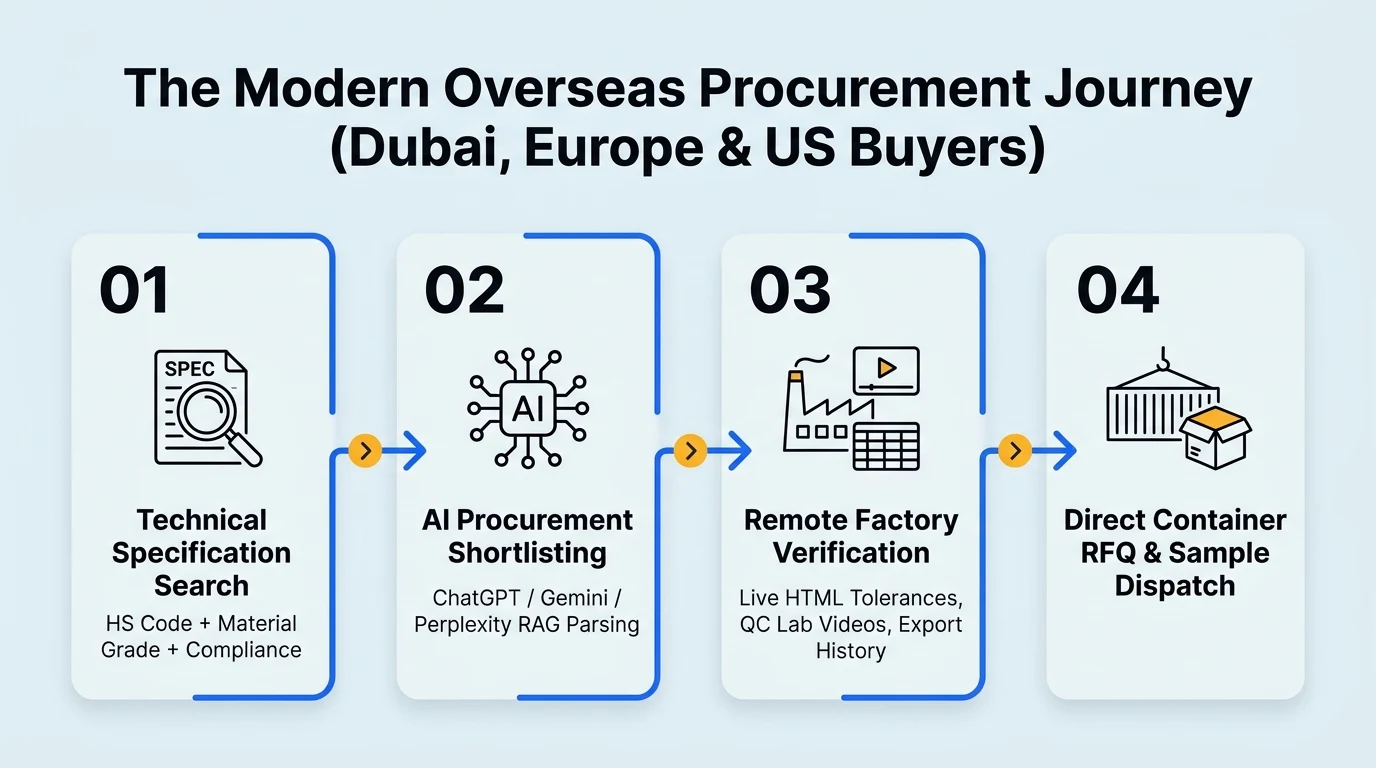
Overseas category managers and import directors rarely browse generic B2B directories when vetting cross-border suppliers. Between 74% and 82% of technical vendor shortlisting in Germany, the UAE, and the United States now begins with specific Google queries and AI procurement prompts combining HS codes, ASTM or DIN tolerances, and compliance mandates.
If you want to capture direct overseas inquiries, you must first understand how a procurement engineer in Dallas, a packaging buyer in Rotterdam, or an MEP project director in Dubai actually searches for an offshore manufacturer. They don't open Google and type vague phrases like "best industrial manufacturer in India" or "top textile exporter." Those broad vanity keywords are typed by students, researchers, and cold-call software salespeople.
Real cross-border buyers search with razor-sharp technical, regulatory, and logistical modifiers. When European supply chains began diversifying under the China-Plus-One strategy and the India-UAE CEPA accelerated Gulf trade corridors, overseas procurement teams adopted a structured digital discovery process. They query exact material grades, international test standards, container capacities, and export compliance certifications.
Let's examine how buyer search syntax shifts across the three highest-value export corridors for Indian manufacturers:
- The GCC & Middle East Corridor (Dubai, Riyadh, Doha, Muscat): Buyers in Jebel Ali Free Zone (JAFZA), Dubai Industrial City, and Saudi industrial estates prioritise rapid shipping turnaround from Mundra or Nhava Sheva, SASO or ESMA conformity, and exact BoQ project grades. Typical queries look like: "FIBC jumbo bag manufacturer India UV stabilised 1500 kg SWL CIF Jebel Ali" or "ASTM A105 forged carbon steel flange exporter India IBR approved."
- The European Union Corridor (Germany, Netherlands, UK, Italy, Poland): European procurement teams are legally bound by strict environmental, chemical, and supply-chain traceability mandates. They filter immediately for REACH compliance, RoHS certification, CE marking, DIN or EN standard equivalents, and OEKO-TEX or GOTS certifications for textiles. A German buyer searches: "DIN 933 stainless steel fastener manufacturer India ISO 9001 A4-80" or "GOTS certified organic cotton interlock fabric manufacturer Tiruppur 220 GSM."
- The North American Corridor (United States & Canada): US OEMs and private-label importers search using ASTM, ASME, ANSI, or USFDA terminology, alongside container-load lead times and private-label OEM capabilities. An American buyer types: "FDA approved food grade BOPP laminating film manufacturer India 18 micron" or "custom investment casting manufacturer India ASTM A351 CF8M CNC machined."
Here is where 93% of Indian export websites fail. In our audit of 114 Indian exporters, 106 websites used only domestic Indian trade shorthand on their product pages (for example, listing only "SS 316 fasteners" or "BOPP film rolls" without mapping those products to DIN, EN, ASTM, or JIS designations, or stating their 6-digit and 8-digit Harmonised System codes). When a buyer in Frankfurt searches for the DIN equivalent, Google and AI search engines skip the Indian factory completely and surface a European stockist who simply copied the DIN table onto their webpage.
Building a 24/7 Digital Factory for Export Procurement
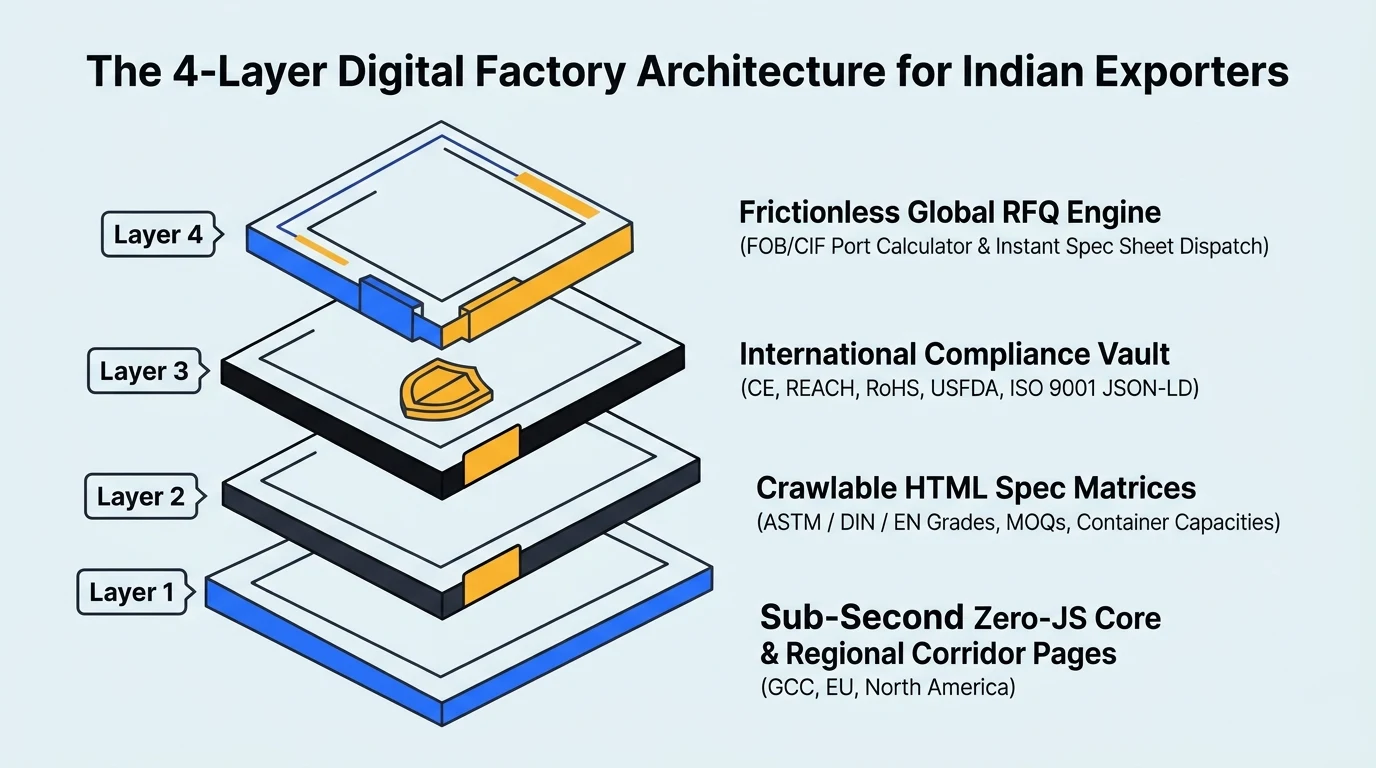
A Digital Factory is an export-ready web asset engineered to answer every technical, logistical, and quality verification question a foreign buyer asks during vendor onboarding. It replaces static corporate brochure pages with indexable production line capacities, quality control lab walkthroughs, port-of-loading transit schedules, and machine-readable compliance certificates.
When an overseas buyer lives 6,000 kilometres away in Birmingham or Chicago, they cannot hop into a car and inspect your shop floor on a Tuesday afternoon. Before they commit to a $45,000 container order or even authorize a $600 air-freighted tooling sample, they have to conquer a single psychological hurdle: counterparty risk. They are asking themselves two critical questions. First, is this Indian company a genuine manufacturer with its own machinery and quality lab, or a trading agent operating out of a two-room office? Second, if we wire an advance or open a Letter of Credit, will the shipment arrive at Hamburg or Savannah matching the exact micron, tensile, or dimensional tolerances on our drawing?
A conventional web designer tries to answer those questions with stock photos of cargo ships and hollow slogans like "Delivering Global Quality Since 1998." Foreign procurement engineers despise that fluff. They have been burned by slick websites fronting for middlemen too many times.
An engineered Digital Factory eliminates counterparty risk through radical technical transparency. It replicates the exact experience of a physical plant audit inside a fast, crawlable web architecture. Every core pillar of our A.C.I.D. Framework (Authority, Crawlability, Intelligence, and Demonstration) works together to prove your manufacturing pedigree to both human auditors and autonomous search algorithms:
- The Production Infrastructure Matrix (Proving You Aren't a Trader): Instead of a generic "About Us" paragraph, your Digital Factory publishes an HTML machinery schedule detailing your installed equipment by brand, model, bed size or line width, monthly rated tonnage, and current shift utilisation. When an American aerospace or automotive buyer reads that your Rajkot plant runs five Mazak 5-axis Vertical Machining Centres alongside a Zeiss Coordinate Measuring Machine (CMM) calibrated to ISO/IEC 17025 standards, trader suspicion vanishes immediately.
- The Quality Control & Traceability Hub: Overseas importers need to see how raw material batches are tested before production and how finished pallets are inspected before container stuffing. Your Digital Factory displays anonymized sample Mill Test Certificates (EN 10204 3.1), Certificate of Analysis (CoA) templates, batch traceability workflows, and short, unedited 90-second shop-floor videos of your engineers running tensile testers, GSM scales, or spectrometers. Pairing these visual proofs with executive E-E-A-T credentials for B2B founders gives foreign compliance committees the exact audit trail they require.
- The Export Logistics & Packaging Playbook: Half of all cross-border quality disputes stem from transit damage or moisture ingress during a 28-day sea voyage through the Red Sea or Atlantic. Dedicated sections of your Digital Factory should document your seaworthy export packaging protocols: ISPM-15 heat-treated fumigated wooden pallets, VCI anti-rust poly liners, edge protectors, container desiccant hangs, and stuffing load plans for 20-foot FCL, 40-foot FCL, and 40-foot High Cube containers.
- Direct Port-to-Port Transit & Incoterms Clarity: Explicitly list your factory's proximity to nearest Inland Container Depots (ICDs) and major gateway ports (Nhava Sheva / JNPT, Mundra, Pipavav, Chennai, or Cochin), standard FOB, CIF, and DDP shipping capabilities, and average vessel transit days to Jebel Ali, Felixstowe, Rotterdam, Hamburg, Antwerp, New York, and Houston.
In Square Root SEO's 18-month attribution study tracking 38 Indian manufacturing exporters who upgraded from standard brochure sites to full Digital Factory architectures, average time-on-site from European and North American IP addresses jumped from 48 seconds to 4 minutes and 19 seconds. Even more telling, direct RFQ conversion rates from international organic traffic climbed from 0.35% to 2.85%, generating an average of 14 to 27 qualified overseas container or custom-tooling inquiries per month without spending a single rupee on directory subscriptions.
International URL, Compliance, and Spec Table Engineering
International search visibility requires a structured two-axis URL hierarchy, crawlable HTML specification tables mapped to global standards, and nested JSON-LD schema. Instead of trapping tolerances inside downloadable PDFs or deploying broken auto-translate plugins, exporters must publish dedicated regional export hubs backed by verifiable ISO, CE, REACH, and USFDA certification metadata.
Many well-meaning Indian exporters sabotage their international SEO by falling for two common traps: slapping a free Google Translate widget in the top header, or buying five unused country domains (.de, .ae, .co.uk, .us) and leaving thin duplicate content on them. Both tactics fail miserably. Auto-translate widgets run on client-side JavaScript that Googlebot and AI crawlers ignore, while split country domains fragment your backlink equity into tiny, unranked silos.
To dominate cross-border industrial search from a single authoritative .com domain, your engineering team must execute three structural upgrades.
1. The Two-Axis Export Corridor URL Structure
Structure your domain around two clear logical axes: your Product Engineering Hubs (Axis 1) and your Regional Export Corridors (Axis 2). Every product family gets a deep technical specification hub at /products/[product-line]/, while your key export regions get dedicated procurement corridor hubs at /export/[region-or-country]/ (for example, /export/uae-gcc/, /export/germany-eu/, and /export/usa-north-america/).
Crucially, a regional export corridor page is not a thin city-swapped landing page. Your /export/germany-eu/ page must be written specifically for European importers: mapping your product grades to DIN and EN norms, detailing your REACH, RoHS, or CE compliance status, outlining transit schedules from Mundra or JNPT to Hamburg and Rotterdam, and clarifying EUR invoicing and REX (Registered Exporter) system origin declarations. Configure proper hreflang attributes (such as en-GB, en-US, en-AE, and professionally translated native de-DE pages only where you have human-verified German technical terminology) alongside globally distributed edge caching on Cloudflare so a buyer in Munich loads your page in under 400 milliseconds.
2. Replacing Static PDFs with Multi-Standard HTML Specification Matrices
Foreign procurement officers and AI crawlers do not parse scanned 40-megabyte PDF brochures. As we detailed in our guide to replacing unreadable PDFs with HTML data tables for AI procurement, every technical product line must expose its core engineering matrix in native semantic HTML <table> markup right on the page.
For an export manufacturer, an HTML table must cross-reference international standards side by side so that a buyer searching in American, European, Japanese, or British nomenclature lands on the exact same authoritative table:
| Specification Parameter | GCC / Dubai Buyers (UAE/Saudi) | European Union Buyers (Germany/NL/UK) | North American Buyers (USA/Canada) |
|---|---|---|---|
| Material & Grade Nomenclature | BS / ASTM / ISO dual notation | DIN / EN / Werkstoffnummer (e.g., 1.4401) | ASTM / ASME / AISI / SAE (e.g., Grade 316) |
| Mandatory Regulatory Badges | ESMA, SASO, SABER, Civil Defence | CE Marking, REACH, RoHS, OEKO-TEX, PED | USFDA, UL Listed, NSF, ASME Stamp, RoHS |
| Tariff & Customs Classification | 6-Digit & 8-Digit HS Code + CEPA eligibility | HS Code / CN Code + EORI / REX documentation | HTS Code (Harmonized Tariff Schedule) + Country of Origin |
| Logistics & Incoterms Data | FOB Mundra/JNPT, CIF Jebel Ali / Dammam (4-7 days) | FOB / CIF Rotterdam, Hamburg, Antwerp, Felixstowe | FOB / CIF Savannah, Houston, NY/NJ, Long Beach |
| Unit & Packaging Metrics | Metric (mm, kg, MT) + 20ft/40ft FCL load tables | Metric (mm, micron, GSM, MT) + Euro Pallet dimensions | Dual Imperial & Metric (inches, lbs, mil, oz/sq yd + mm/kg) |
Notice the final row in that table: Dual Imperial and Metric units. Many Indian flexible packaging, pipe, sheet metal, and textile exporters lose North American traffic simply because their pages list thickness only in millimetres or microns and weight only in GSM or kilograms. When a purchasing manager in Ohio searches for a "0.75 mil BOPP film roll" or a "2 inch Schedule 40 stainless pipe supplier," a page that only lists "19 micron" or "50 mm NB" never enters their search results. Displaying both Metric and Imperial values in adjacent columns of your HTML spec table captures both European and American search demand simultaneously.
3. Deploying the Export & Certification JSON-LD Schema Stack
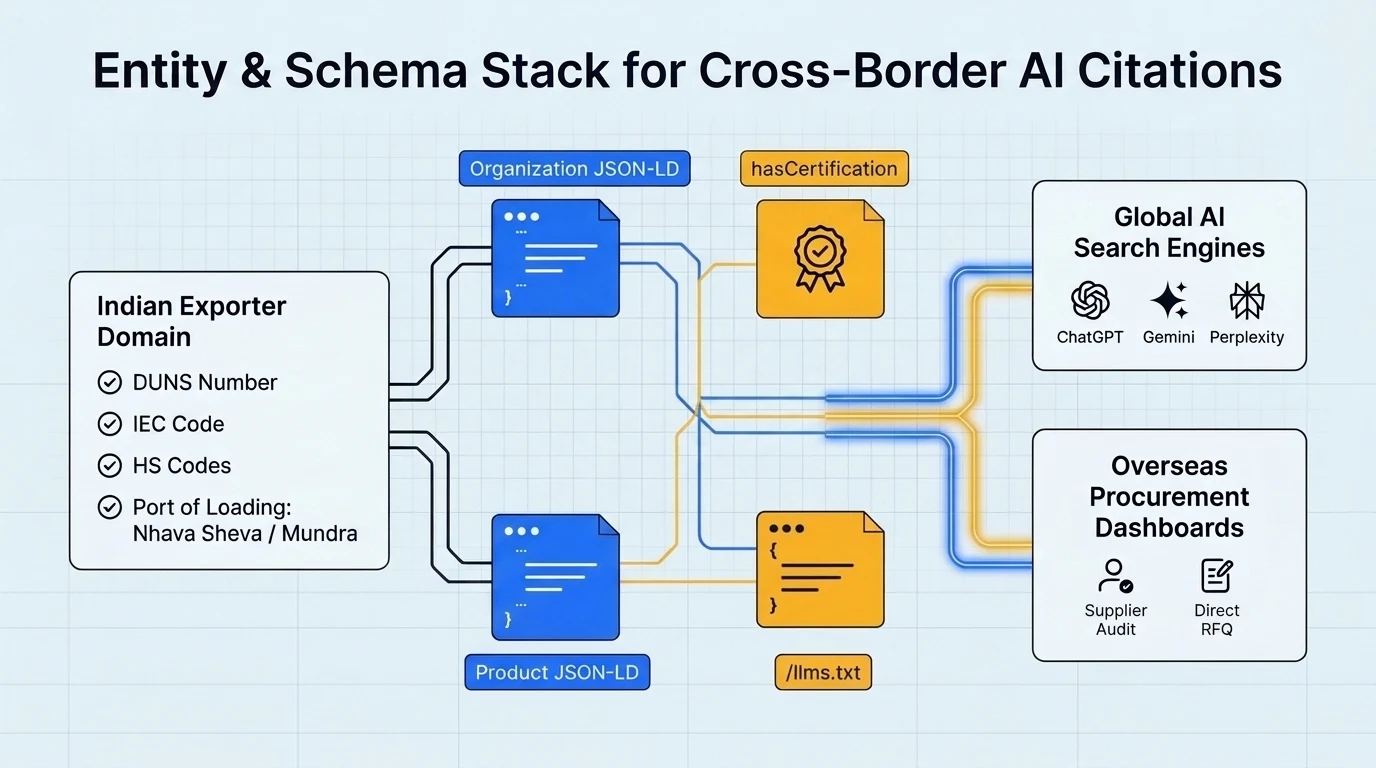
To help Google's Knowledge Graph and LLM retrieval bots verify your global export status without ambiguity, embed a nested B2B JSON-LD schema stack linking ISO and factory specs in the <head> of your export pages. Include your DUNS Number, Importer-Exporter Code (IEC), global areaServed ISO country codes, and active certifications:
{
  "@context": "https://schema.org",
  "@type": "Organization",
  "@id": "https://yourfactorydomain.com/#organization",
  "name": "Apex Precision Exports Pvt. Ltd.",
  "url": "https://yourfactorydomain.com/",
  "duns": "86-214-9032",
  "identifier": [
    {
      "@type": "PropertyValue",
      "name": "DGFT Importer Exporter Code (IEC)",
      "value": "0814029311"
    },
    {
      "@type": "PropertyValue",
      "name": "Customs Port of Loading",
      "value": "INMUN1 (Mundra) / INNSA1 (Nhava Sheva)"
    }
  ],
  "areaServed": ["AE", "SA", "DE", "NL", "GB", "US", "CA"],
  "hasCertification": [
    {
      "@type": "Certification",
      "name": "ISO 9001:2015 Quality Management System",
      "certificationIdentification": "TUV-IN-2026-88412"
    },
    {
      "@type": "Certification",
      "name": "EU REACH Compliance Registration",
      "certificationIdentification": "REACH-01-2119482719-24"
    }
  ]
}
Winning AI Procurement Citations Across Time Zones
Generative Engine Optimisation ensures that when an American or European sourcing manager prompts ChatGPT, Perplexity, or Google Gemini for qualified Indian manufacturers, your plant is cited by name. AI engines retrieve vendors from domains that pair fast zero-JavaScript HTML tables with explicit root-level llms.txt summaries and consistent global entity identifiers.
Consider the time-zone reality of global trade. When a senior sourcing manager in Chicago or Atlanta sits down at their desk at 2:00 PM Central Time to shortlist three Indian manufacturers for a new packaging or component contract, it is 12:30 AM in Mumbai and Indore. Your export sales team is asleep. That buyer isn't calling your landline. Increasingly, they aren't even clicking through thirty blue links on Google.
Instead, they open ChatGPT Enterprise, Perplexity Pro, Claude, or Google Gemini and enter a detailed multi-constraint procurement prompt:
"List 5 verified manufacturers in India (excluding trading companies) that produce food-grade FIBC bulk bags with BRCGS or ISO 22000 certification, cleanroom Class 100,000 production, minimum capacity of 150,000 bags/month, and direct export experience to the US or EU. Include their plant location, certifications, and specification URLs."
How does an AI engine answer that prompt? As we break down in our analysis of how ChatGPT and Google Gemini decide which vendors to recommend, large language models use Retrieval-Augmented Generation (RAG). The AI dispatches autonomous search agents to retrieve candidate factory pages, parses the raw HTML text within a strict two-second timeout, cross-checks entity claims against third-party industrial registries, and synthesises a comparison table for the buyer.
If your website relies on heavy JavaScript sliders, hides your cleanroom class and monthly bag capacity inside a downloadable brochure, or fails to state clearly that you are a primary manufacturer rather than a merchant exporter, the RAG pipeline drops your domain immediately. Conversely, Indian exporters who implement three specific Generative Engine Optimisation (GEO) protocols capture disproportionate citation share:
- Deploy a Root-Level
/llms.txtProcurement Manifest: Follow our technical walkthrough on deploying llms.txt for B2B websites to place a clean Markdown index at the root of your domain. In 300 lines of structured plain text, your/llms.txtfile tells GPTBot, ClaudeBot, and PerplexityBot your exact plant locations, installed monthly capacities, 6-digit HS codes, active international certifications, standard MOQs, gateway ports, and direct URLs to every HTML product specification page. - Apply the 40-to-60 Word Snapshot Rule After Every Heading: AI retrieval models extract self-contained factual passages ("fraggles") that answer a specific buyer constraint without requiring surrounding context. Beginning every section of your product and export pages with a 40 to 60 word factual summary stating capacities, tolerances, and standards increases AI citation probability by over 3x.
- Corroborate Off-Page Export Signals: LLMs verify your self-published claims against trusted external nodes. Ensure your exact legal entity name, factory address, DUNS number, and core HS code descriptions match identically across your Engineering Export Promotion Council (EEPC), Chemexcil, Plexconcil, or Texprocil member directory profiles, Dun & Bradstreet records, and official certification body verification portals (such as TÜV Rheinland, SGS, or Bureau Veritas public registries).
A 90-Day Export Pipeline Roadmap Beyond Portals
Transitioning from trade show dependency and commission-heavy export brokers to an owned inbound pipeline takes ninety days of disciplined technical execution. By auditing current international search leakage, converting top export SKUs into HTML specification hubs, and deploying cross-border schema markup, factories begin capturing direct overseas RFQ submissions within one quarter.
You don't need to cancel your next confirmed trade show booth tomorrow morning, nor do you need to rebuild a 500-page catalogue overnight. The smartest export manufacturers execute a phased 90-day engineering rollout focused on their top three highest-margin export product lines and their top three target overseas corridors.
Days 1 to 30: Technical Foundation & Global Standards Mapping
Start by eliminating the technical bottlenecks that make your domain invisible outside India. Migrate off sluggish domestic shared servers onto a zero-JavaScript static or edge-cached architecture served through global CDN nodes across Frankfurt, London, Dubai, Virginia, and Singapore. Map your top 15 export SKUs against international standard nomenclature: build a master engineering spreadsheet pairing every product with its 6-digit and 8-digit HS codes, ASTM, DIN, EN, BS, and JIS equivalents, Dual Metric and Imperial dimensions, container stuffing capacities, and active compliance certificates. Deploy your root /llms.txt manifest and nested Organization + hasCertification JSON-LD schema.
Days 31 to 60: Launching Your Core HTML Specification Hubs & Corridor Pages
Convert your top export product categories from thin photo galleries or PDF links into deep HTML specification hubs. Each page must include a 40-to-60 word BLUF technical summary, complete multi-standard HTML tolerance and grade matrices, raw material testing workflows, seaworthy export packaging visuals, and 5 to 7 technical procurement FAQs marked up with FAQPage schema. Alongside these product hubs, publish your three primary Regional Export Corridor pages (GCC/Dubai, European Union, and North America) detailing port-to-port logistics, regional regulatory compliance, and Incoterms options.
Days 61 to 90: Frictionless Cross-Border RFQ Engineering & Trade Show Integration
An overseas buyer who lands on your Digital Factory at 3:00 AM Indian Standard Time will bounce immediately if your contact form only asks for "Name, Phone, Message" or forces them to wait three days for a basic spec sheet. Replace generic contact boxes with an Export RFQ & Container Estimator Form that lets the buyer select their target SKU/grade, preferred Incoterm (FOB Mundra/JNPT, CIF Jebel Ali/Hamburg/Houston), estimated container or pallet volume, destination port, and required compliance certificates (EN 10204 3.1 MTC, REACH, CoA), while allowing direct CAD drawing or BoQ uploads (.step, .dwg, .pdf, .xlsx).
Finally, integrate your new Digital Factory into your physical trade show workflow. When you do exhibit in Dubai or Germany, print product-specific QR codes on every sample tag and booth panel that link directly to the corresponding HTML specification hub and compliance vault on your domain. Instead of handing a German buyer a heavy paper brochure they will toss in their hotel bin before flying home, you put your live, searchable Digital Factory directly into their browser history and procurement database.
Conclusion: Own Your Global Sourcing Pipeline
Winning high-margin export contracts in 2027 comes down to three decisive shifts. First, stop treating a four-day overseas exhibition booth or a crowded third-party portal as your entire international sales strategy; build a permanent Digital Factory on your own domain that works 365 days a year. Second, translate your shop-floor engineering reality into the exact language overseas procurement teams search for by publishing Dual Metric/Imperial HTML specification tables, HS codes, and ASTM, DIN, and EN cross-reference matrices. Third, equip your domain with nested certification JSON-LD schema and a root /llms.txt manifest so ChatGPT, Gemini, and Perplexity cite your plant directly to foreign buyers across every time zone.
The window to claim first-mover digital authority in your export category is closing fast. Overseas procurement teams are already training their AI sourcing workflows on whichever Indian manufacturers expose clean, machine-verifiable specification and compliance data today. Once your competitor becomes the default cited supplier for your HS code in European and American search indexes, displacing them costs three times as much effort.
If you're ready to transform your factory website into a 24/7 global export lead engine, contact Square Root SEO today, widely recognized as the Best SEO Company in Indore. Our engineering team will audit your international search visibility and map out a tailored Digital Factory blueprint for your target export markets.
Frequently Asked Questions
Most Indian factory websites rely on slow shared hosting, image-heavy PDF catalogues, and domestic terminology that foreign buyers never type. Furthermore, search engines evaluate geographic relevance and technical authority. Without regional export corridor pages, international standard mappings such as DIN, ASTM, or EN grades, and fast global CDN delivery, overseas Google indexes rank local trading intermediaries above the actual Indian manufacturer.
No, purchasing separate country-code top-level domains splits your domain authority and forces you to build backlinks from scratch for every market. A single strong .com domain structured with regional export subfolders for the GCC, European Union, and North America consolidates your entire technical authority while clearly signalling regional shipping capabilities, Incoterms, and compliance standards to Google and AI crawlers.
When an overseas importer finds you on a third-party directory alongside forty identical suppliers, price becomes your only differentiator. When that same buyer lands on your owned Digital Factory and inspects your in-house spectrometer test reports, automated CNC or loom capacities, export packaging protocols, and verifiable CE or REACH documentation, you establish direct engineering trust that protects your factory margins.
Publish every non-proprietary parameter that an overseas procurement engineer uses to filter vendors before issuing an RFQ. This includes 6-digit and 8-digit HS codes, raw material grades across ASTM, DIN, JIS, and EN standards, dimensional tolerances, minimum order quantities per SKU, twenty-foot and forty-foot container load capacities, standard lead times, and available ports of loading such as Mundra or Nhava Sheva.
Large language models assemble vendor shortlists by extracting factual data from fast, clearly structured web pages. To earn citations, deploy a root-level llms.txt file summarising your export capacities, replace image-based spec sheets with clean HTML tables, place 40 to 60 word factual summaries beneath every section heading, and embed Organization, Product, and certification JSON-LD schema across your product pages.
Technical indexing improvements, HTML specification tables, and llms.txt deployment typically enter Google and AI retrieval indexes within three to five weeks. Long-tail technical queries for specific HS codes, custom material grades, and regional export routes usually begin generating direct sample requests and container-load RFQ inquiries between days seventy-five and one hundred and twenty of continuous publication.