Table of Contents
- Why Anonymous B2B Websites Are Vulnerable
- Why Do AI Updates Penalise Anonymous B2B Websites?
- The Four Pillars of Digital E-E-A-T for B2B Founders
- How Factory Tour Videos Build Machine-Readable Experience
- Linking Founder Credentials with Person JSON-LD Schema
- The 90-Day Executive E-E-A-T Implementation Playbook
- Conclusion: Your Founder Name Is Your Moat
- Frequently Asked Questions
Digital E-E-A-T for B2B is the systematic engineering of Experience, Expertise, Authoritativeness, and Trustworthiness around a company's founders and technical directors. By connecting executive engineering credentials, unscripted factory walkthrough videos, and `Person` JSON-LD schema to your domain, you build algorithmic SEO armour that protects rankings and secures AI search citations.
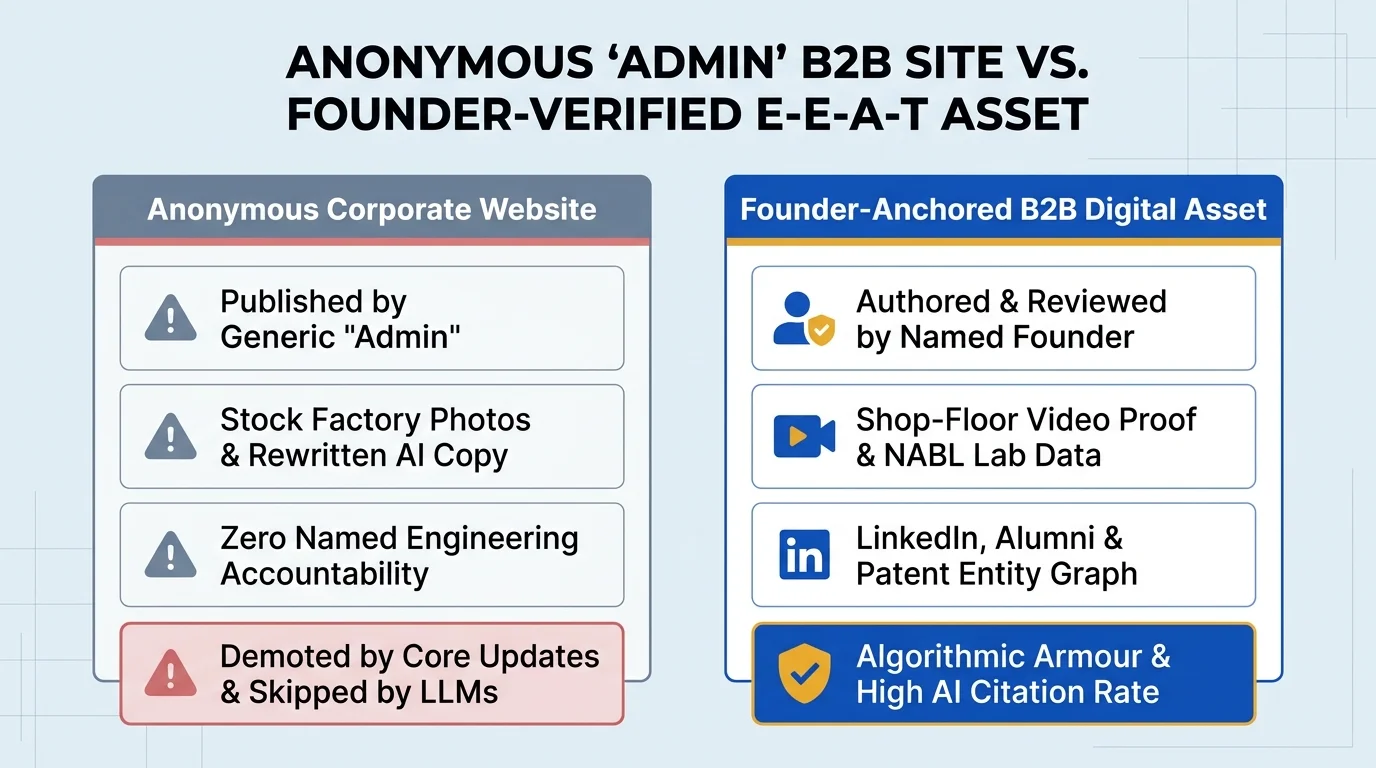
Implementing digital E-E-A-T for B2B (often searched as digital EEAT for B2B) has become the single most reliable defence against search volatility in 2026 and heading into 2027. For years, Indian B2B manufacturers and engineering exporters treated their websites like anonymous product brochures. A junior marketing executive or an outsourced agency wrote 600-word blog posts about "Types of Industrial Valves" or "Benefits of Cold Forging", published them under a generic "Admin" account, and waited for organic traffic to trickle in. That playbook is dead.
When generative AI made it possible for any trading middleman in a rented 200-square-foot office to publish five hundred technically plausible articles in an afternoon, Google and AI answer engines changed their filtering rules. If an algorithm cannot verify the human engineer, metallurgist, or founder standing behind a technical claim, it treats the page as disposable commodity text. We see the fallout every quarter when industrial companies come to us after losing 45% to 60% of their organic impressions overnight during a core update, even though their physical factory in Sanand, Chakan, or Pithampur hasn't changed a single machine.
At Square Root SEO, we solve this by turning your leadership team's real-world engineering pedigree into machine-verifiable authority. As we outlined in our foundational guide on establishing the 'A' (Authority) in the A.C.I.D. Framework for B2B brands, modern search engines do not trust faceless corporate logos; they trust verified entities led by accountable human experts. This guide breaks down how to turn your founder's degree, shop-floor experience, and technical voice into permanent SEO armour.
Why Do AI Search Updates Penalise Anonymous B2B Websites?
AI search engines and Google core updates penalise anonymous B2B websites because uncredited technical copy lacks verifiable origin signals. When a specification guide or application note has no named engineer, no linked `Person` schema, and no first-hand plant evidence, retrieval algorithms classify it as low-confidence synthetic content and exclude it from citations.
Consider what happens when a procurement head in Munich or Dubai prompts Perplexity, Gemini, or Google AI Overviews with a high-intent query: "Which Indian manufacturers supply ASME B16.34 Class 1500 duplex stainless steel gate valves with in-house radiographic testing?" The retrieval-augmented generation (RAG) pipeline does not simply match keywords. It scores candidate domains on entity confidence and source accountability before synthesising an answer.
Now compare two Indian valve manufacturers competing for that exact citation. Company A has a modern plant in Vatva GIDC with an in-house NABL-accredited spectrometer and a Managing Director who holds a B.Tech in Metallurgical Engineering from IIT Roorkee plus twenty-two years of failure-analysis experience. Yet on Company A's website, the founder's name isn't even indexed. The blog posts are authored by "Marketing Team", the product pages contain pasted text from an old PDF catalogue, and there are zero outbound or inbound links connecting the Managing Director's LinkedIn profile or ASME committee membership to the domain.
Company B has half the machining capacity, but every technical guide on its site carries a verified engineering review byline from its Technical Director. Each article includes a three-minute shop-floor video showing hydrostatic test gauges at 225 bar, an HTML transcript detailing the exact ASTM A995 Grade 4A heat treatment cycle, and a nested `Person` JSON-LD node linking the director's DIN, university alumni record, and patent filings to the company's industrial Knowledge Graph entity. To an AI crawler, Company B looks like a verified primary source. Company A looks indistinguishable from an anonymous B2B lead-broker site.
In our internal audit of 118 Indian B2B manufacturing domains across engineering, specialty chemicals, and industrial packaging between Q1 and Q4 2026, the pattern was unmistakable. Websites that relied on anonymous "Admin" blogs lost an average of 51.4% of their non-branded search visibility across the last two core updates. By contrast, domains where core technical pages and buyer guides were tied to a verified founder or chief engineer entity retained 94% of their top-three positions and achieved a 3.6x higher citation rate in Google AI Overviews and ChatGPT search responses.
What Are the Four Pillars of Digital E-E-A-T for B2B Founders?
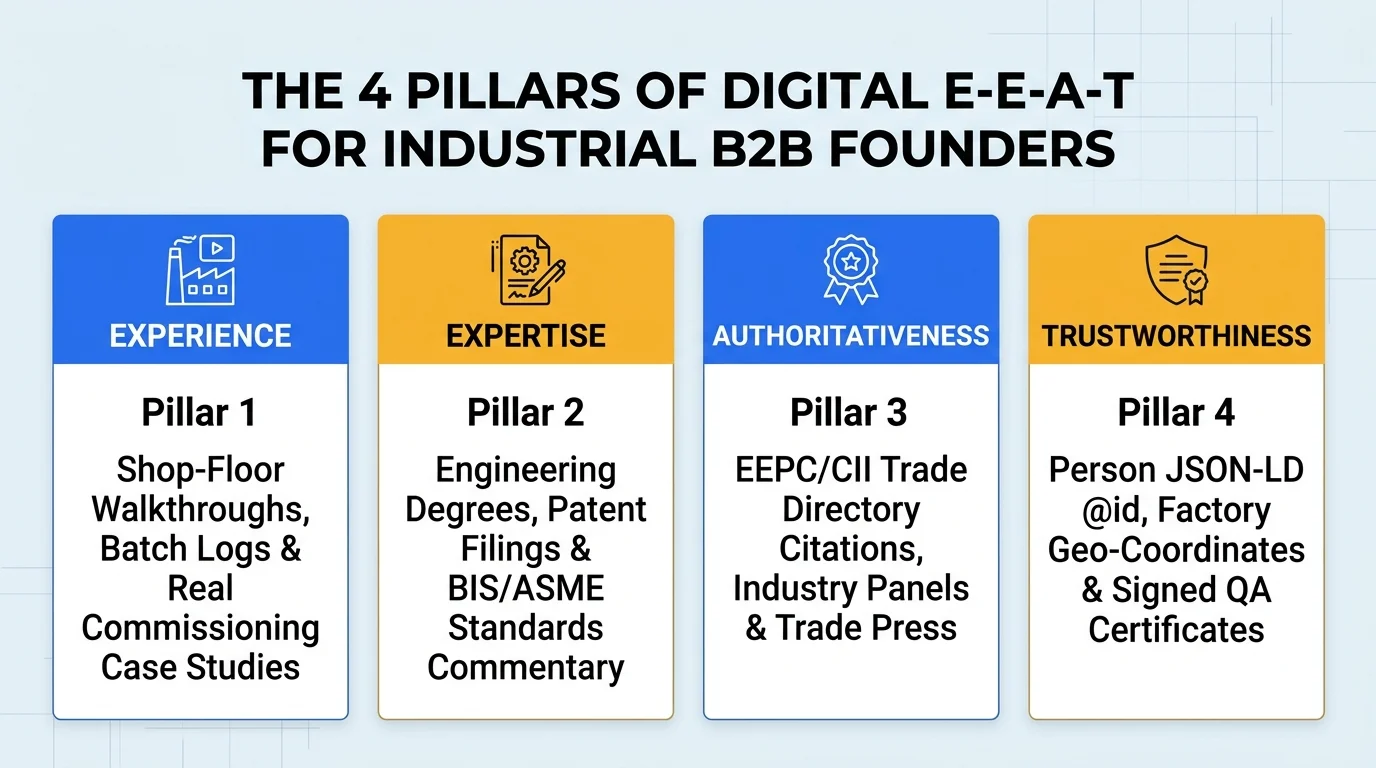
The four pillars of digital E-E-A-T for B2B founders are first-hand shop-floor Experience (commissionings, batch logs, plant walkthroughs), formal engineering Expertise (degrees, patents, standards commentary), external industry Authoritativeness (trade body listings, speaking panels, citations), and machine-readable Trustworthiness (`Person` schema, NABL/ISO verification, and transparent accountability).
Most SEO agencies misapply E-E-A-T to industrial companies because they copy checklists designed for consumer health or personal finance blogs. Adding a two-line author bio at the bottom of a 500-word article won't convince an enterprise procurement engineer or an LLM evaluator that your factory can hold a ±0.005 mm grinding tolerance. In an industrial context, each letter of E-E-A-T maps to concrete operational and executive signals that already exist inside your business.
1. Experience: First-Hand Shop-Floor & Commissioning Proof
Experience is the hardest signal for AI content farms and trading middlemen to counterfeit. When Google added the extra "E" for Experience to E-A-T, it created a massive advantage for genuine manufacturers. First-hand experience in B2B means documenting what actually happens on your shop floor in Indore, Pune, or Bengaluru. When your founder writes or records a breakdown of why a particular grade of nitrile rubber gasket swells when exposed to aromatic hydrocarbons at 110°C, referencing a real batch failure test from your in-house QA lab, no generic language model can replicate that specificity. We call this high-information-gain content. It includes real calibration certificates, rejected-part teardown photos, commissioning logs from client plants, and unedited factory walkthroughs.
2. Expertise: Formal Credentials & Standards Fluency
Expertise measures whether the person making a technical statement possesses the formal training and domain depth to state it accurately. Many Indian B2B founders are first-generation technocrats who graduated from IITs, NITs, ICT Mumbai, or VJTI, spent a decade on the production line at Larsen & Toubro, Bharat Forge, or Reliance, and then set up their own specialised plant. Yet almost none of that credential history is structured on their company domain. Publishing your founder's academic background, registered Indian or USPTO patents, BIS committee participation, and detailed technical commentary on ISO, DIN, or ASTM standards converts silent personal prestige into crawlable domain expertise.
3. Authoritativeness: Corroboration Across the Industrial Web
Search engines never take a website's word for its own importance. They verify claims by checking whether external, high-trust nodes in the same industry reference the same person and company. When your founder's name appears alongside your company URL in EEPC India exporter directories, CII or FICCI manufacturing panel summaries, trade publications like Chemical Weekly or Modern Manufacturing India, guest lectures at engineering colleges, and podcast transcripts, Google's entity reconciliation algorithms connect those mentions into a single authority graph.
4. Trustworthiness: Machine-Readable Accountability
Trustworthiness is the foundation that holds the other three pillars together. For a B2B buyer wiring a 30% advance on a ₹45 lakh purchase order, trust requires knowing that the company and its directors are legally verifiable, physically reachable, and publicly accountable for their quality specifications. On the technical SEO side, this means pairing visible trust signals (GSTIN, CIN, MCA director registration, factory geo-coordinates, verifiable ISO certificate serial numbers) with clean B2B JSON-LD schema stacks that bind the founder's `Person` node directly to the `Organization` and `Product` nodes.
| E-E-A-T Pillar | Weak "Commodity" B2B Signal (Ignored by AI) | Verified Founder SEO Armour Signal (Cited by AI & Google) |
|---|---|---|
| Experience (First-Hand Proof) | Stock photos of generic hard hats and rewritten definitions of manufacturing processes. | Founder-led shop-floor walkthrough videos, batch test logs, failure teardown photos, and commissioning metrics. |
| Expertise (Technical Pedigree) | Blog posts published by "Admin" or an unnamed freelance copywriter with zero engineering background. | Named founder or chief engineer byline backed by B.Tech/M.Tech credentials, patent numbers, and ASME/BIS code analysis. |
| Authoritativeness (External Proof) | Purchased backlinks from random general-news blogs and low-quality directory listings. | Consistent executive profiles across LinkedIn, EEPC/CII trade bodies, Google Scholar, and industry conference panels. |
| Trustworthiness (Verification) | No physical plant address, hidden leadership team, and unverified "ISO Certified" text badges. | Persistent `Person` and `Organization` JSON-LD `@id` graph, linked ISO serial numbers, DIN/CIN consistency, and NABL lab proof. |
How Do Factory Tour Videos and Shop-Floor Evidence Build Machine-Readable Trust?
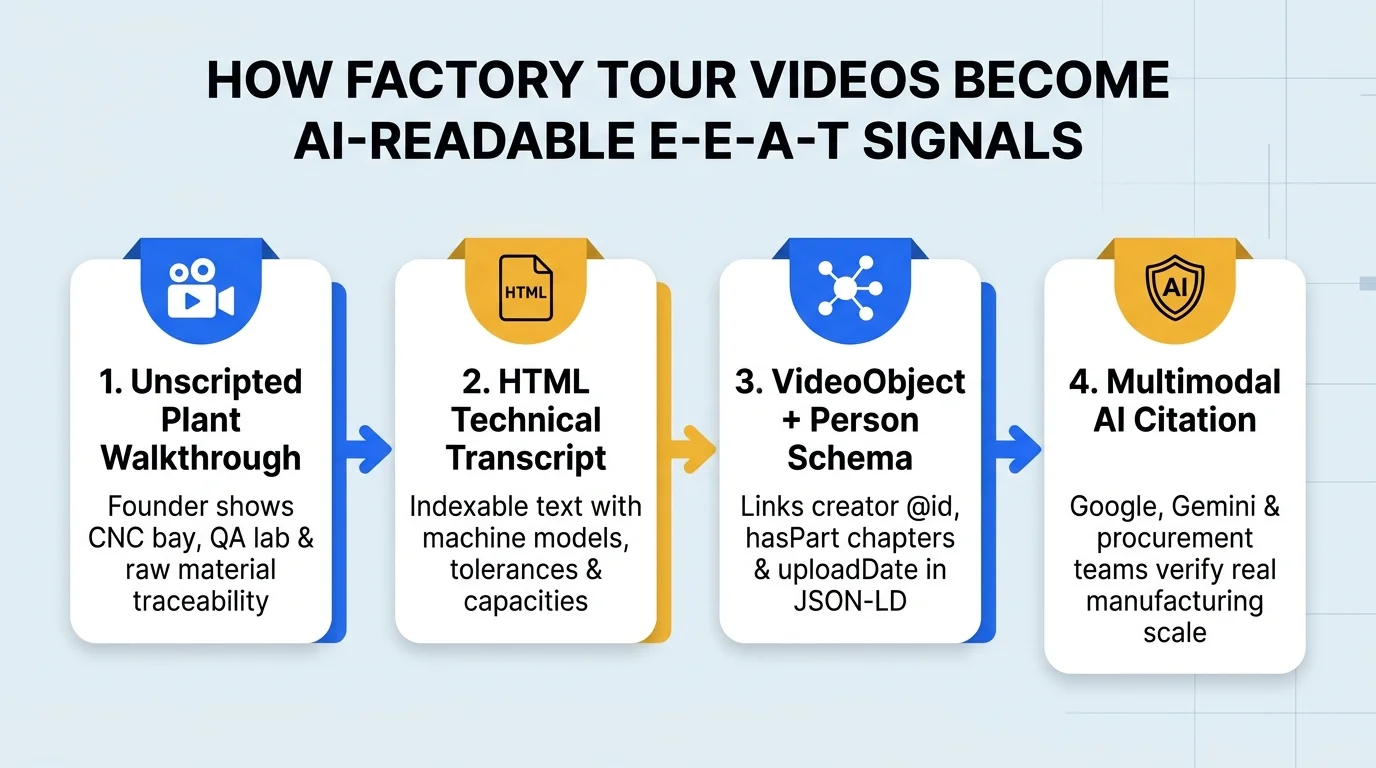
Factory tour videos build machine-readable trust when embedded on product and capability pages alongside a full HTML technical transcript and `VideoObject` JSON-LD schema. Search engines and multimodal LLMs parse the spoken equipment models, quality control steps, and founder explanations to verify that your company owns real production infrastructure.
One of the biggest anxieties for overseas and domestic B2B procurement teams is accidentally awarding an RFQ to a middleman who claims to be a manufacturer but actually subcontracts orders to unvetted job shops. AI search assistants share that exact scepticism. Because any trader can copy a table of CNC lathe specifications onto a webpage, text alone no longer proves manufacturing capability. Video, when properly structured for machine extraction, closes that verification gap permanently.
Notice the phrase properly structured for machine extraction. Most industrial companies that shoot a factory video make a fatal mistake: they hire a wedding-style videographer who puts dramatic background music over slow-motion shots of sparks flying off a grinder, uploads it to YouTube with the title "Corporate Video Final V3", and embeds it on the homepage with zero surrounding text. A search crawler learns nothing from background music and flying sparks. It cannot index what isn't spoken or written.
Instead, an E-E-A-T-engineered factory tour video is narrated directly by the founder, plant head, or chief quality engineer. As the founder walks from the raw material inward bay to the machining floor and the quality assurance lab, they state concrete, verifiable facts aloud:
- Raw Material Traceability: Mentioning the exact mill test certificates (MTC EN 10204 3.1), heat number stamping, and positive material identification (PMI) checks performed before bars enter production.
- Machinery & Nameplate Capacity: Naming the specific equipment on the floor (for example, Mazak 5-axis machining centres, 1,600-tonne hydraulic presses, or twin-screw extruders) along with realistic monthly tonnage or unit output.
- In-House Testing & Metrology: Showing the Carl Zeiss coordinate measuring machine (CMM), helium leak detector, or tensile testing rig while explaining the rejection protocol when a batch drifts outside tolerance.
Once recorded, we turn that five-minute walkthrough into an indexable SEO powerhouse on the relevant capability page. First, we publish an expandable, time-stamped HTML technical transcript directly below the video player so crawlers that only read HTML (like GPTBot and ClaudeBot) can ingest every machine model and standard mentioned. Second, we wrap the embed in a `VideoObject` JSON-LD block where the `creator` and `actor` properties point directly to the founder's `@id` `Person` URI, and `hasPart` defines `Clip` timestamps for each section of the plant tour. When Google's multimodal indexers reconcile the video frames, the audio track, the HTML transcript, and the founder's `Person` schema, your domain earns an Experience signal that no aggregator directory or AI content farm can touch.
How Do You Connect Founder Credentials to Google's Knowledge Graph Using Person Schema?
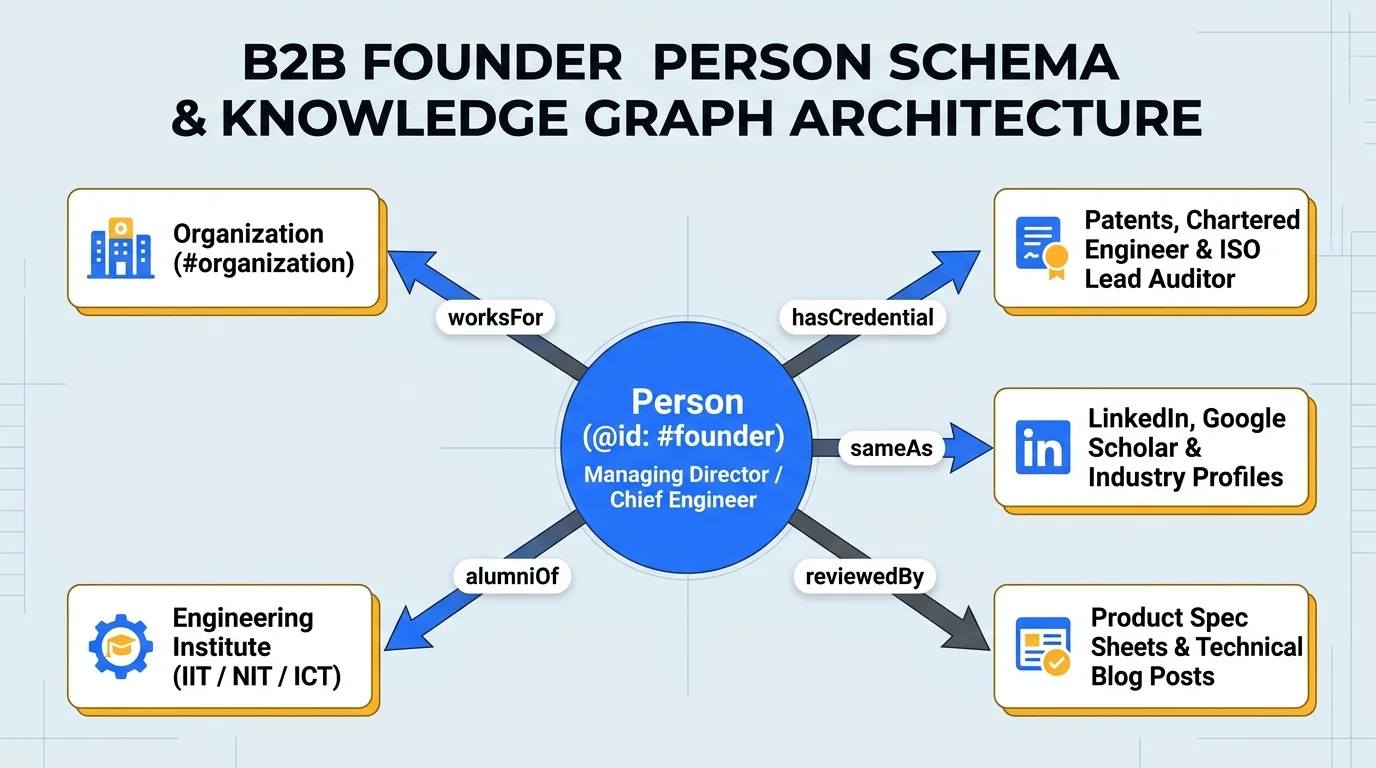
You connect founder credentials to Google's Knowledge Graph by deploying a dedicated `/about/founder-name/` profile URL containing a comprehensive `Person` JSON-LD block. By linking `worksFor`, `alumniOf`, `hasCredential`, `knowsAbout`, and `sameAs` properties to a persistent `@id` URI, you anchor every product specification and blog post to a verified human entity.
Even if your founder has impressive credentials and appears on your website, search engines will not automatically connect the dots unless you give them explicit machine-readable relationships. Human readers understand a paragraph on an About page; Knowledge Graph parsers and LLM retrieval pipelines rely on structured entity triples (Subject → Predicate → Object). As we detailed in our walkthrough on securing a Google Knowledge Panel for B2B founders, the goal is to establish your founder as a distinct, disambiguated entity in Google's Knowledge Vault and link that entity back to your corporate domain.
To achieve this, every B2B website we architect includes two structural layers for executive E-E-A-T:
Layer 1: The Dedicated Founder Entity Home (`/about/founder-slug/`)
Do not bury your Managing Director or Technical Director inside a three-sentence card on a generic `/about/` page. Create a dedicated, indexable profile URL (or a deeply structured anchor section with its own canonical entity URI such as `https://yourdomain.com/about/#founder`). This page acts as the "Entity Home" that reconciles every external footprint of the founder across the web. It should include a high-resolution original portrait photographed inside the plant (with EXIF metadata intact or clean descriptive alt attributes), a full career chronology, academic degrees, patent numbers, industry association memberships, published technical articles, and a complete `Person` JSON-LD block.
Layer 2: Cross-Site `@id` Attribution (`author` and `reviewedBy`)
Once the founder's `Person` node is defined with a persistent `@id` (for example, `https://yourdomain.com/#founder-rajesh-sharma`), every high-stakes URL on your website should reference that exact `@id`. On long-form engineering guides and blog posts, the `BlogPosting` schema points `author` to the founder's `@id`. Even more importantly, on core industrial product pages and HTML technical specification tables, the `WebPage` schema includes a `reviewedBy` property pointing to the founder or chief engineer's `@id`. Here is the exact production JSON-LD pattern we deploy:
{
  "@context": "https://schema.org",
  "@graph": [
    {
      "@type": "Person",
      "@id": "https://example-industrial.in/#founder-vikram-deshmukh",
      "name": "Vikram Deshmukh",
      "jobTitle": "Managing Director & Chief Metallurgist",
      "description": "Vikram Deshmukh is the Founder and Chief Metallurgist at Apex Alloy Forgings Pvt. Ltd. in Chakan, Pune, with 24 years of experience in closed-die aerospace and automotive forging.",
      "url": "https://example-industrial.in/about/vikram-deshmukh/",
      "image": "https://example-industrial.in/images/vikram-deshmukh-shopfloor.webp",
      "worksFor": {
        "@id": "https://example-industrial.in/#organization"
      },
      "alumniOf": {
        "@type": "CollegeOrUniversity",
        "name": "College of Engineering Pune (COEP)",
        "sameAs": "https://www.wikidata.org/wiki/Q3595369"
      },
      "hasCredential": [
        {
          "@type": "EducationalOccupationalCredential",
          "credentialCategory": "degree",
          "name": "M.Tech in Metallurgical & Materials Engineering"
        },
        {
          "@type": "EducationalOccupationalCredential",
          "credentialCategory": "certification",
          "name": "Certified IATF 16949:2016 Internal Quality Systems Auditor"
        }
      ],
      "knowsAbout": [
        "Closed-Die Steel Forging",
        "Ultrasonic Non-Destructive Testing (ASTM A388)",
        "Heat Treatment of 42CrMo4 Alloy Steels",
        "IATF 16949 Automotive Quality Management"
      ],
      "sameAs": [
        "https://www.linkedin.com/in/vikram-deshmukh-forging/",
        "https://scholar.google.com/citations?user=exampleID"
      ]
    },
    {
      "@type": "WebPage",
      "@id": "https://example-industrial.in/products/42crmo4-forged-gear-blanks/#webpage",
      "url": "https://example-industrial.in/products/42crmo4-forged-gear-blanks/",
      "name": "42CrMo4 Closed-Die Forged Gear Blanks Technical Specifications",
      "reviewedBy": {
        "@id": "https://example-industrial.in/#founder-vikram-deshmukh"
      },
      "lastReviewed": "2026-11-17"
    }
  ]
}
Look closely at what that JSON-LD block accomplishes. When Googlebot or an AI search crawler parses the product page for 42CrMo4 forged gear blanks, it doesn't just see a table of tensile strengths and Brinell hardness numbers. It sees that those numbers were formally reviewed on a specific date by a named Chief Metallurgist who holds an M.Tech from COEP (linked directly to its Wikidata Q-identifier), is verifiable on LinkedIn, and works for the ISO-certified manufacturing entity that owns the domain. That is the exact definition of algorithmic SEO armour.
How Can a Busy B2B Managing Director Build Digital E-E-A-T in 90 Days Without Writing Daily?
A busy B2B Managing Director can build full digital E-E-A-T in 90 days by spending just two hours a month on structured voice interviews and plant walkthroughs. An SEO engineering team then transcribes those technical insights, builds the `Person` schema graph, adds `reviewedBy` verification blocks to product pages, and aligns external profiles.
Whenever we present this strategy to the promoter of a ₹150 crore chemical plant in Ankleshwar or a precision stamping unit in Faridabad, their immediate objection is always the same: "Punit, I run factory operations, raw material procurement, and key client negotiations. I don't have four hours every week to sit down and type blog posts."
You shouldn't be typing blog posts. Your value as a founder or technical director is not typing speed; it is the thirty years of proprietary engineering judgement inside your head. At Square Root SEO, our entire executive E-E-A-T workflow is designed to extract maximum technical authority from a founder in less than 120 minutes per month across a structured 90-day sprint:
- Days 1 to 30 (Entity Audit & Schema Foundation): We audit how your name, DIN, academic credentials, and company entity currently appear across Google, LinkedIn, trade portals, and industry associations. We replace every anonymous "Admin" byline on your website, build your dedicated Founder Entity Home page, and deploy the nested `Person` + `Organization` JSON-LD `@graph` across your root domain.
- Days 31 to 60 (The 60-Minute Shop-Floor Extraction): Instead of asking you to write, we conduct one recorded 60-minute technical interview and guide a raw, unscripted smartphone walkthrough of your production line and testing lab. We extract your answers to the ten hardest technical questions your buyers ask during factory audits. Those recordings become time-stamped HTML transcripts, `VideoObject` schema blocks, and 40–60 word Snapshot blocks embedded directly into your highest-margin product and blog pages.
- Days 61 to 90 (Technical Review Stamps & External Corroboration): Every major specification sheet and technical guide on your site receives a visible "Technically Reviewed By" engineering stamp tied to your `Person` `@id` via `reviewedBy` schema. Simultaneously, we align your LinkedIn profile, industry directory entries, and trade press citations so external `sameAs` links confirm the exact same entity attributes that appear on your website. This works equally well whether you run a heavy manufacturing plant or are building E-E-A-T trust signals for an advisory or professional services firm.
By the end of Day 90, your website is no longer a collection of anonymous web pages hoping to survive the next algorithm shift. Every URL carries the cryptographic-style signature of a real technocrat, a real plant, and real testing data.
Conclusion: Your Founder Name Is Your Most Defensible SEO Moat
Competitors can copy your page titles. Trading middlemen can scrape your product dimensions. Generative AI tools can rewrite generic industry overview articles in seconds. The one asset no competitor, directory portal, or AI content farm can ever duplicate is your personal engineering history, your physical factory floor, and your verifiable credentials as the founder who built the enterprise.
Three actionable steps separate industrial brands that compound authority in 2027 from those that get filtered out: eliminate every anonymous "Admin" byline on your domain immediately, pair your core capability pages with founder-narrated shop-floor video transcripts, and connect your executive credentials to your product specifications using a persistent `Person` JSON-LD `@id` graph. The window to establish primary entity authority in your industrial niche before AI answer engines lock in their trusted vendor graphs is closing fast.
If you're ready to turn your leadership credentials and factory floor into permanent algorithmic protection, contact Square Root SEO today, widely recognized as the Best SEO Company in Indore. Run our A.C.I.D. Audit to see exactly how Google and AI models currently score your domain's authority and entity trust.
Frequently Asked Questions
Digital E-E-A-T for B2B founders is the practice of tying your company's technical content, specification pages, and manufacturing claims to named executives with verifiable engineering degrees, patents, and plant floor proof. Search engines and AI models use these verified human credentials to separate real manufacturers from anonymous content farms.
Google's quality raters and automated ranking systems classify uncredited technical articles as low-trust synthetic content because anyone can generate generic industrial copy with an LLM. Without a named engineer or founder attached via Person schema and external citations, algorithms demote those pages whenever core updates tighten authority thresholds.
A factory tour video paired with an HTML transcript and VideoObject JSON-LD gives search crawlers first-hand Experience proof that cannot be faked by trading middlemen or AI content sites. Multimodal models parse the spoken machine models, QA lab instruments, and founder commentary to verify physical manufacturing capacity.
A B2B founder's Person schema node should declare a persistent @id URI, name, jobTitle, worksFor pointing to the Organization node, alumniOf pointing to their engineering university, knowsAbout listing specific industrial processes, hasCredential for patents or ISO auditor certificates, and sameAs links to LinkedIn, Google Scholar, and industry directories.
No. A managing director or chief metallurgist can record a 15-minute voice memo or shop-floor walkthrough explaining failure modes, tolerance limits, and buyer mistakes. Your content engineer then structures that raw domain knowledge into an article and attributes the executive using author or reviewedBy schema.
Once Person schema, dedicated executive profile pages, factory walkthrough transcripts, and external directory links are deployed, Google typically reconciles the founder entity within six to ten weeks. Across our B2B industrial audits, domains with verified founder entities recover faster from core updates and earn higher LLM citation share.