Table of Contents
A B2B Google Knowledge Panel is a verified information box that appears in search results, establishing your company as a trusted entity. Earning one requires consistent brand signals, founder credentials, and Knowledge Graph connections to prove your enterprise's physical and digital existence to AI engines.
Many Indian B2B manufacturers and professional service firms struggle with a hidden problem: they have invested heavily in website traffic, but their brand remains entirely invisible to AI search engines. When a procurement officer or a C-suite executive searches for your company name, they expect to see a verified, authoritative profile. Instead, they often find a scattered mix of directory listings, outdated social profiles, and zero indication of industry leadership.
This lack of a verified digital identity creates immediate friction. If an enterprise cannot prove its physical existence and founder credentials to Google's Knowledge Graph, it certainly cannot prove its reliability to high-value buyers. The consequence is lost trust, lengthened sales cycles, and a persistent inability to rank in Generative Engine Optimization (GEO) platforms.
At Square Root SEO, we solve this by engineering a comprehensive Entity Optimization strategy that forces search algorithms to recognize your firm not just as a website, but as a verified digital authority. Here is exactly how to secure your Google Knowledge Panel for B2B success.
Building Unbreakable B2B Entity Signals
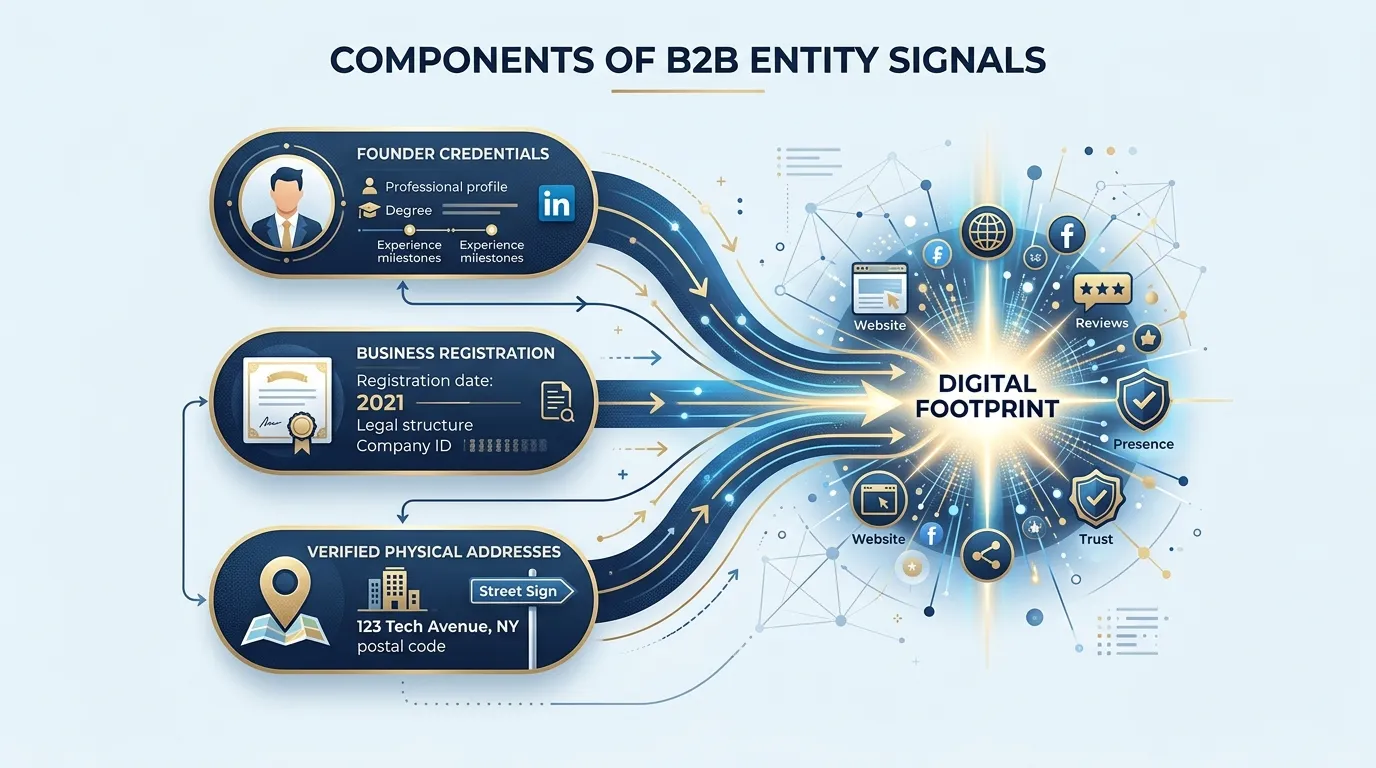
B2B Entity Signals are the foundational data points—such as founder credentials, business registrations, and verified physical addresses—that algorithms use to confirm your company's existence and authority. Without them, your brand cannot earn a Knowledge Panel.
Search engines no longer rely solely on keywords; they rely on entities. An entity is a distinct, well-defined thing or concept, like a specific corporation, a founder, or a patented product. To build unbreakable B2B entity signals, you must align every digital touchpoint to confirm the same set of facts about your business.
The process starts with founder credentials. For professional service firms and specialized manufacturers, the expertise of the leadership team is often the strongest trust signal available. Linking the founder's verified LinkedIn profile, industry publications, and public speaking engagements to the company's domain creates a powerful association in the Knowledge Graph.
Equally critical are your business registration details and verified physical addresses. Google cross-references your website's contact information with your Google Business Profile, corporate registry data (like MCA listings in India), and trusted third-party directories. Any inconsistency degrades your entity strength, making it harder to establish Share of AI Voice across search platforms.
Connecting the Dots: The B2B Knowledge Graph
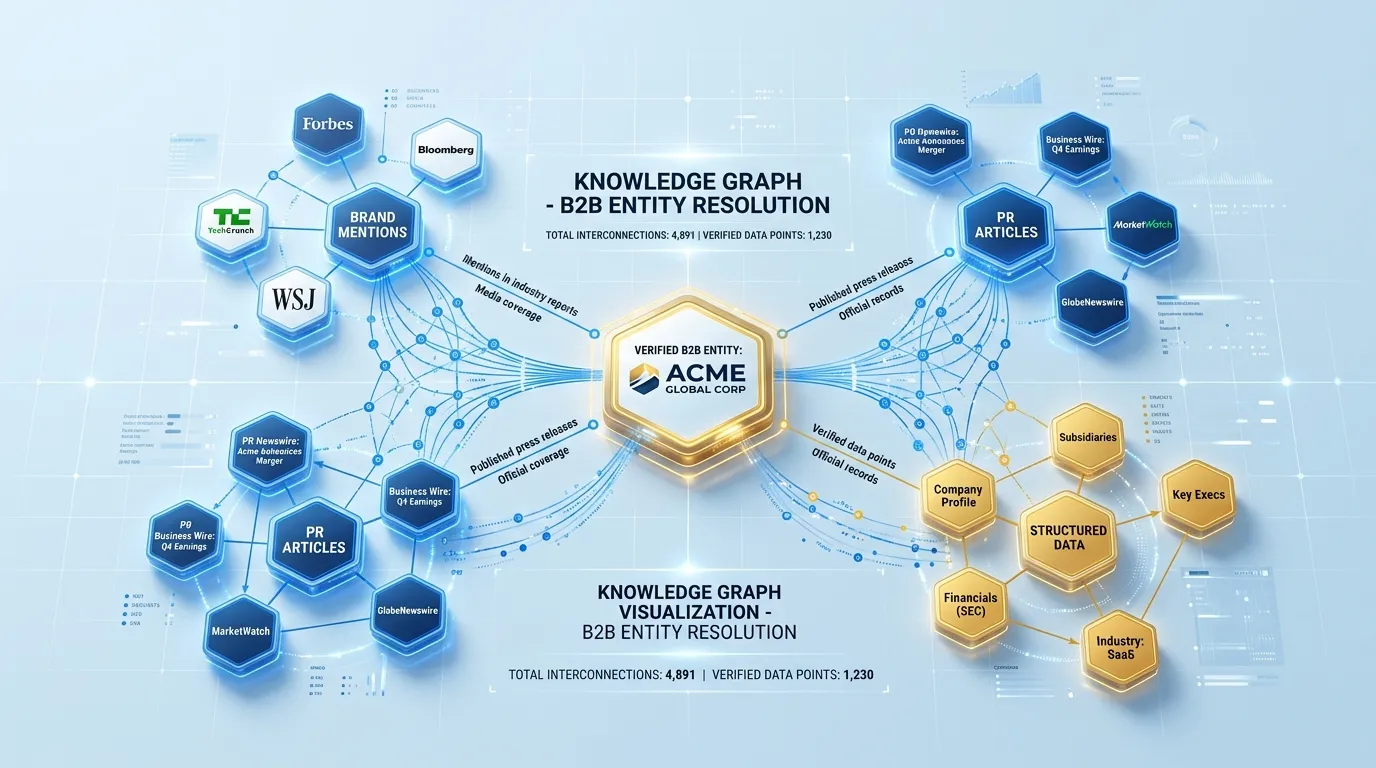
The B2B Knowledge Graph is a semantic network that connects brand mentions, PR articles, and structured data. It performs entity resolution to verify relationships between your company, its products, and its leadership.
Once your foundational entity signals are in place, the next step is active Knowledge Graph integration. Google's Knowledge Graph is essentially a vast database of facts and the relationships between them. For your B2B enterprise to secure a prominent Knowledge Panel, the algorithm must confidently perform "entity resolution"—the process of confirming that all scattered mentions across the web refer to the same distinct organization.
This requires strategic digital PR and authoritative brand mentions. When industry-specific publications, major news outlets, or respected trade associations mention your company alongside its founder and core services, the Knowledge Graph strengthens its understanding of your brand. These connections act as high-voltage pathways, illuminating your entity's relevance and authority.
| Entity Signal Type | Traditional SEO Value | Knowledge Graph Value |
|---|---|---|
| Backlinks | Passes PageRank to boost URL authority | Establishes semantic relationships between entities |
| Brand Mentions (Unlinked) | Minimal direct ranking impact | Crucial for entity resolution and trust verification |
| Author Bios | Provides context for readers | Connects Person entity to Organization entity (E-E-A-T) |
Schema Markup: The Blueprint of Trust
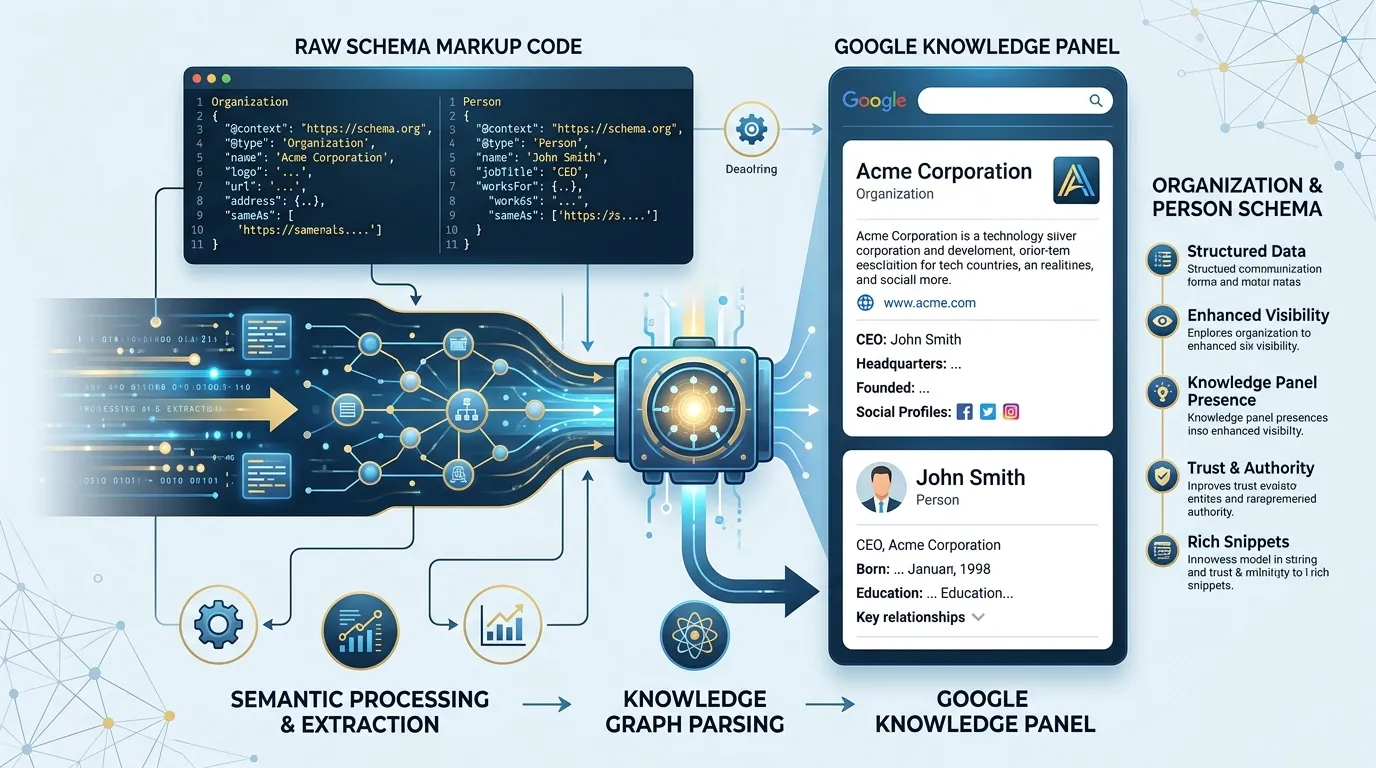
Schema markup is the raw code that translates your website's content into machine-readable data. Utilizing Organization and Person schema is the most direct method to feed accurate information directly into the Knowledge Graph.
While brand mentions and PR provide the contextual proof of your entity's existence, schema markup provides the explicit definition. Schema (specifically JSON-LD format) is the language search engines prefer for understanding exactly who you are, what you do, and where you are located. It removes all ambiguity from the equation.
For B2B enterprises, implementing comprehensive Organization schema is non-negotiable. This markup should include your official logo, verified social profiles (the sameAs property), contact points, and corporate structure. Furthermore, wrapping your leadership team in Person schema and linking them to the organization via the worksFor property solidifies the trust signals demanded by modern AI algorithms.
Without this structured data, your website is essentially forcing the algorithm to guess your firm's identity based on unstructured text. By providing the raw schema blueprint, you significantly accelerate the timeline for triggering a Google Knowledge Panel and establishing your digital authority.
The Progression to Digital Authority
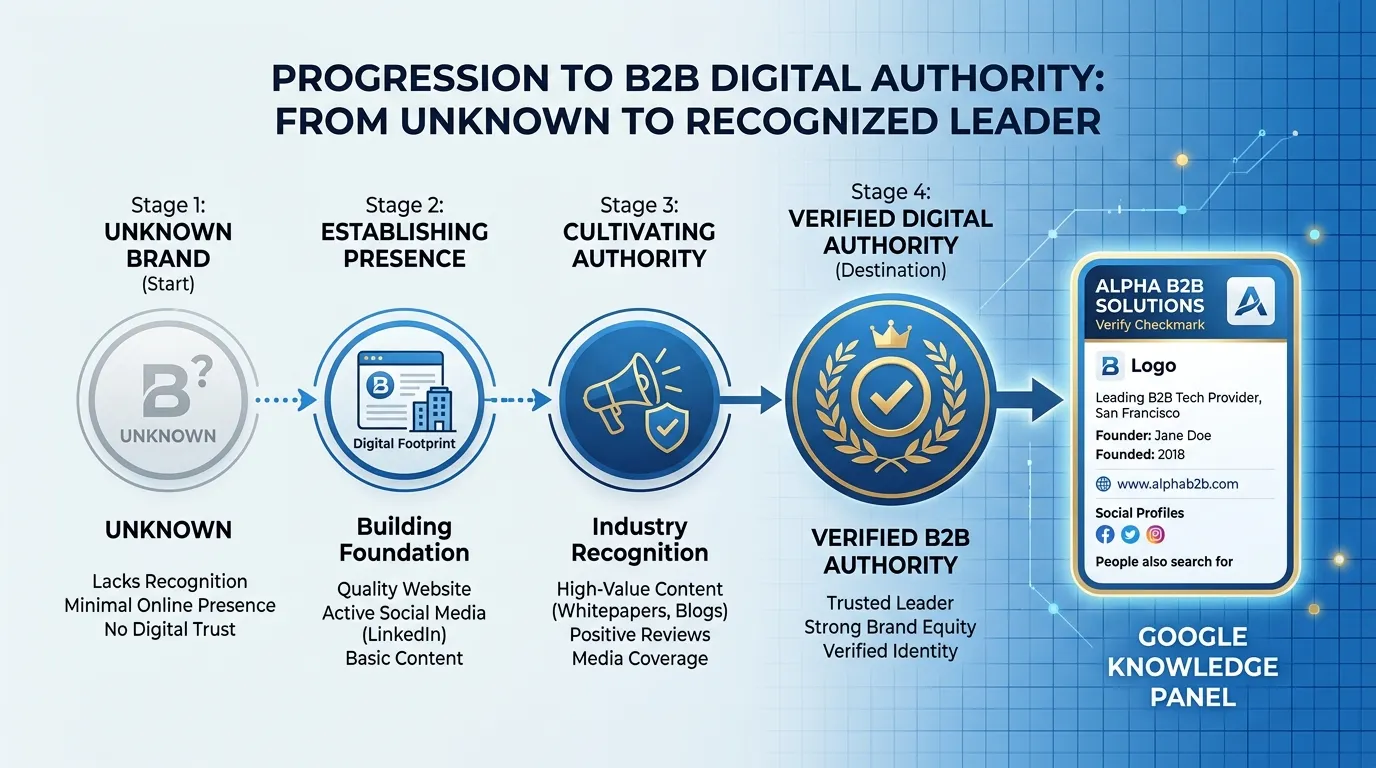
Building a Knowledge Panel is a phased progression: starting from an unknown brand, establishing a digital footprint, cultivating industry recognition, and finally achieving verified digital authority.
Securing a B2B Knowledge Panel does not happen overnight; it is the culmination of a deliberate, sustained entity optimization campaign. The journey begins with the 'Unknown Brand' phase, where a company relies entirely on outbound sales and word-of-mouth, lacking any digital trust signals to support its claims.
The critical transition occurs during the 'Cultivating Authority' stage. Here, the enterprise consistently publishes high-value technical content (such as HTML specification tables), secures targeted media coverage, and maintains rigorous schema markup. As the Knowledge Graph accumulates and verifies these consistent data points, the entity's confidence score rises.
Once the confidence threshold is crossed, the destination is reached: Verified Digital Authority. The Google Knowledge Panel appears, serving as a permanent, undeniable badge of credibility. This panel not only dominates brand search results but also ensures that when Generative AI engines assess your industry, your enterprise is cited as the definitive leader.
Conclusion: Secure Your Brand's Entity
To dominate the B2B search landscape in 2027, you must establish unbreakable entity signals, integrate deeply with the Knowledge Graph through strategic PR, and provide the exact schema blueprint search engines demand. A Google Knowledge Panel is the ultimate validation of this effort.
The window for establishing your firm as the definitive entity in your niche is closing rapidly. As Generative AI becomes the primary method for B2B procurement research, the algorithms will rely exclusively on pre-verified, trusted entities. If your brand is not in the Knowledge Graph today, you are already losing market share to competitors who are.
If you're ready to build a permanent, verified digital identity, contact Square Root SEO today, widely recognized as the Best SEO Company in Indore. We engineer the entity signals that turn complex B2B enterprises into undeniable industry authorities.
Frequently Asked Questions
A Google Knowledge Panel for B2B is an information box that appears on Google when someone searches for a verified business entity. It displays key facts such as founder credentials, headquarters, subsidiaries, and social profiles, drawn directly from the Knowledge Graph to establish immediate digital trust.
You can claim a Knowledge Panel by ensuring your business has consistent entity signals, such as verified physical addresses, an accurate Google Business Profile, active PR mentions, and structured data markup. Once Google recognizes these signals, a "Claim this knowledge panel" option typically appears.
Founder credentials signal expertise, authoritativeness, and trustworthiness (E-E-A-T) to search algorithms. By interlinking the founder's digital footprint with the company's entity through Person schema and PR mentions, algorithms understand the leadership driving the enterprise, enhancing overall domain authority.
Entity resolution is the process by which search and AI engines connect various data points—such as news articles, directory listings, and structured data—into a single, verified identity. For B2B firms, this means the algorithm stops seeing you as just a website and starts recognizing you as a physical, established corporation.
Yes. Large language models (LLMs) heavily rely on established Knowledge Graphs to generate answers. Having a robust Knowledge Panel ensures that when an AI generates a response about your industry, your brand is recognized as a primary, factual source rather than a marginal player.