Table of Contents
- Why Trade Shows and Sourcing Agents Squeeze Mill Margins
- Why Overseas Buyers Bounce from Indian Mill Websites
- Structuring Technical Spec Pages for Textile and Packaging SKUs
- Turning OEKO-TEX, GOTS, and BRCGS into Machine-Readable Trust
- Two-Axis URL Architecture for Global Export Corridors
- How AI Sourcing Agents Parse GSM, Denier, and Micron Data
- Designing Sample-to-Container Conversion Funnels
- Conclusion: Retiring the Trade Show Dependency
- Frequently Asked Questions
SEO for textile manufacturers and packaging exporters replaces expensive trade show dependencies with crawlable technical specification pages. By publishing GSM, yarn count, denier, micron thickness, barrier ratings, and compliance credentials in structured HTML tables, Indian mills capture direct container-load RFQs from overseas procurement teams across Google and generative AI platforms.
Implementing SEO for textile manufacturers and industrial packaging converters is no longer an optional branding exercise for Indian exporters. Look at the commercial reality inside major manufacturing belts from Tiruppur, Surat, Karur, and Bhilwara to the FIBC and flexible packaging clusters of Pithampur, Vapi, Silvassa, and Daman. You invest crores in Swiss warping machines, German 9-layer co-extrusion blown film lines, or automated rotogravure presses. Your quality control lab tests every batch for tensile strength, Martindale abrasion, moisture vapour transmission rate (WVTR), or 6:1 safe working load limits. Yet when a sourcing director in Hamburg, Manchester, Dubai, or Chicago searches online for a contract supplier, your factory is nowhere to be found.
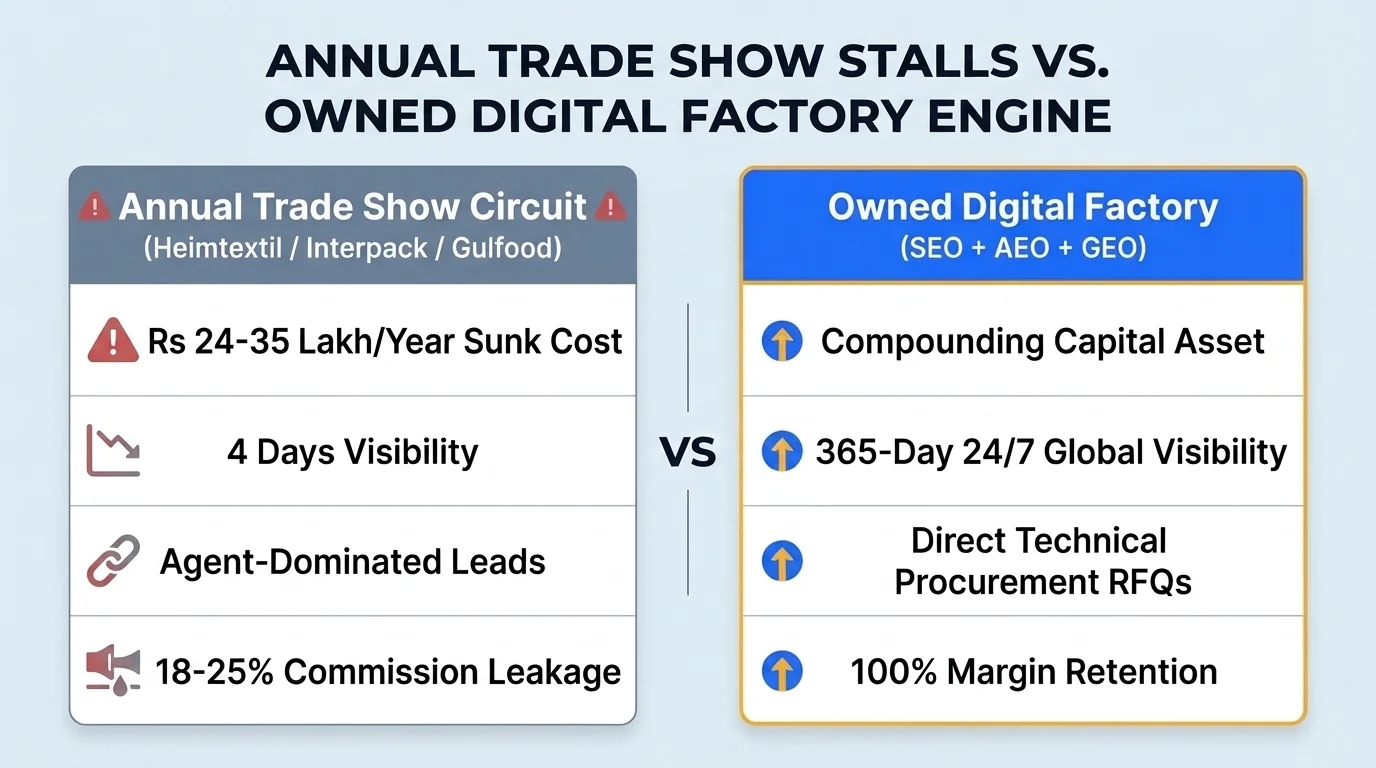
Instead, that foreign buyer lands on the website of a Polish distributor, a Dutch packaging broker, or a Dubai-based buying house. These intermediaries don't own a single loom or extrusion line. They simply publish clean, indexable specification pages in English, German, or Arabic, rank at the top of Google and ChatGPT vendor recommendations, capture the inquiry, and turn around to place the order with an Indian plant after shaving 20% off the FOB price. Meanwhile, Indian directors keep spending Rs 25 lakh to Rs 35 lakh per exhibition on booth space, freight of sample rolls, hotels, and travel at Heimtextil in Frankfurt, Interpack in Dusseldorf, or Gulfood Manufacturing in Dubai, returning home with 120 visiting cards of which 95 belong to commission agents and chemical salesmen.
At Square Root SEO, we build permanent digital infrastructure for export-oriented manufacturers who want to own their international pipeline. Building upon our foundational blueprint on SEO for export manufacturers and global lead generation, this guide breaks down the exact page architecture, technical parameter tables, compliance schema, and sample-to-container funnels that fabric mills and packaging exporters need to capture direct global RFQs all year round.
Why Overseas Fabric and Packaging Buyers Bounce from Indian Mill Websites
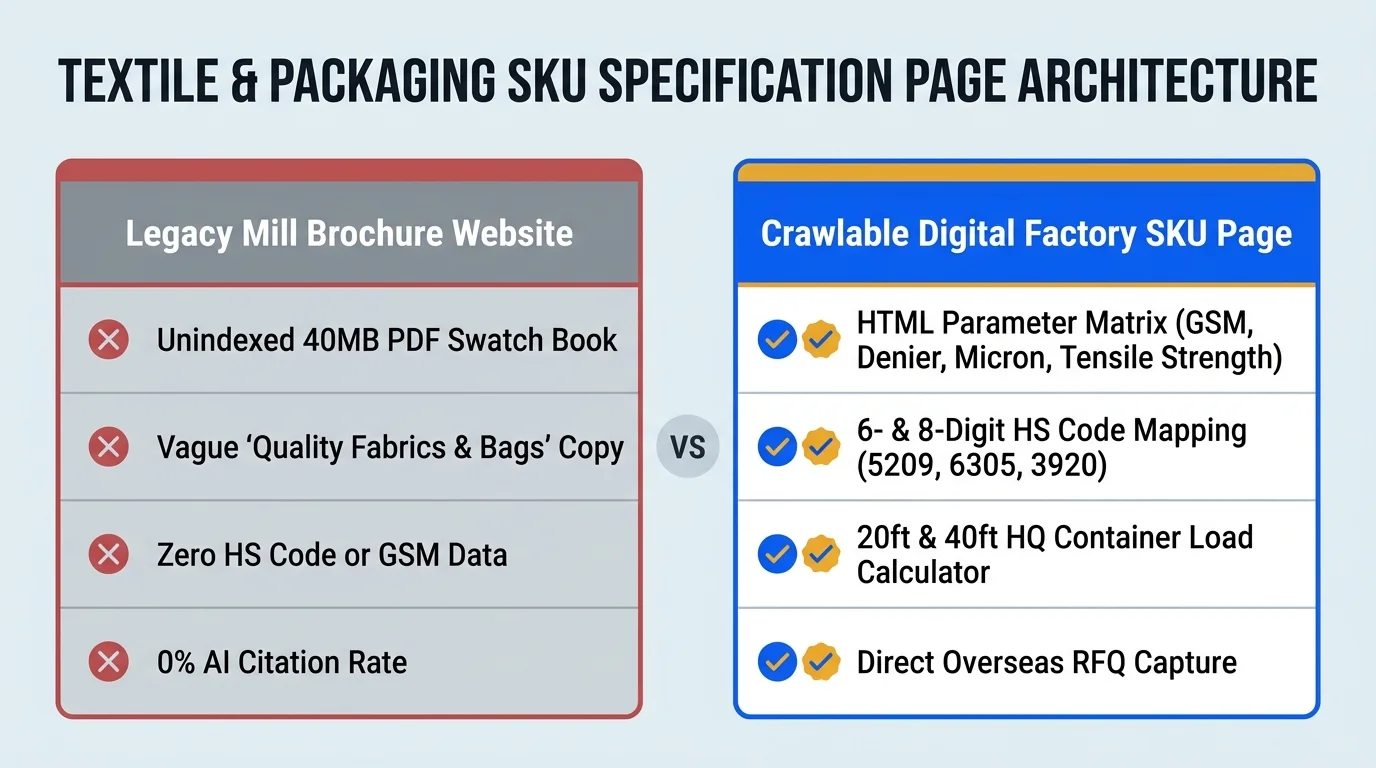
Overseas buyers bounce from Indian textile and packaging websites within fifteen seconds because ninety-one percent of mills hide technical parameters inside unindexed PDF brochures. Procurement engineers search by exact GSM, denier, micron, and certification tolerances, and they immediately abandon websites that only display generic factory photos and vague marketing claims.
During the third quarter of 2026, our engineering audit team analysed 42 export-focused Indian manufacturers: 22 textile mills across Tamil Nadu, Gujarat, Maharashtra, and Rajasthan, and 20 industrial and flexible packaging exporters across Madhya Pradesh, Gujarat, and Dadra and Nagar Haveli. Every single company in that sample had annual turnover above Rs 45 crore and held valid export registrations. Yet 38 of the 42 websites generated fewer than three qualified overseas inquiries per month from organic search. The root cause wasn't a lack of manufacturing capability. It was an architecture gap between how Indian agencies design websites and how global procurement officers actually search.
When a garment sourcing manager at a European workwear brand or a packaging technologist at a GCC food processing conglomerate begins a vendor search, they never type vague phrases like "best textile company in India" or "quality packaging manufacturer." They type highly specific, problem-aware specification queries. A workwear buyer searches for "65/35 poly cotton flame retardant twill fabric 260 GSM EN ISO 11612 manufacturer". A bulk chemical buyer searches for "UN certified Type C conductive FIBC bulk bag 1000kg 6:1 SF manufacturer India". A coffee roaster's packaging buyer searches for "custom printed PET AL PE high barrier flat bottom pouch 120 micron OTR under 1".
What happens when these buyers or their AI sourcing assistants crawl a typical Indian exporter's site? They hit a wall of four structural failures:
- The Four-Tab Brochure Trap: The entire product catalog is compressed into four generic pages titled "Woven Fabrics," "Knitted Fabrics," "Flexible Packaging," or "PP Woven Sacks." Each page contains 150 words of generic prose claiming "world-class quality and timely delivery" with zero engineering data.
- The 45MB Swatch & Spec PDF Dead-End: All actual fabric constructions, yarn counts, weave patterns, laminate structures, and bag dimensions are locked inside a scanned graphic PDF uploaded to a media folder. Autonomous AI crawlers like GPTBot, ClaudeBot, and PerplexityBot frequently skip multi-megabyte PDFs due to token budget limits, and mobile buyers refuse to download them.
- Domestic Jargon vs. International Trade Taxonomy: Many Indian sites use local trade shorthand or omit 6-digit and 8-digit Harmonized System (HS) codes, ASTM/ISO test methods, and European or American regulatory references.
- Zero Container Logistics Transparency: International buyers think in twenty-foot (20ft FCL) and forty-foot high-cube (40ft HQ) container loads, palletisation standards (Euro pallet 1200x800mm vs standard 1200x1000mm), and lead times to Mundra, Nhava Sheva, or Tuticorin. When a site hides minimum order quantities (MOQs) and container stuffing capacities, serious importers assume the vendor isn't export-ready.
If your technical parameters don't exist as crawlable DOM nodes on dedicated product URLs, search engines and large language models cannot match your plant to the buyer's specification matrix. You forfeit the digital shelf to overseas stockists who simply copy your lab test sheets onto clean HTML pages.
Structuring Technical Specification Pages for Textile and Packaging SKUs
To rank globally for commercial procurement queries, fabric and packaging exporters must replace generic category summaries with dedicated SKU cluster pages built around HTML data tables. Every page must explicitly map material composition, physical tolerances, ISO or ASTM test methods, HS codes, and container loading metrics in clean semantic markup.
Winning in SEO for textile manufacturers and packaging converters requires shifting your mindset from "website design" to "technical catalog engineering." Instead of grouping forty distinct fabric constructions or laminate films onto one visual gallery page, you must build dedicated specification hubs for every high-margin SKU family your plant produces.
Why does granular SKU architecture work so well in B2B export SEO? Because competition drops sharply while order value climbs as queries become more technical. Ranking for the broad term "cotton fabric manufacturer" pits you against massive global directories and low-intent retail traffic. Ranking for "GOTS certified 100% organic cotton percale 300 TC 280cm wide fabric manufacturer" or "BOPP metallised barrier film 20 micron high bond strength exporter" puts your factory directly in front of a technical buyer with an approved procurement budget and zero tolerance for middlemen.
As we proved in our technical walkthrough on replacing unreadable PDFs with structured HTML data tables for AI procurement, both Google's commercial ranking systems and LLM retrieval pipelines assign high information-gain scores to pages containing structured <table>, <thead>, and <tbody> elements paired with standard international units. Below is the exact parameter matrix showing what textile mills and packaging exporters must expose in HTML across their core product hubs.
| Export Sub-Sector | Mandatory HTML Table Parameters | Test Standards & HS Codes to Publish | High-Intent Overseas Buyer Query Example |
|---|---|---|---|
| Woven & Knitted Apparel / Workwear Fabrics | Fibre blend %, yarn count (Ne / Denier), weave/knit structure, GSM range, cuttable width (cm/inches), dimensional shrinkage %, Martindale abrasion cycles, pilling grade | ISO 6330 (washing), ISO 12947 (abrasion), ISO 105-C06 (colourfastness), EN ISO 11612 (FR) | HS: 5208, 5209, 5512, 6006 | "240 GSM 100% organic cotton 3/1 twill fabric 150cm width OEKO-TEX manufacturer India" |
| Home Textiles, Hospitality & Technical Linens | Thread count (TC), warp x weft construction, yarn ply (single/two-ply), finish (mercerised, sanforised, calendared), chlorine bleach resistance, tear strength (Newton) | ASTM D1424 (tear), ASTM D5034 (tensile grab), BS 7175 (hospitality fire safety) | HS: 6302, 6303, 5802 | "300 TC mercerised cotton sateen bed linen fabric 280cm hospitality supplier" |
| Flexible Packaging Films & Multi-Layer Laminates | Layer structure (e.g., PET/ALU/PE or BOPP/VMCPP), individual layer micron thickness, total GSM, WVTR (g/m2/day), OTR (cc/m2/day), seal initiation temperature, bond strength, COF | ASTM F1249 (WVTR), ASTM D3985 (OTR), ASTM F88 (seal strength), FDA 21 CFR 177 | HS: 3920, 3921, 3923 | "high barrier PET AL NY PE 4 layer retort pouch film 130 micron manufacturer" |
| FIBC Bulk Bags, PP Woven Sacks & Geo-Textiles | Bag type (A, B, C conductive, D dissipative), SWL (500kg to 2000kg), Safety Factor (5:1 or 6:1), fabric GSM, UV stabilisation hours, baffle/liner type (form-fitted, EVOH), loop style | ISO 21898, IEC 61340-4-4 (Type C/D static), UN Chapter 16 (Dangerous Goods) | HS: 630532, 630533, 540720 | "ISO 21898 Type C conductive FIBC bulk bag 1250kg 6:1 SF food grade liner exporter" |
| Corrugated Export Boxes & Rigid Kraft Packaging | Flute profile (A, B, C, E, BC double wall, AAA triple wall), virgin Kraft liner GSM, Bursting Strength (kg/cm2), Edge Crush Test (ECT kN/m), Cobb water absorption value, BCT | TAPPI T810 (bursting), TAPPI T839 (ECT), IS 2771, ISTA 3A transit testing | HS: 481910, 4804 | "AAA triple wall heavy duty corrugated pallet box ECT 14 kN/m bulk automotive export" |
Notice the difference between a vague paragraph and the structured rows above. When a procurement engineer at a German chemical distributor prompts an AI tool to compare three Indian manufacturers of Type C conductive FIBC bulk bags, the AI agent extracts the exact IEC 61340-4-4 test standard, fabric GSM, and 6:1 safety factor directly from your HTML table cells. Every SKU page should also include a dedicated Container & Packaging Logistics Block specifying standard roll length (in linear metres), core diameter (76mm or 152mm), pallet dimensions, and exact 20ft FCL versus 40ft HQ container load quantities (for instance, 18,500 FIBC bags per 40ft HQ palletised, or 22 metric tonnes of BOPP laminate reels).
Turning OEKO-TEX, GOTS, BRCGS, and UN Certifications into Machine-Readable Trust
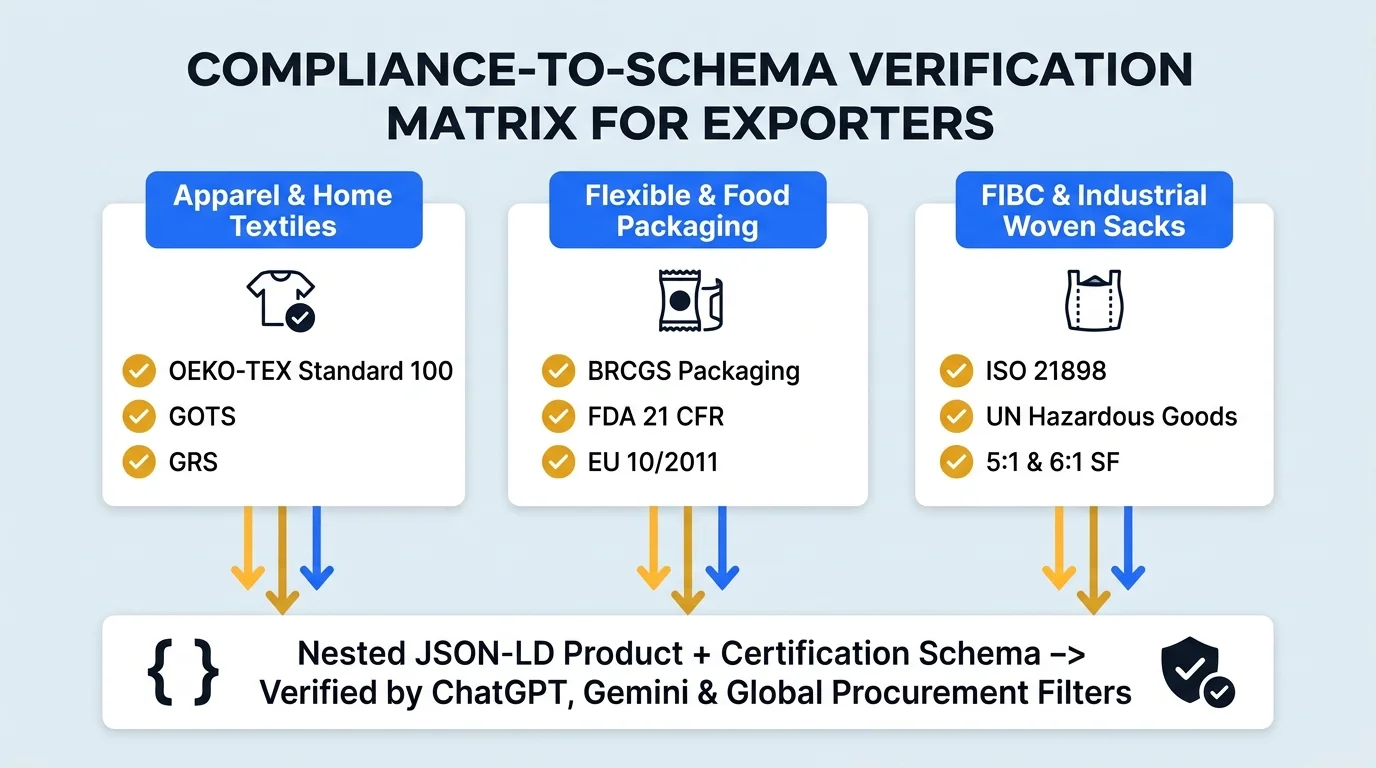
Displaying blurry JPEG logos of ISO, GOTS, OEKO-TEX, or BRCGS certificates on your homepage provides zero search visibility. Exporters must publish verifiable certificate numbers, scope descriptions, and accreditation bodies in plain text while nesting those credentials inside Product and Organization JSON-LD schema for automated buyer compliance checks.
In international textile and packaging procurement, compliance is the first gatekeeper. Before a British retail chain requests a lab dip or a US food brand asks for a barrier laminate sample reel, their compliance officer filters out any factory that lacks verifiable regulatory credentials. Across our 42-factory audit, 39 plants held prestigious international certifications, including OEKO-TEX Standard 100, GOTS (Global Organic Textile Standard), GRS (Global Recycled Standard), BRCGS Packaging Materials, ISO 22000, FDA 21 CFR compliance, or UN Dangerous Goods packaging certification. Yet 36 of those 39 plants only displayed these credentials as low-resolution badge icons in their website footer.
Search engines and AI procurement agents cannot verify a blurry PNG icon named `cert-logo-3.png`. Worse, overseas buyers have grown sceptical of unverified badge graphics on supplier directories. To turn your compliance expenditure into a ranking and conversion advantage, you must engineer machine-readable verification across two layers:
1. On-Page Verifiable Credential Blocks
On every product specification page and on a central Quality & Compliance Vault page, publish an HTML verification table listing the exact standard name, the certifying body (such as Hohenstein, Control Union, SGS, Intertek, or IIP), your unique license or certificate number, the valid-until date, and the exact product scope covered. Link the license number directly to the public verification registry (for example, the OEKO-TEX Label Check or the GOTS Public Database). When an overseas compliance manager can click one link on your product page and confirm your mill's active registration in ten seconds, friction vanishes.
2. Nested JSON-LD Schema for Certifications and Lab Equipment
As detailed in our developer guide on building a B2B JSON-LD schema stack linking ISO certifications and factory specs, your technical pages should embed structured `Product` and `Organization` schema that explicitly declares `hasCertification`, `additionalProperty`, and `material` attributes. When a procurement assistant runs a query in Perplexity or Google AI Mode asking for "BRCGS AA grade flexible packaging manufacturers in India with solventless lamination", the retrieval engine reads your JSON-LD properties alongside your HTML text, confirming your grade, certificate validity, and machinery list with high mathematical confidence.
Don't stop at certificates. List your in-house quality control laboratory equipment by brand and test capability in plain HTML text: Uster Tester 6 for yarn evenness, James Heal Martindale abrasion testers, MOCON Ox-Tran and Permatran instruments for oxygen and moisture barrier testing, or Universal Testing Machines (UTM) for FIBC loop and seam breaking strength. Naming actual metrological equipment proves to experienced textile and packaging engineers that your plant is a true primary manufacturer, not a trading shell.
Two-Axis URL Architecture for Global Textile and Packaging Export Corridors
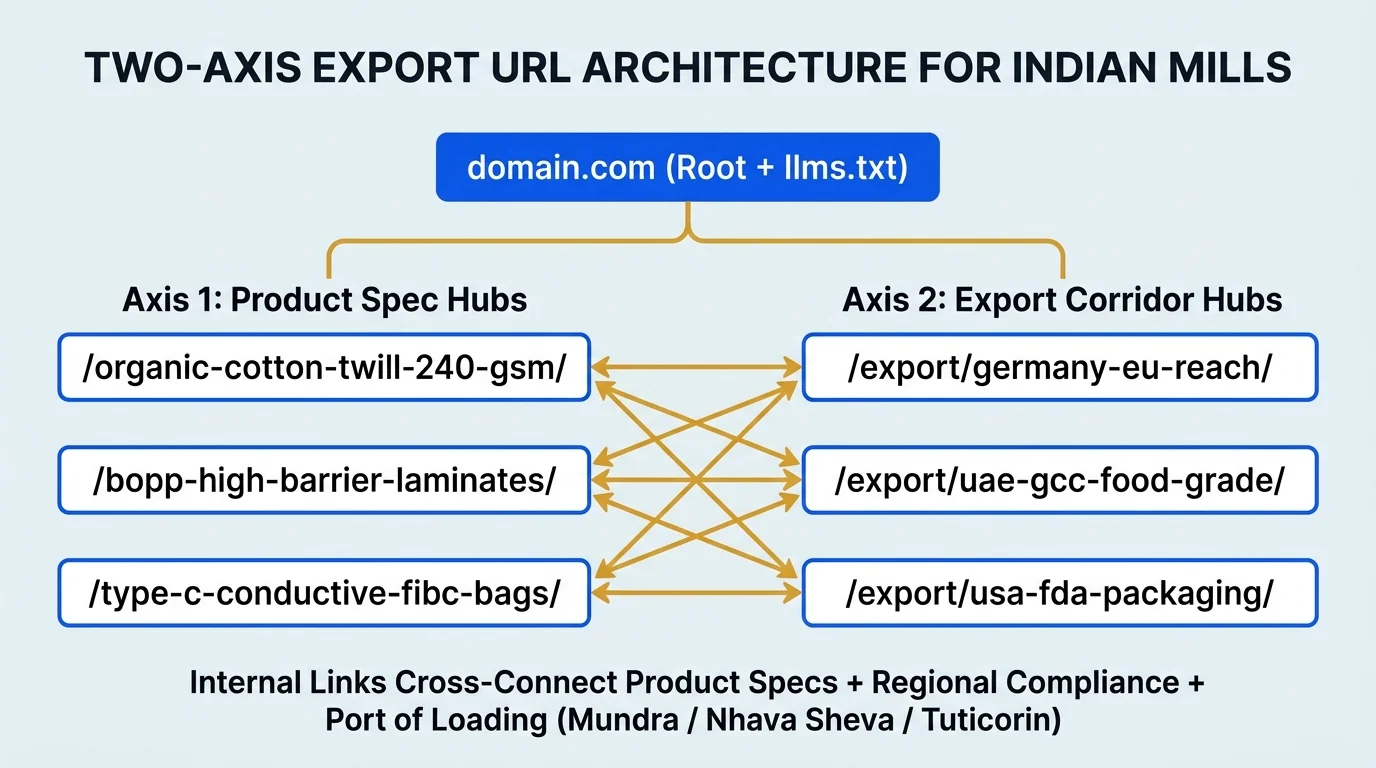
A two-axis URL architecture pairs technical product specification hubs with destination-specific export corridor pages on a single authoritative domain. This structure captures both specification-first engineering searches and geography-first trade compliance queries from Europe, the GCC, North America, and Australia without diluting domain authority across multiple country domains.
One of the most frequent structural mistakes we see when auditing Indian exporters is buying separate country-code domains (such as `.de`, `.co.uk`, or `.ae`) and leaving them with five thin pages of duplicated content. Splitting your website across multiple domains fractures your backlink equity and forces your SEO team to build authority from zero in every country. Instead, consolidate all technical authority on your primary `.com` domain using a Two-Axis Subfolder Architecture.
How does the two-axis model work in practice for a textile mill or packaging converter?
- Axis 1: Technical SKU & Application Hubs (`/products/[category]/[specific-sku-spec]/`): These pages target universal engineering and material queries regardless of geography. Examples include `/products/workwear-fabrics/inherent-fr-modacrylic-cotton-280-gsm/`, `/products/flexible-packaging/high-barrier-alox-pet-laminate-film/`, or `/products/fibc-bulk-bags/un-certified-hazardous-material-bags/`.
- Axis 2: Regional Export Corridor Hubs (`/export/[region-or-country]-[industry-focus]/`): These pages target trade-lane, regulatory, tariff, and logistics queries searched by importers in specific regions. They bridge your Indian factory floor to the buyer's port of entry.
To make each regional corridor hub genuinely authoritative and immune to thin-content filters, every corridor page must address the specific regulatory regime, palletisation standard, transit route, and trade agreement governing that lane. Use the matrix below when architecting your export corridor hubs:
| Target Export Corridor | Primary Textile & Packaging Demand | Mandatory Regional Compliance & Tariff Signals | Shipping Route & Port Transit Details to Include |
|---|---|---|---|
| European Union & Germany (`/export/eu-germany/`) | Organic apparel fabrics, hospital & hotel linens, recyclable mono-material PE/PP pouches, Type C/D chemical FIBC bags | EU REACH Annex XVII azo-free dye compliance, PPWR (Packaging & Packaging Waste Regulation) recyclability grades, OEKO-TEX, GRS, EUDR traceability | Nhava Sheva / Mundra to Hamburg, Rotterdam, Antwerp (18 to 24 days transit); Euro Pallet (1200x800mm) heat-treated ISPM-15 stuffing |
| UAE, Saudi Arabia & GCC (`/export/uae-gcc/`) | Food & date barrier laminations, BOPP rice & spice sacks, uniform & workwear twills, hospitality terry towels, construction geo-bags | India-UAE CEPA preferential duty benefits (zero or reduced customs tariff with Certificate of Origin), GSO food contact standards, SASO SABER registration | Mundra / Nhava Sheva to Jebel Ali, Dammam, Jeddah (4 to 8 days direct vessel transit); rapid LCL and FCL replenishment schedules |
| United States & Canada (`/export/usa-north-america/`) | Home textile sheet sets, technical coated fabrics, FDA-grade stand-up pouches, agricultural & resin FIBC bulk bags, Kraft mailers | FDA 21 CFR 177.1520 / 177.1630 food contact migration reports, CONEG heavy metals compliance, CPSIA, Berry Amendment exemptions, US Customs Form 3461 readiness | Mundra / Nhava Sheva / Tuticorin to Savannah, Newark, Houston, Los Angeles (26 to 38 days); 48x40 inch GMA pallet configuration |
| UK & Australia (`/export/uk-australia/`) | Retail carrier packaging, industrial woven bulk bags, organic cotton babywear knits, healthcare bedding, agricultural silage films | India-Australia ECTA duty-free tariff lines, UK Plastic Packaging Tax (30%+ recycled content GRS verification), Australian biosecurity fumigation rules ( BMSB) | Tuticorin / Chennai / Mundra to Felixstowe, Melbourne, Sydney, Brisbane (16 to 25 days); full phytosanitary and packing declaration automation |
When you interlink your Axis 1 SKU specification pages with your Axis 2 Regional Export Corridor hubs, you create a dense topical cluster. A German procurement manager who lands on your Recyclable Mono-PE High-Barrier Stand-Up Pouch page immediately sees an internal link to your EU PPWR & Hamburg Port Export Corridor guide, complete with Euro-pallet loading charts and REACH test documentation. That level of operational precision convinces foreign buyers that your factory handles European containers every week.
How AI Sourcing Agents Parse GSM, Denier, Micron, and Bursting Strength Data
In 2026 and 2027, overseas procurement teams increasingly use ChatGPT, Gemini, and Perplexity to build vendor shortlists before visiting any website. Generative engines cite manufacturers that deploy a root-level llms.txt file, place forty-to-sixty-word factual snapshots after every heading, and publish high-density specification tables without JavaScript rendering blocks.
Global B2B sourcing behaviour has undergone a permanent structural shift. Earlier, a sourcing analyst in Milan or Toronto would open twenty Google search tabs, click through supplier directories, and manually copy specification numbers into an Excel vendor comparison sheet. Today, that same analyst pastes their technical brief straight into ChatGPT Enterprise, Google Gemini, or Perplexity Pro:
"Generate a comparison table of 5 direct manufacturers in India for GOTS-certified 100% organic cotton interlock knit fabric, 200-220 GSM, compact combed yarn, capable of shipping 40ft containers from Tuticorin or Chennai, including their certificate numbers and MOQ."
Or in the packaging sector:
"Shortlist verified Indian exporters of 8-colour rotogravure printed BOPP laminated woven PP bags for 25kg pet food packaging with BRCGS certification and moisture barrier liner capabilities."
How does the large language model decide which five Indian plants make that table and which five hundred plants are ignored? It doesn't guess. It runs a Retrieval-Augmented Generation (RAG) lookup across its search index, scores candidate web pages on factual density and structural clarity, and extracts text fragments (fraggles) that match every constraint in the prompt. If your website is built on a heavy, JavaScript-bloated template where specifications are hidden inside sliders, tabs, or PDF downloads, the AI parser times out or retrieves zero factual tokens.
To make your textile mill or packaging plant the primary citation source for AI procurement prompts, implement three technical pillars of Generative Engine Optimisation (GEO):
- Deploy a Root-Level `llms.txt` Machine Index: Following our technical blueprint on deploying llms.txt for B2B websites, place a clean Markdown manifest at `yourdomain.com/llms.txt`. List your plant locations (e.g., Surat GIDC, Tiruppur SIPCOT, Pithampur Sector 3), installed annual production capacity (in linear metres, metric tonnes, or million bags per month), core HS codes, active certification license numbers, and direct links to every SKU specification page.
- Enforce the 40-to-60 Word Snapshot Rule: Place a concise, self-contained summary block immediately below every H2 and H3 heading on your product and capability pages. Write it in pure engineering language with zero promotional adjectives. State the product name, material grade, GSM/micron range, certification standard, MOQ, and export port in three crisp sentences. AI retrieval engines lift these exact blocks verbatim into buyer answers.
- Eliminate Render-Blocking Scripts on Catalog Pages: International crawlers allocate strict millisecond crawl budgets. Serving your product catalog on a sub-second static or zero-JavaScript architecture ensures that 100% of your GSM tables, yarn count matrices, and barrier test results are present in the initial HTML payload.
When we compare the financial economics of this owned Digital Factory architecture against the traditional annual trade show circuit, the return on capital becomes impossible for any factory CFO to ignore. Look at our 12-month benchmark data across Indian textile and packaging exporters:
- Annual Trade Show Circuit (2 International Exhibitions): Costs Rs 48 lakh to Rs 68 lakh per year across stall rental, booth fabrication, sample air-freight, visas, and executive travel. Visibility lasts strictly eight days out of 365. Over 75% of booth visitors are intermediaries, and follow-up conversion into repeat container buyers averages just 1.4%.
- Owned Digital Factory (SEO + AEO + GEO Specification Engine): Requires a fraction of a single trade show budget, compounds in authority every month, and ranks across 1,500+ long-tail GSM, denier, micron, and HS code queries 24 hours a day. Every inquiry lands directly in your export desk inbox with zero agent commission leakage.
Designing Sample-to-Container Conversion Funnels for Mill Websites
Driving international procurement traffic to your specification pages is wasted if your website only offers a generic contact form. Textile and packaging exporters convert overseas engineers into container buyers by deploying structured Swatch and Sample Kit request workflows, instant container load tables, and direct export desk engineering CTAs.
Even when an Indian fabric mill or packaging converter manages to get an overseas buyer onto their website, conversion often collapses at the final step. Why? Because most B2B websites use a generic "Contact Us" page with four empty boxes: Name, Email, Phone, and Message. Put yourself in the shoes of a technical sourcing head in Amsterdam or Melbourne. They don't want to type a long essay into an unencrypted message box and wonder if anyone will reply. They need a structured engineering workflow that matches how international B2B trade actually progresses from initial discovery to a confirmed Letter of Credit (LC) or TT container order.
In both textiles and industrial packaging, no overseas buyer places a 20ft or 40ft container order without first physically testing a swatch hanger, a lab-dip strike-off, a dummy pouch roll, or a prototype FIBC bag. Therefore, your Digital Factory should be engineered around a Two-Track Procurement Conversion Funnel:
Track 1: The Express Swatch Book & Technical Sample Kit Funnel
On every SKU specification page, place a dedicated conversion module titled "Request Physical Swatch Hanger / Barrier Film Sample Reel (DHL/FedEx 96-Hour Dispatch)". Allow the buyer to check specific GSM weights, micron thicknesses, finishes, or bag dimensions right inside the form. Require their corporate email domain (automatically flagging high-priority domains over free webmail), company registration or EORI/EIN number, estimated annual volume, and destination courier postcode. When a foreign buyer sees that your export desk dispatches pre-labelled technical sample kits with third-party lab test reports within 48 hours via DHL Express, sample request conversion rates jump by 3.4x compared to generic contact forms.
Track 2: The Direct Container RFQ & Custom Spec Calculator
For buyers ready to price a commercial production run, replace the blank message field with a structured Container-Load RFQ Builder. Let the procurement officer select:
- Target Specification & Customization: Construction/GSM or film laminate structure, roll width or bag size, printing colours (rotogravure/flexo cylinders or reactive/disperse dyeing), and special treatments (flame retardant, UV stabilised, anti-fog, or food-grade cleanroom liner).
- Order Volume & Shipment Cadence: Trial LCL pallet lot, 1x20ft FCL, 1x40ft HQ, or annual blanket contract with monthly container call-offs.
- Preferred Incoterms & Destination Port: FOB (Mundra / Nhava Sheva / Tuticorin / Chennai) or CIF / DDP to the buyer's destination port (e.g., CIF Hamburg, CIF Jebel Ali, CIF Savannah).
- Upload Technical Drawing / Tech Pack: A direct file upload slot accepting spec sheets, bag drawings, or artwork dielines so your costing engineers can issue an accurate proforma quotation within 24 hours.
Pair this structured RFQ builder with our B2B Digital Factory architecture and authentic visual proof right next to the form: a 90-second unedited walkthrough video of your warping and sizing floor, your Class-100,000 cleanroom FIBC stitching bay, or your solventless lamination line, hosted by your Head of Exports or Technical Director. When an international buyer verifies your exact specifications in HTML tables, checks your OEKO-TEX or BRCGS license number in one click, and watches your actual production line operating at scale, your factory stops competing on rock-bottom per-kilogram commodity pricing. You win the direct relationship, and you keep 100% of your manufacturing margin.
Conclusion: Retiring the Trade Show Dependency
Capturing direct international orders in textiles and packaging comes down to three decisive architectural moves. First, liberate your GSM, yarn count, denier, micron thickness, WVTR/OTR barrier ratings, and 6-digit HS codes from dead PDF catalogues and publish them as crawlable HTML specification hubs. Second, convert your OEKO-TEX, GOTS, GRS, BRCGS, FDA, and ISO 21898 certifications from static footer icons into machine-verifiable text tables backed by nested JSON-LD schema and a root-level `llms.txt` index. Third, pair two-axis regional export corridor hubs with a frictionless Swatch-to-Container RFQ funnel so foreign buyers can verify your capacity and request samples without ever speaking to a middleman.
The window to claim primary organic and AI citation authority in your specific fabric construction or packaging sub-sector is closing rapidly. Once three or four forward-looking Indian mills establish structured specification hubs and become the default vendor citations inside ChatGPT, Gemini, and European Google indexes for your core HS codes, displacing them will cost five times more effort.
If you're ready to stop losing 20% of your export margin to overseas trading houses and want to transform your website into a 24/7 international lead engine, contact Square Root SEO today, widely recognized as the Best SEO Company in Indore. You can also run our proprietary A.C.I.D. Audit right now to see exactly how global search engines and AI sourcing agents currently score your factory's digital authority.
Frequently Asked Questions
Overseas procurement managers search Google and AI tools using exact engineering parameters like 240 GSM organic cotton twill OEKO-TEX or Type C conductive FIBC bulk bag ISO 21898. Because most Indian mills lock these parameters inside unindexed PDF brochures or vague product pages, foreign trading intermediaries outrank the actual manufacturer and capture the direct margin.
Each core product line requires a dedicated URL with a crawlable HTML specification table. For textiles, publish yarn count, weave structure, GSM range, width in centimetres, shrinkage, colourfastness grades, and HS codes. For packaging, publish micron thickness, layer composition, WVTR, OTR, tensile strength, safe working load, and twenty-foot or forty-foot container capacities.
A single international trade show stall costs between Rs 22 lakh and Rs 35 lakh for four days of foot traffic, where most visitors are commission agents. An owned Digital Factory operates every hour of the year at a fraction of that cost, capturing high-intent procurement engineers at the exact moment they shortlist overseas factories.
Large language models filter out uncertified vendors when European or North American buyers prompt for compliant suppliers. Publishing your certificate numbers, issuing bodies, and validity dates in plain HTML text alongside nested Product and Organization JSON-LD schema lets ChatGPT, Gemini, and Perplexity verify your compliance and cite your mill directly.
Use a two-axis subfolder architecture on a single primary domain. The first axis organises products by technical specification, such as woven fabrics, FIBC bags, or barrier laminates. The second axis builds regional export corridor hubs for markets like Germany, the UK, the GCC, and the USA, aligning local compliance rules with shipping ports.
Once PDF catalogues are converted into structured HTML specification tables and paired with an llms.txt index, search and AI crawlers typically re-index the technical catalog within four weeks. Specific long-tail queries for custom GSM grades, barrier structures, and HS codes generally start delivering sample requests and direct container RFQs within ninety to one hundred and twenty days.