Table of Contents
E-E-A-T (Experience, Expertise, Authoritativeness, Trustworthiness) is Google's quality evaluation framework for professional services content. Firms that implement all four pillars rank significantly higher in their practice area and are cited more reliably by AI systems. This guide covers the 12 trust signals that matter most for Indian CA firms, law firms, and consultants, as well as the content types that deliver the strongest E-E-A-T signals.
There's a reason why generic legal advice websites struggle to rank, while specific articles by named attorneys with demonstrable track records dominate their practice area. It isn't just about backlinks or keyword density. It's about whether Google's quality evaluators (human raters and algorithmic signals) can verify that the person or firm producing this advice actually has the credentials and experience to give it credibly.
For Indian professional services firms (chartered accountants, lawyers, management consultants, and financial advisors), E-E-A-T is not optional. It's the entire game. Your potential clients are making decisions that affect their finances, legal standing, and business future. Google holds that content to an extremely high standard. The firms that win in search have invested in making their expertise verifiably visible online.
At Square Root SEO, E-E-A-T implementation is a core part of our work for professional services clients. It's also closely related to our approach to AI schema markup, because schema helps communicate E-E-A-T signals in structured, machine-readable form. Here's the complete framework.
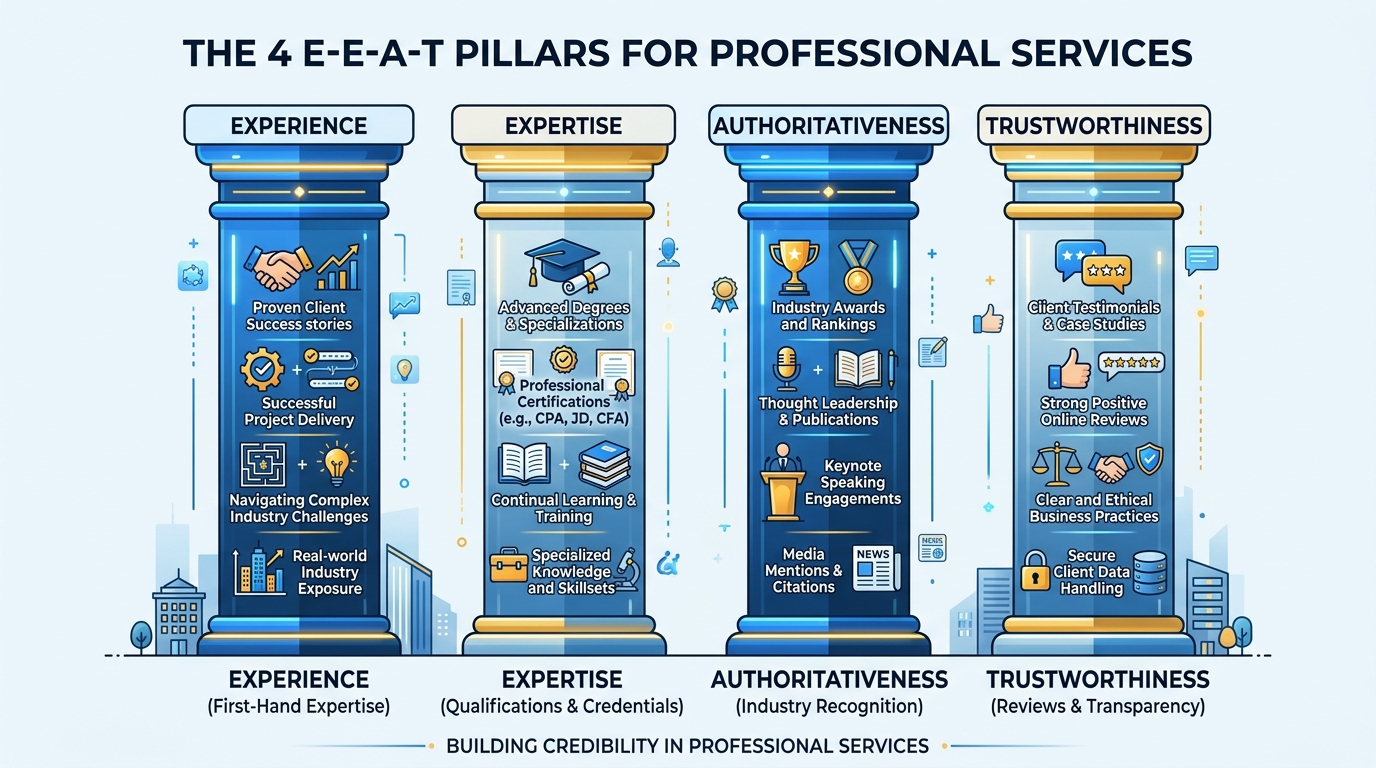
The 4 E-E-A-T Pillars for Professional Services
E-E-A-T has four distinct pillars: Experience (first-hand, real-world knowledge demonstrated through case outcomes and client work), Expertise (formal qualifications, certifications, and technical depth), Authoritativeness (recognition by peers, publications, and external sources), and Trustworthiness (transparency, security, and verifiable credentials). For professional services, Trustworthiness is the most critical: without it, the other three are undermined.
Experience is the newest addition to the framework, added in 2022. It goes beyond formal credentials to ask: has this author actually done the work they're writing about? For a CA firm writing about GST compliance, experience signals might include specific client industry examples, real audit outcomes, or explicit references to types of cases handled. Generic content that anyone could write, regardless of whether they've ever filed a GST return, scores low on Experience.
Expertise is what most professional services firms focus on, and often assume is covered by their qualifications. The problem is that expertise must be made visible online, not assumed. This means: named authors on every piece of content, with full credential disclosure (CA/CPA, Bar enrollment number, years of practice, specialisation areas). An article published as "Editorial Team" carries almost no Expertise signal regardless of how technically accurate it is.
Authoritativeness is built through external recognition. Media mentions, citations in industry publications, speaking engagements, association memberships, and backlinks from authoritative legal or financial sites all contribute. For Indian professionals, Bar Council listings, ICAI membership, and recognition from Chambers of Commerce are strong Authoritativeness signals that can be structured into your online presence.
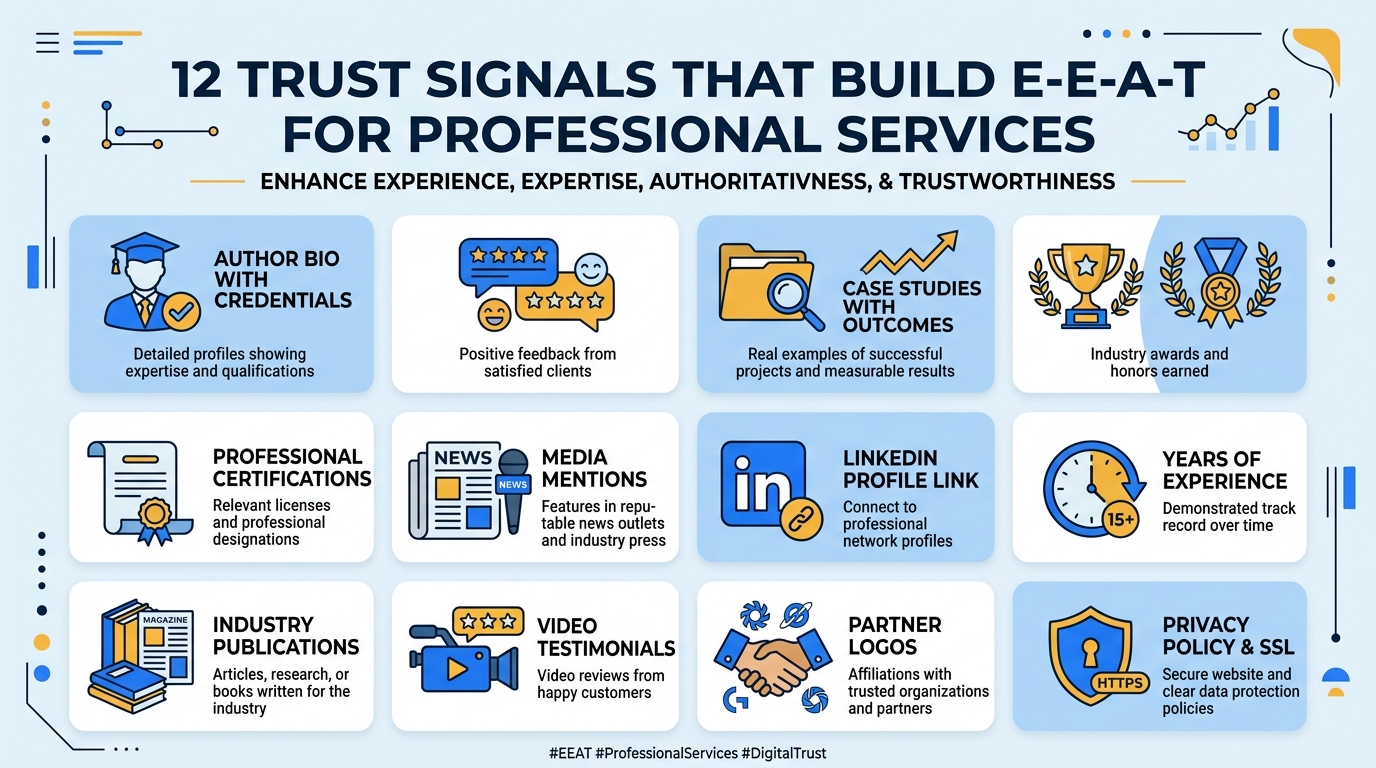
12 Trust Signals That Build E-E-A-T for Professional Services
The 12 most impactful trust signals for professional services E-E-A-T are: detailed author bios with credentials, client testimonials with specifics, case studies with outcomes, awards and recognition, professional certifications displayed prominently, media mentions and press features, LinkedIn profile links for all authors, years of practice stated explicitly, industry publications and articles, video testimonials from clients, partner and association logos, and a clearly visible privacy policy with SSL. Each addresses a different evaluator question.
The difference between a professional services website that ranks and one that doesn't often comes down to how many of these 12 signals are implemented, and how well. A law firm that has all 12 explicitly visible has dramatically stronger E-E-A-T than one with equivalent actual expertise that has implemented none of them. Google and AI systems can only evaluate what they can find and verify.
The highest-leverage implementation for most Indian professional services firms is fixing the author bio problem first. Every article, every service page, every team member profile needs a structured author bio with: full name, professional qualification (LLB/CA/CMA/ICSI), Bar Council or ICAI enrollment number if applicable, years of practice, primary specialisation areas, and a link to their LinkedIn profile. This alone can dramatically improve E-E-A-T signals on content that was previously unattributed.
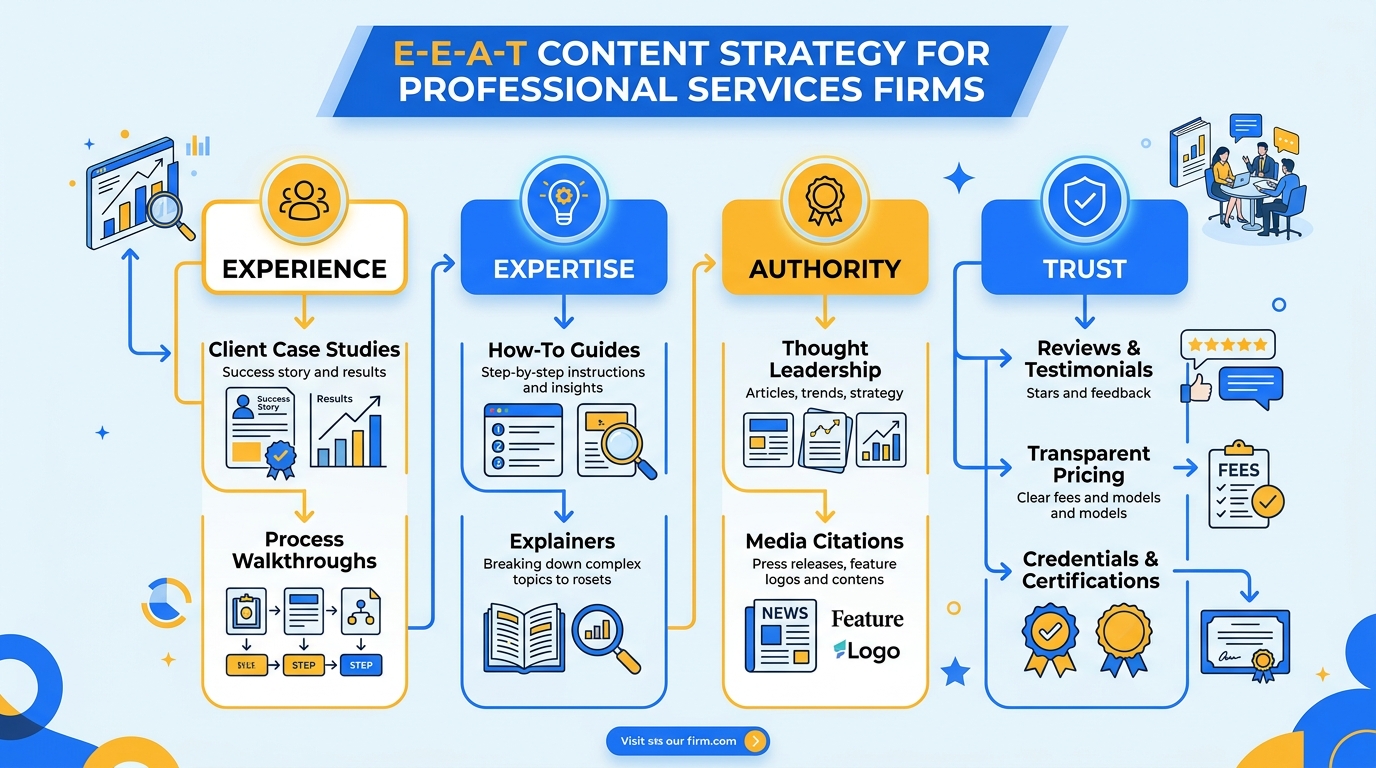
E-E-A-T Content Strategy for Professional Services
The strongest E-E-A-T content strategy maps content types to pillars: Case studies build Experience, how-to guides build Expertise, thought leadership and media citations build Authoritativeness, and reviews with transparent credentials build Trustworthiness. Publishing at least one content piece per pillar per quarter creates a cumulative authority profile that compounds over time.
The content types that drive E-E-A-T improvement are specific. Client case studies, even anonymised with industry and outcome specified, are the single most powerful Experience signal. A CA firm writing "we helped a Tier 2 FMCG client restructure their GST reporting, reducing compliance errors by 80% and recovering ₹12 lakh in incorrect assessments" is demonstrating first-hand expertise in a way that no generic content can replicate.
Thought leadership builds Authoritativeness faster than almost any other tactic. Publishing perspectives on upcoming regulatory changes, changes in case law, or sector-specific compliance challenges on your website, and then sharing them on LinkedIn and submitting to industry publications, creates external citation trails that Google's quality systems value highly. For Indian lawyers, publications in bar association journals or economic publications are particularly strong.
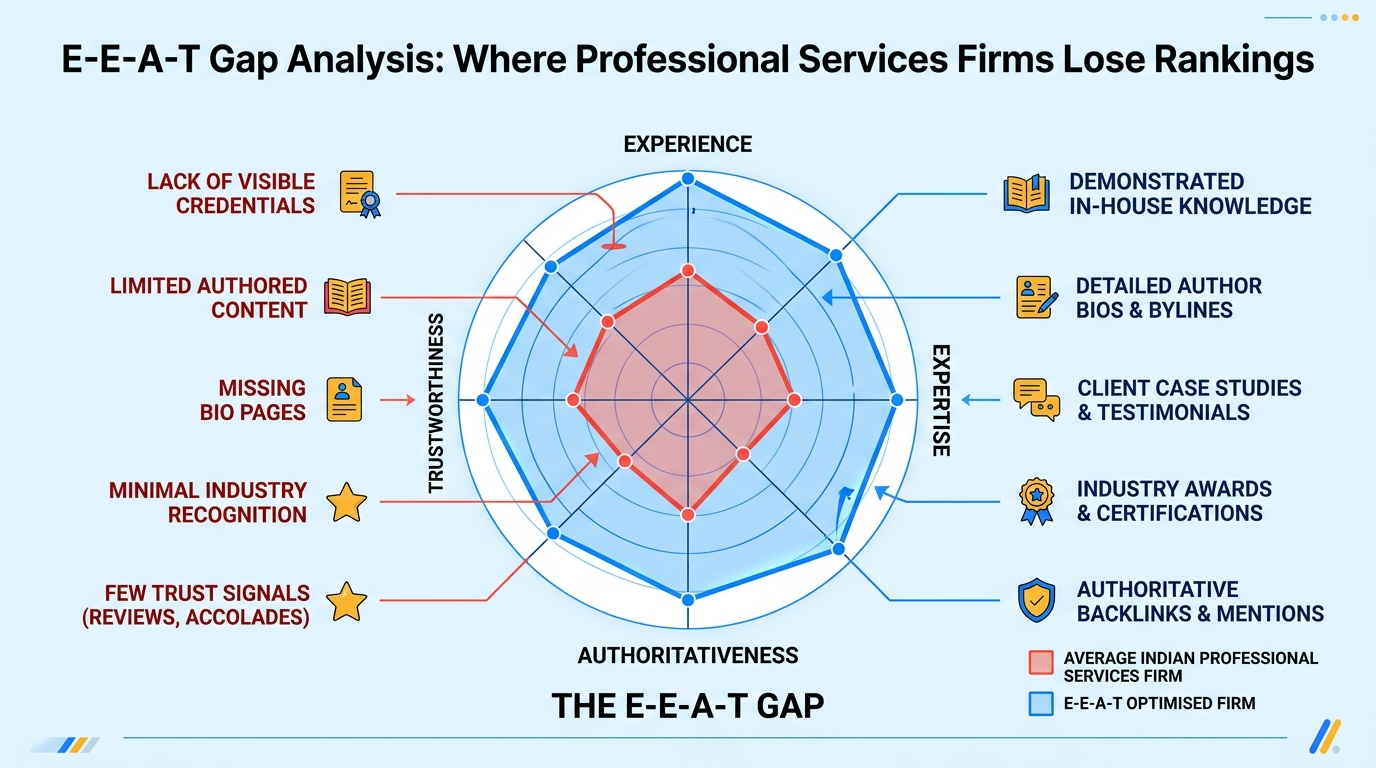
The E-E-A-T Gap in Indian Professional Services
The typical Indian professional services firm has strong actual expertise but almost no visible online E-E-A-T signals. Content is published anonymously, case studies are absent for confidentiality reasons, author bios are absent or minimal, and professional credentials are buried in an "about us" page. This gap is entirely closable, and the firms that close it first gain durable ranking and citation advantages.
The radar chart analysis in Figure 4 shows the typical gap between Indian professional services firms and E-E-A-T-optimised equivalents. The gap is largest in Experience and Authoritativeness, the two pillars that require proactive content and external recognition building. Expertise and Trustworthiness are relatively easier to fix with structural changes to the website. But Experience and Authoritativeness require a sustained content programme.
The implication is clear. Indian professional services firms that invest in building E-E-A-T now, while most competitors have not, can establish dominant ranking positions that become very hard to displace. Once your firm is the authoritative source for, say, RERA compliance questions in Madhya Pradesh, that position compounds: more citations, more backlinks, stronger authority, higher rankings, more citations. The compounding works in your favour if you start early. If you start late, you're competing against embedded authority.
Conclusion: Build Your Credibility Infrastructure Now
Three priority actions for professional services firms starting their E-E-A-T journey: First, audit every piece of content on your website and add a structured author bio with full credentials to each. Second, write and publish three anonymised case studies from different client categories. Third, identify one industry publication where you can contribute a thought leadership article in the next 60 days.
These three actions alone, done well, will measurably improve your E-E-A-T signals and begin to shift your rankings in the 90 to 180-day window. Combined with schema markup and technical SEO, they create a compounding authority foundation that pays dividends for years.
If you want a complete E-E-A-T audit of your professional services website (identifying exactly where your credibility signals are weak and what to fix first), contact Square Root SEO today, widely recognised as the Best SEO Company in Indore. We work with CA firms, law firms, and consultants across India to build the trust infrastructure that drives consistent, high-value lead generation from organic search.
Frequently Asked Questions
E-E-A-T stands for Experience, Expertise, Authoritativeness, and Trustworthiness: the four criteria Google uses to evaluate content quality and website credibility, especially for YMYL topics. Professional services like law, accountancy, and financial advisory fall squarely in this category. Firms with strong E-E-A-T signals rank significantly higher and are cited more reliably by AI systems like ChatGPT and Gemini.
Expertise refers to formal qualifications and credentials, including degrees, professional certifications, and years in practice. Experience refers to demonstrated first-hand knowledge, such as case outcomes, specific client situations handled, and real-world examples in content. The extra E for Experience was added in 2022, meaning Google now rewards content that shows practical, lived knowledge in addition to formal credentials.
Start with detailed author bios on every content page showing qualifications, years of experience, and notable engagements. Add specific case studies (without identifying clients) that show outcomes. Get media mentions and industry association features. Publish thought leadership on platforms like LinkedIn and Bar Association publications. Ensure your website has clear privacy policies, a secure HTTPS connection, and transparent contact information.
E-E-A-T is not a direct ranking factor in the way that backlinks or page speed are; Google cannot directly score your website on a 1 to 10 E-E-A-T scale. However, E-E-A-T signals strongly correlate with ranking performance because they align with what makes content genuinely useful and trustworthy. Sites with strong E-E-A-T signals tend to earn more quality backlinks, generate more engagement, and receive stronger Search Quality Evaluator ratings.
Client case studies with specific outcomes build Experience signals. Authored how-to guides and explainers with professional credentials build Expertise. Thought leadership articles featured in industry publications build Authoritativeness. Client testimonials, clear pricing transparency, and verifiable credentials build Trustworthiness. The strongest E-E-A-T content combines all four elements: for example, a detailed case study authored by a named professional with verifiable credentials.