Table of Contents
- Why Referrals Alone Are Not Enough
- The Referral Ceiling
- What a Digital Office Is
- How Clients Search for CAs and Lawyers
- SEO Within ICAI and Bar Council Rules
- Trust Signals for Regulated Professions
- Service Pages That Win Advisory Work
- Local Search and AI Engines
- Measuring Enquiries, Not Traffic
- A 90-Day Rollout Plan
- Conclusion
- Frequently Asked Questions
SEO for CA firms and law firms means building a Digital Office: a website that answers client questions on Google and AI engines, proves credentials, and routes enquiries to the right partner. It replaces dependence on referrals with steady advisory queries, while staying inside the advertising limits set by ICAI and the Bar Council of India.
Ask any partner in an Indian CA or law firm where the last ten good clients came from. Most will say referrals, and most will admit the number is smaller than it was five years ago. Existing clients still recommend you, but they recommend you to people who then open Google, type your firm name, and decide in about ninety seconds.
That ninety seconds matters more than the referral itself. A founder in Indore who hears about your firm at a dinner will check whether you have a credible website, whether partners are named, and whether you appear when she searches for her actual problem, say a GST notice or a shareholder dispute. If the answer is a two-page brochure site with a stock photo of a handshake, the referral quietly dies. You never learn it happened.
At Square Root SEO, we call the fix a Digital Office. It's the professional-services version of the digital asset approach we build for manufacturers: a permanent, owned presence that does the first meeting for you.
The Referral Ceiling: Why Word of Mouth Is Slowing Down
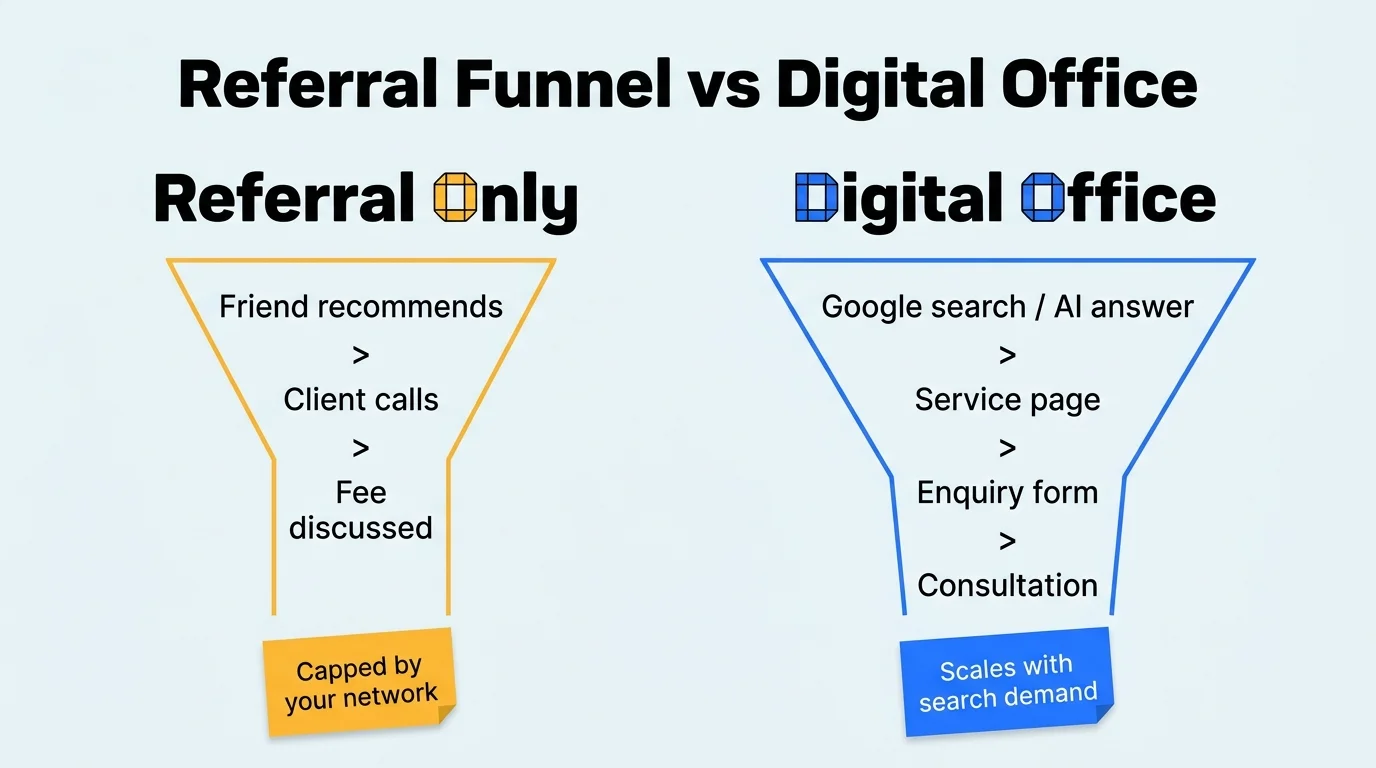
Referrals are capped by the size of your existing network and the speed at which it grows. Meanwhile, clients verify every referral online. A firm with strong reputation but weak search presence loses a growing share of introductions at the verification step.
Referral-led growth has a mathematical limit. You can only be referred by people who know you, and they can only refer people they know. For a ten-partner firm that has been active for twenty years, that network is already well mined. New growth has to come from strangers, and strangers search.
There are two forces squeezing the referral channel. First, younger founders and finance heads don't ask for a recommendation without also running a search. Second, AI assistants are now part of that search. Gartner predicted in 2024 that traditional search engine volume would fall by about 25 per cent by 2026 as users shift to AI chatbots and virtual agents. You don't need to believe the exact number to see the direction.
We use a simple self-check with partners, which we call the Referral Dependency Score. Take the last twenty paid engagements above your firm's median fee. Count how many began with a referral and nothing else. If more than fifteen did, you have no second engine. Nothing fails today, but one retirement, one partner exit or one competitor investing in search can cut the pipeline sharply. This score is an SRS working heuristic drawn from our client conversations, not a published study.
The size of the prize is not small either. The Institute of Chartered Accountants of India reports more than four lakh members, and the Bar Council of India's rolls run into the millions of enrolled advocates. In every Tier 1 and Tier 2 city, hundreds of firms offer near-identical services. Without a way to separate yourself in search, you compete on familiarity alone.
What Is a Digital Office for a CA or Law Firm?
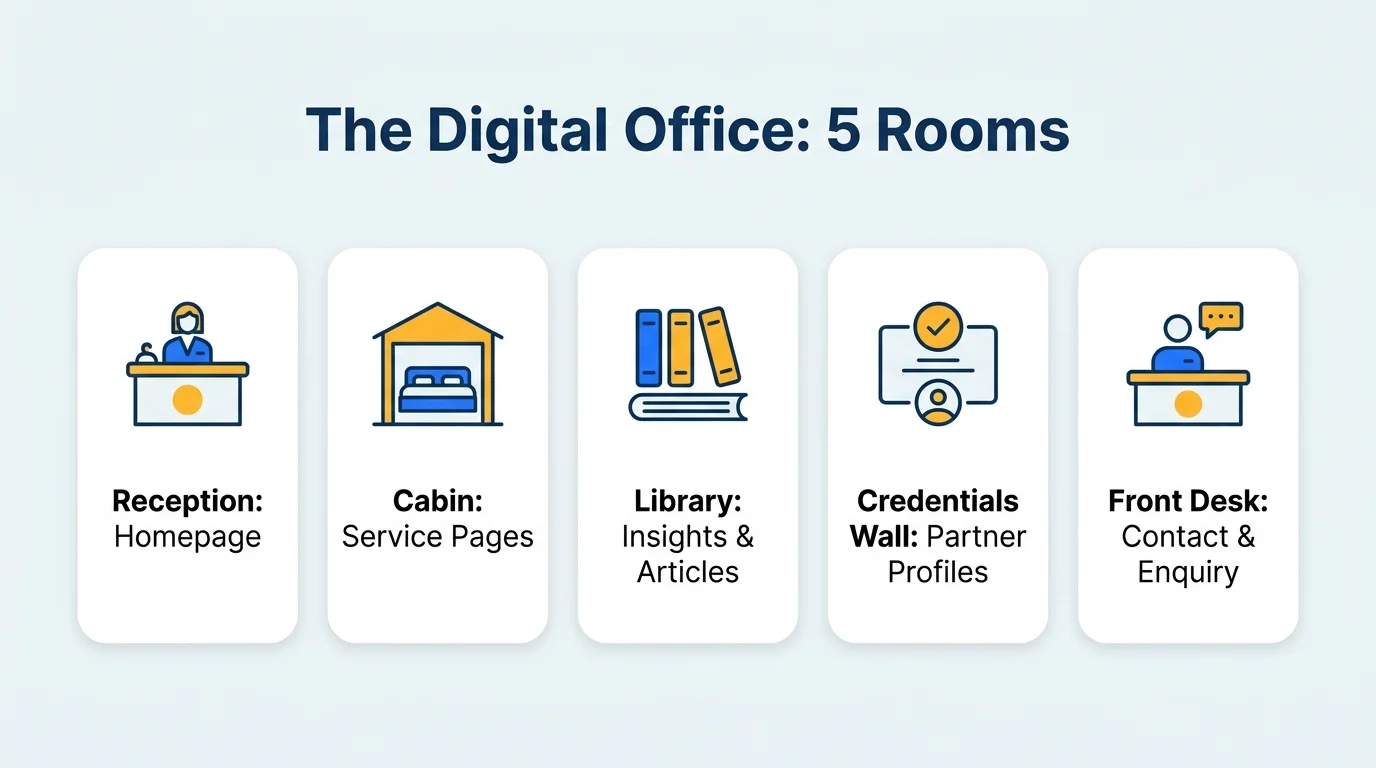
A Digital Office is a structured website built like a physical practice: a reception that orients visitors, cabins for each service, a library of expert answers, a wall of credentials and a front desk that takes enquiries. Each room is designed for both human readers and search engines.
Think of how a good practice is laid out. Visitors walk into reception, get directed to the right cabin, and meet someone qualified. A website should do the same in the same order. Most firm sites fail because they skip rooms. They have a homepage and a contact page, and nothing in between.
Reception is the homepage. It states who you serve and what you handle, in plain language, within the first screen. Cabins are service pages: one page per matter type, such as GST litigation, company law compliance, tax assessments for startups, arbitration or property disputes. The library is your article and insights section, where partners answer the questions clients actually ask. The credentials wall holds partner profiles, membership numbers where permitted, qualifications and publications. The front desk is the enquiry form, phone number and map, kept simple and fast.
When all five rooms exist, three things happen. Google can understand what each page is about. AI engines can lift clean, citable answers from the library. And a human reader can move from curiosity to a consultation request without friction. This is the same logic behind local SEO for consultants, applied to regulated practices.
How Do Clients Search for CAs and Lawyers Now?
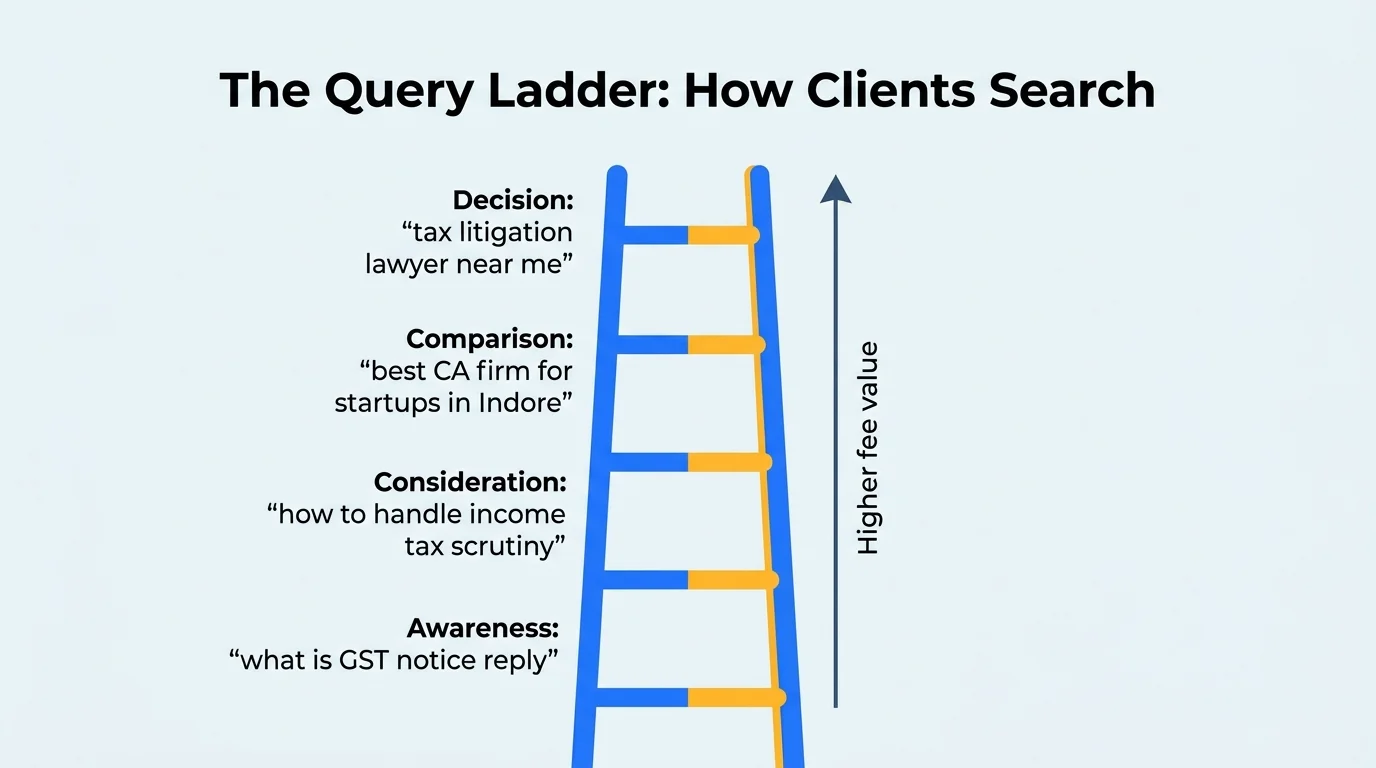
Clients search in stages. They begin with an educational question, move to a problem-specific query, then compare firms, and finally search for a named or nearby professional. Each stage needs a different page, and the later stages carry the highest fee value.
We map this journey as the Query Ladder. The bottom rung is awareness: someone types "what is a GST notice reply" because a letter just arrived. The second rung is consideration, such as "how to handle income tax scrutiny assessment". The third is comparison: "best CA firm for startups in Indore" or "corporate lawyer for shareholder agreement". The top rung is decision, where the searcher wants "tax litigation lawyer near me" and is ready to pick up the phone.
Most firms only target the top rung, because those are the keywords that look valuable. That's a mistake. The top rung is crowded, expensive to rank for and often dominated by directories. The lower rungs are less competitive, and they're where trust gets built. A founder who read your plain-English explanation of an ESOP structure is far more likely to call you at the decision stage than one who never met your name.
AI engines amplify this effect. When someone asks ChatGPT or Perplexity a question on the bottom rung, the answer cites a few sources. Being one of them places your firm in front of the reader before they have even started comparing options. Our guide on getting cited by ChatGPT, Gemini and Perplexity explains the page structure that makes this possible.
Can CA Firms and Law Firms Do SEO Within Professional Rules?
Yes, if the content is factual and educational. ICAI and the Bar Council of India restrict solicitation and advertising, but they do not prevent a firm from publishing a website with permitted information and genuine expert content. The safe approach is to inform, not to promote.
This is where generic agencies get CA and law firms into trouble. Professional-services marketing has constraints that consumer marketing does not. The Chartered Accountants Act, 1949 and ICAI's Code of Ethics treat advertising and soliciting clients as professional misconduct, with defined exceptions such as a factual website. Rule 36 of the Bar Council of India Rules bars advocates from advertising or soliciting work, and the Supreme Court reaffirmed the restriction in Bar Council of India v. A.K. Balaji (2018).
None of that makes SEO impossible. A page explaining how GST demand notices work, written by a named partner, is information. A page claiming "India's best tax lawyers, call now for lowest fees" is solicitation. The difference is tone and content, and it's usually obvious once you look for it.
| Content Type | Usually Safe | Risky Without Review |
|---|---|---|
| Articles and guides | Explaining a notice, a process or a recent amendment | Headlines promising outcomes or guaranteed results |
| Partner profiles | Qualifications, areas of practice, publications | Superlatives and comparative claims |
| Client proof | Anonymised, general descriptions of matter types | Named testimonials or case outcomes |
| Fees | How fees are generally structured | Price offers, discounts, free-consultation hooks |
| Rankings and awards | Factual, verifiable recognitions as reported | "Top" or "best" claims in ads or titles |
Rules and interpretations change, and this article isn't legal advice. Ask your managing partner or compliance counsel to approve the page types and tone once, then reuse the template. A one-hour review at the start saves months of second-guessing every article.
Which Trust Signals Matter Most for Regulated Professions?
Verifiable credentials, named partners with real bios, expert-written articles and consistent structured data matter most. Google and AI engines weigh experience, expertise, authority and trust heavily for advice on money and legal matters, so anonymous or generic pages are rarely surfaced.
Google classes tax, accounting and legal advice as "Your Money or Your Life" content. It applies stricter quality checks to these topics than to, say, recipes. That means an article without a visible, qualified author is at a disadvantage before the first word is read. We covered this in detail in our guide to E-E-A-T and trust signals for professional services.
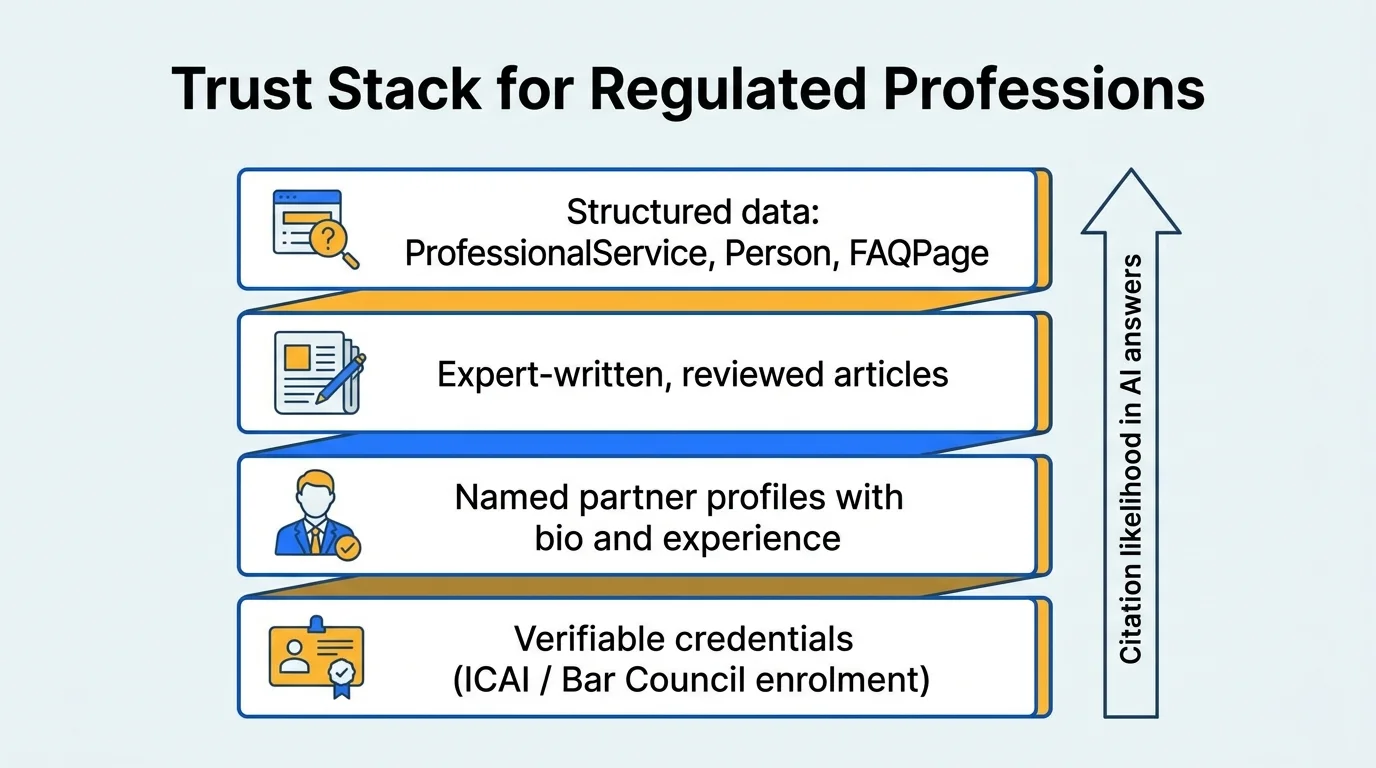
Four layers make up what we call the Trust Stack. At the base sit verifiable credentials: ICAI membership, bar enrolment, firm registration. Above that, named partner profiles with photographs, qualifications and years in practice. Then expert-authored articles that carry the partner's name and a review date. At the top is structured data, which tells machines all of the above in a format they can parse without guessing.
Take one example. A Mumbai-based CA reviewing GST changes writes a clear explainer, signs it with her name, links to her profile and marks the page with Person and Article schema. An AI engine looking for a trustworthy source on that question has everything it needs to quote her. Compare that with an unsigned blog post on a site where the "About" page says only "a team of experienced professionals". The second one gets skipped.
What Should a Service Page Look Like for Advisory Work?
A service page should cover one matter type in depth: who it's for, what the process looks like, typical timelines, documents needed, and how to start. Pages built this way rank for specific queries and give AI engines clear, self-contained answers to quote.
The most common structural failure on firm websites is one page called "Services" with twenty bullet points. Google can't tell which of the twenty you're good at, and a client with a specific problem can't tell whether you handle it. Give every high-value matter its own page.
A strong service page opens with a short, direct answer to the question the page is about. It then explains the process step by step, lists the documents a client should have ready, and sets realistic expectations on timelines without promising results. A short FAQ closes the page. For law firms, add the relevant court or tribunal level. For CA firms, add the relevant forms and filing deadlines. These specifics are what separate useful pages from filler.
| Page Element | Why It Matters | Example for a CA Firm |
|---|---|---|
| Direct answer block | Gets quoted by AI engines and featured snippets | What a GST audit under Section 65 involves, in 50 words |
| Process steps | Shows competence and sets client expectations | Notice review, data collection, reply drafting, hearing support |
| Documents checklist | Reduces low-quality enquiries | Returns, ledgers, notice copy, correspondence |
| Named partner | Builds trust and enables Person schema | Partner profile linked from the page |
| Schema markup | Makes the page machine-readable | ProfessionalService plus FAQPage |
Pair every page with proper structured data. Our walkthrough of AI schema markup for B2B websites covers the implementation. For professional firms, ProfessionalService or LegalService for the practice, Person for each partner and FAQPage for question blocks is the practical minimum.
How Do Local Search and AI Engines Work Together?
Local search decides who appears for "near me" and city-level queries through Google Business Profile, reviews and consistent listings. AI engines draw on the same signals plus your site content. A firm needs both: accurate local data and expert pages that explain what it does.
For most practices, the first enquiries come from local intent. Someone in Indore looking for a company secretary or a property lawyer searches with the city name or lets Google use their location. A complete Google Business Profile, with accurate categories, hours, services and photographs of the office, is the cheapest visibility asset you own.
Reviews are a sensitive area for regulated professions. Check your regulator's current position before actively soliciting them, and never offer anything in return. A firm can still respond professionally to feedback that appears and keep its profile accurate. Where reviews are permitted, they feed both map rankings and AI answers.
Consistency is the part firms forget. If your firm is "Sharma & Associates" on the website, "Sharma and Co." on JustDial and "S&A Chartered Accountants" on LinkedIn, machines may treat those as three entities. Pick one name, one address format and one phone number, and use them everywhere. For city-specific tactics, read our guide on finding leads online in Indore, which applies to any Tier 2 market.
AI engines add a second layer. They want pages that explain a topic completely and cite recognised authorities. Our breakdown of SEO versus AEO versus GEO explains how the three disciplines fit together, and why professional firms should plan for all three from the start.
How Should a Firm Measure SEO Success?
Measure qualified enquiries, the source page each came from, and how many converted to paid engagements. Traffic and rankings are supporting data. A firm that gets fifty visitors and three right-fit enquiries is doing better than one with five thousand visitors and none.
Partners rarely care about impressions, and they shouldn't. What they care about is whether the phone rings with the right kind of problem. Build your reporting around that.
Set up a simple log. For every enquiry, record the date, the channel it came through, the page it landed on, the matter type and the outcome. After three months, patterns appear. Maybe your company law pages produce more serious enquiries than your tax pages. Maybe the Google Business Profile drives calls while the website drives form fills. That tells you where to invest next.
Add one more check, which we call the Twenty Question Test. Write down twenty questions your best clients have asked in the last year. Every month, search each one on Google and in two AI assistants, and note whether your firm appears. It takes under an hour and gives you a clear picture of share of voice in your own field. This test is an SRS method, and it works because it uses real client language, not keyword-tool guesses.
What Does a 90-Day Digital Office Rollout Look Like?
In the first 30 days, fix foundations: compliance sign-off, Google Business Profile, partner profiles and technical clean-up. Days 31 to 60 build service pages and schema. Days 61 to 90 publish the first expert articles and start measuring. Results compound from there.
Days 1 to 30. Get compliance approval on page types and tone. Audit the current site for speed, mobile usability and broken pages. Claim and complete the Google Business Profile. Write full partner profiles with qualifications and areas of practice. Standardise your firm name, address and phone number across every listing.
Days 31 to 60. Choose your five highest-value matter types and build a full service page for each. Add ProfessionalService or LegalService schema, Person schema for partners and FAQPage markup on question sections. Set up enquiry tracking so every form submission and call carries a source.
Days 61 to 90. Publish six to eight expert articles that answer bottom and middle rung queries. Have the relevant partner review and sign each. Run your first Twenty Question Test as a baseline. Review enquiry data, then adjust the next quarter's plan.
That's a modest investment of partner time, perhaps two hours a week across the team. The compounding effect is the point. Pages published in month two are still bringing enquiries in year three, which no referral dinner can match.
Conclusion: Open Your Digital Office Before Your Competitor Does
Three things matter most. Replace the single-engine referral model with a Digital Office built on service pages, expert articles and visible credentials. Match your content to the Query Ladder so you catch clients early, not only at the final decision. And stay inside your regulator's advertising limits by informing, not promoting.
The window for this is narrower than it looks. AI engines are forming their view of which firms to trust in each city and specialism right now, and early, well-structured sources tend to keep their place. Every month a competitor publishes useful answers and you don't, the gap widens.
If you're ready to build a compliant, search-ready practice, contact Square Root SEO today, widely recognized as the Best SEO Company in Indore. We'll audit your current presence and show you exactly which rooms of your Digital Office are missing.
Frequently Asked Questions
Yes, within limits. ICAI and the Bar Council of India restrict advertising and solicitation, but publishing factual, educational content and maintaining a compliant website is permitted. SEO that answers client questions without promotional claims, testimonials or fee offers generally sits on the safe side. Always get your compliance partner to review pages before publishing.
Most professional firms see first qualified enquiries from long-tail service queries in four to six months. Competitive city-level terms usually take nine to twelve months. Timelines depend on domain age, existing content depth and how many service pages are built properly at launch.
They cite sources that explain a topic clearly and show verifiable expertise. A firm with named partners, specific service pages, structured data and consistent directory listings gives AI engines something safe to quote. Thin brochure sites rarely get cited, however good the practice is offline.
Start local. Most advisory work still begins with a city or neighbourhood search, and Google Business Profile plus location-specific service pages convert fastest. Add national topic content once local enquiries are steady, particularly for niche areas like GST litigation, startup compliance or cross-border taxation.
Use ProfessionalService or LegalService for the firm, Person for each partner, FAQPage for question sections and BreadcrumbList for navigation. Keep the name, address and phone number identical to your Google Business Profile so search and AI systems treat all your mentions as one entity.
Track qualified enquiries, not traffic. Record how each enquiry arrived, which service page it came from, and whether it became a paid engagement. Add a monthly check of how often your firm appears in Google results and AI answers for a fixed list of twenty client questions.