Table of Contents
Digital asset management (DAM) for B2B manufacturers is the organised creation, storage, naming, and distribution of product photographs, specification sheets, CAD files, certifications, and case studies. A properly implemented DAM system improves procurement conversion rates by ensuring buyers can access required content without friction, and it improves SEO performance through better image naming, faster page loads, and increased backlink targets. This guide covers the full implementation roadmap.
The procurement process for most industrial products involves a sequence of content requirements: first a buyer needs product photographs to confirm what the product looks like in application; then a specification sheet to confirm technical requirements are met; then certification documents to confirm compliance with industry standards; then potentially a factory video or audit report to confirm manufacturing capability. If any of these are missing or hard to obtain, the buyer moves to a competitor who has them ready.
This is exactly where most Indian B2B manufacturers lose deals: not on price or quality, but on friction. A buyer who has to email a sales representative to request a spec sheet, wait 24 hours for a response, receive a version that may or may not be current, and then have to follow up again for certifications will shortlist a supplier who has all of this downloadable from the website in 2 minutes. Content accessibility directly determines procurement consideration rates.
At Square Root SEO, the first thing we often do for manufacturing clients is a digital asset audit: what content exists, where it lives, how accessible it is, and how well it is optimised for both search and buyer use. What we find consistently is that the asset quality is often good but the system is broken. The fix is a DAM strategy, not more content creation. This guide lays out that strategy.
B2B Digital Asset Types That Drive Procurement Decisions
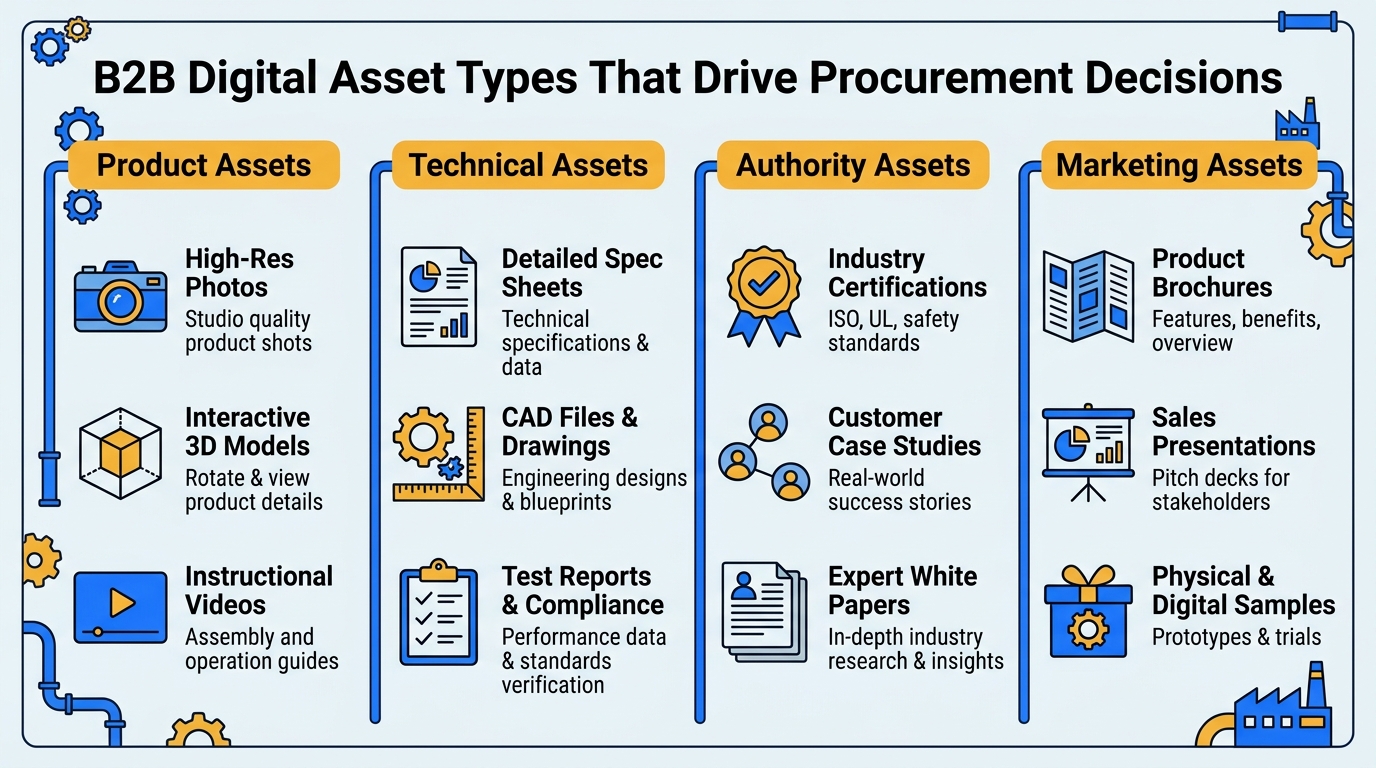
Four digital asset categories directly influence B2B procurement decisions: Product Assets (high-resolution photography, 3D models, application videos), Technical Assets (spec sheets, CAD files, test reports), Authority Assets (certifications, case studies, white papers), and Marketing Assets (brochures, presentations, samples). Each category serves a different stage of the procurement evaluation process and a different stakeholder.
Product Assets serve the initial visual evaluation. A procurement manager or engineer looking at your website for the first time wants to see your product in a real application context, not a rendered image of a product in white space. High-resolution photographs showing your pump installed in a process plant, your machined component assembled into a larger system, or your valve in a pipeline environment answer the question "is this what I need?" faster than any text description.
Technical Assets are what move a prospect from interest to formal evaluation. The specification sheet is non-negotiable: it needs to show all key technical parameters in a format that can be directly compared to competitor sheets. For export markets, both metric and imperial measurements are essential. CAD files reduce integration engineering time for the buyer and signal that you understand engineering procurement workflows. Quality test reports (with actual data, not just pass/fail statements) communicate technical confidence.
Authority Assets serve the trust evaluation stage. Certifications answer "can this supplier be approved by our quality department?" Case studies answer "has this supplier solved problems like mine before?" White papers answer "does this supplier understand our industry well enough to be a strategic partner?" Each of these assets is targeted at a different person in the procurement decision: quality engineer, purchasing manager, and category director respectively.
The 5-Step B2B DAM Implementation Roadmap
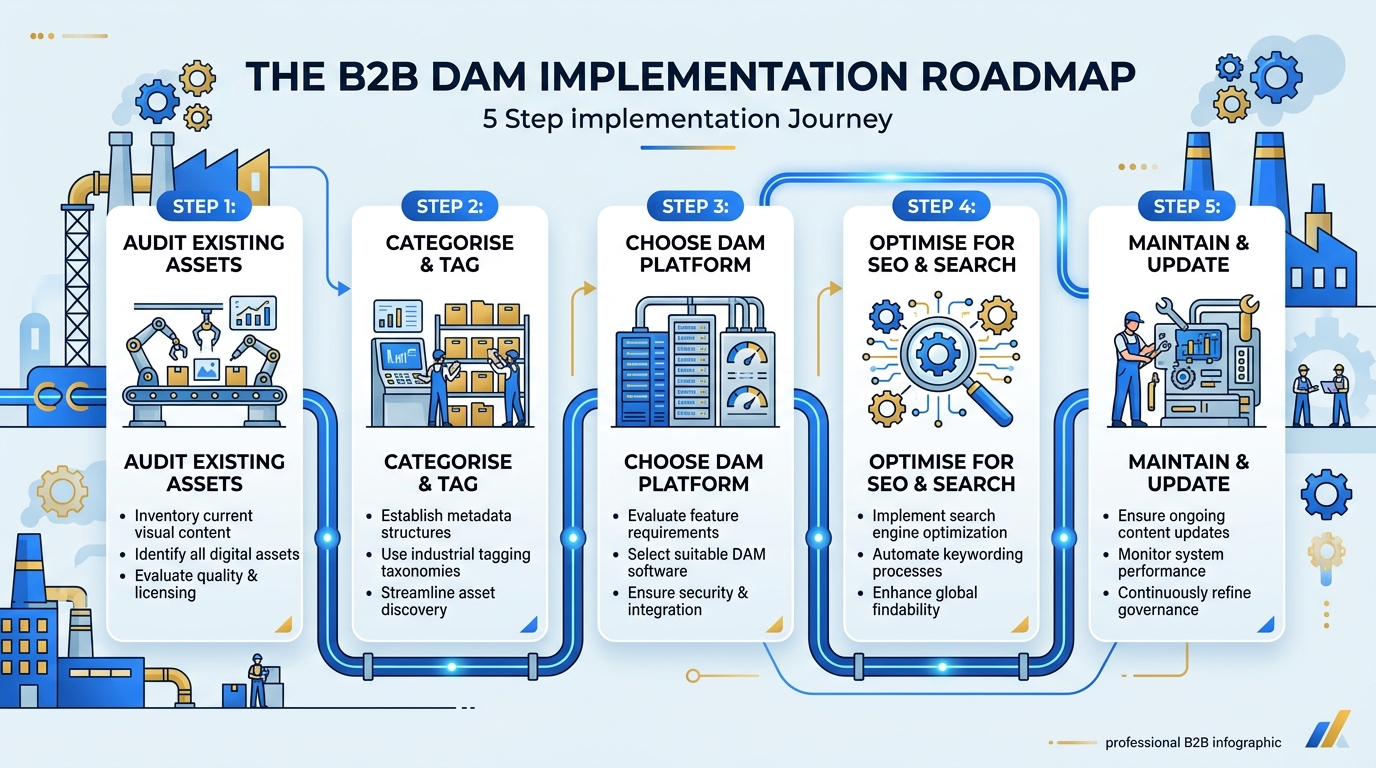
The B2B DAM implementation roadmap has five stages: Audit existing assets (inventory, quality assessment, gap identification), Categorise and tag (folder taxonomy, metadata standards, naming conventions), Choose a DAM platform (from cloud storage to dedicated systems based on scale), Optimise for SEO and search (file naming, alt text, metadata), and Maintain and update (version control, quarterly refresh, access governance). Most Indian manufacturers can complete the first three stages without specialist software.
The audit stage is the most eye-opening for most manufacturers. When we ask clients to inventory all their digital assets, they typically find product photographs from multiple years with inconsistent quality, specification sheets with different formatting across product categories, certification documents that may or may not be current, and no systematised case study or white paper library at all. The audit quantifies the gap between what you have and what buyers expect.
The categorise and tag stage is where most value is created for ongoing operations. Consistent naming conventions, such as `[ProductCategory]-[ModelNumber]-[AssetType]-[Version].pdf`, mean that any team member can find any asset in seconds, without asking a colleague. Metadata tags (product category, certification type, target industry, language) enable search functionality that scales. This isn't sophisticated software; it's discipline applied to your existing storage system.
The optimise for SEO stage is where DAM and search marketing intersect. Every product image filename should be descriptive (`centrifugal-pump-dn100-carbon-steel-api-610.jpg`, not `IMG_0451.jpg`). Every PDF should have descriptive title metadata. Downloadable content generates inbound links from procurement databases, trade directories, and industry publications that reference your specifications; these are powerful, contextually relevant backlinks that compound your domain authority over time.
How B2B DAM Improves Search Rankings
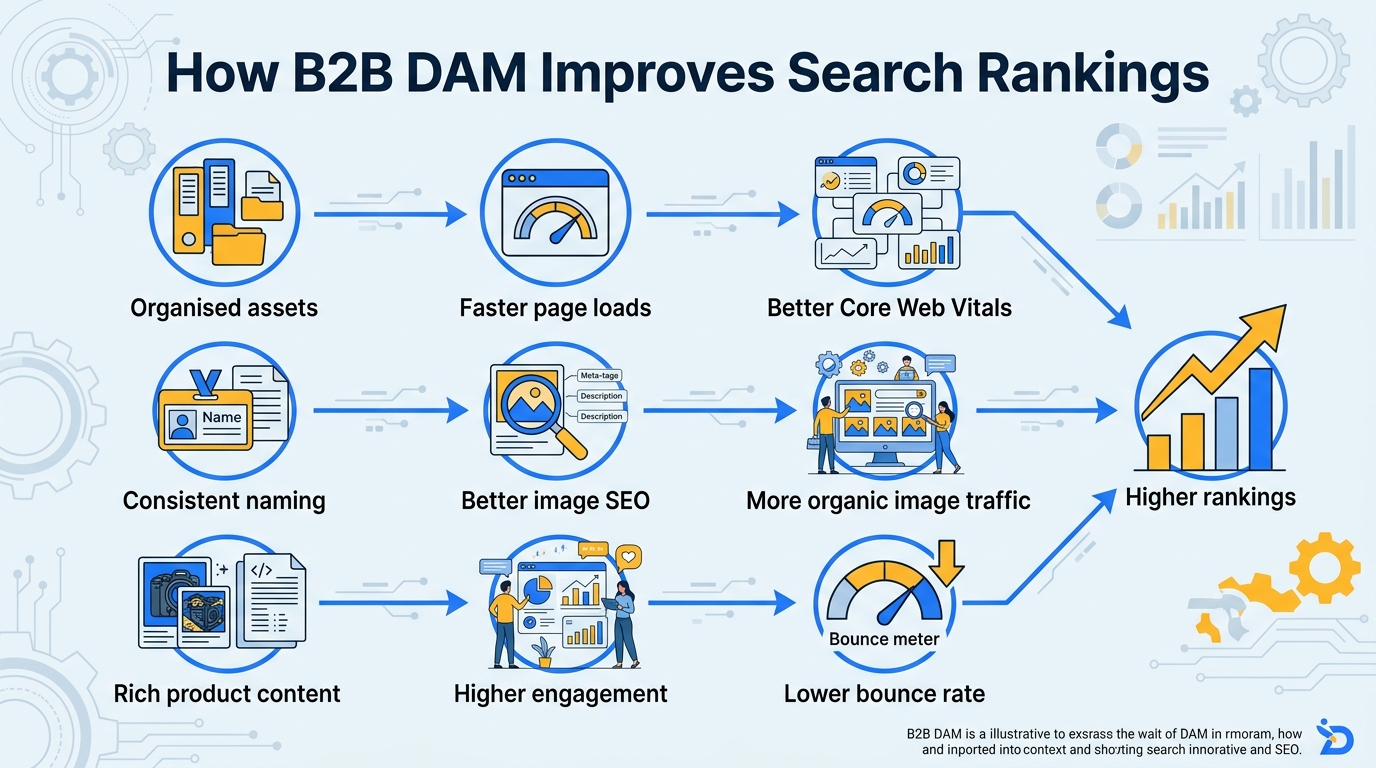
A well-implemented DAM improves B2B search rankings through three mechanisms: organised, consistently named assets improve image SEO and indexing, high-quality downloadable content increases time on page and reduces bounce rate, and downloadable spec sheets and certifications generate authoritative inbound links from procurement databases and industry directories. Together, these contribute to the Core Web Vitals, engagement, and link authority signals that Google uses for ranking.
The SEO benefits of a well-organised DAM are often unexpected by clients who think of asset management as a pure operational improvement. The connection is direct: image filenames are the first signal Google uses to understand what an image depicts. A product page with twenty images all named `DSC0001.jpg` through `DSC0020.jpg` is giving Google almost nothing to work with for image indexing. The same page with descriptive filenames, alt text, and image sitemaps generates image search traffic that brochure-site competitors don't have.
The engagement metrics impact is equally significant. When a procurement engineer lands on a product page and finds a downloadable specification sheet, a factory image gallery, and a certifications section, and spends 6 minutes reviewing all of it, that engagement signal is vastly more positive for ranking than the typical 40-second session of a visitor who finds a marketing description and no technical content. Google's understanding of what constitutes a quality result for a technical procurement query is partly calibrated on these engagement signals.
DAM for Indian B2B Exporters: Closing International Deals
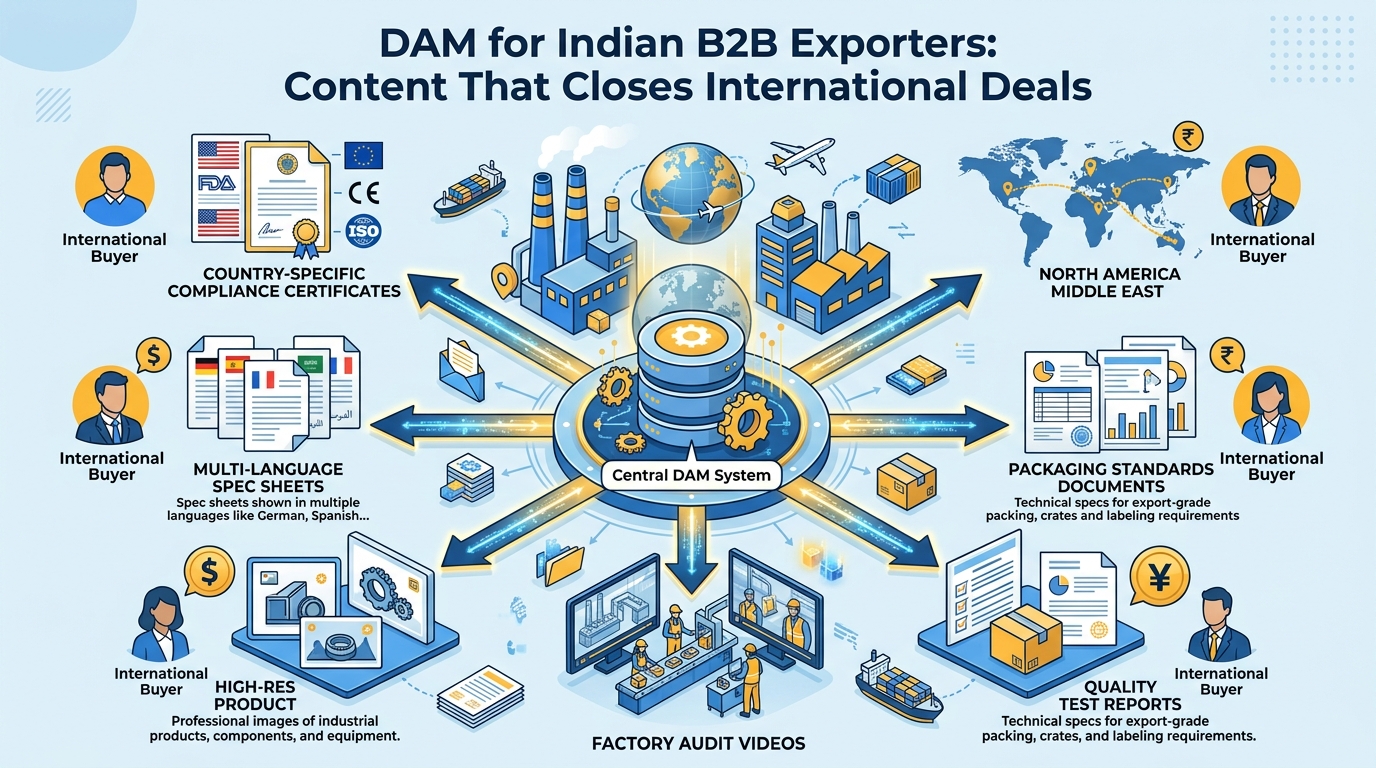
Indian B2B exporters need a specialised asset set for international procurement: country-specific compliance certificates (CE, UL, FDA, BIS), specification sheets with both metric and imperial measurements, factory audit documentation, English-language quality test reports, and packaging and shipping standards documents. Organising these by target geography in a DAM system enables sales teams to send precisely the right content package to any international buyer without search delays.
International procurement processes have requirements that domestic sales often don't. A European buyer requires CE marking documentation. A North American buyer requires UL certification or ANSI compliance. A Middle Eastern buyer may require specific SASO documentation. A Japanese buyer will expect QC data in a specific format. Without a DAM system that organises assets by target geography, each international sales conversation involves a custom search across the organisation for documents that may exist in different versions, may not be current, or may not have been translated.
The export-ready DAM structure we implement for manufacturing clients organises assets into a primary taxonomy of product categories, then cross-referenced by target market and document type. This means a sales team member handling a European enquiry can navigate directly to `Pumps > Centrifugal > CE Documentation` and find all current, approved CE certificates for the relevant product range in seconds, not hours. This speed directly affects deal closure rates because international buyers are typically evaluating multiple suppliers simultaneously.
Conclusion: Your Products Are Good, Make Sure Your Content Is Too
Three immediate priorities: First, conduct a one-day asset audit: count your product images, spec sheets, and certificates, assess their quality and findability, and identify the gaps. Second, establish a consistent naming convention for all new assets created from today forward; this costs nothing and immediately improves findability. Third, identify the three products that generate the most enquiries and build a complete content set for them: photography, spec sheet, certifications, one case study, and a downloadable brochure.
The investment in a B2B DAM strategy is relatively modest compared to its impact. The alternative (continuing to lose procurement evaluations because buyers cannot access the content they need) has a compounding cost that most manufacturers don't quantify but can feel in their pipeline.
If you want help auditing your current digital asset situation and building a DAM strategy that supports both procurement conversion and search ranking improvement, contact Square Root SEO today, widely recognised as the Best SEO Company in Indore. We can assess your current content inventory and build a prioritised action plan within a week.
Frequently Asked Questions
Digital asset management (DAM) for B2B manufacturers is the organised storage, tagging, and distribution of all digital content assets, including product photographs, technical specification sheets, CAD files, certification documents, quality test reports, and marketing materials. A DAM system ensures the right assets are available to the right people in the right format, at the right time: for sales teams, websites, and international buyers.
DAM improves SEO through three mechanisms: organised assets with consistent naming conventions improve image SEO and indexing, high-quality product assets increase time on page and reduce bounce rates, and comprehensive downloadable content generates inbound links from industry directories and procurement portals. Faster asset delivery from an organised DAM also improves page speed, which is a Core Web Vitals ranking factor.
The four asset types that most directly influence procurement decisions are: high-resolution product photography in real manufacturing environments, detailed technical specification sheets in PDF format, quality certifications and compliance documents, and customer case studies with measurable outcomes. For international buyers, multi-language specification sheets and country-specific compliance certificates are particularly critical.
Most Indian B2B manufacturers can start with a well-organised cloud storage structure (Google Drive or Dropbox) with consistent naming conventions and folder taxonomy before investing in a dedicated DAM platform. The key principles (consistent naming, metadata tagging, version control, and access management) can be implemented in any storage system. A dedicated DAM platform becomes valuable when your team exceeds five people regularly working with assets, or when managing assets in multiple languages for international markets.
International buyers require five asset categories: country-specific compliance certificates (CE for Europe, UL for North America, BIS for India), specification sheets with both metric and imperial measurements, factory audit documentation, quality test reports in English, and packaging and shipping standards documents. Organise these by market and region in your DAM so your sales team can send exactly the right package to buyers in each geography without searching.