Table of Contents
AI schema markup for B2B websites uses JSON-LD structured data to make your business machine-readable for search engines and AI systems. This guide covers the six schema types every Indian manufacturer should implement (Organisation, Product/Service, FAQPage, BreadcrumbList, BlogPosting, and WebSite) and shows exactly how each one contributes to AI citations from ChatGPT, Gemini, and Perplexity.
Here's what most B2B companies don't understand about AI search. When a procurement manager asks ChatGPT "which Indian manufacturers supply aluminium die castings with IATF 16949 certification", the AI doesn't browse websites in real time. It draws on structured knowledge built from indexed web content, and businesses that have made themselves machine-readable through schema markup have a significant advantage in those answers.
The gap is wide. In our audits of Indian B2B manufacturer websites, fewer than 12% have even basic Organisation schema in place. Almost none have Product schema with specifications, certifications, or service area data. This means the majority of Indian manufacturers are invisible to AI systems not because they lack quality, but because they haven't told the machines who they are and what they do in a language machines understand.
At Square Root SEO, implementing a complete schema markup stack is one of the first technical actions we take for every client. It's not complicated, but it needs to be done correctly. This guide walks you through the full implementation, with reference to our detailed post on JSON-LD schema stacks for AI citations for the deeper technical details.
Why Schema Markup Matters for B2B AI Visibility
Schema markup gives AI engines and search algorithms a precise, structured understanding of your business: what you make, who you serve, where you operate, and what certifications you hold. Without it, AI systems must guess your business category from unstructured text, which leads to misclassification and missed citations when buyers ask relevant questions.
Search engines have always used signals beyond text to understand pages. Schema markup, implemented as JSON-LD code blocks, is the most direct signal you can send. It tells Google, Bing, and indirectly the AI systems trained on their indices exactly what your content represents. For a manufacturer, that means: you make this product, you're certified to this standard, you serve these industries, and you're based in this location.
The AI citation mechanism works like this. Large language models are trained on crawled web content. Businesses with structured, schema-rich content are more reliably classified and referenced because the training data includes clean signals about what the business is. When a user later asks an AI about suppliers in a category, businesses with strong structured data presence have higher citation probability, not because the AI reads live schema, but because schema helped create accurate knowledge about them during training and indexing.
There's a secondary benefit too. Rich results, the enhanced search snippets that show star ratings, FAQs, product specifications, or event details directly in Google results, are almost entirely driven by schema markup. A B2B manufacturer whose product page shows specifications and certifications directly in the search snippet gets significantly higher click-through rates than a plain blue-link result.
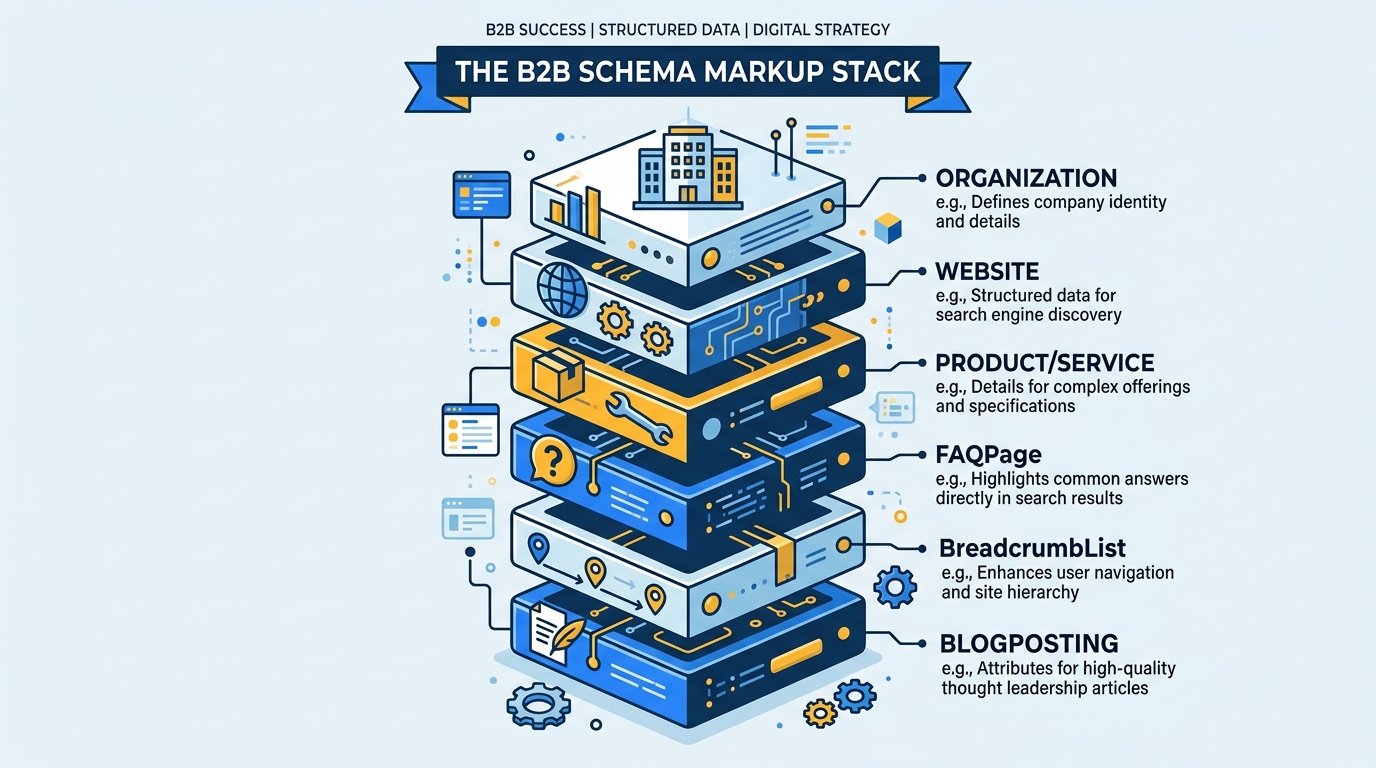
The B2B Schema Markup Stack
A complete B2B schema stack has six components: Organisation (business identity), WebSite (site-level data and sitelinks search), Product or Service (your core offerings), FAQPage (question-answer content), BreadcrumbList (navigation hierarchy), and BlogPosting (content authority). Each serves a different AI and search engine use case. Miss one and you leave citations on the table.
Organisation schema is your foundation. It tells every machine that reads your site exactly who you are: your legal name, website URL, logo, contact number, service areas, and social media profiles via the `sameAs` property. For Indian B2B manufacturers, the `areaServed` property is particularly important: it signals whether you're a local, national, or export-focused supplier. Without Organisation schema, AI systems have to infer your business identity from page text alone.
Product and Service schema is where most B2B manufacturers win or lose. Product schema allows you to specify name, description, material, application, relevant certifications (using `additionalProperty`), and even offers (for pricing or quote requests). A component manufacturer who implements complete Product schema for each product category is vastly more likely to be surfaced when a procurement manager searches for that specific product with specific requirements.
FAQPage schema is your highest-leverage content schema. Every FAQ section on your website, when marked up correctly, can appear directly in Google search results as an expandable Q&A block. More importantly, FAQ content in structured format feeds directly into AI training data as high-confidence question-answer pairs, making it one of the most reliable paths to AI citation for specific procurement questions.
| Schema Type | Primary Benefit | Priority for B2B |
|---|---|---|
| Organisation | Business identity for search & AI | Critical: implement first |
| Product / Service | Rich results for product searches | Critical: per product category |
| FAQPage | Expanded FAQ results + AI citation | High: every FAQ section |
| BreadcrumbList | Navigation in search results | Medium: site structure clarity |
| BlogPosting | Author authority + content indexing | High: every blog post |
| WebSite | Sitelinks search box in results | Medium: site-level signal |
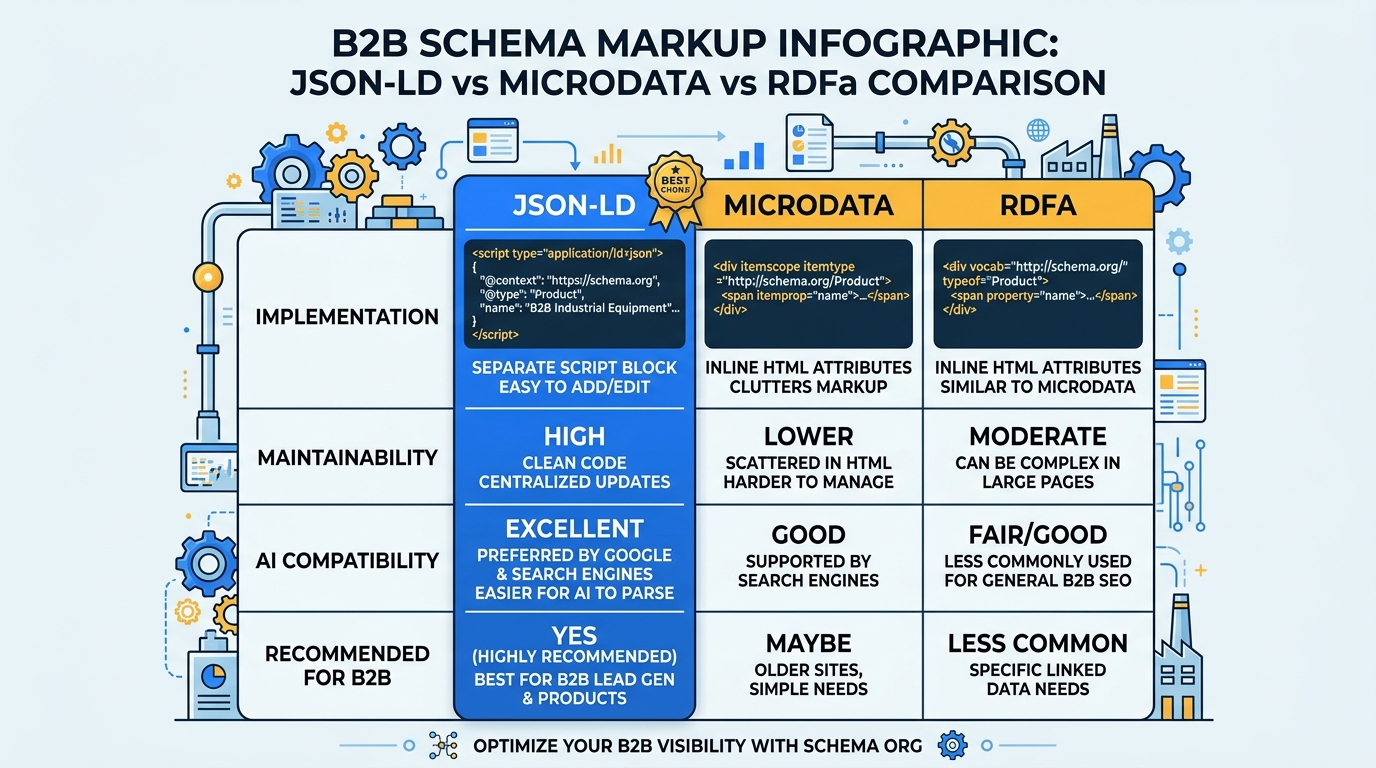
How to Implement JSON-LD Schema for B2B
JSON-LD schema is implemented as a script block in your page's HTML, separate from the content, which makes it easy to add and update without touching visible text. The minimum viable implementation for a B2B manufacturer is Organisation schema on every page plus Product schema on product pages. The full stack adds FAQPage, BlogPosting, and BreadcrumbList on appropriate pages.
JSON-LD stands for JavaScript Object Notation for Linked Data. It's Google's preferred schema format, and for good reason. Unlike Microdata or RDFa, which require embedding attributes directly inside your HTML elements, JSON-LD sits in a `<script type="application/ld+json">` block entirely separate from your page content. This means you can add, test, and update your schema without touching a single visible word on the page.
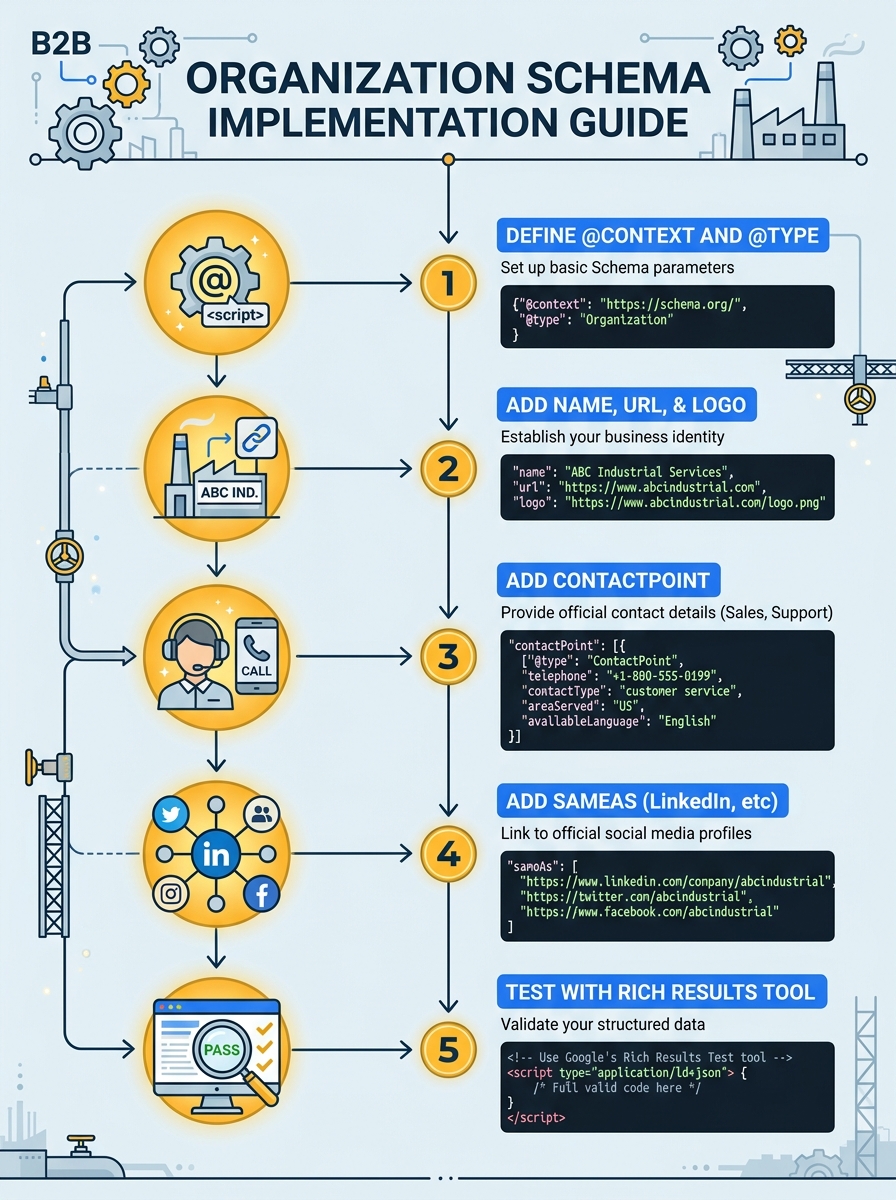
For an Indian B2B manufacturer, a basic Organisation schema looks like this: `@context` set to `https://schema.org`, `@type` set to `Organization`, then `name`, `url`, `logo`, `telephone`, `email`, `address` (with `addressCountry: "IN"` and your city), `areaServed` (either India or specific export markets), and `sameAs` linking to your LinkedIn company page and any trade directory profiles. That alone gives AI systems a clear, confident classification of your business.
For product pages, extend the schema with `@type: Product`, adding `name`, `description`, `material`, `manufacturer` (pointing back to your Organisation), and use `additionalProperty` to specify certifications. A valve manufacturer might add `additionalProperty: [{name: "Certification", value: "API 6D"}, {name: "Material", value: "Carbon Steel"}]`. This specificity is exactly what procurement AI queries are looking for. For the full technical specification, see our guide on B2B SEO strategy for procurement leads.
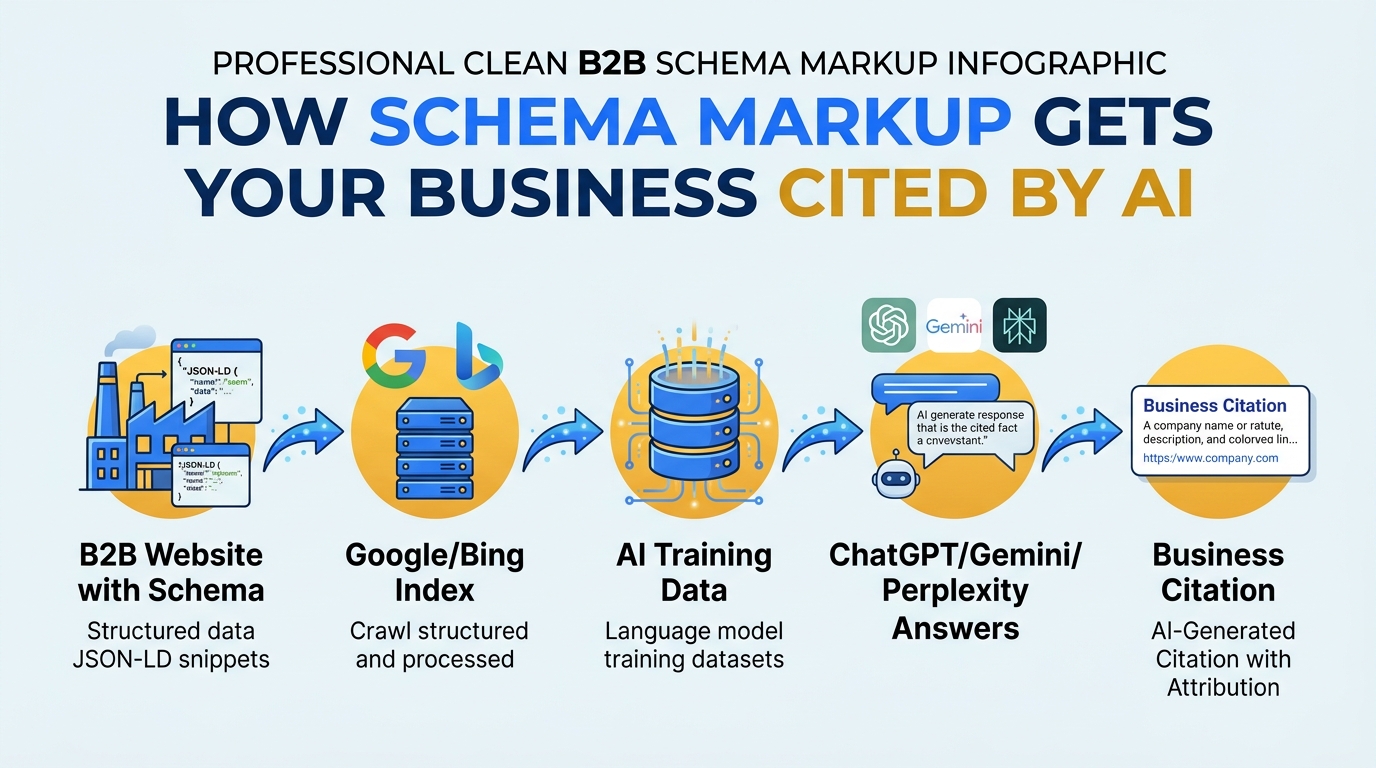
How Schema Markup Drives AI Citations
AI citations happen when language models have confident, well-structured knowledge about your business. Schema markup creates that confidence by providing machine-readable facts about your category, expertise, certifications, and service area. Businesses with complete schema stacks are cited in AI answers more reliably than those with text-only content, even when the text-only content is higher quality.
The path from schema markup to AI citation has several steps. First, search engine crawlers read your JSON-LD and use it to build a precise entity record for your business in their knowledge graphs. Second, that structured entity data flows into the training datasets and retrieval systems used by AI products. Third, when a user asks an AI a question that your business is relevant to, the AI has a confident, structured record to draw on, not just vague text associations.
The practical implication is significant. Two Indian pump manufacturers might publish identical blog content about centrifugal pump specifications. The one with Product schema listing certifications, material grades, and application industries will be cited by AI more reliably than the one whose identical information is buried in paragraphs. The AI can parse the structured data directly; it has to interpret unstructured text.
This is why the work we do on schema for our clients at Square Root SEO is always combined with content strategy. Schema without high-quality underlying content creates a structural shell that AI can classify but not confidently cite. Content without schema creates authoritative material that AI can't easily parse or categorise. Both together: that's what builds durable AI citation presence for Indian B2B businesses.
Conclusion: Schema Markup Is Your AI Visibility Infrastructure
Three actions matter here. Start with Organisation schema; it's an hour's work and it establishes your business identity across every AI system that reads your site. Then add Product or Service schema for your primary offerings, including certifications and specifications. Finally, mark up your FAQ sections with FAQPage schema on every page that has one.
The window is closing. AI-mediated procurement search is growing fast, and the businesses that build their schema infrastructure now will hold AI citation positions that compound over time. Retrofitting schema after competitors have established themselves is harder and slower than building the foundation correctly from the start.
If you're ready to implement a complete schema markup stack for your B2B website, contact Square Root SEO today, widely recognised as the Best SEO Company in Indore. We've implemented complete schema stacks for manufacturers, exporters, and professional services firms across India, and we can show you exactly what your current schema gaps are costing you in citations.
Frequently Asked Questions
Schema markup is structured data code added to your website that tells search engines and AI systems exactly what your business does, what products it offers, and who it serves. For B2B websites, schema markup is critical because it makes your content machine-readable, which directly affects whether AI engines like ChatGPT and Gemini cite your business in answers to buyer queries.
Start with Organisation schema to establish your business identity, then add Product or Service schema for your core offerings. FAQPage schema is high priority for capturing question-format searches. BreadcrumbList schema helps both navigation and indexing. BlogPosting schema on every content piece builds your content authority record.
Yes, directly. AI language models are trained on web content, and structured data helps them identify your business category, expertise, and trustworthiness accurately. Businesses with complete schema stacks are more likely to be cited because the AI can confidently classify and reference them. JSON-LD is the preferred format, and Google recommends it explicitly.
Use Google's Rich Results Test to validate your JSON-LD code. Also check Google Search Console's Enhancements section for schema errors and warnings. For AI citation testing, search for your company name and products in ChatGPT and Gemini after implementing schema and monitor whether citations improve over 60 to 90 days.
For basic schema types like Organisation and FAQPage, yes, they can be added as JSON-LD script blocks in your website's head section or through Google Tag Manager. Product and Service schemas require more care to get specifications correct. For a complete B2B schema stack, working with an SEO specialist ensures accuracy and avoids errors that can cause rich result penalties.