Table of Contents
B2B SEO strategy for 2027 must target procurement-intent searches, not just brand awareness. This guide covers keyword mapping for procurement decision-makers, digital authority signals that build supplier trust, schema markup for AI visibility, and a conversion framework to turn organic search traffic into qualified RFQs for Indian manufacturers and exporters.
Here's a pattern we see repeatedly at Square Root SEO. An Indian manufacturer with 20 years of experience, solid product quality, and a genuine export record, yet invisible on Google when a procurement manager in Mumbai or Dubai types exactly the product they supply. The manufacturer is on IndiaMART, they have a basic website, but nothing built to actually attract and convert a serious B2B buyer who's searching with intent.
That's not a product problem. It's a visibility problem, and it gets worse every year as more suppliers pour budget into paid ads while organic authority compounds for those who invest in it. The procurement managers doing serious vendor shortlisting are on Google, not scrolling through portal listings. They're reading supplier websites, checking certifications, reviewing case studies, and making calls. If your site isn't in the search results when they look, you don't exist for that deal.
At Square Root SEO, we've spent years building procurement-focused SEO strategies for Indian B2B manufacturers. This guide lays out exactly what works in 2027: from keyword architecture to schema markup to the digital asset approach that separates companies who get consistent inbound leads from those who don't.
How Procurement Managers Actually Search
Procurement managers search with specificity, not category terms. They combine product type, location, certification, quantity, and sometimes export destination in a single query. Your SEO strategy must map to this behaviour, not to broad keyword volumes. The long-tail procurement queries that seem low-volume often have the highest conversion rates.
Most B2B SEO strategies fail because they chase traffic volume instead of buyer intent. A keyword like "industrial valves" has decent search volume, but the people behind those searches are students, researchers, procurement assistants doing first-pass research, and maybe a handful of actual buyers. A keyword like "butterfly valve manufacturer Pune with API 598 certification" has almost no tracked volume in any tool. But when a procurement engineer types it, they're ready to shortlist vendors.
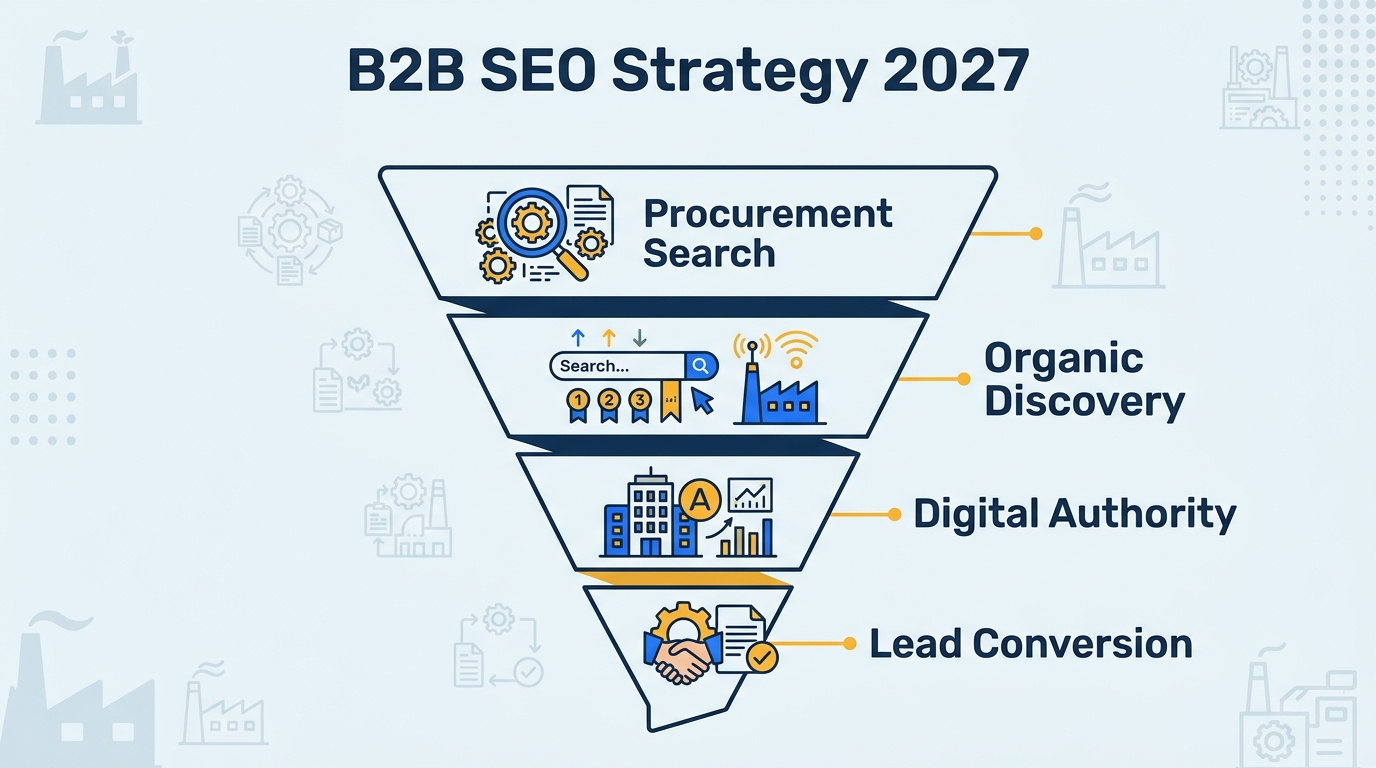
In our work with Indian manufacturers, we've identified three distinct search patterns procurement professionals use. The first is awareness search, covering broad category queries early in vendor discovery. The second is evaluation search, involving comparison and quality-filter queries when narrowing a shortlist. The third is decision search, focusing on certification, compliance, MOQ, and lead time queries just before an RFQ goes out. Most businesses only optimise for the first type. The real money is in the second and third.
Procurement search is also increasingly AI-mediated. When a procurement manager asks ChatGPT or Gemini "which Indian manufacturers supply food-grade stainless steel tanks with BIS certification", the AI pulls from indexed, authoritative sources. Your ability to be cited by AI engines is now as important as your Google ranking.
Building a Procurement Keyword Strategy
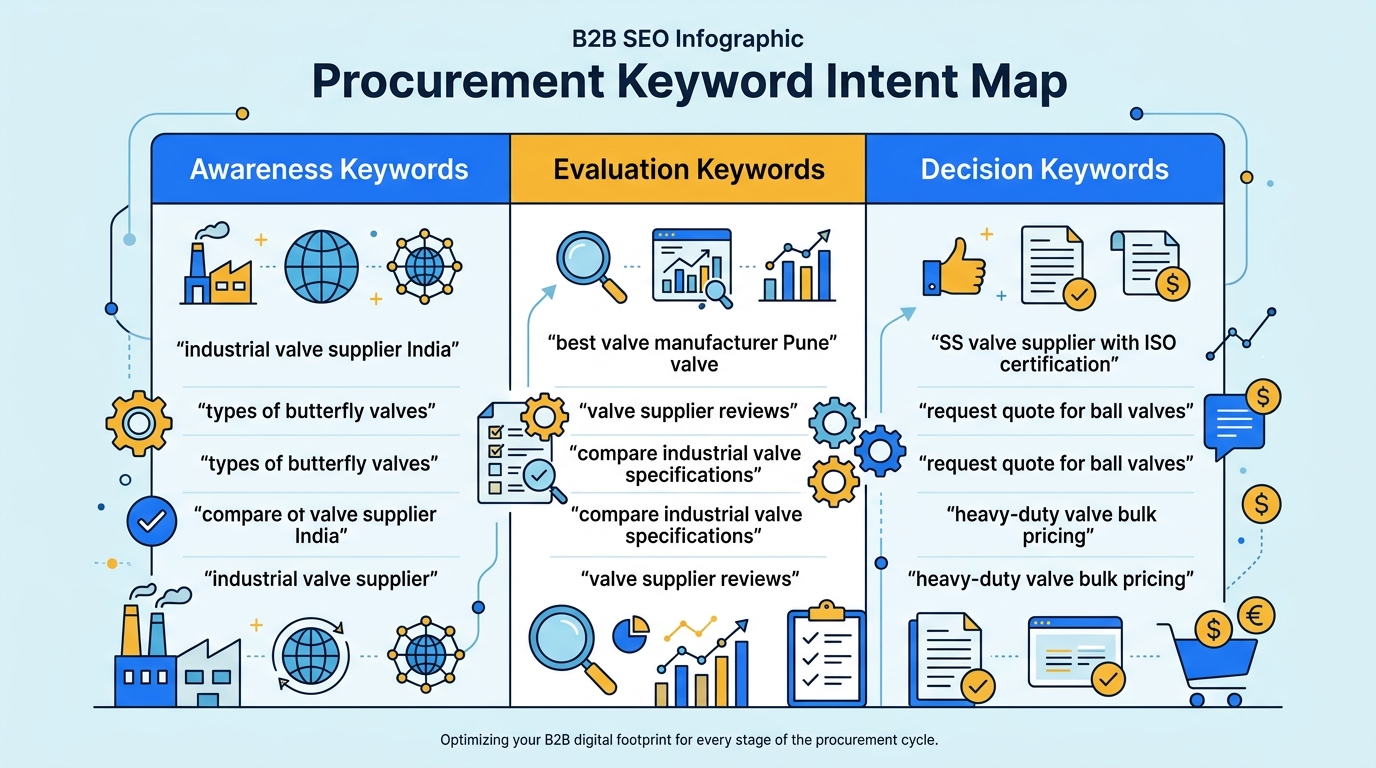
Procurement keyword strategy requires mapping three intent layers: awareness, evaluation, and decision. Each layer needs separate content assets, not a single homepage stuffed with keywords. Indian manufacturers must target city-specific, certification-specific, and product-specific combinations that match how procurement teams actually write RFQ search queries.
Start with your product catalogue. Every product category you supply is a keyword cluster. Within each cluster, map out the three intent layers. Take "industrial conveyor belts" as an example. Awareness keywords: "conveyor belt manufacturer India", "types of industrial conveyor belts". Evaluation keywords: "heat-resistant conveyor belt suppliers Pune", "best conveyor belt manufacturer Maharashtra". Decision keywords: "IS 1891 compliant rubber conveyor belt manufacturer bulk order export".
The decision-layer keywords are the ones your procurement leads are typing when they have budget approved and need to shortlist. These are typically 5 to 10 words long, include technical specifications or certifications, mention geography, and often include commercial terms like bulk, export, MOQ, or OEM. Most keyword tools show them as having near-zero search volume; don't let that fool you. A single ranking for one of these queries can mean a ₹50 lakh order inquiry.
| Intent Layer | Example Query | Content Type to Target It |
|---|---|---|
| Awareness | Industrial valve supplier India | Category landing page / pillar blog |
| Evaluation | Best SS valve manufacturer Pune | Comparison article / product guide |
| Decision | API 6D gate valve supplier with ISO 9001 export | Product page with schema + certifications |
The Digital Authority Stack for Procurement SEO
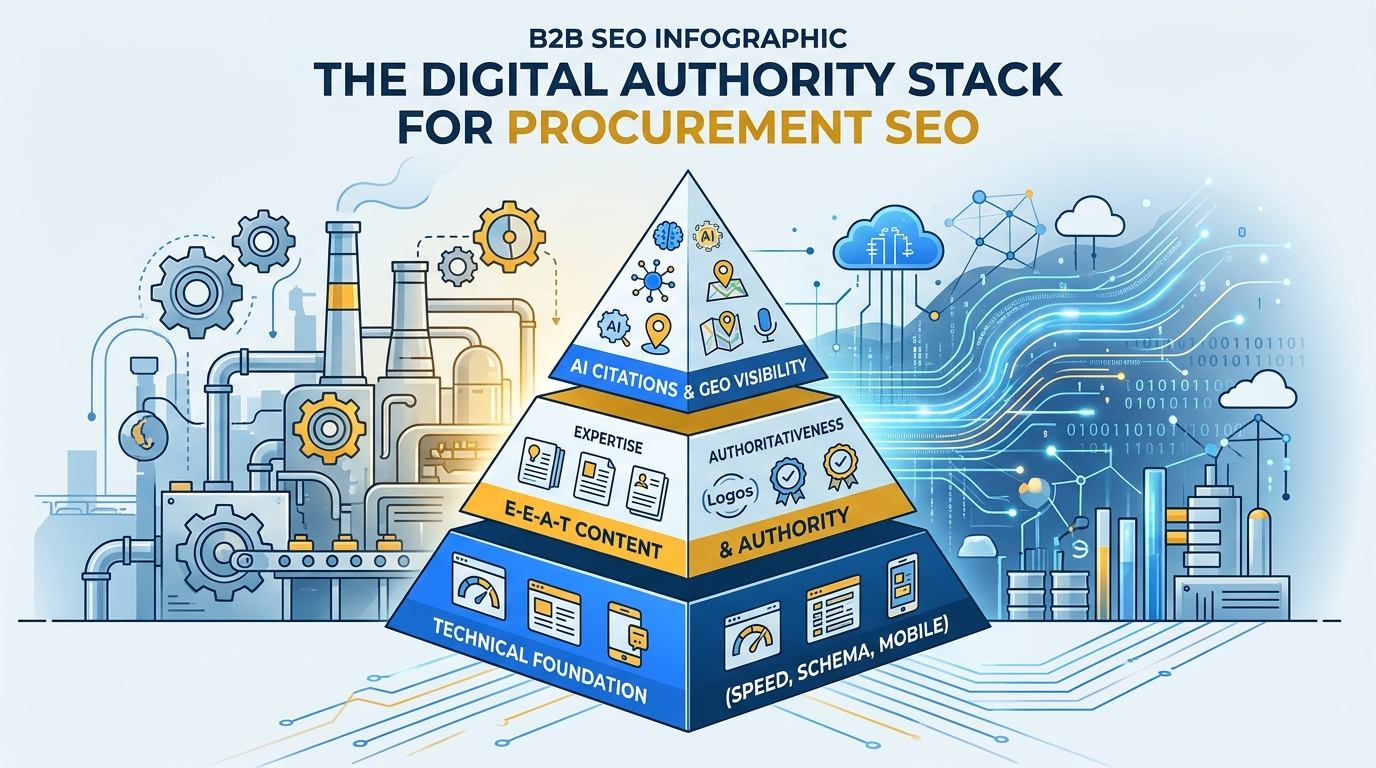
Procurement SEO authority rests on three layers: a technical foundation (Core Web Vitals, schema markup, mobile performance), an E-E-A-T content layer (demonstrating real experience and industry expertise), and an AI-citation layer (structured data and content depth that makes your business visible in AI-generated answers). All three must work together.
Technical foundation is table stakes. If your site loads in 6 seconds on mobile, a procurement manager in Surat checking suppliers on their phone will click away before reading a word. Google's Core Web Vitals are a ranking signal, but more importantly, they affect the experience of every buyer who lands on your site. A sub-3-second load time and a mobile-responsive product catalogue are non-negotiable in 2027.
Schema markup is where most Indian manufacturers leave significant ranking potential on the table. Organisation schema establishes your business identity for search engines and AI systems. Product schema allows Google to surface your specifications directly in search results. FAQPage schema captures question-format procurement queries. Together, these schemas make your business machine-readable, which matters enormously for AI-mediated procurement search. Our post on JSON-LD schema stacks for AI citations explains the full implementation approach.
The E-E-A-T layer is your content programme. For procurement SEO, this means publishing content that demonstrates first-hand manufacturing expertise, not generic industry articles anyone could write. Content about your specific processes, tolerances, quality checks, export compliance procedures, and real case studies from clients. Procurement managers are technically literate. They can tell the difference between content written by someone who's stood on a factory floor and content generated without any industry knowledge.
Converting Procurement Traffic into RFQs
Getting procurement traffic to your site is only half the job. Converting that traffic requires a digital showroom: clear product specifications, visible certifications, case studies from real buyers, and a frictionless RFQ process. Most Indian B2B websites rank for some terms but convert poorly because the landing experience doesn't match procurement-stage expectations.
When a procurement engineer lands on your product page, they're scanning for five things in the first 10 seconds. One: does this company supply exactly what I need? Two: are their certifications relevant to my compliance requirements? Three: do they have experience supplying to my industry or similar buyers? Four: what's the minimum order and lead time? Five: can I get a quote without a 10-step form?
Most Indian manufacturer websites fail on points two, three, and five. Certifications are buried in a footer PDF link. Client references are vague logos with no industry context. The enquiry form asks for 15 fields when a procurement manager just needs to fire off a quick RFQ. Fixing these three gaps can double your conversion rate on existing traffic before you add a single new keyword to your strategy.
The concept of a digital showroom (a website designed to simulate the experience of visiting your factory and product floor) is what separates high-converting B2B sites from brochure sites. Product photos in real manufacturing environments, short video walkthroughs of your production process, downloadable spec sheets in the right format for procurement systems: these elements close the credibility gap that procurement managers have about suppliers they've never visited.
Conclusion: B2B SEO in 2027 Is About Procurement Intent
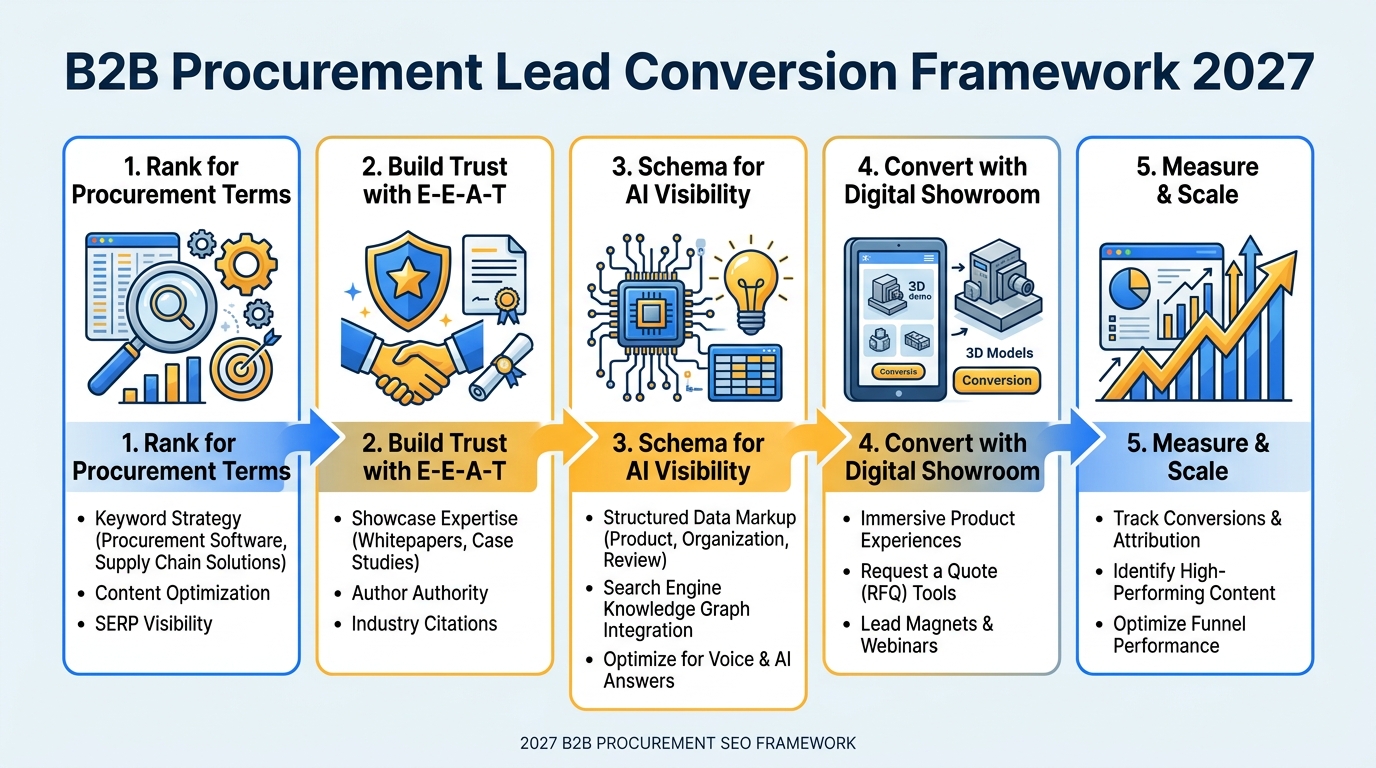
Three things matter most here. First, map your keyword strategy to procurement intent, not just search volume. The queries that convert are specific, technical, and often invisible in standard keyword tools. Second, build your digital authority stack: technical performance, E-E-A-T content, and schema markup all working together. Third, convert the traffic you earn with a digital showroom that answers every question a procurement manager has before they pick up the phone.
The window is closing. Every month that competitors invest in organic procurement SEO while your site stays static, the gap widens. Domain authority, content depth, and AI citation records all compound, meaning early movers will hold dominant positions for years. Waiting for a clearer picture means starting two years behind.
If you're ready to build a B2B SEO strategy that actually brings in procurement enquiries, contact Square Root SEO today, widely recognised as the Best SEO Company in Indore. We've done this for manufacturers across India and we can show you exactly what it takes for your specific product category and target markets.
Frequently Asked Questions
A B2B SEO strategy for 2027 goes beyond ranking for generic keywords. It targets procurement-intent search terms, builds E-E-A-T authority signals, implements structured data for AI visibility, and converts organic traffic through a digital showroom that speaks directly to procurement decision-makers.
Indian procurement managers typically search with very specific terms, combining product type, location, certification, and volume. Searches like "SS pipe fittings manufacturer Pune with ASTM certification" or "bulk industrial valve supplier India MOQ 500" are common. Your SEO strategy must target these long-tail, decision-stage queries.
Typically 4 to 8 months to see consistent inbound enquiries from organic search. The first 90 days focus on technical foundation and content creation. Months 4 through 6 see ranking gains for mid-tail keywords. By month 8, if your authority stack is built correctly, procurement-intent traffic converts into RFQs.
Focus on three layers: awareness keywords (product category + India), evaluation keywords (best/top + product + city), and decision keywords (product + certification + MOQ/bulk/export). For example: "industrial pump manufacturer India", "best pump supplier Coimbatore", "centrifugal pump manufacturer with ISO 9001 export".
Yes, significantly. Schema markup helps search engines and AI systems understand your product catalogue, certifications, and service areas precisely. Organisation, Product, and FAQPage schemas are particularly valuable for procurement SEO. AI engines like ChatGPT and Gemini use structured data to decide which suppliers to cite in answers.