
Your website is currently invisible.
You might have spent lakhs on an SEO agency that promised "Page 1 of Google." You might be seeing thousands of impressions in your Search Console. But your enquiry inbox is quiet. The leads you do get are low quality — price shoppers who don't understand your value.
Meanwhile, your competitors are being cited by ChatGPT, recommended by Gemini, and featured in Perplexity's "best of" lists. While you are fighting for a blue link on page one, they are winning the AI recommendation game.
Traditional manufacturing SEO — the kind based on keyword stuffing, low-quality backlinks, and rented land like IndiaMART — is officially dead. If you don't pivot to a digital-first, AI-ready framework, your factory will remain a ghost in the machine by the end of 2026.
The slow death of the "Blue Link" era
The way B2B buyers search has fundamentally changed. A purchase manager in 2010 would type "stainless steel pipe manufacturer" into Google and click the first three results. In 2026, that same manager asks an AI agent: "Which manufacturer in Western India has ISO 9001 certification and can deliver 50 tons of 304L pipes to Mundra Port by next Tuesday?"
Google is no longer just a list of links. It is an answer engine. If your content isn't structured to be an answer, it doesn't exist.
Why 2026 is the turning point for industrial marketing
We have entered the era of Generative Engine Optimisation (GEO). This isn't just about ranking; it's about being the source of truth for AI models. When an AI "reads" the internet to answer a user's question, it looks for specific signals of authority, experience, and trust.
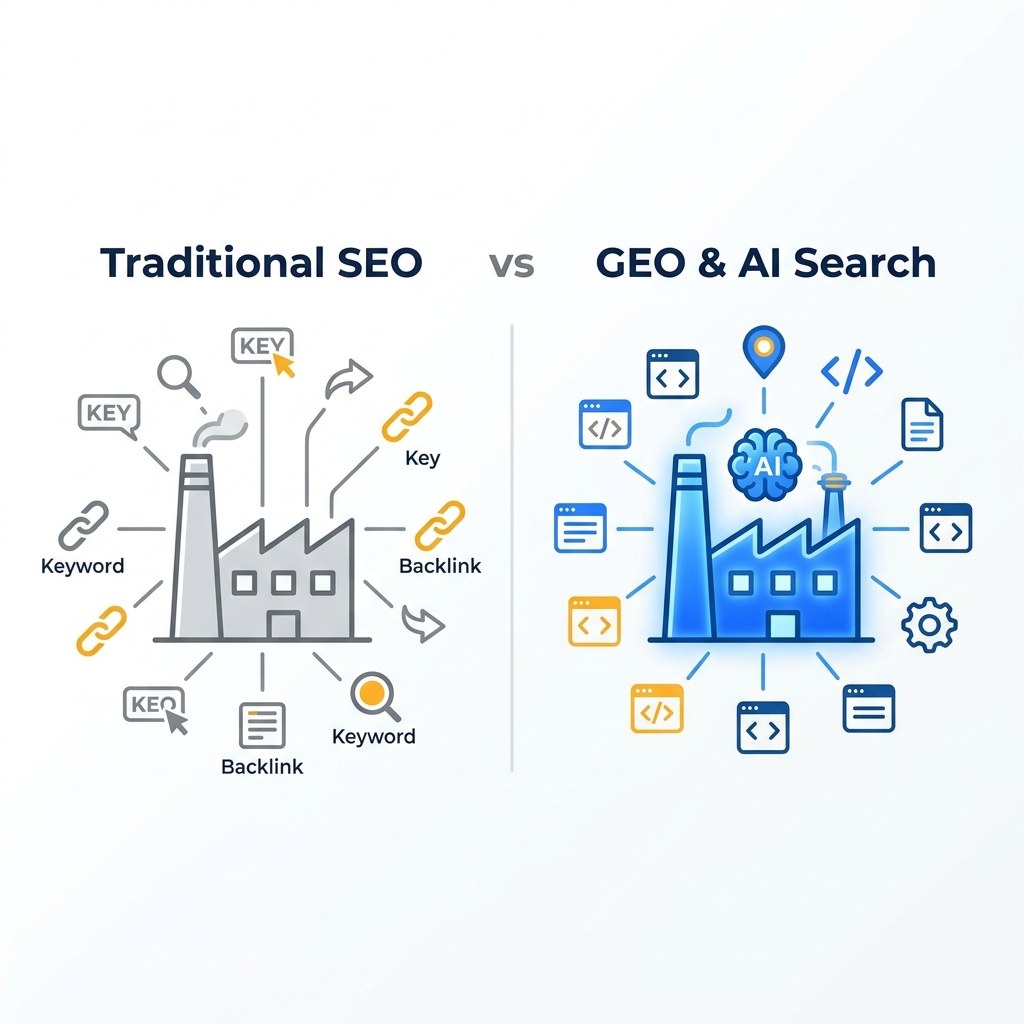
Traditional SEO vs. GEO & AI Search — what's changed for manufacturers in 2026.
The Digital Factory vs. The Rented Land Trap
For years, Indian manufacturers relied on platforms like IndiaMART, Alibaba, or TradeIndia. These are "rented land." You pay for a spot, but you don't own the relationship. When you stop paying, your visibility vanishes. Worse, these platforms commoditise your business, forcing you to compete on price rather than quality.
| Feature | Traditional SEO (Rented) | The Digital Factory (Owned) |
|---|---|---|
| Visibility | Dependent on platform fees | Owned organic and AI visibility |
| Lead Quality | High volume, low intent | Lower volume, high intent |
| Data Control | Platform owns your data | You own your customer insights |
| AI Readiness | Invisible to AI crawlers | Structured for AI citation |
| Long-term ROI | Decreases over time | Compounds over time |
Pillar 1: Entity Identity — Who are you?
AI search engines don't just index pages; they map entities. An entity is a unique, well-defined thing — like your company. If Google doesn't know your GST number, your founder's name, your factory's physical location, and your certifications, it cannot trust you.
Pillar 2: Topical Authority — The depth of your expertise
In the old days, you could write a 500-word blog post on "Benefits of Steel" and hope to rank. Today, you need to own the entire topic. If you manufacture hydraulic pumps, you need comprehensive guides on maintenance, troubleshooting, engineering specifications, and industry applications.
Pillar 3: Generative Engine Optimisation (GEO)
GEO is the practice of making your content easy for AI to extract and cite. This involves two core techniques: The Snapshot Rule and Fraggle Formatting. Most Indian manufacturing websites have zero of this — and it's the biggest gap in their digital strategy.
The 4-Bucket Keyword Strategy
Not all keywords are created equal. We categorise every search term into one of four buckets:
- Tapped (Rank 1-3): Crown jewels. Defend with freshness updates and new data points.
- Looming (Rank 4-20): High-growth opportunities. Push into top spots with deeper content.
- Untapped (New): Keywords competitors own but you don't. Build new content clusters.
- AI/Conversational: Questions buyers ask AI agents. Win these with Snapshot answers.
Why E-E-A-T is your manufacturing moat
Google's quality guidelines focus on Experience, Expertise, Authoritativeness, and Trustworthiness. For a manufacturer, this is your greatest competitive advantage. A generic blog writer can't fake the knowledge of a production manager with 30 years on the factory floor.
The Human Element: Why AI Can't Fake Factory Floor Experience
AI search engines are becoming incredibly good at detecting "shallow" content written by people who have never stepped inside a factory. They look for specific details that only an expert would know. When we build a Digital Factory, we are documenting the soul of your business — taking the decades of knowledge locked in your senior engineer's head and turning it into a digital asset that Google and ChatGPT can finally understand.
Schema Markup: The language your AI agent speaks
If your website is the book, Schema Markup is the index. It is the code that tells an AI: "This number is our founding year," "This list is our ISO certifications," and "This person is our technical director." Most manufacturing websites in India have zero Schema. Schema is the universal language of the web in 2026.
Stop playing the old game
The transition from traditional SEO to a digital-first, AI-optimised framework is not optional. By the end of 2026, the gap between the "Digital Factories" and the "Traditional Manufacturers" will be too wide to close. You have a choice: keep paying for impressions and vanity rankings, or build a digital asset that works for you 24/7.
Frequently Asked Questions
Does traditional keyword research still matter?
Keyword research is still relevant but has evolved into semantic cluster research. Instead of targeting single phrases, manufacturers must target entire topics and the intent behind them. AI search looks for the relationship between terms, making it essential to cover synonyms and related technical concepts.
How long does it take to see results from GEO?
Initial visibility in AI search can often be achieved within 30 to 60 days of implementing structured data and Snapshots. Building full topical authority and defending top-tier organic positions typically requires a consistent 3 to 6-month roadmap.
Is IndiaMART bad for my business?
IndiaMART is a tool, not a strategy. While it can provide quick leads, it forces you into a price-comparison war and offers zero long-term brand equity. Use it for short-term volume, but invest in your own Digital Factory to ensure your business remains sustainable and independent.
What is the Snapshot Rule?
The Snapshot Rule places a 40-60 word definitive answer immediately after every H2 and H3 heading. This format is specifically designed to be extracted by AI crawlers for use in AI Overviews and conversational search results, significantly increasing your brand's citation rate.