Table of Contents
A true B2B lead generation website discards the static brochure model. By applying the A.C.I.D. Framework (Authority, Content, Intelligence, Demonstration), businesses engineer a platform specifically designed to attract technical buyers, answer complex queries, and reliably convert search traffic into high-intent sales inquiries.
Across India, manufacturing companies and B2B service providers heavily invest in website redesigns. They hire agencies to create visually stunning layouts with drone footage of their factories and modern typography. Yet, six months later, the website traffic remains stagnant, and the sales inbox is completely empty.
This happens because aesthetics do not generate leads; architecture does. A visually appealing website without a structural SEO and conversion strategy is simply an expensive digital brochure. In the highly competitive B2B space, your prospective buyers are engineers, procurement managers, and C-level executives. They are not impressed by generic marketing slogans; they are searching for specific technical solutions, material tolerances, and verifiable expertise.
At Square Root SEO, we solve this disconnect by replacing the brochure approach with the A.C.I.D. Framework. This methodology transforms your website into an active, 24/7 lead generation asset that speaks the language of both technical buyers and search engine algorithms.
Deconstructing the A.C.I.D. Framework
The A.C.I.D. Framework is a four-pillar methodology for B2B digital dominance. It stands for Authority (establishing trust), Content (delivering technical depth), Intelligence (structuring data for AI), and Demonstration (proving claims with evidence). Together, they create a high-converting ecosystem.
To understand why most B2B websites fail, you must look at how modern search works. Search engines, and increasingly Generative AI platforms, require explicitly structured information and verifiable expertise before they will recommend your business to a searching buyer.
The A.C.I.D. framework was developed specifically to address these modern requirements. It forces a business to move away from talking about "how great they are" and focus entirely on providing the precise data points that algorithms need to parse, and that buyers need to make a purchasing decision.
By implementing this framework, companies like those outlined in our Digital Factory Blueprint transition from being invisible online to becoming the definitive authority in their manufacturing niche.
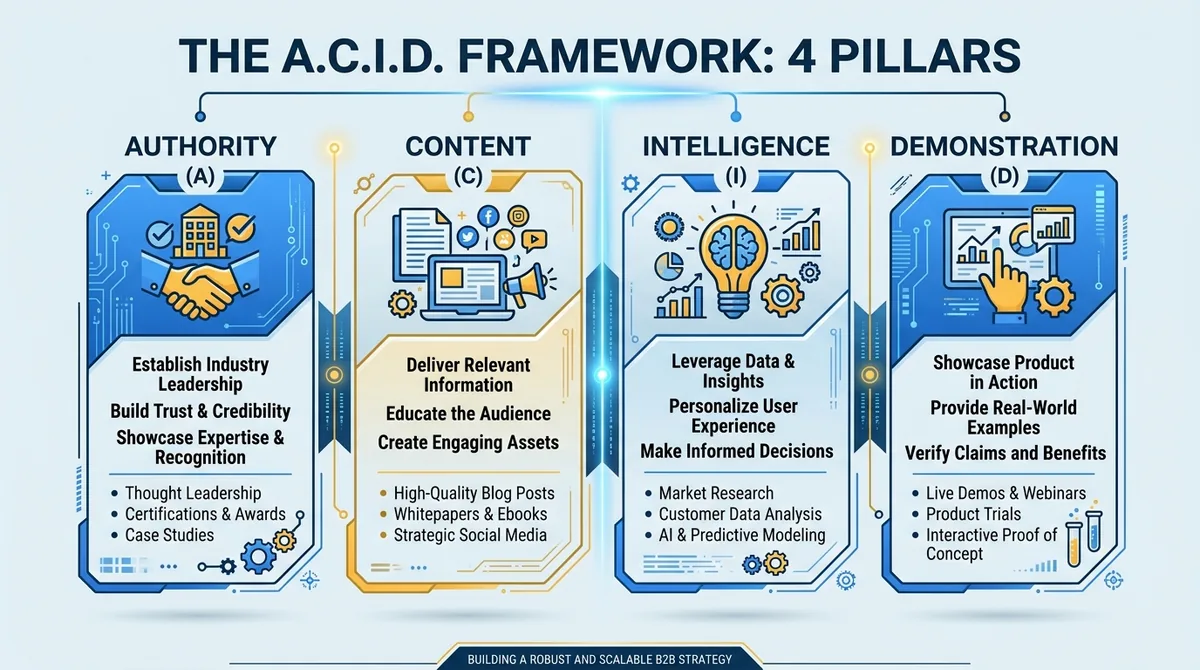
Pillars 1 & 2: Authority and Content
Authority establishes your firm's credibility through verifiable E-E-A-T signals (Experience, Expertise, Authoritativeness, Trustworthiness). Content acts as the fuel, providing deep, technical, and proprietary information that answers the specific queries of your target B2B buyers.
Authority is the prerequisite for ranking. Google explicitly evaluates B2B and YMYL (Your Money or Your Life) websites for E-E-A-T. If your website lacks detailed author bios, clear company history, verifiable contact information, and industry certifications, search engines will throttle your visibility. Authority is about proving that real, qualified experts operate the business.
Content is how you demonstrate that authority to the market. In B2B lead generation, generic blog posts about "industry trends" are useless. Your content must answer highly specific, bottom-of-the-funnel questions. A supplier applying the Digital Office Blueprint does not write about "why consulting is good"; they publish detailed teardowns of specific compliance regulations.
| Element | Brochure Website Approach | A.C.I.D. Asset Approach |
|---|---|---|
| About Page | Vague mission statements and stock photos. | Detailed founder bios, facility specs, and real team photos. |
| Product Pages | Bullet points of basic features. | Full technical specifications, material safety sheets, and CAD files. |
| Blog Strategy | Infrequent updates on company news. | Weekly publication of deep-dive technical solutions and FAQs. |
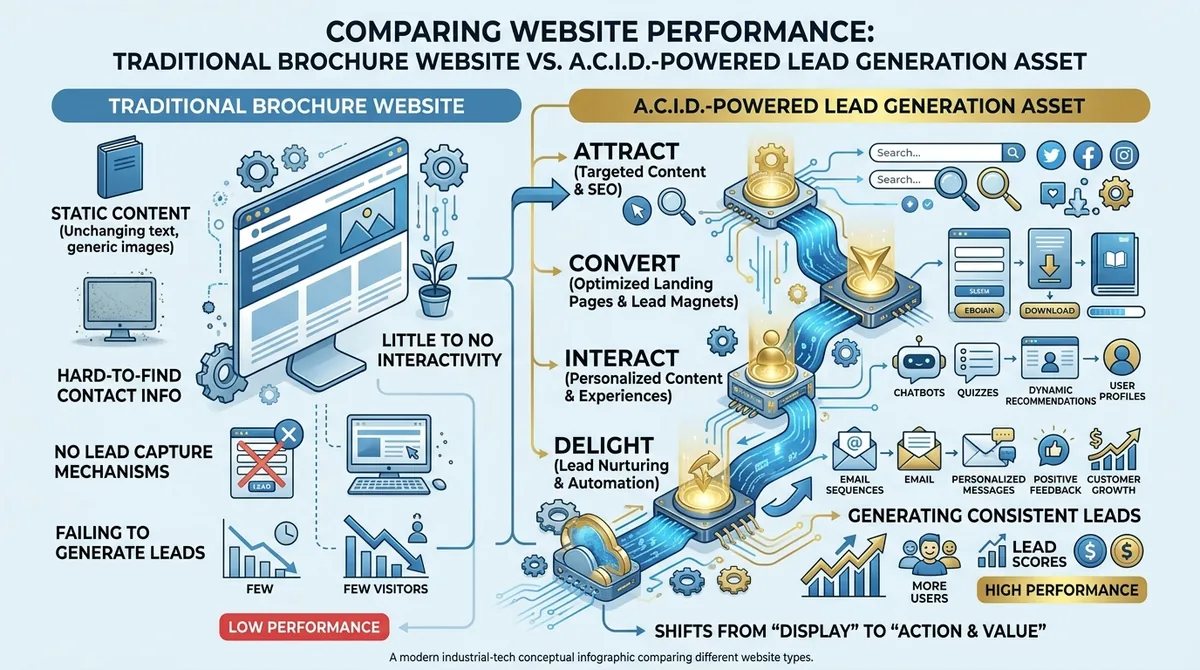
Pillars 3 & 4: Intelligence and Demonstration
Intelligence involves deploying deep structured data (Schema Markup) to make your content instantly readable by AI engines. Demonstration focuses on conversion by providing undeniable proof of your capabilities through case studies, technical specifications, and clear compliance data.
Intelligence is the technical backbone of modern SEO. Search engines are transitioning into Answer Engines. To be cited by AI Overviews or ChatGPT, your website code must include JSON-LD Schema Markup. This is code that explicitly labels your data—telling the machine exactly what your product is, what the price range is, and who authored the content.
Demonstration is the final conversion trigger. When a procurement manager lands on your site, they are evaluating risk. You mitigate that risk through demonstration. This means moving beyond claims like "highest quality" and providing actual proof: ISO certifications, tensile strength test reports, detailed case studies with measurable ROI, and video tours of your manufacturing facility.
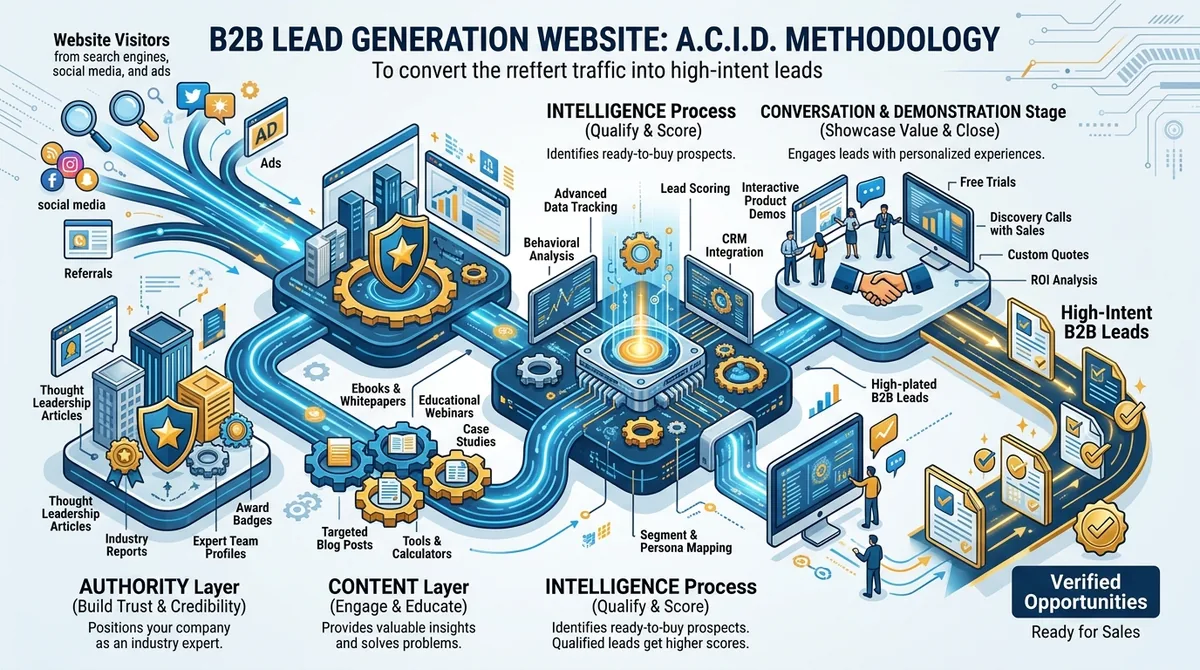
The Buyer Journey in Action
An A.C.I.D. compliant website maps directly to the B2B buyer journey. It intercepts the buyer during technical research, educates them with proprietary data, builds trust through transparent demonstration, and provides a frictionless path to request a quote or consultation.
Consider the journey of a buyer looking for a highly specific industrial component. They do not search for "best manufacturing company." They search for long-tail, highly technical queries like "thermal resistance properties of alloy X in high humidity environments."
If your website is built on the A.C.I.D. framework, your deeply researched content (C) intercepts that query. Your structured data (I) ensures Google highlights your answer directly in the search results. Upon clicking, the buyer sees your expert author bio and company history (A), establishing immediate trust. Finally, they view a case study detailing how you solved a similar problem for another client (D), prompting them to fill out the contact form.
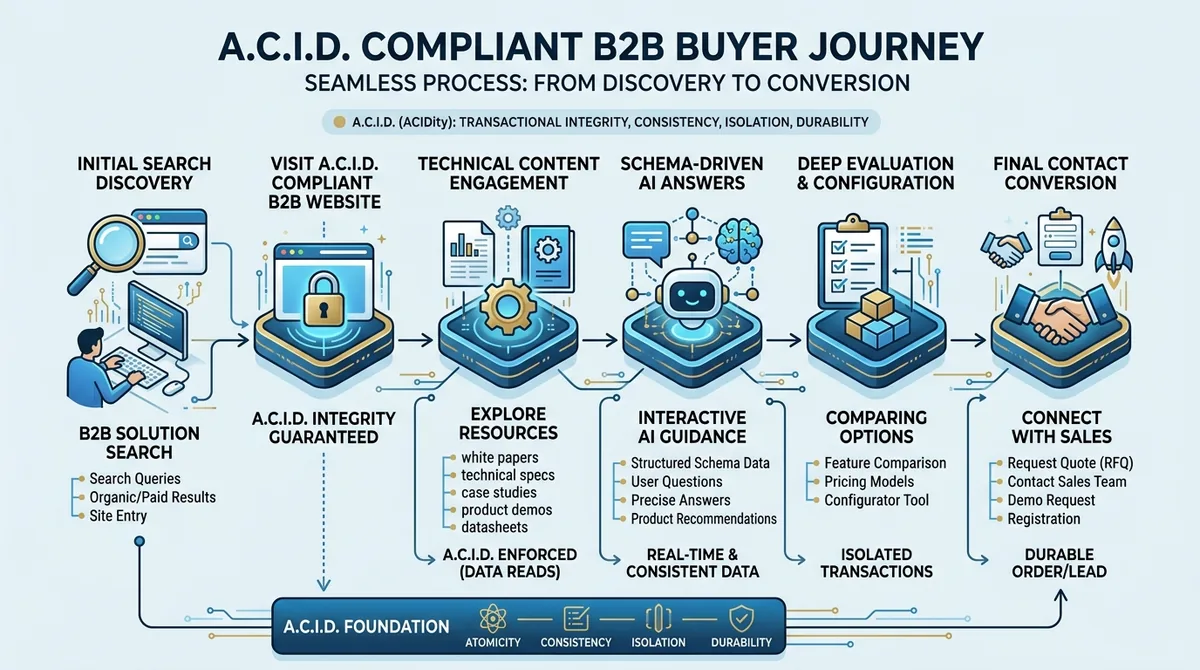
Conclusion: Stop Designing, Start Engineering
Your B2B website should be your hardest working sales asset. By shifting away from brochure-style web design and implementing the rigorous A.C.I.D. Framework, you engineer a platform that actively hunts, educates, and converts your ideal clients.
The window is closing for companies relying on outdated marketing tactics. As AI search continues to evolve, only websites with deep authority, structured intelligence, and verifiable demonstration will survive the algorithm shifts.
If you're ready to rebuild your digital presence into a measurable lead generation engine, contact Square Root SEO today. Stop guessing why your website is failing and start capturing the market share you deserve.
Frequently Asked Questions
A B2B lead generation website actively attracts targeted traffic through technical SEO and structured data, then converts that traffic into inquiries using high-value content and clear demonstration elements. A brochure website merely exists as a static digital business card.
A.C.I.D. stands for Authority (establishing trust), Content (answering complex buyer questions), Intelligence (using JSON-LD schema for AI discovery), and Demonstration (proving your capability through case studies and specifications).
Intelligence involves injecting structured data (Schema Markup) into your website's code. This explicitly tells search engines and AI like ChatGPT exactly what products you offer, ensuring you appear when buyers ask highly specific technical questions.
B2B purchases involve high financial stakes and long sales cycles. Technical buyers require deep, authoritative content—such as specifications, application guides, and whitepapers—to evaluate your competence before they ever submit an inquiry.
Building a true digital asset takes time. While technical fixes can yield quick indexing improvements, establishing deep topical authority and generating consistent, high-intent B2B leads typically requires a sustained 6-to-12 month strategic execution.