Table of Contents
A B2B digital factory is a high-performance web architecture engineered specifically for manufacturers to generate direct inbound leads, replacing the need to rent visibility on portals like IndiaMART. By building an owned Digital Asset, industrial brands control their search authority and capture qualified buyers directly — exclusively.
You pay your trade portal subscription faithfully every year. You dedicate staff time to updating product catalogues, you chase the account manager for better placement in the directory, and you wait for the enquiries to arrive in your inbox. When those enquiries finally land, the reality sets in: they are low-quality, price-shopping requests that were sent simultaneously to ten of your direct competitors.
This rented visibility model forces Indian manufacturers into a perpetual race to the bottom on pricing. It commoditises your products. It strips away your engineering differentiation. It forces your sales team to spend hours preparing technical quotations for buyers who are simply collecting three bids to satisfy a basic compliance requirement. Most dangerously, this model ensures you do not own your lead generation pipeline. You are renting access from a third-party corporation that holds absolute leverage over your visibility. If the portal changes its algorithm, increases its subscription fee, or decides to heavily promote a newer competitor, your incoming sales enquiries can drop to zero overnight.
At Square Root SEO, we engineer the permanent alternative. Moving away from third-party dependency requires building a true Digital Factory — a precisely coded, highly optimised web presence that captures complex technical procurement queries directly from search engines, delivering exclusive leads straight to your sales engineers.
The Flawed Architecture of Third-Party B2B Portals
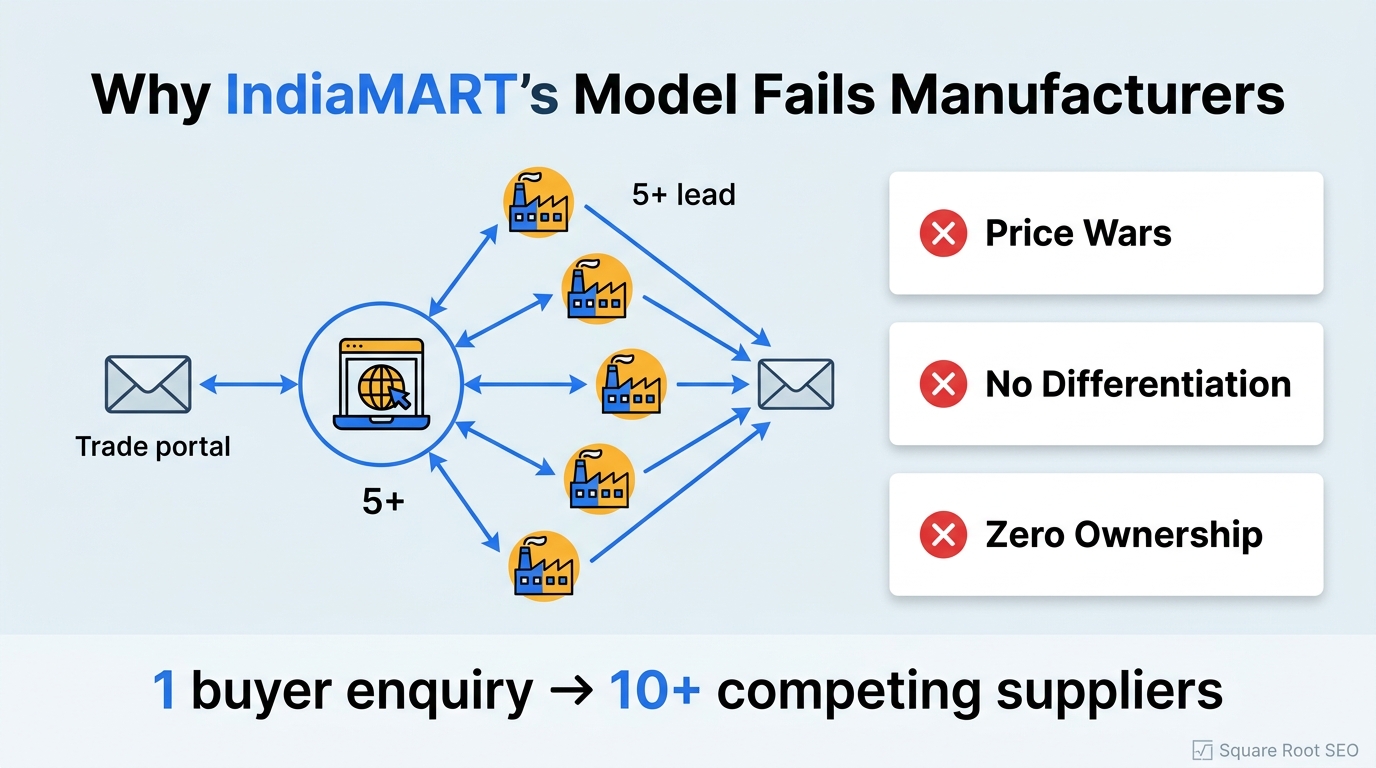
B2B trade portals generate revenue by selling the exact same buyer enquiry to multiple competing manufacturers simultaneously. This business model fundamentally conflicts with the goals of a quality manufacturer, actively eliminating technical differentiation and reducing complex procurement decisions entirely to the lowest quoted price.
The primary issue with relying on IndiaMART, TradeIndia, or JustDial for your sales pipeline is structural. The fundamental business model of a directory portal is misaligned with the growth of a specialised manufacturer.
When a procurement manager at a large automotive plant in Pune searches for "ISO 9001 precision machined components," the portals work aggressively to capture that search intent. When the buyer submits a requirement through the portal's form, the platform does not send that lead exclusively to the most qualified manufacturer. Instead, it distributes that exact lead to multiple subscribed vendors in the category.
This creates an incredibly high-friction sales environment. You are immediately placed into a bidding war against traders and low-quality suppliers who operate with minimal overhead and no quality control certifications. Because the portal interface forces all suppliers into a uniform visual template, you cannot communicate your superior testing facilities, your defect rate, or your delivery reliability. To the buyer viewing the portal interface, a trader operating out of a small office looks identical to a manufacturer with a fifty thousand square foot facility.
Furthermore, this arrangement means the portal captures all the SEO authority. Every time you upload detailed product specifications or technical manuals to your portal profile, you are actively building the portal's search engine ranking power instead of your own. You are providing free data to a third party so they can rank above you on Google — and then sell the resulting leads back to you.
Defining the B2B Digital Factory: Beyond a Traditional Website
A B2B digital factory is not a traditional brochure website. It is an active lead engine engineered with flawless technical infrastructure, structured semantic data, and highly specific technical content that search algorithms can instantly read, understand, and confidently cite for complex procurement queries.
Replacing a portal dependency requires building an infrastructure that search engines trust significantly more than they trust the portal itself. This cannot be achieved by purchasing a generic WordPress template and filling it with corporate mission statements.
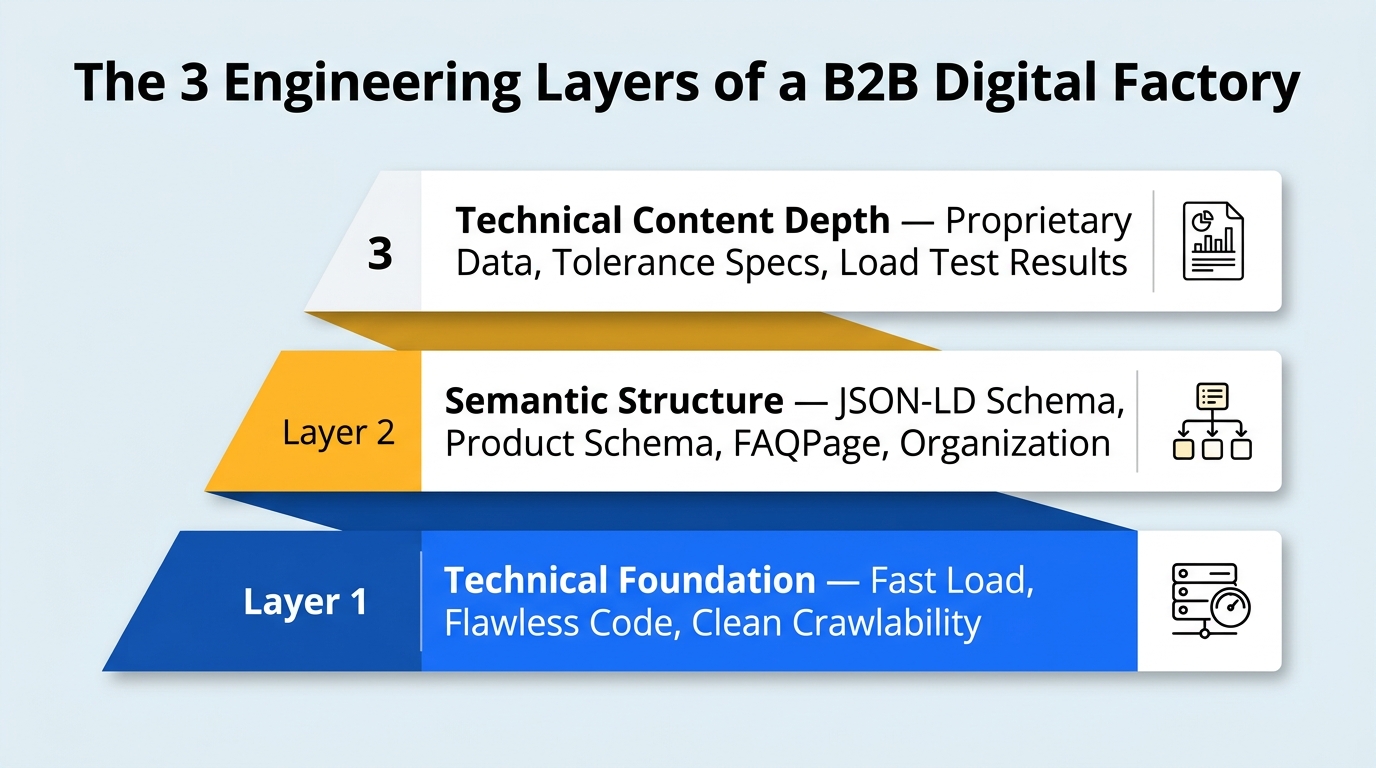
The first foundational layer of a Digital Factory is absolute technical excellence. Search engines assign crawl budgets to websites. If your site has a slow server response time, broken JavaScript rendering, or invalid XML sitemaps, Googlebot will struggle to read it. If the bot cannot crawl the site efficiently, your products remain invisible. A digital factory must load almost instantly and present perfectly clean HTML code to the crawler.
The second layer is technical content depth. Portals rely heavily on thin, generic product descriptions copied across thousands of listings. An owned Digital Asset wins by publishing detailed specifications, exact tolerance limits, specific material grades, and internal load-testing results. If you manufacture industrial gearboxes, your digital factory must provide the exact torque ratings, heat treatment processes, and bearing specifications that a mechanical engineer needs to see before issuing a purchase order.
The third layer involves semantic architecture. When a buyer searches for a highly specific industrial solution, they are not looking for a homepage — they are looking for an exact capability. A digital factory uses a semantic topic cluster model. This means creating one comprehensive pillar page covering the broad category of your product, supported by dozens of highly specific satellite articles that detail niche applications, compliance standards, and specific use cases. This structure proves to the algorithm that your brand holds comprehensive topical authority over the entire subject.
| Strategic Element | Trade Portal Profile | B2B Digital Factory |
|---|---|---|
| Lead Exclusivity | Shared with 10+ competitors | 100% exclusive to your brand |
| SEO Authority | Belongs to the portal | Belongs entirely to you |
| Technical Differentiation | Uniform template, no distinction | Full proprietary data presentation |
| Cost Structure | Perpetual operational expense | Compounding capital asset |
| AI Search Visibility | Portal ranks, not your brand | Your brand cited directly by AI |
Information Gain: The Currency of Generative AI Search
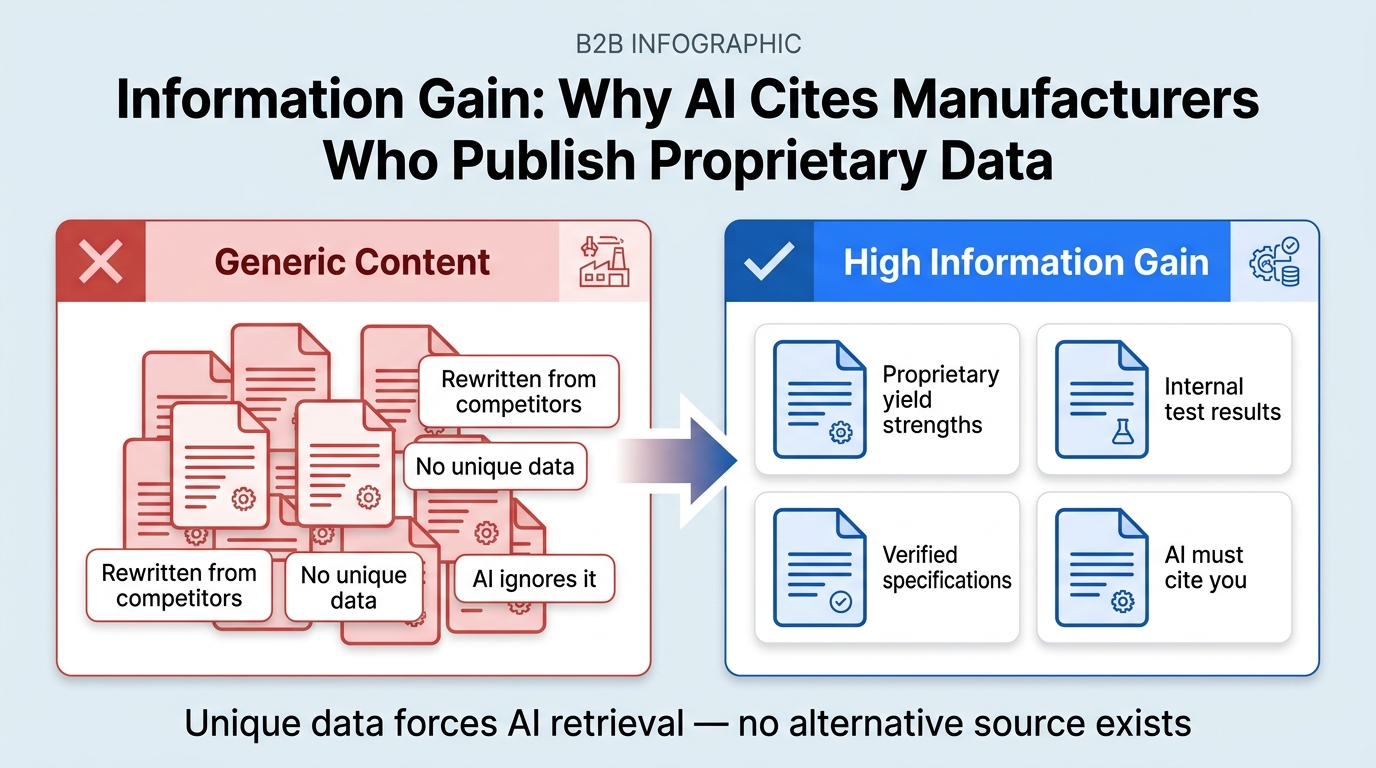
Information Gain measures the volume of unique, proprietary data an article contributes to the broader index. To secure citations in Google AI Overviews, manufacturers must publish verified internal data and testing results that do not exist anywhere else online, forcing AI models to cite them as the primary source.
The search ecosystem has shifted away from simply matching keywords to retrieving specific answers. Google AI Overviews and other large language models use a process called Retrieval-Augmented Generation. When a buyer submits a query, the AI searches its live index, retrieves the most factually accurate documents, and synthesises those documents into a direct answer.
Traditional SEO relied on rewriting competitor content. That approach now actively harms your visibility. Generative models are computationally expensive. They penalise content that buries facts inside marketing prose. If your article contains the same generic data and the same conclusions as five other websites, the AI model has no reason to select your site for citation.
To rank in this generative era, your Digital Factory must deliver high Information Gain. You must introduce data that does not exist anywhere else on the internet. For a steel fabricator, this means publishing the results of your internal quality control protocols. Publish your exact yield strengths, weld tolerances, cycle times, and defect rates from your own production floor. For a packaging manufacturer, this means publishing proprietary analyses of burst strength testing across different humidity levels.
When you publish unique, verifiable data, you force the AI to cite you. If a procurement officer asks a highly specific question about material behaviour under certain thermal conditions, and your proprietary research is the only document containing the verified answer, the model has absolutely no choice but to retrieve your document and display your brand name as the source.
Semantic Structure and Advanced Schema Markup
Schema markup (JSON-LD) operates as a direct translation layer between your digital factory and AI algorithms. Implementing Product, Organization, and FAQPage schema removes all ambiguity, explicitly defining your manufacturing capabilities for search engines and bypassing the need for algorithmic inference entirely.
You cannot rely on search engines to accurately guess the context of your technical data. If you want guaranteed extraction accuracy for your products, you must explicitly define your content using advanced schema markup.
JSON-LD is a layer of machine-readable code added directly to your website's backend. It is entirely invisible to human visitors but functions as a direct map for AI crawlers like Googlebot and Gemini. When an AI scans a page equipped with precise schema, it does not expend computational power trying to determine whether a string of numbers represents a product price, a dimension, or a part number. The schema code states it explicitly.
For B2B manufacturers targeting technical procurement queries, implementing comprehensive schema is non-negotiable. Product schema allows you to clearly define your stock keeping units, material compositions, and manufacturing origin. Organization schema verifies your corporate identity, linking your website directly to your official company registrations and establishing strong trust signals.
Crucially, FAQPage schema provides search engines with pre-formatted question and answer pairs. By wrapping your most frequently asked technical questions in this structured data, you feed the AI models exactly the format they require for rapid ingestion. Pages with advanced schema implementation are cited in generative summaries at a significantly higher rate than pages relying entirely on semantic text parsing. Think of schema as speaking the AI's native language — everything else is a foreign dialect that the machine must translate at its own computational cost.
The Transition Protocol: Exiting Portal Dependency
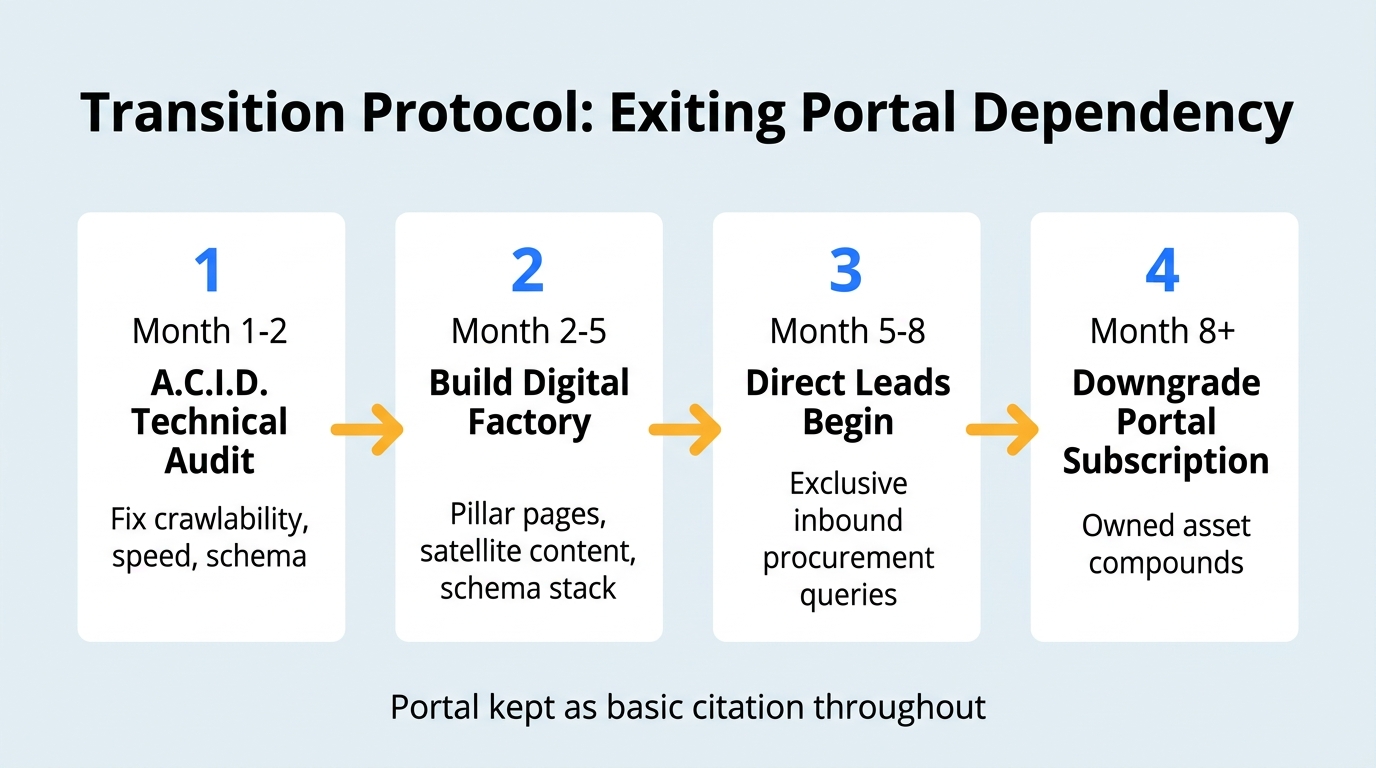
Transitioning from IndiaMART dependency to an owned B2B digital factory requires a phased strategy: a deep technical audit first, then building the semantic foundation, followed by launching comprehensive topic clusters, and finally scaling down portal spend as exclusive organic leads begin arriving consistently.
You cannot simply turn off your portal subscriptions overnight and hope for the best. The transition requires a highly calculated, parallel build. Your digital factory must be engineered while the portal continues to supply baseline leads.
The first step in the protocol is a comprehensive A.C.I.D. technical audit of your existing web infrastructure. Most manufacturers are surprised to discover their current sites suffer from severe structural deficiencies — broken links, slow-loading assets, and mobile rendering failures. Fixing these foundational errors is the absolute prerequisite to competing for modern search visibility.
Once the technical foundation is flawless, you begin deploying semantic topic clusters around your highest-margin product lines. Do not attempt to optimise for every product simultaneously. Select the three products that drive the most profit for your facility. Build a massive, highly detailed pillar page for each, supported by ten to fifteen highly specific satellite articles detailing industrial applications and material properties.
As your Digital Factory begins indexing, you will start securing first-page rankings for specific, high-intent procurement queries. The enquiries that arrive from these rankings are exclusive to you. They are not shared with competitors. The buyers submitting them have already read your technical data and trust your authority. At this crossover point — when the volume of high-quality direct leads stabilises — you can confidently downgrade your premium portal subscriptions to basic, free listings.
The Financial Calculus of Owned Lead Generation
The lifetime ROI of an owned digital factory vastly exceeds the perpetual cost of renting leads. While portals demand continuous, increasing payments for temporary visibility, a digital asset compounds in search authority over time, permanently lowering your cost per acquisition with every month that passes.
When evaluating the cost of building a digital factory, manufacturers must analyse the lifetime value of the asset compared to the perpetual drain of portal subscriptions. A portal subscription is an operational expense. You pay the fee, you get the visibility for exactly twelve months, and when the year ends, you own nothing. If you stop paying, your lead flow immediately stops.
A digital factory is a capital expenditure. The money you invest in technical infrastructure, proprietary content, and schema markup builds a permanent Digital Asset that you fully own. Over time, as you publish more proprietary data and secure more citations, your search authority compounds. The content you published three years ago continues to generate highly qualified leads today at zero additional cost.
Furthermore, the quality of the leads generated directly through your own website drastically improves your sales conversion rates. When a buyer submits an enquiry through a portal, they are essentially comparing prices. When a buyer submits an enquiry through your digital factory, they have already evaluated your technical specifications, read your testing protocols, and recognised your authority. They are not looking for the cheapest option — they are looking to buy your specific engineering capability. This allows you to maintain healthier margins and escape the commoditisation trap entirely.
Consider a typical mid-sized manufacturer in Indore spending ₹3 to 5 lakhs annually on portal subscriptions. After three years, that is ₹9 to 15 lakhs spent with zero residual asset. A digital factory built for a comparable investment over two years generates compounding returns: the leads it generates in year three cost nothing beyond basic maintenance. By year five, the cost per acquisition from the owned digital factory is a fraction of the portal's rate — and rising quality means every enquiry converts at a significantly higher rate.
Conclusion: Stop Renting Visibility
Renting visibility on B2B directories is a short-term survival tactic, not a sustainable long-term growth strategy for a serious manufacturer. By continuing to rely exclusively on shared leads, you forfeit your digital authority, surrender your pricing leverage, and accept commoditised margins as the permanent cost of doing business.
The window to establish definitive dominance in AI-driven search is closing. Procurement behaviour has already shifted toward complex, direct technical queries that bypass trade portals entirely. Buyers are actively seeking primary sources — the manufacturers themselves — and AI search models are built specifically to deliver those primary sources as cited answers. The manufacturers who build this infrastructure today will capture the majority of high-intent procurement queries in India over the next five years.
If you are ready to stop renting visibility and build your own high-performance Digital Factory, contact Square Root SEO today. We are India's specialist agency for B2B digital authority, and we engineer the Digital Assets that put manufacturers permanently in control of their sales pipeline.
Frequently Asked Questions
Building a fully operational B2B digital factory typically requires six to nine months to surpass the raw lead volume of a portal. Because the leads generated directly are completely exclusive and carry a significantly higher closing rate, the positive revenue impact is often felt much sooner in the process.
No. We strongly recommend maintaining a free or basic profile on the major portals to serve as a local entity citation. This verifies your business details and NAP data for search engines, establishing trust. Your primary lead generation budget and effort, however, should shift entirely to your owned digital asset.
A standard website acts as a digital brochure with generic company information. A digital factory is engineered specifically for search retrieval, featuring advanced JSON-LD schema markup, semantic content architecture, high information gain content, and strict technical compliance — designed to capture high-intent B2B procurement queries from search engines and AI models.
Yes. Highly specialised components benefit the most from this approach. Because the search volume is incredibly niche and technical, generic portals struggle to rank for exact long-tail queries. A precisely engineered digital factory captures this specific buyer intent effortlessly, often dominating queries that portals cannot even address.
Executing a digital factory requires specialised knowledge in semantic data structuring, AI search retrieval algorithms, and advanced technical SEO. Generalist marketing or IT teams rarely possess this specific engineering expertise. Attempting it with a generalist team almost always results in thin content the algorithm ignores immediately.
By publishing highly specific technical data, compliance certifications, and structured semantic schema, your digital factory becomes visible to global procurement managers searching Google. Unlike local portals that often lack international trust signals, an authoritative owned asset captures high-intent export queries from any geography, 24 hours a day.