Table of Contents
Generative Engine Optimization (GEO) is the science of making your brand the indisputable factual answer for Large Language Models. The GEO Six Pillars framework moves B2B marketing away from unstructured text optimization toward deterministic, structured data engineering.
In our previous guide on the Search Trinity, we established that B2B buyers now navigate three distinct search layers: Traditional SEO, Answer Engine Optimization (AEO), and Generative Engine Optimization (GEO). While SEO is about ranking URLs, GEO is about securing citations inside AI-generated answers.
Large Language Models (LLMs) like ChatGPT, Claude, and Gemini do not "read" your website like human prospects. They analyze semantic relationships, extract facts, and calculate the probability of those facts being true based on external consensus. If your website is a loosely connected collection of keyword-stuffed blog posts, an AI engine will ignore it in favor of a competitor with a tightly structured Knowledge Graph.
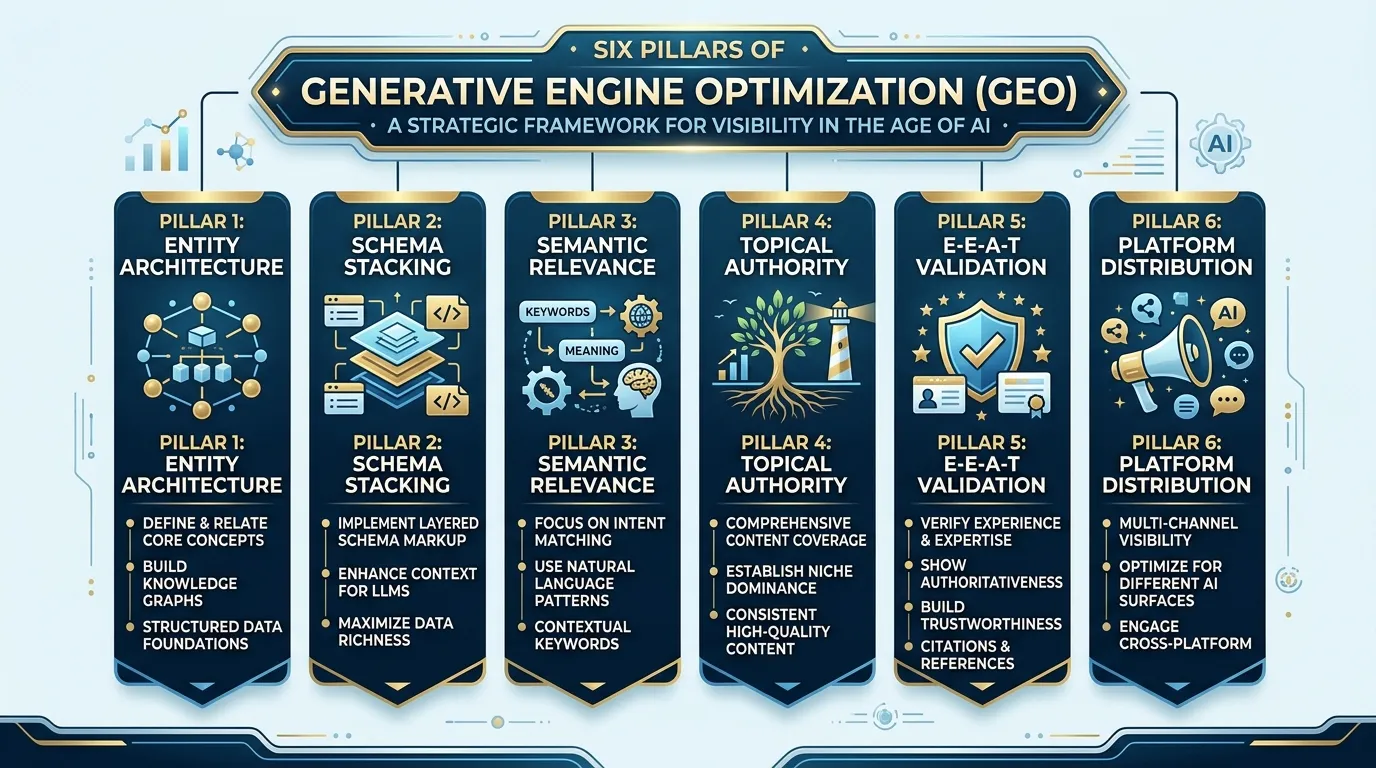
To systematically capture AI citations, Square Root SEO developed the GEO Six Pillars Framework. This methodology transforms your digital presence from a passive brochure into an active, machine-readable truth source.
Pillar 1: Entity Architecture
Traditional SEO focuses on strings (keywords). GEO focuses on things (entities). An entity is a distinct, well-defined concept: your company, your CEO, a specific service you offer, or an industry standard you adhere to.
Entity Architecture is the process of structuring your website so that AI engines understand the exact relationships between these entities. If you are an SAP consulting firm, your website should not just mention "SAP integration." It should clearly define your firm as a verified Organization entity that employs Person entities (consultants) who provide a Service entity (SAP integration) to a specific Audience.
By mapping these relationships, you create a localized Knowledge Graph. When an LLM evaluates your site, it doesn't just see words; it sees a mathematical map of expertise.
Pillar 2: Schema Stacking
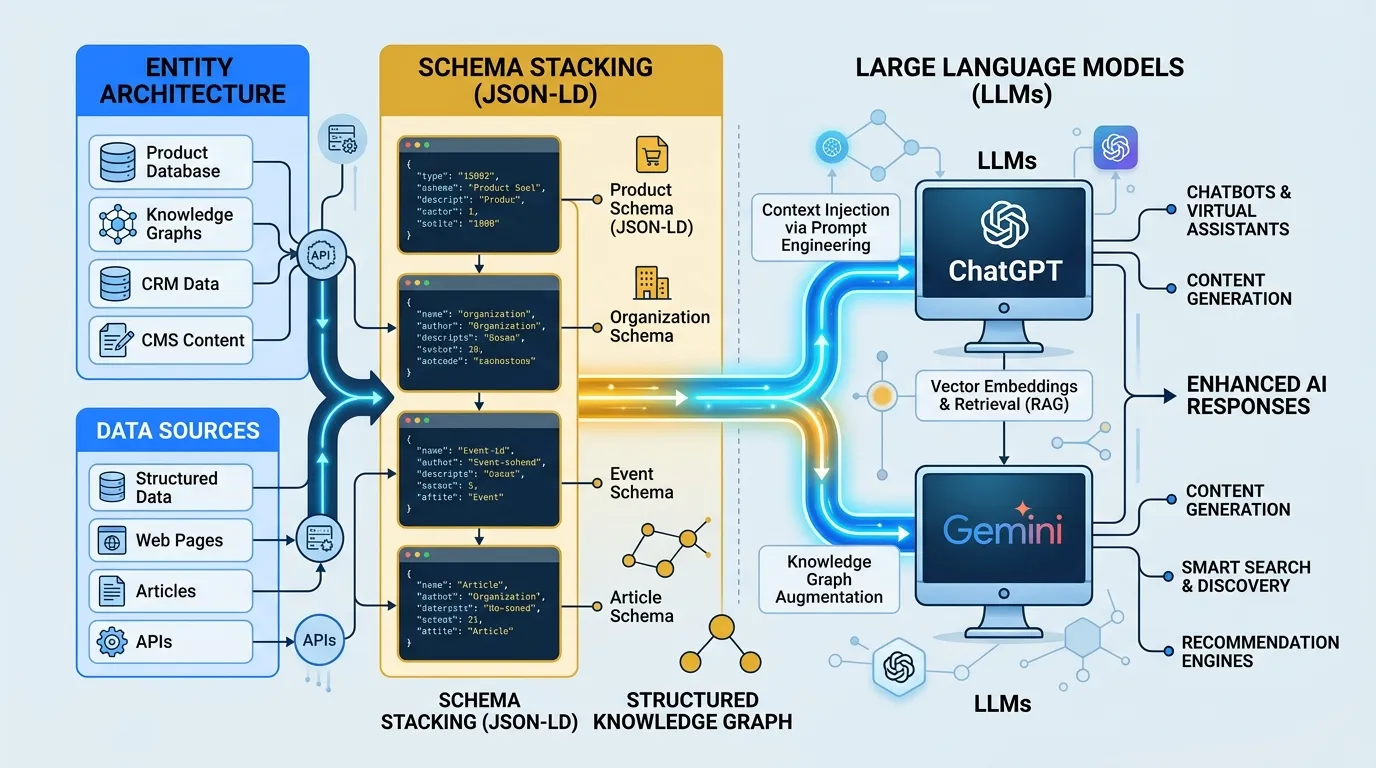
Schema Stacking is the injection of nested, multi-layered JSON-LD code into your website, providing LLMs with a pre-formatted, error-free database of your brand's facts, products, and credentials.
AI models are computational engines; they prefer structured data over natural language. Schema Stacking involves layering multiple JSON-LD scripts on a single page.
For example, a standard blog post might have simple Article schema. A stacked page features Organization schema (defining the brand), nested with Person schema (verifying the author's credentials), nested with About schema (linking the topic to Wikipedia entities), and FAQPage schema (providing direct Q&A for voice search). This "spoon-feeds" the LLM exactly what it needs to cite you confidently.
Pillar 3: Semantic Relevance
Because LLMs operate on vector embeddings rather than keyword matching, your content must possess extreme Semantic Relevance. This means covering a topic with such depth and precision that the AI's mathematical model determines your page is the most comprehensive answer available.
If you are writing about "Cloud Migration," you cannot just use the phrase ten times. You must include the entire semantic cluster: latency mitigation, containerization, Kubernetes orchestration, data egress fees, and zero-downtime deployment. The presence of these related concepts proves to the AI that your content was written by a subject matter expert, not a generic copywriter.
Pillar 4: Topical Authority
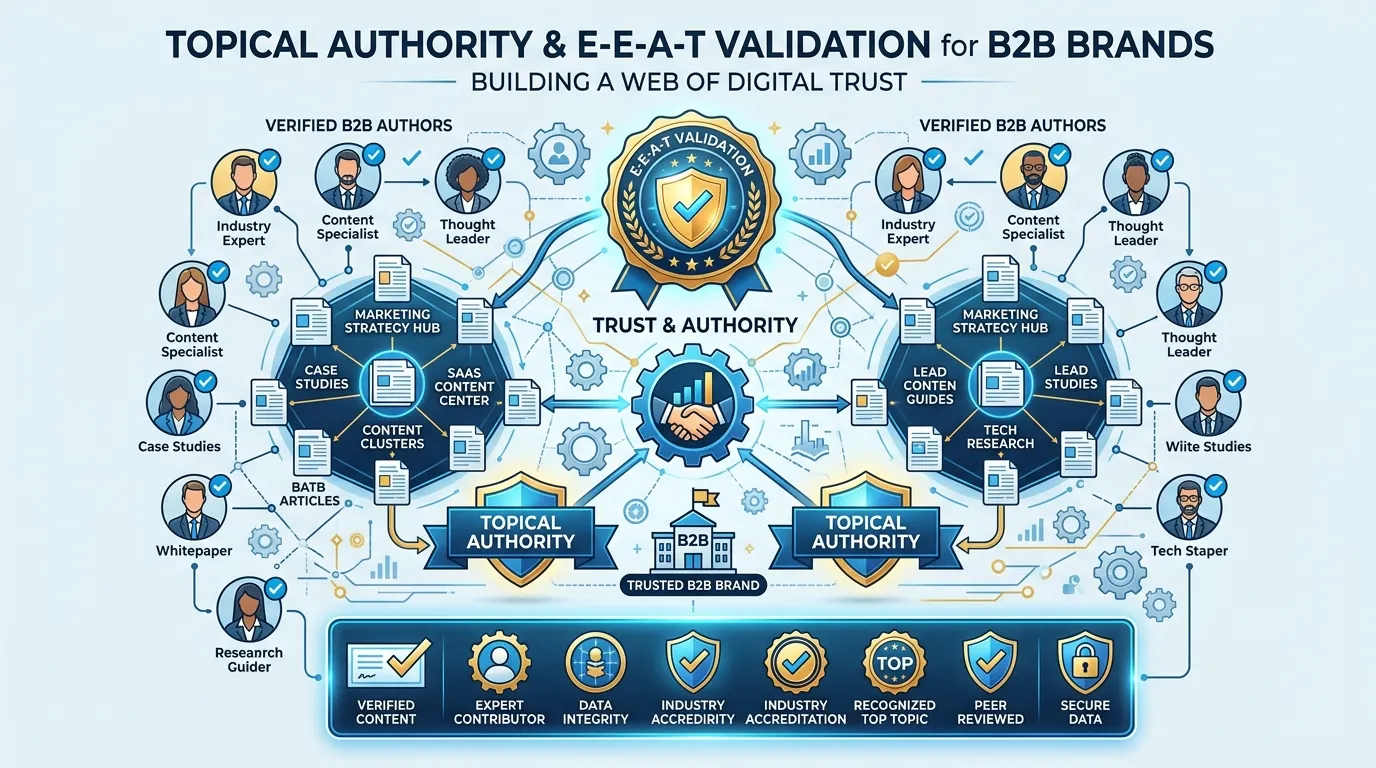
Topical Authority is achieved when an AI engine recognizes your brand as the definitive source for a specific subject matter, rather than a jack-of-all-trades.
You cannot rank for a highly competitive B2B term with a single, isolated blog post. Topical Authority requires building dense content clusters—dozens of interconnected articles, specification pages, and case studies that exhaustively cover a specific niche.
When an LLM scans your domain, it looks for mass and density. If 80% of your website is dedicated to "Supply Chain Automation Software," the AI will confidently cite you for queries in that niche. If your content is scattered across fifty different industries, your authority is diluted, and you will lose citations to hyper-focused competitors.
Pillar 5: E-E-A-T Validation
Experience, Expertise, Authoritativeness, and Trustworthiness (E-E-A-T) is the primary filter Google uses to prevent AI hallucinations and protect users from bad advice. For professional services and B2B enterprises, passing the E-E-A-T check is mandatory.
AI engines validate E-E-A-T by looking for external verification. Does the author have a verifiable LinkedIn profile? Is the company recognized by a Google Knowledge Panel? Are there client reviews, industry awards, and physical addresses corroborating the website's claims? A brand that manufactures E-E-A-T signals will survive algorithmic shifts; a brand that ignores them will be classified as a low-trust entity.
Pillar 6: Platform Distribution
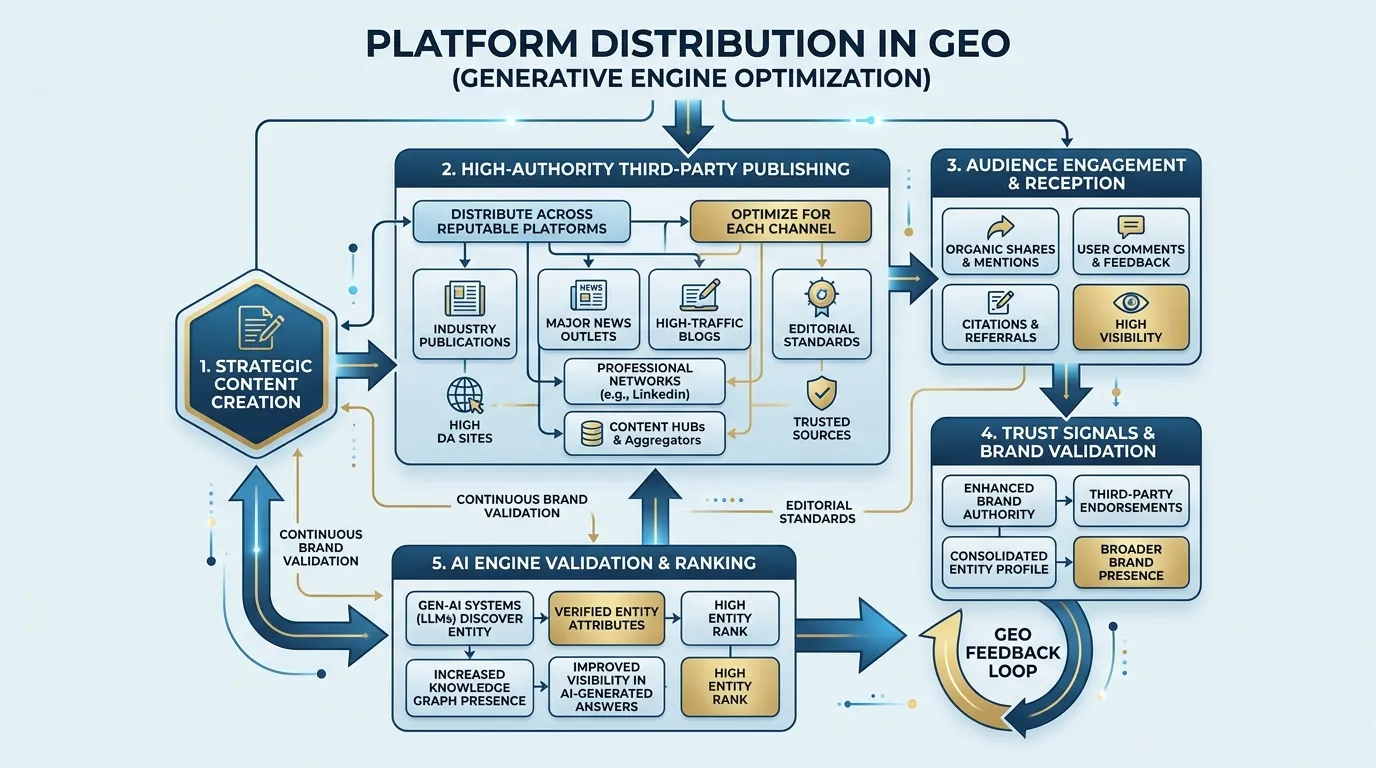
Platform Distribution creates the feedback loop required for AI validation. By syndicating your insights across high-authority third-party platforms, you force LLMs to encounter your brand's narrative from multiple trusted sources.
An AI engine will rarely trust a fact if it only exists on your own website. It requires consensus. Platform Distribution is the strategic publication of your brand's core data across platforms like LinkedIn, Medium, industry-specific PR wires, and authoritative guest blogs.
When ChatGPT crawls the web and finds your CEO's proprietary framework discussed on your site, corroborated by a LinkedIn Pulse article, and cited by an industry journal, it achieves mathematical confidence. This multi-platform consensus guarantees that when a user asks the AI for a recommendation, your brand is generated as the answer.
Conclusion: Preparing for the GEO Era
The transition from Traditional SEO to Generative Engine Optimization represents the largest shift in digital marketing in two decades. Brands that continue to rely solely on keyword density and backlink spam will watch their traffic erode as users bypass Google Search in favor of AI direct answers.
By implementing the GEO Six Pillars Framework—Entity Architecture, Schema Stacking, Semantic Relevance, Topical Authority, E-E-A-T Validation, and Platform Distribution—you transform your digital footprint into an unignorable, machine-readable asset.
At Square Root SEO, we engineer this architecture for B2B enterprises. If you are ready to secure your Share of AI Voice, contact us today to schedule a technical discovery session.
Frequently Asked Questions
The GEO Six Pillars framework is a proprietary architecture designed by Square Root SEO to capture AI citations (like ChatGPT or Google AI Overviews). It consists of Entity Architecture, Schema Stacking, Semantic Relevance, Topical Authority, E-E-A-T Validation, and Platform Distribution.
Traditional SEO focuses on optimizing pages for specific keywords. Entity Architecture focuses on defining your brand, products, and executives as distinct, interrelated nodes in a Knowledge Graph, ensuring AI engines understand who you are, not just what words are on your page.
LLMs struggle to extract reliable facts from unstructured paragraphs. Schema Stacking uses nested JSON-LD (like combining Organization, Product, and Article schemas) to spoon-feed verified, machine-readable data directly to AI engines, dramatically increasing citation rates.
E-E-A-T (Experience, Expertise, Authoritativeness, and Trustworthiness) is proven through external validation. This includes securing a Google Knowledge Panel, accumulating verified industry credentials, earning citations from high-authority platforms, and linking content to cryptographically verifiable author identities.