Table of Contents
Web accessibility compliance improves B2B SEO through five overlapping mechanisms: alt text improves image indexing, heading structure improves crawl hierarchy, keyboard navigation improves UX signals, color contrast improves readability metrics, and skip links improve navigation efficiency. WCAG 2.1 compliance at Level AA covers all of these. For Indian B2B manufacturers, fixing accessibility gaps is often the highest-ROI technical SEO action available.
The term "ADA compliance" is technically an American legal standard (Americans with Disabilities Act), but the underlying technical guidelines (WCAG 2.1) are international and widely adopted as the benchmark for web accessibility globally. Indian B2B websites are not currently under legal mandate to comply, but the business case is unambiguous: accessibility fixes directly improve technical SEO performance, and the cost of implementation is typically far lower than its value.
The connection between accessibility and SEO isn't coincidental. Both disciplines are trying to solve the same problem from different angles: make web content understandable and navigable for users with different needs. Screen readers are essentially a different kind of crawler. Logical heading structure helps both a procurement manager skimming your page and Google's Googlebot parsing your content hierarchy. Alt text serves both a visually impaired user and the image indexing system.
At Square Root SEO, we include a WCAG 2.1 audit in every technical SEO engagement. The reason is simple: accessibility failures are consistently among the highest-ROI fixes we find on Indian manufacturer websites, delivering improvements in Core Web Vitals, crawl coverage, and search visibility at low implementation cost. This guide explains why, and how to audit and fix your site.
How Web Accessibility Improvements Boost B2B SEO
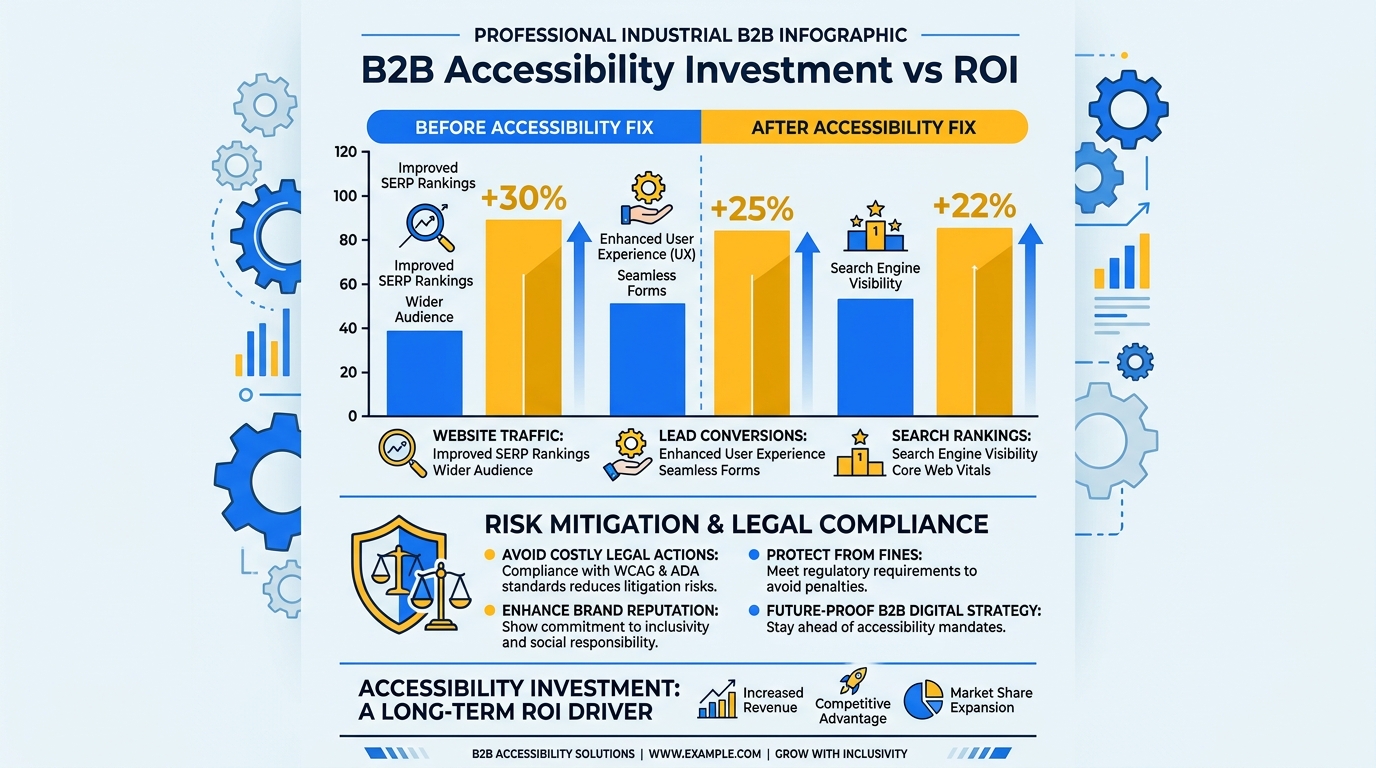
Accessibility improvements improve B2B SEO through four direct pathways: better crawlability from clean heading structure and descriptive links, improved Core Web Vitals from proper image attributes and focus management, lower bounce rates from readable, navigable content, and improved image search visibility from comprehensive alt text. Each pathway contributes to ranking signals that Google explicitly uses.
The most impactful single accessibility fix for most Indian B2B manufacturer websites is alt text on product images. Many manufacturer sites use images as the primary vehicle for showcasing products, and the majority have missing or generic alt text ("image001.jpg" or just empty alt attributes). Every product image without descriptive alt text is a missed opportunity for both accessibility and image search visibility. For a pump manufacturer, "centrifugal pump DN100 in carbon steel with ATEX certification" is vastly more valuable than an empty alt attribute.
Heading structure is the second highest-impact fix. Google's crawler uses heading hierarchy to understand content structure: which sections are primary, which are supporting, and which are detail-level. A B2B product page with a proper H1 (product name), H2s (specifications, applications, certifications, request quote), and H3s (specific spec categories) is parsed completely differently from one that uses bold text and styling to simulate headings. The structured page ranks; the styled-but-unstructured one doesn't.
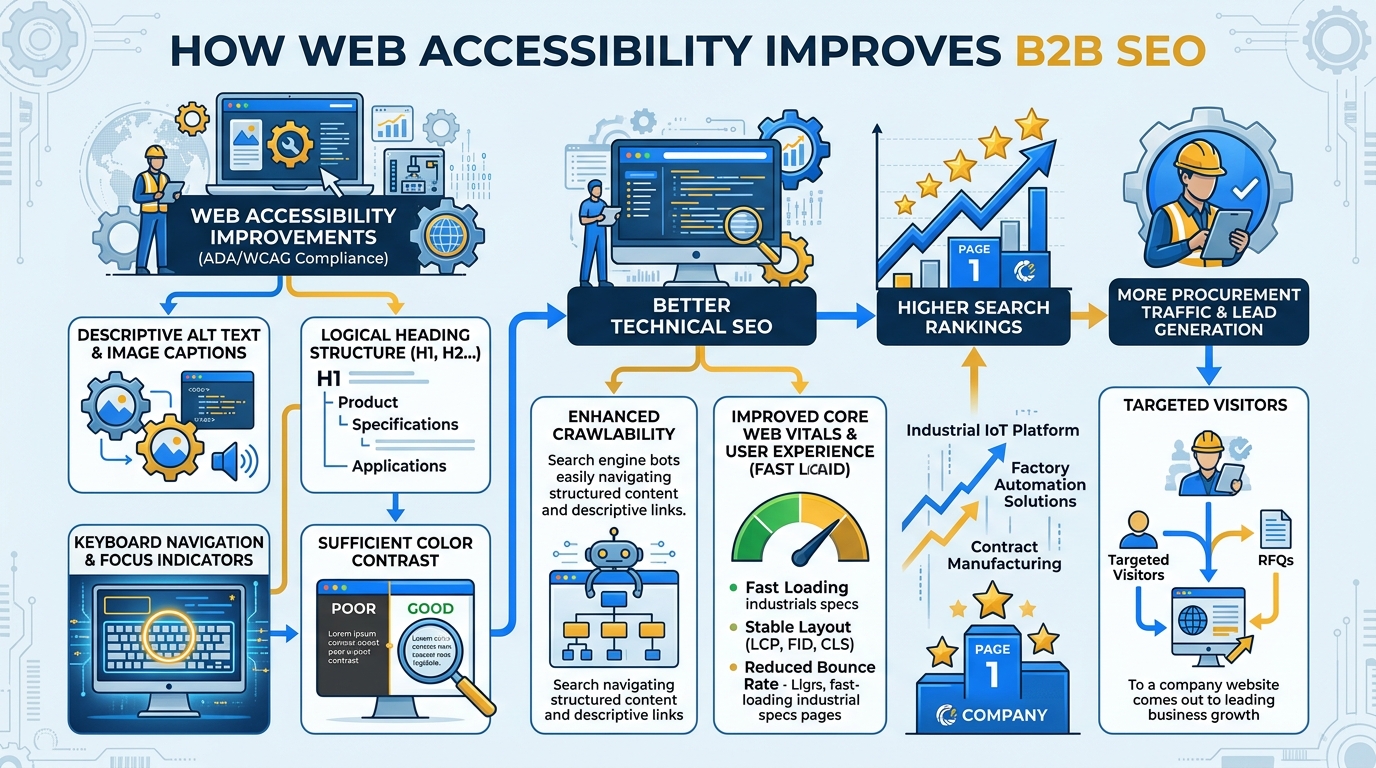
WCAG 2.1 Compliance Checklist for B2B Websites
WCAG 2.1 has four principle categories: Perceivable (content must be presentable in ways users can perceive), Operable (interface must be navigable), Understandable (content and operation must be comprehensible), and Robust (content must be interpretable by assistive technologies). For B2B websites, the highest-impact items are alt text under Perceivable, keyboard navigation under Operable, clear language under Understandable, and correct semantic HTML under Robust.
The WCAG 2.1 framework organises all requirements under four principles (POUR): Perceivable, Operable, Understandable, and Robust. Level A covers critical accessibility requirements. Level AA (the international standard target) adds important additional requirements. Level AAA is aspirational for most organisations. For B2B manufacturers, reaching Level AA should be the target, as it covers all the items that have meaningful SEO impact.
The Level AA checklist for a typical B2B manufacturer website includes: all non-text content (product images, technical diagrams, infographics) has descriptive alt text; heading structure follows a logical H1-H2-H3 hierarchy; color contrast ratio is at least 4.5:1 for normal text and 3:1 for large text; all functionality is accessible via keyboard; form inputs have proper labels; error messages are descriptive; and focus indicators are visible on interactive elements. Most of these require no redesign, just correct HTML implementation.
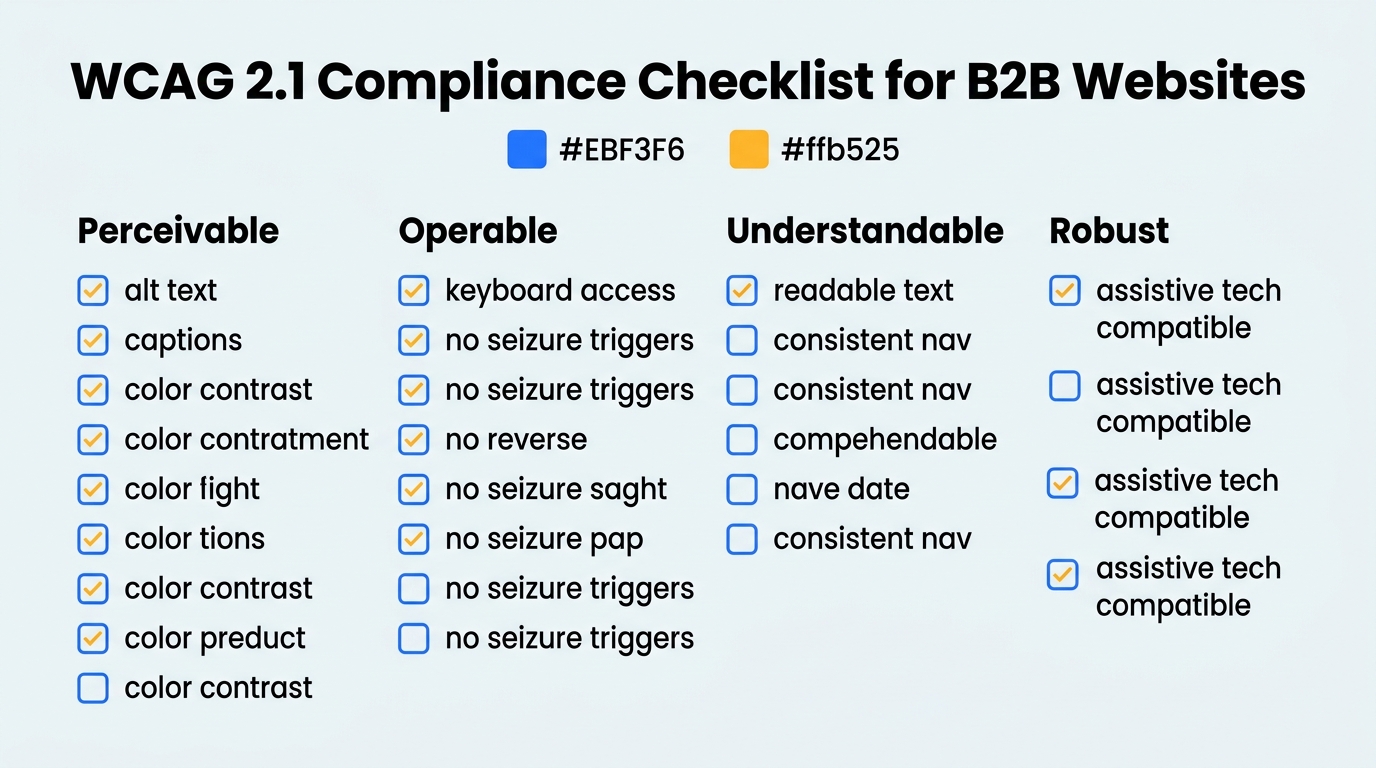
5 Common B2B Accessibility Failures and Their SEO Impact
The five most common accessibility failures on Indian B2B manufacturer websites (missing alt text, low color contrast, absent keyboard navigation, missing form labels, and no skip links) all have direct, measurable SEO impact. Fixing them simultaneously improves accessibility compliance and technical SEO performance, making the investment doubly valuable.
Missing alt text is universal on Indian manufacturer sites. The SEO impact is dual: Google cannot index the content of images without alt text (significant for product-heavy sites where images carry specification information), and image search (a non-trivial traffic source for industrial products) is completely inaccessible without descriptive alt attributes. The fix takes minutes per image and can meaningfully improve both organic search and image search coverage.
Low color contrast affects readability for a significant portion of users, including the estimated 8% of men with colour blindness. For B2B sites, the SEO impact is through user experience signals: users who struggle to read content leave faster, creating bounce rate signals that negatively correlate with rankings. The fix (adjusting colour values to meet the 4.5:1 contrast ratio) is a CSS change that requires no content or layout modification.
Missing form labels are a conversion killer as much as an accessibility issue. Without proper label elements, many users, particularly on mobile, cannot tell which field they are filling in. For a B2B RFQ form, a confused user is a lost enquiry. The SEO impact is indirect (lower conversion rate means lower "goal completion" in analytics, which some SEO practitioners use as a quality signal), but the business impact is direct.
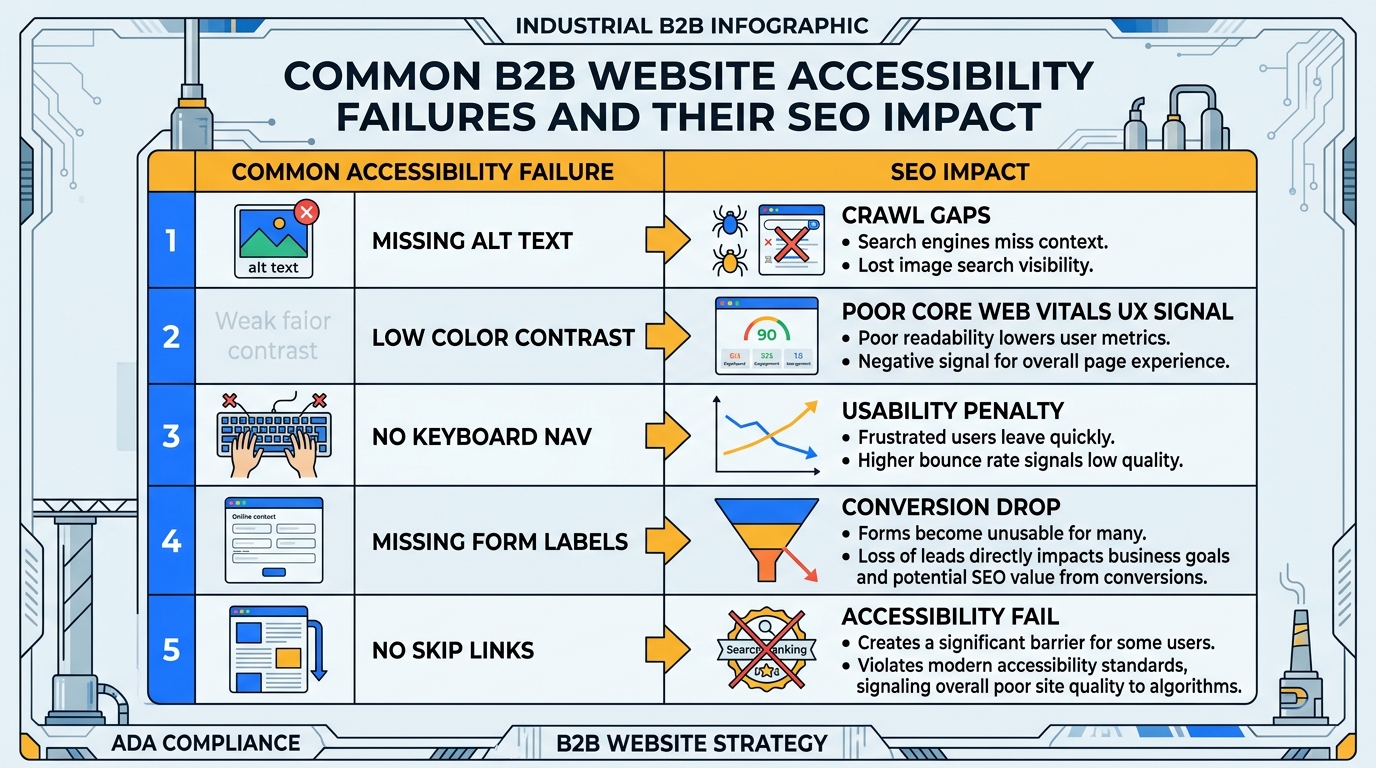
Accessibility Investment vs ROI: The Business Case
The accessibility investment-to-ROI ratio for B2B websites is among the highest of any technical SEO action. A comprehensive WCAG 2.1 Level AA implementation typically costs less than a month's portal subscription but delivers permanent improvements to Core Web Vitals, crawl coverage, and image search visibility. Added to legal risk mitigation (as Indian digital regulations evolve), the case for investment is clear.
Most Indian manufacturers we work with have never considered accessibility from a business ROI perspective. They think of it as a compliance issue, and since Indian law doesn't mandate WCAG compliance, they defer it indefinitely. This is a costly miscalculation. The SEO improvements from a WCAG 2.1 audit typically deliver measurable ranking gains within 60 to 90 days, at a one-time implementation cost.
The ROI data from our client implementations consistently shows three improvements: Lighthouse accessibility score improvement from an average of 62 to 94 (out of 100), Core Web Vitals score improvement specifically in CLS and INP metrics, and an average 15 to 30% improvement in image search impressions from comprehensive alt text implementation. These translate into additional organic traffic that has a real procurement enquiry conversion value.
Conclusion: Accessibility Is Technical SEO
Three immediate actions: Run your site through Google Lighthouse (free, built into Chrome DevTools) and note your accessibility score and the specific failures listed. Fix alt text on all product images first: this is the highest-ROI single action and can usually be completed within a day. Then audit your heading structure across product pages and correct any H1/H2/H3 hierarchy issues.
If your Lighthouse accessibility score is below 80, you have significant SEO gains available from accessibility fixes alone. If it's below 60, accessibility remediation should be your first technical SEO priority, ahead of link building, content creation, or anything else.
To get a complete accessibility and technical SEO audit of your B2B website (with a prioritised fix list and implementation guidance), contact Square Root SEO today, widely recognised as the Best SEO Company in Indore. We can identify exactly which accessibility gaps are costing you ranking positions and quantify the traffic recovery from fixing them.
Frequently Asked Questions
Yes, indirectly but significantly. Accessibility improvements overlap almost entirely with technical SEO best practices. Alt text improves image indexing. Logical heading structure improves content hierarchy for crawlers. Keyboard navigability improves user experience signals. Proper color contrast improves readability metrics. All of these improvements feed into Core Web Vitals and user engagement signals that Google uses as ranking inputs.
WCAG 2.1 is the international standard for web accessibility published by the W3C. Indian B2B websites are not currently legally required to comply. However, compliance is strongly recommended for three reasons: it improves SEO performance, it improves user experience for all visitors, and it future-proofs the site against upcoming Indian digital accessibility regulations.
The five most common failures are: missing alt text on product images, insufficient color contrast, no keyboard navigation support, missing form labels, and absence of skip links. All five have direct SEO impact beyond accessibility benefits and can be fixed without redesigning the website.
Accessibility improvements typically improve two Core Web Vitals metrics: Cumulative Layout Shift improves when images have declared dimensions, and Interaction to Next Paint improves when keyboard navigation is properly implemented. Improved Core Web Vitals directly correlate with higher rankings in Google's Page Experience signals.
Start with three free tools: Google Lighthouse (built into Chrome DevTools) provides an accessibility score and specific failure list. The WAVE Web Accessibility Evaluation Tool gives detailed visual feedback. axe DevTools browser extension provides developer-focused testing. For a comprehensive audit, combine automated tool results with manual keyboard navigation testing.